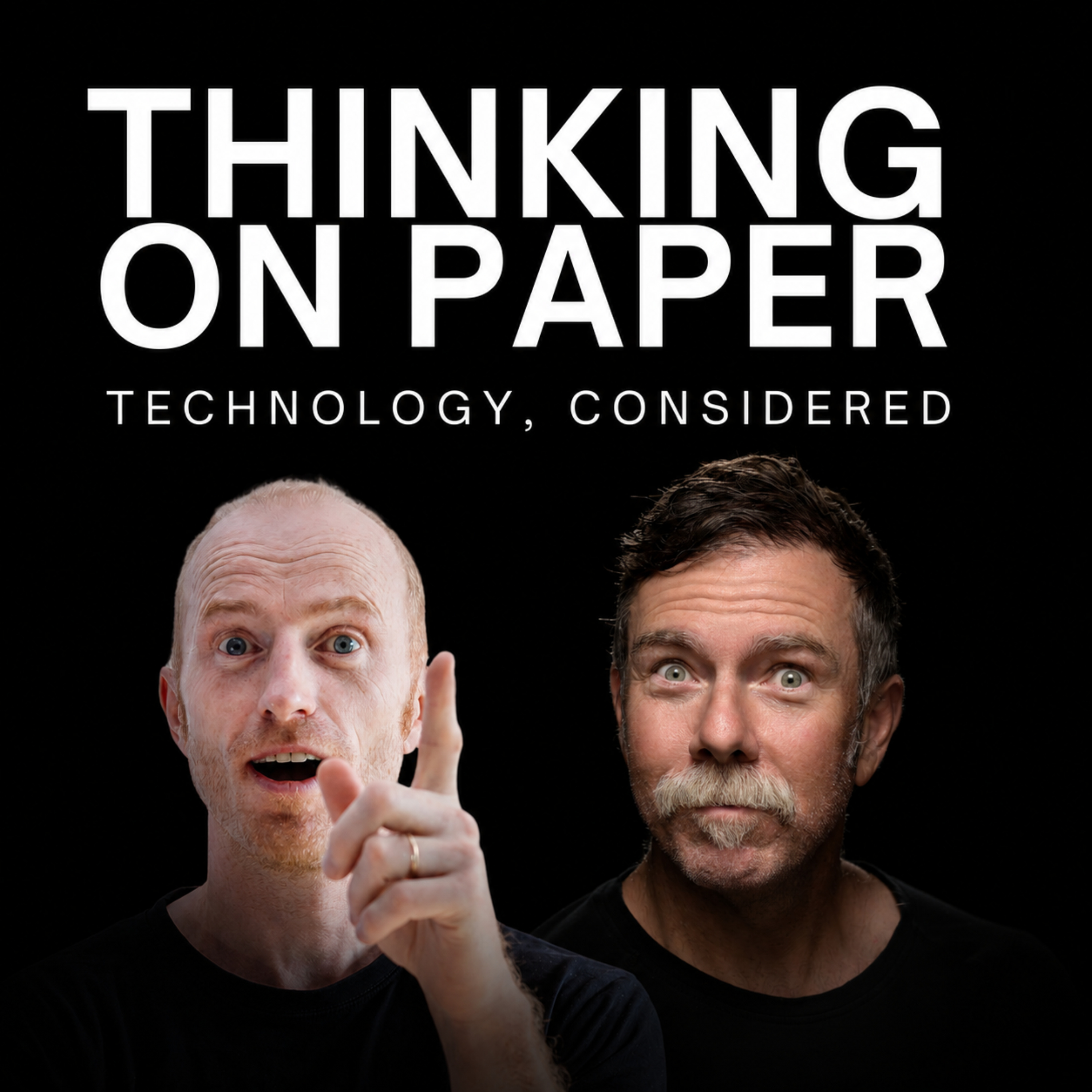
Mark Fielding and Jeremy Gilbertson
Technology, Connected
All original. All human. Thinking On Paper is a weekly technology podcast about AI, quantum computing, robotics, space infrastructure, privacy, media, energy and the future of human life. It's a show for people who know technology is changing everything, but don’t trust the hype merchants, doom merchants, or LinkedIn prophets to explain it. Every week, Mark Fielding and Jeremy Gilbertson speak to founders, CEOs, scientists, writers, philosophers and outliers about the technologies reshaping business, society, work, creativity, politics and power. For curious minds.
Author
Mark Fielding and Jeremy Gilbertson
Category
Podcast website
Latest episode
Jul 8, 2026
Where to listen?
Podcasts in the app Replaio Radio Coming soonPodcasts are coming to the app soon. Install now and be the first to see a whole new take on podcasts
 Install for free
Android 5M+ downloads · 4.8 rating
iOS soon
Install for free
Android 5M+ downloads · 4.8 rating
iOS soon
Episodes
The AI Business Playbook - Ajay Malik, CEO StudioX AI 12.05.2025 41:46
Shopify. Duolingo. Box. Meta: Don’t give it to a human until you’ve asked the machine. This isn’t disruption. This is displacement. And if you’re not ready, you’re next. Ajay Malik helped run Google’s data centers. Now he’s building AI agents that kill the corporate time-suck at its source. Emails? Scanned. Contracts? Summarized. Cameras? Watching. Support tickets? Prioritized before you’ve had yo...
AI Will Never Be Conscious - Federico Faggin, Irreducible (Chapter 6) 06.05.2025 25:08
In Chapter 6 of Irreducible, by Federico Faggin, Mark and Jeremy get into what makes living cells tick and why machines will never be conscious. What is “live information” and how does it blend matter, energy, and data into life? How can machines be alive if they don't know, if they can't know what it's like to be aware? How can AI be conscious when it can't feel? Please enjoy the show. And share...
The World Was Saved From Nuclear Disaster Because Of A Human 17.04.2025 35:47
On the 26th september, 1983, in the midst of the Cold War, the world was saved from nuclear disaster because of a human. An Ai wouldn't have seen the patterns and World War 3 would have been triggered. We're reading chapters 4 and 5 of Irreducible. And he lays out the groundwork for a new theory of consciousness. He proposes it's fundamental to the universe. And the repercussions of that are monum...
Space-Based Solar Power Vs Climate Change 15.04.2025 48:33
Space-based solar power is the focus of this episode with Sanjay Vijendran, former European Space Agency lead on space-based solar power and founder of Space Energy Insights. We explore whether solar farms in orbit could collect sunlight above the clouds and beam clean energy back to Earth. The conversation explains why space-based solar power is being reconsidered now, from climate change and ene...
What Is Decentralized AI? 07.04.2025 48:31
Jihao Sun, co-founder of Flock.io, joins Mark and Jeremy to Think on Paper about decentralized AI. LLMs that trains locally, protect privacy, and reward users. They get into data ownership, blockchain-based training, and whether federated learning can really compete with centralized giants. If your data is building the next generation of AI, who’s it building it for? And why aren’t you in control?...
Can AI Ever Be Conscious? - Irreducible, Federico Faggin (Chapter 3) 03.04.2025 26:16
We're reading Chapter 3 of Irreducible by Federico Faggin, and he argues that consciousness is rooted in the quantum nature of life, something potentially inaccessible to classical, deterministic machines. If that's true, AI consciousness is impossible. Faggin contrasts the symbolic processing of computers with the dynamic, self-organizing behavior of living systems. He suggests that real...
How Hollywood Uses AI - David Bianchi on Building RZR Outside the Studio System 31.03.2025 43:23
When Hollywood passed on RZR, David Bianchi chose to build the series independently. He used NFTs to finance production, retained creative control, and incorporated AI tools such as Midjourney into the development process. The result was an Emmy-nominated science-fiction series created outside the traditional studio system. In this episode, Bianchi explains how Hollywood uses AI, where those tools...
Federico Faggin Says The Universe Is Quantum Consciousness 26.03.2025 34:22
Is quantum based panpsychism a valid explanation of our experience? Is the universe made of conscious units know as seities? Does the universe want to know itself? Federico Faggin thinks so. It's a book club, captain, but not as we know it. Please enjoy the show. And share with a curious friend. Why classical physics broke under its own weight What quantum mechanics tells us about the nature o...
Sam Altman’s World ID: Can Iris Scans Prove You’re Human Online? 19.03.2025 45:04
Ajay Patel, Head of World ID at Tools for Humanity, joins Mark and Jeremy to discuss digital identity in the age of artificial intelligence. As AI-generated content spreads across the internet and bots become harder to distinguish from people, existing verification systems are starting to fail. CAPTCHAs are increasingly ineffective, while conventional identity checks often require users to hand ov...
Nexus: Yuval Noah Harari on AI, Digital Empires and the Silicon Curtain 18.03.2025 30:02
In the final chapter of Nexus, Yuval Noah Harari argues that artificial intelligence could divide the world into competing digital empires, each built on separate hardware, software, data and political systems. Mark and Jeremy examine Harari’s idea of a “Silicon Curtain” and what it could mean for the future of AI, geopolitics and the internet. Rather than producing one shared technological future...
Nexus: Yuval Noah Harari on AI, Dictatorships and the Future of Authoritarian Power 14.03.2025 11:01
In Chapter 10 of Nexus, Yuval Noah Harari examines whether artificial intelligence will strengthen authoritarian regimes or expose weaknesses within them. Dictatorships rely on fear, loyalty and centralised control. AI feels no fear, has no political allegiance and can process information at a scale no human bureaucracy can match. That could make it an effective tool for surveillance and censorshi...
Why Web3 Marketing Failed: Diego Borgo on Brand Strategy, AI and Blockchain 06.03.2025 43:13
Diego Borgo has helped develop Web3 strategies for brands including Adidas, Porsche and Mastercard. In this episode, he explains why many corporate blockchain and NFT projects failed, and what brands should do differently. Much of Web3 marketing prioritised hype, technical jargon and short-term attention over clear customer value. Brands launched tokens, NFT collections and online communities with...
How IonQ’s Trapped-Ion Quantum Computers Work: Coleman Collins on Qubits, Fidelity and Quantum Advantage 28.02.2025 54:09
Coleman Collins, Director of Product at IonQ, joins Thinking on Paper to explain how trapped-ion quantum computers work and why IonQ believes they offer a credible path towards useful quantum computing. IonQ builds its systems using individual atoms held in place and controlled with lasers. This differs from the superconducting, neutral-atom, photonic and topological approaches being pursued by co...
Can AI Data Centers Work in Space? StarCloud Co-Founder Philip Johnston Explains 26.02.2025 42:19
Philip Johnston, co-founder of StarCloud, joins Mark and Jeremy to explain how the company plans to build AI data centers in space. StarCloud is developing orbital computing infrastructure designed to run large numbers of GPUs using solar power. Instead of relying on water-based cooling systems, the company plans to remove heat through large space radiators and transmit data between orbit and Eart...
Can Democracy Survive AI? Yuval Noah Harari on Jobs, Creativity and Data 21.02.2025 47:54
In Chapter 9 of Nexus, Yuval Noah Harari examines whether democracy can survive the data age and what happens when artificial intelligence begins to compete with humans in work, creativity and decision-making. Mark and Jeremy discuss Harari’s argument that AI could disrupt intellectual professions before many manual jobs. They also examine whether the deeper risk is not simply unemployment, but th...
How AI Satellites Detect Wildfires and Monitor Earth in Real Time 20.02.2025 55:22
Fintan Buckley, CEO of Ubotica, joins Thinking on Paper to explain how artificial intelligence is changing the way satellites observe Earth, detect disasters and make decisions in orbit. Traditional Earth-observation satellites often collect data and send it back to ground stations for processing. Ubotica is developing onboard AI systems that can analyse images in space, identify relevant events a...
What Is the AI Alignment Problem? Yuval Noah Harari on When Machines Follow Orders Too Well 15.02.2025 43:33
In Chapter 8 of Nexus, Yuval Noah Harari examines the AI alignment problem: how to ensure that artificial intelligence acts in ways that support human goals without causing harmful or unintended consequences. The central risk isn’t necessarily that AI will rebel. A system can follow its instructions accurately and still produce disastrous results because its objective is incomplete, poorly defined...
What Are Smart Transactions? How STXN Is Trying to Fix Ethereum’s Failed Transactions 14.02.2025 55:43
Boris Mamlyuk and Anuj Dasgupta, founders of STXN, join Thinking on Paper to explain how smart transactions could make Ethereum easier to use. Standard blockchain transactions execute immediately under fixed conditions. Users often have limited control over when a transaction runs, what fees they’ll pay or what happens if market conditions change before execution. Failed transactions can still con...
How AI Surveillance Works: Yuval Noah Harari on Metadata, Social Credit and Predictive Control 31.01.2025 38:39
In Chapter 7 of Nexus, Yuval Noah Harari examines how artificial intelligence is transforming surveillance from passive observation into continuous analysis, prediction and control. Mark and Jeremy discuss how governments, companies and digital platforms collect data through phones, cameras, apps, online reviews and everyday transactions. AI makes it possible to combine these signals, identify pat...
How AI Shapes Beliefs: Yuval Noah Harari on Algorithms, Stories and Human Manipulation 29.01.2025 41:23
In Chapter 6 of Nexus, Yuval Noah Harari examines how artificial intelligence could shape human beliefs, political movements, religions and scientific ideas. Mark and Jeremy discuss the difference between technologies that distribute human ideas and AI systems that can generate new stories, arguments, images and relationships. Unlike the printing press, AI doesn’t simply reproduce information. It...
How to Stay Valuable in the Age of AI: Packy McCormick on Why the Most Human Wins 27.01.2025 38:16
AI can now produce text, images, analysis and software at low cost. That weakens the value of work built around repeatable processes, standard templates and easily replicated outputs. In his latest Not Boring essay Packy McCormick argues that people will remain valuable by developing qualities that are harder to automate: judgement, originality, humour, emotional intelligence, physical experience...
How Information Creates Power: Yuval Noah Harari on Democracy, Propaganda and AI 21.01.2025 37:53
In Chapter 5 of Nexus, Yuval Noah Harari examines how information networks shape political power, from ancient empires and mass propaganda to social media and artificial intelligence. Mark and Jeremy discuss why information doesn’t automatically produce truth, and how both democracies and totalitarian systems use stories, institutions and communication technologies to organise society. The central...
How Quantum Computing Could Help Solve Climate Change, Medicine and Energy 21.01.2025 50:41
Kathrin Spendier, Technical Prize Director at XPRIZE, joins Thinking on Paper to explain how quantum computing could contribute to climate science, medicine, energy and materials discovery. She also discusses the $5 million Quantum XPRIZE, a three-year global competition designed to move quantum algorithms beyond theory and towards practical applications. The competition brings together hundreds o...
How Information Systems Shape Truth and Power: Yuval Noah Harari on Religion, Books and AI 15.01.2025 42:06
In Chapter 4 of Nexus, Yuval Noah Harari examines how information systems shape belief, authority and our understanding of truth. Mark and Jeremy discuss how religious texts, books and institutions created durable systems for organising knowledge and legitimising power. They also examine the difference between traditions that claim access to unquestionable truth and the scientific method, which tr...
How AI and Virtual Reality Will Change Entertainment: Wevr on the Future of Immersive Media 16.12.2024 56:10
Anthony Batt and Neville Spiteri, co-founders of Wevr, join Thinking on Paper to discuss how artificial intelligence and virtual reality could change entertainment, communication and digital creativity. Wevr develops immersive experiences that combine interactive design, real-time computing and virtual environments. Drawing on careers spanning visual effects, gaming, VR and early internet platform...
Similar podcasts







Listen to the Technology, Connected podcast in Replaio
Radio and podcasts in one app - free, with no sign-up. Install today and do not miss the launch
Replaio is not a podcast publisher; show names, artwork and audio belong to their authors and are distributed through public RSS feeds.