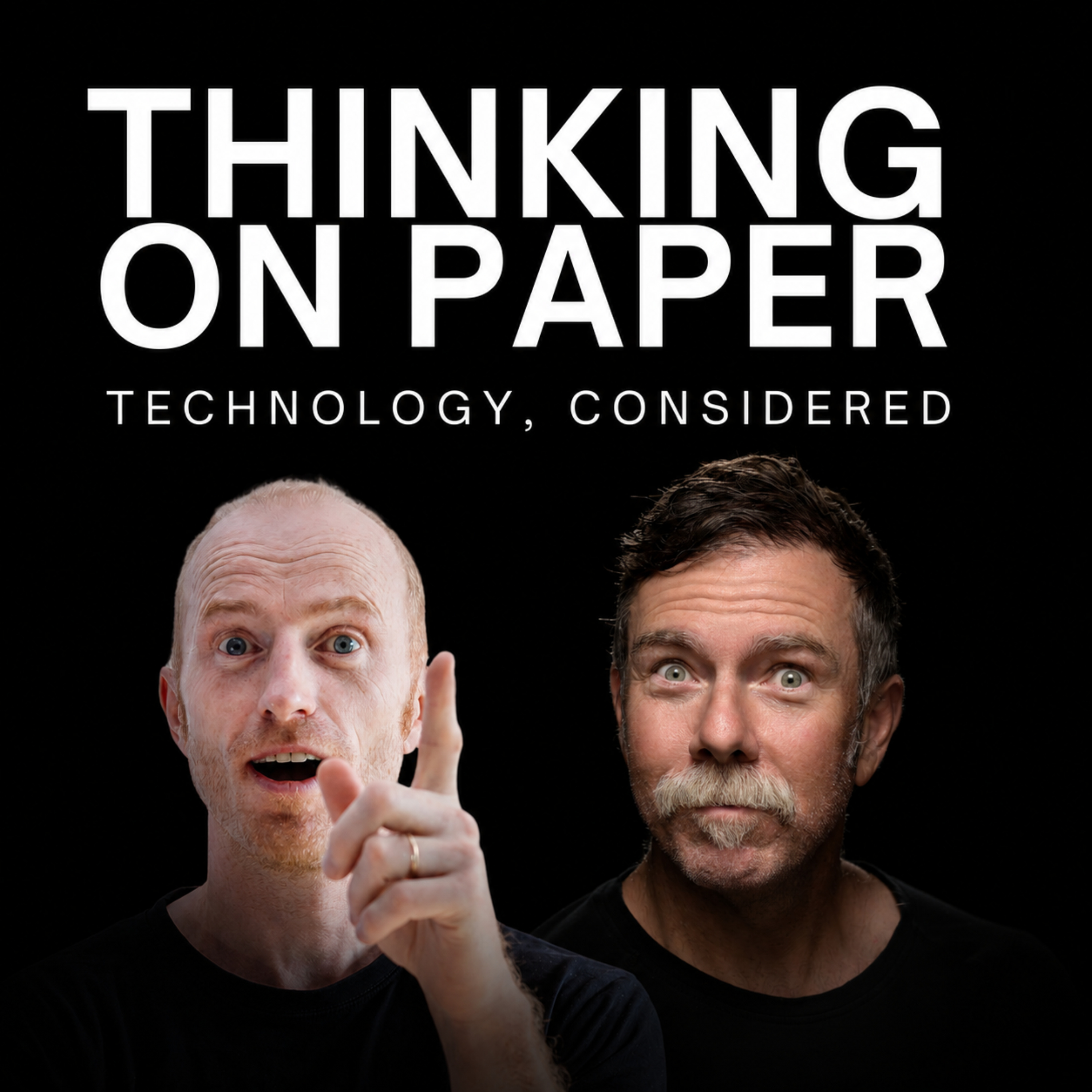
Mark Fielding and Jeremy Gilbertson
Technology, Connected
All original. All human. Thinking On Paper is a weekly technology podcast about AI, quantum computing, robotics, space infrastructure, privacy, media, energy and the future of human life. It's a show for people who know technology is changing everything, but don’t trust the hype merchants, doom merchants, or LinkedIn prophets to explain it. Every week, Mark Fielding and Jeremy Gilbertson speak to founders, CEOs, scientists, writers, philosophers and outliers about the technologies reshaping business, society, work, creativity, politics and power. For curious minds.
Author
Mark Fielding and Jeremy Gilbertson
Category
Podcast website
Latest episode
Jul 8, 2026
Where to listen?
Podcasts in the app Replaio Radio Coming soonPodcasts are coming to the app soon. Install now and be the first to see a whole new take on podcasts
 Install for free
Android 5M+ downloads · 4.8 rating
iOS soon
Install for free
Android 5M+ downloads · 4.8 rating
iOS soon
Episodes
The Quantum Clock That Could Replace GPS 09.03.2026 40:22
Infleqtion CEO Matt Kinsella joins Thinking on Paper to explain neutral atom quantum computing, quantum clocks, and why the future of computing may depend on synchronisation as much as raw processing power. The conversation moves from GPS spoofing and UK submarine navigation to Nvidia’s hybrid quantum AI stack, quantum sensing, edge computing, quantum error correction, and the growing race to buil...
Nvidia Is Building The AI-Quantum Supercomputer 08.03.2026 37:00
Nvidia is treating quantum computing as the next stage of accelerated computing, not as a separate machine sitting apart from AI supercomputers. Sam Stanwyck from Nvidia and Pranav Gokhale from Infleqtion explain how NVQLink connects QPUs and GPUs with low-latency, high-bandwidth communication, allowing quantum computers, GPU supercomputers, CPUs, CUDA-Q, and AI software to work inside the same co...
The Rare Fuel That Could Make Us Mine the Moon 07.03.2026 40:09
There are about 100 kilograms of helium-3 on planet Earth. The current US reserve is 29 kilograms. Global production runs around 20 kilograms per year. And early estimates put quantum computing demand alone at 300 to 400 kilograms per year. The math doesn't work, which is why people are starting to look at moon mining. On this episode of Thinking on Paper, we talk with Glen Martin, CEO of the Extr...
Your Chatbot Knows Too Much 05.03.2026 28:17
There are now more non-democratic countries in the world than democratic ones. Only a third of Americans under 35 say it's vital to live in a democracy. The share who would welcome military government rose from 7 percent in 1995 to 18 percent in 2017. On this episode of Thinking on Paper, we talk with Carissa Véliz, associate professor at Oxford's Institute for Ethics in AI and author of Privacy I...
The Tech Startup Trying To Open A Hotel On The Moon 26.02.2026 23:31
A hotel on the Moon sounds like science fiction, but Skyler Chan argues it is really a test case for lunar habitats and off-world surface habitation. His company Gru wants to prove two basic things first: inflatable structures can hold pressure and temperature on the lunar surface, and lunar regolith can be turned into Moon bricks for radiation protection, landing pads, roads, warehouses, habitats...
Why AI Data Centers Might Leave Earth 18.02.2026 24:55
Philip Johnston is the CEO of Starcloud and launched an Nvidia H100 chip in space and gave a TED talk about it. As you do if you're responsible for building the infrastructure for space-based data centers. Elon Musk was not the first. He follows in the footsteps of Mr Johnston. And so, rather than Mr SpaceX, our first technology reaction video is this TED talk from San Francisco. We watched it...
The Missing Infrastructure For The Moon Economy 16.02.2026 44:48
Philip Metzger spent 30 years working at NASA. He's knows a lot about the physical, economic, and political problems of building space stations and starting lunar economies. From rocket exhaust blasting moon dust across the lunar surface, NASA’s role as an anchor customer, lunar mining, asteroid mining and helium-3, to landing pads, microgravity manufacturing, and the economics of moving AI data c...
Where Drone Delivery Actually Makes Sense 12.02.2026 43:23
Drone delivery is not about filling the sky with quadcopters, Etienne Louvet argues. It is about rebuilding light-cargo logistics for places where vans, ferries, roads, and traditional delivery networks struggle: islands, remote communities, rural routes, hospitals, offshore platforms, and hard-to-reach homes. The conversation explains how Iona Drones is building fixed-wing VTOL aircraft for auton...
Prompting Is Not Thinking 06.02.2026 4:09
Can you use AI to think better or think more critically? Philosopher Pia Lauritzen says no. The second we give up to the shortcut use AI, we are letting go of the very basic condition that forces us to think. When we ask if machines can think, the first question should be: why do humans think? Why do we think? For Pia, it is fairly simple. We think because we know there is something we do not know...
Can AI Make Music Without Stealing? 05.02.2026 9:37
What if you could use AI to make your own music without stealing other people's beats, rhymes and melodies? Unlike platforms trained on scraped catalogs, Overtune’s AI is built on licensed music, starting with ~20,000 loops produced in-house. Producers can submit stems voluntarily, creating a clean foundation for ethical training and attribution. The platform uses vector-based audio embeddings to...
Your Customer Is Now OpenAI 04.02.2026 7:12
Marketing funnels don't exist. They never did. The internet just convinced us they were real. Meta, Google, OpenAI and a supporting cast of billionaire sociopaths figured out they could control distribution and black-box your customers. Hurrah. Humanity forgot to read the small print. Now you're running a business where you don't even know who your customer is. Well here’s the AI-shaped healthche...
Quantum And AI Just Joined Forces 03.02.2026 6:54
Matt Kinsella runs Infleqtion, a company building quantum computers. The biggest misconception about quantum computing is that it will replace classical computing. It won't. Quantum processors will sit above GPUs in data centers the same way GPUs sit above CPUs today. NVIDIA just built the bridge to make this work. It's called NVQ Link, and it changes how we think about the future of compute. NV...
Why The Next Space Station Might Be Inflatable 26.01.2026 31:04
The International Space Station cost about $100 billion to build and runs another $4 billion a year to operate. For a long stretch, it absorbed roughly half of NASA's annual budget. Skylab, the first US space station, lasted six years before falling out of the sky. Carl Sagan thought space stations were a waste of money. Ronald Reagan thought they were the next clipper ship. The killer app for spa...
One Wrong Button Can Take Down The World's Most Advanced Data Center 22.01.2026 27:44
Two-thirds of data center outages are caused by someone pressing the wrong switch. Not a hacker, not a hardware failure. A person, in a room with thousands of switches, and their mind elsewhere. We talk with Shapol, CEO and co-founder of Entangl, about the engineering layer underneath everything we now call AI. Before Entangl, Shapol led a reusable rocket program and oversaw four launches. He hate...
How NASA Created the Company That Replaced It 19.01.2026 26:08
SpaceX reusable rockets and NASA’s commercial space economy are the focus of this Space to Grow book club episode, covering chapters one to three of Space to Grow: Unlocking the Final Economic Frontier. We trace how NASA moved from Apollo and the Space Shuttle era into commercial partnerships, why COTS and fixed-price contracts changed the incentives around ISS cargo delivery, and how SpaceX used...
Elon Musk Wants Mars. Gerard O’Neill Wanted Orbitals 15.01.2026 29:28
John Bucknell made Raptor engines at SpaceX. He also designed a nuclear thermal turbo rocket. He now wants to solve energy. Ambitious young man. Virtus Solis puts solar panels in orbit, beams power to the ground via radio waves that pass through clouds and weather without loss, and delivers electricity at $30 to $40 per megawatt hour while the plant is being financed. Once the asset is paid off: 5...
A Fusion Startup Just Turned Mercury Into Gold 06.01.2026 27:16
Every year, Tom Whitwell—reformed journalist, reformed consultant, electronic instrument designer—publishes 52 surprising things he learned. This year's list reveals how the world actually works. Mark and Jeremy steal his homework (like OpenAI scraping the internet) and pick their favorites across AI, energy, labor, culture, psychology, and—yes—shrimp. Some findings are encouraging: - Deaths from...
Seemingly Conscious AI 23.12.2025 8:32
The machines do not need to wake up. The risk is the illusion. When AI convincingly claims subjective experience—"I feel," "I understand," "I care about you"—humans have no reliable way to disprove it. We infer consciousness from behavior. We attach emotionally to what feels real. The danger isn't rogue superintelligence. It's a benign chatbot optimized for empathy, memory, and persuasion, interac...
Quantum Computing Is Not What You Think 22.12.2025 8:48
Quantum computing doesn't make computers faster. It changes what's computable. Joe Fitzsimons, CEO of Horizon Quantum, explains why quantum progress is so hard to grasp: it's exponential in a way that breaks everyday intuition. Here's the math that matters: Each additional qubit doubles the difficulty of simulating the system on classical computers. Meanwhile, quantum processors are scaling faster...
AI Stole The Music. This Is How We Take It Back 18.12.2025 31:21
Making music used to require heartbreak, bleeding fingers, and a thousand late nights. Now, with SUNO, you can write AI songs in 30 seconds. This changes everything about taste, credit, and what it means to be a musician. Nicholas Ponari—guitarist, investor, COO at Overtune—explains how musicians get paid when AI generates the music. The old model is dead. You used to need: - A guitarist - A bass...
No China. No Electric Future 10.12.2025 22:55
America has a Technological inferiority complex. China makes over half the world's lithium batteries. They produce 90% of neodymium magnets. They mine 70% of rare earths and process 85%. America makes burgers. This is the story of how China won the Electric Stack—and whether America can catch up. What's the Electric Stack? Everything that moves will eventually run on batteries and electric motors....
The Housing Market Was Built for a World That’s Gone 08.12.2025 29:35
Median US income: $68,000. Median home price: $440,000. The math doesn't work. Only 13% of Americans earn a salary. Everyone else gets paid hourly or hustles in the gig economy. Yet housing policy assumes stable W-2 income, 20% down payments, and 30-year mortgages. The system is built to extract value, not create stability. Chris Moeller joins Mark and Jeremy to talk about an alternative: stable l...
The Microchip Pioneer Who Says the Universe Is Conscious 05.12.2025 4:51
What is consciousness? Federico Faggin—physicist, inventor of the microprocessor—says it's not created by brains. It's fundamental to reality. Everything is conscious: atoms, electrons, maybe even spacetime itself. This is panpsychism. And Faggin argues quantum physics proves it. We're reading his book, *Irreducible*, to figure out if we agree. Quantum conscious units called "Seities"? A universe...
Silicon Valley Is Selling You Religion 04.12.2025 45:25
The internet decayed into AI slop. Marketing became manipulation. Trust disappeared. How do brands build real connections when platforms feed you lies, hide your customers, and optimize for extraction? Nick Richtsmeier—founder of CultureCraft, writer at Damns Given—says brands now live inside mirrored cages. You see what algorithms want you to see. Your customers see distorted versions of you. Nob...
The Question You Almost Never Ask 27.11.2025 41:09
AI answers faster than any human. But can it help you think? Does it erode critical thinking, or augment it? Pia Lauritzen has analyzed 30,000 questions across languages and cultures. She's a philosopher of the question. And she says we're losing the muscle for real wonder. The problem: We ask "what" and "how." Rarely "why." ChatGPT answers instantly. We skip the struggle. The blank page—where thi...
Similar podcasts







Listen to the Technology, Connected podcast in Replaio
Radio and podcasts in one app - free, with no sign-up. Install today and do not miss the launch
Replaio is not a podcast publisher; show names, artwork and audio belong to their authors and are distributed through public RSS feeds.