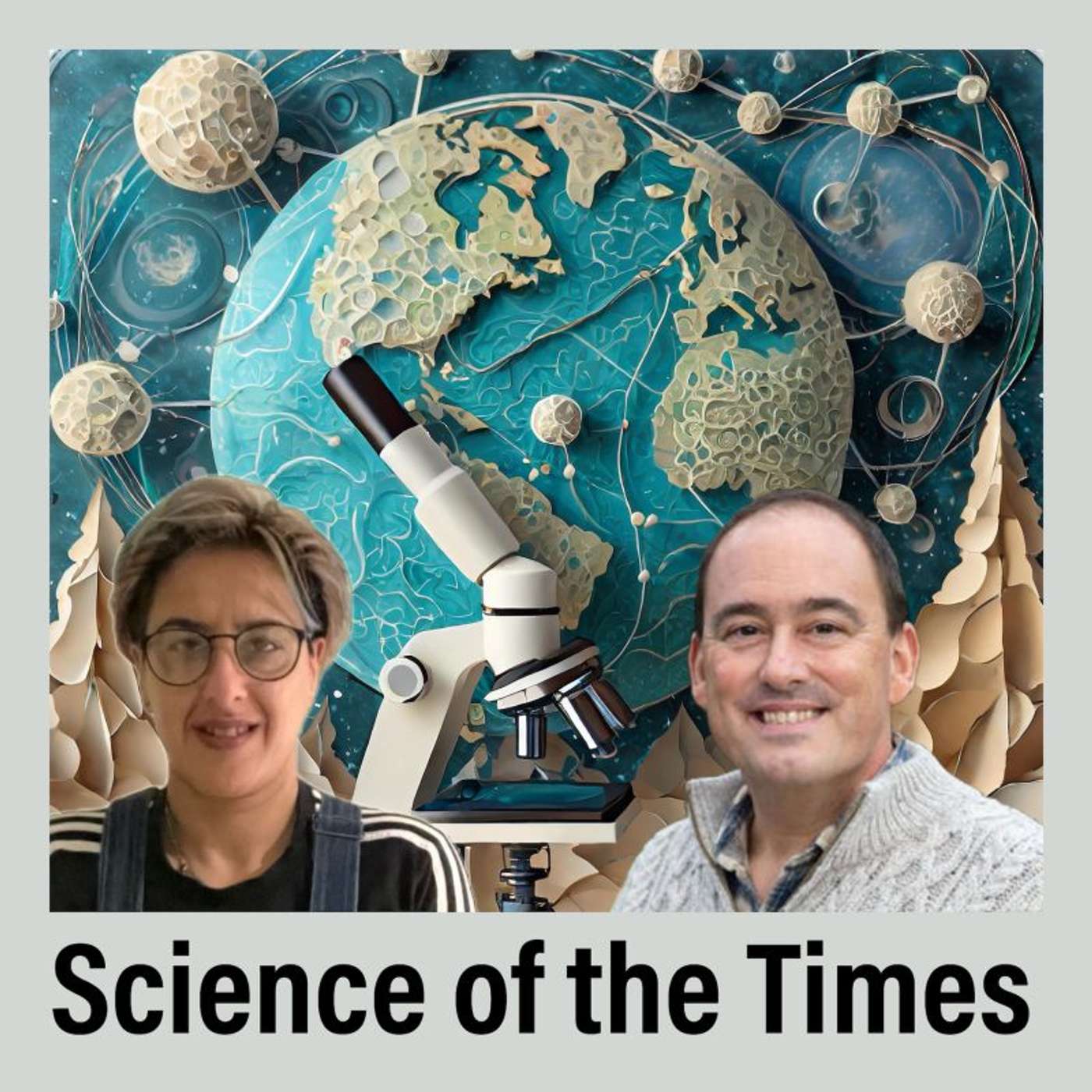
Tim Coulson And Syma Khalid
Science Of The Times
Do you want to learn a little more about topical science findings? Do many of the science stories you hear leave you with unanswered questions? Syma and Tim will discuss in non-technical language and in a fun and engaging style, recently published science findings. Guests will be authors of these papers and will include some of the world’s most exciting scientists who are pushing the frontiers of human knowledge. Covering, among other things, artificial intelligence, the search for alien life, the latest treatments for diseases, quantum computers, the science of football and topics requested b...
Author
Tim Coulson And Syma Khalid
Category
Podcast website
Latest episode
Jun 26, 2026
Where to listen?
Podcasts in the app Replaio Radio Coming soonPodcasts are coming to the app soon. Install now and be the first to see a whole new take on podcasts
 Install for free
Android 5M+ downloads · 4.8 rating
iOS soon
Install for free
Android 5M+ downloads · 4.8 rating
iOS soon
Episodes
Science Explainer: Why is it so hard to kill bacteria? 26.05.2025 6:12
In this explainer, Syma discusses some of the methods bacteria use to defend themselves from attack from external threats such as antibiotics. These ostensibly simple organisms have elaborate and sophisticated defence mechanisms which is why it is so hard to kill bacteria.
Why Wolves Don’t Change Rivers 22.05.2025 47:53
Dan MacNulty has studied the wildlife in Yellowstone National Park since 1995. His research, and that of his colleagues, has revealed that the narrative that wolves have changed the park, leading to forests coming back, and rivers being diverted is not true. The Yellowstone story is more complicated than you might think, and endlessly fascinating. Join us as we talk about wolves, mountain lions, e...
Science Explainer: New Funding for US based scientists looking to move to the UK. 19.05.2025 3:23
Tim breaks down a game-changing shift in global science research: as U.S. funding for future research faces uncertainty, UK funding agencies are seizing the moment—offering incentives to attract scientists currently working in the US to relocate and thrive in the UK.
Break Barriers: Women, the Physical Sciences Need You Now! 19.05.2025 3:35
In this short bonus episode Syma talks to Philipp Kukura. Philipp led the development of a technique called mass photometry which enables tracking the movement of individual proteins. Here he briefly describes the technique, but importantly emphasises the need for more women in the areas of instrument and technology development in the physical sciences. Link To Philipp's Paper: https://www.nature....
Why Ginger Cats Are Mostly Boys (and Why Some Wolves Are Black!) 16.05.2025 3:22
In this third quick hit explainer of the week. Why are most ginger cats male? Simple genetics — the orange fur gene is on the X chromosome. Males only need one to flaunt that fiery coat, while females need two, making ginger ladies much rarer. And as for wolves — not all are grey! Some are black. Nature loves a remix.
How To Build A Sustainable World 15.05.2025 55:15
If we don’t build a more sustainable world our civilisation will collapse, potentially in the coming decades. Paul Behrens spends his time researching our impact on the world, and working out how civilisation can transition to a sustainable future. Covering multitudes of Lego to plant-based diets and solar power, we explore how we can create a civilisation to help humanity thrive in the future. ht...
AI Undermines Health Science 14.05.2025 5:14
In our second quick-hit explainer episode this week, Tim breaks down how AI might be disrupting—not advancing—health science. Is the hype overshadowing real medical insight? Tune in for a sharp take on where AI could be leading us astray.
Why Is There A Universe? Why Is There Something Rather Than Nothing? 13.05.2025 5:19
In this quick bonus episode, Tim breaks down one of science’s most intriguing mysteries as featured in BBC News today: the difference between matter and antimatter. Join us for a bite-sized explainer that sheds light on the surprising facts behind this cosmic puzzle!
The Quantum Revolution: Lee Smolin’s Bold Theory to Unite Physics 08.05.2025 32:57
Theoretical physics has two theories at its core that are not straightforward to link – quantum mechanics and general relativity. Lee Smolin, one of the world’s greatest living theoretical physicists, has spent his career working out why the theory of quantum mechanics is incomplete and how it might link to general relativity. He is an advocate of versions of quantum loop gravity. His work to marr...
Special Edition- Can academia provide solutions to threats to biodiversity? 02.05.2025 1:09:48
Biodiversity is under threat, and there are many ongoing efforts to help save it, including from within universities. But are academic contributions doing any good? Our cohost Tim Coulson discussed this topic with Professor Dame EJ Milner-Gulland in the Oxford Martin School (OMS) in April. Thanks to Carlyn Samuel, OMS and the OMS team for hosting the debate and allowing us to record.
Should we fear AI? 25.04.2025 55:31
Artificial intelligence is a modern-day technology that will impact the way we live much as past innovations like mastering fire, and inventing the printing press, home computers and the internet changed civilisation. But what exactly is it, how does it work, and what are the opportunities and risks of its continued development? We talk to Chris Summerfield about Artificial Intelligence and his fa...
Natural and artificial genetic hybrids: dogs, coyotes and dire wolves. PART 2 18.04.2025 33:55
Colossal Bioscience has brought genetic variation back from the grave. It is a remarkable technological achievement, but is it species de-extinction? In this second part of this podcast we talk to Professor Peter Hudson FRS, a world-leading ecologist, who is concerned by Colossal’s claims and what they might mean.
Natural and artificial genetic hybrids: dogs, coyotes and dire wolves. 17.04.2025 38:27
Colossal Bioscience has brought genetic variation back from the grave. It is a remarkable technological achievement, but is it species de-extinction? We talk to Professor Bridgett vonHoldt, a world-leading dog geneticist, who was involved in Colossal Bioscience’s recent dire wolf de-extinction work that has caused some controversy. In part 2 of this podcast we talk a world-leading ecologist who gi...
Will Zombie ants be the last of us? 16.04.2025 5:03
A bonus episode in which Tim and Syma discuss how the zombie ant-based creatures seen on popular dystopian future drama Last of Us are based on real fungi (Cordyceps) which infect ants - and then exploit the now zombie ants to produce more fungi, killing the ants in the process. Yes it’s a bit gruesome, but it’s science!
SPECIAL EDITION - Interview with David Baker 2024 Nobel Prize winner for Chemistry 13.04.2025 12:22
Syma and Tim are joined by Nobel Laureate David Baker, one of the winners of the 2024 Nobel Prize for Chemistry for his work on computational protein design. This follows the interview with Tim Jenkins, and Susana Vasquez in Episode 7 who worked with David. After the interview Tim asks Syma to explain in simple terms the process of protein design and what may be possible in the future.
De-mything the hype around de-extinction 10.04.2025 8:25
Colassal says it has de-extincted an animal. Is this a dire wolf or a dire mistake? Join Tim and Syma on this short bonus edition!
Snake venom 'milkers' beware the proteins and not the snake! 10.04.2025 41:58
Proteins are the workhorses of life, with thousands overseeing and getting involved in reactions within our cells. Biologists have long dreamed of being able to make designer proteins to do specific tasks, and recently a team of scientists have made this happen. Syma and Tim talk to researchers who designed, and then made, a protein that neutralises a type of snake venom. In the first release we...
How did dogs become our best friend? 02.04.2025 39:19
Dogs are people’s best friend, but how did that happen? Did we tame them or did they train us, or is it a bit of both? Join us as we discuss domestication with Greger Larson and Lachlan Scarsbrook
Not all birds are the same 26.03.2025 39:01
Not all Birds are the same. In analyses of thousands of hours of bird song our guests, Nilo Merino Recalde and Ben Sheldon found predictable variation in the calls of great tits. Showcasing the power of AI in analyses of data from the natural world they show birds show cultural differences much like humans do. https://nilomr.github.io/
OSIRIS-REx 'Touch and go' and the emergence of life elsewhere in the cosmos! 18.03.2025 1:12:43
OSIRIS-REx is a space craft that visited the asteroid Bennu, returning samples to Earth in late 2023. The first exciting results from the analyses of these samples are just being published. In the first part of the Podcast we talk to Sara Russell about the mission and her recently published results, and then in the second Part we talk to Addy Pross on what the insights mean for the emergence of li...
Unravelling the secrets of our genes. 11.03.2025 48:42
Tim and Syma’s guests are Gordon Sanghera and Lakmal Jayasinghe of Oxford Nanopore Technologies. They discuss how their elegant technology is transforming the ease with which we can now learn what information is contained in our genes and how this is being used already in hospitals to detect for example, cancers in children. Gordon gives his vision of what might be achievable in the future.
Smart Male Fish Get The Girls! 05.03.2025 30:38
Later in this episode, Tim flies solo in the wake of Syma's imminent departure for duties on the west coast of the US! Tim's guests are Ivan Vinogradov and Michael Jennions, both of the Australian National University, and co-authors of the scientific paper 'Paternity analysis reveals sexual selection on cognitive performance in mosquitofish". It would appear that smarter male fish are more likely...
Hello! Welcome to our new podcast. 26.02.2025 30:51
In this introductory episode, Syma and Tim introduce themselves and explain what subjects and ideas they hope to bring to their audience, and some of the things they will be covering in future episodes. Subscribe now for future episodes!
Similar podcasts







Listen to the Science Of The Times podcast in Replaio
Radio and podcasts in one app - free, with no sign-up. Install today and do not miss the launch
Replaio is not a podcast publisher; show names, artwork and audio belong to their authors and are distributed through public RSS feeds.