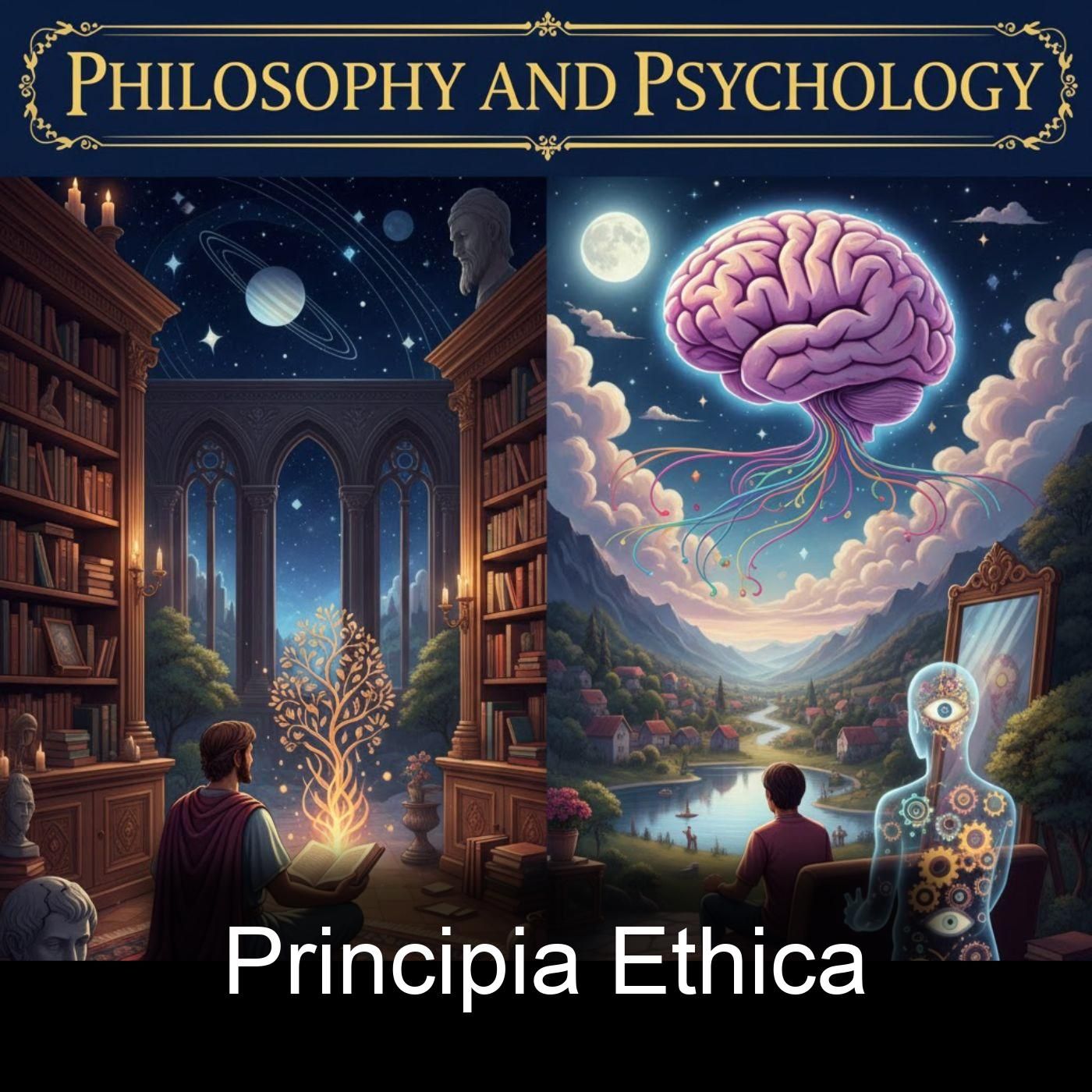
George Edward Moore
Principia Ethica
George Edward Moore, commonly referred to as G. E. Moore, (1873 – 1958) was a prominent and influential English philosopher. Alongside notable figures such as Bertrand Russell, Ludwig Wittgenstein, and the earlier Gottlob Frege, he played a crucial role in establishing the analytic tradition in philosophy, shaping the way we think about ethics and the nature of moral understanding.
Be sure to visit the podcast's website and support the creator: www.spreaker.com
Author
George Edward Moore
Category
Podcast website
Latest episode
Nov 14, 2026
Where to listen?
Podcasts in the app Replaio Radio Coming soonPodcasts are coming to the app soon. Install now and be the first to see a whole new take on podcasts
 Install for free
Android 10M+ downloads · 4.7+ rating
iOS soon
Episodes
019 - Chapter 6 The Ideal part 2 09.02.2026 27:39
George Edward Moore, commonly referred to as G. E. Moore, (1873 – 1958) was a prominent and influential English philosopher. Alongside notable figures such as Bertrand Russell, Ludwig Wittgenstein, and the earlier Gottlob Frege, he played a crucial role in establishing the analytic tradition in philosophy, shaping the way we think about ethics and the nature of moral understanding.
018 - Chapter 6 The Ideal part 1 09.02.2026 25:01
George Edward Moore, commonly referred to as G. E. Moore, (1873 – 1958) was a prominent and influential English philosopher. Alongside notable figures such as Bertrand Russell, Ludwig Wittgenstein, and the earlier Gottlob Frege, he played a crucial role in establishing the analytic tradition in philosophy, shaping the way we think about ethics and the nature of moral understanding.
017 - Chapter 5 Ethics in Relation to Conduct part 4 09.02.2026 29:21
George Edward Moore, commonly referred to as G. E. Moore, (1873 – 1958) was a prominent and influential English philosopher. Alongside notable figures such as Bertrand Russell, Ludwig Wittgenstein, and the earlier Gottlob Frege, he played a crucial role in establishing the analytic tradition in philosophy, shaping the way we think about ethics and the nature of moral understanding.
016 - Chapter 5 Ethics in Relation to Conduct part 3 09.02.2026 26:01
George Edward Moore, commonly referred to as G. E. Moore, (1873 – 1958) was a prominent and influential English philosopher. Alongside notable figures such as Bertrand Russell, Ludwig Wittgenstein, and the earlier Gottlob Frege, he played a crucial role in establishing the analytic tradition in philosophy, shaping the way we think about ethics and the nature of moral understanding.
015 - Chapter 5 Ethics in Relation to Conduct part 2 09.02.2026 27:58
George Edward Moore, commonly referred to as G. E. Moore, (1873 – 1958) was a prominent and influential English philosopher. Alongside notable figures such as Bertrand Russell, Ludwig Wittgenstein, and the earlier Gottlob Frege, he played a crucial role in establishing the analytic tradition in philosophy, shaping the way we think about ethics and the nature of moral understanding.
014 - Chapter 5 Ethics in Relation to Conduct part 1 09.02.2026 26:51
George Edward Moore, commonly referred to as G. E. Moore, (1873 – 1958) was a prominent and influential English philosopher. Alongside notable figures such as Bertrand Russell, Ludwig Wittgenstein, and the earlier Gottlob Frege, he played a crucial role in establishing the analytic tradition in philosophy, shaping the way we think about ethics and the nature of moral understanding.
013 - Chapter 4 Metaphysical Ethics part 3 09.02.2026 27:20
George Edward Moore, commonly referred to as G. E. Moore, (1873 – 1958) was a prominent and influential English philosopher. Alongside notable figures such as Bertrand Russell, Ludwig Wittgenstein, and the earlier Gottlob Frege, he played a crucial role in establishing the analytic tradition in philosophy, shaping the way we think about ethics and the nature of moral understanding.
012 - Chapter 4 Metaphysical Ethics part 2 09.02.2026 29:06
George Edward Moore, commonly referred to as G. E. Moore, (1873 – 1958) was a prominent and influential English philosopher. Alongside notable figures such as Bertrand Russell, Ludwig Wittgenstein, and the earlier Gottlob Frege, he played a crucial role in establishing the analytic tradition in philosophy, shaping the way we think about ethics and the nature of moral understanding.
011 - Chapter 4 Metaphysical Ethics part 1 09.02.2026 28:20
George Edward Moore, commonly referred to as G. E. Moore, (1873 – 1958) was a prominent and influential English philosopher. Alongside notable figures such as Bertrand Russell, Ludwig Wittgenstein, and the earlier Gottlob Frege, he played a crucial role in establishing the analytic tradition in philosophy, shaping the way we think about ethics and the nature of moral understanding.
010 - Chapter 3 Hedonism part 4 09.02.2026 34:10
George Edward Moore, commonly referred to as G. E. Moore, (1873 – 1958) was a prominent and influential English philosopher. Alongside notable figures such as Bertrand Russell, Ludwig Wittgenstein, and the earlier Gottlob Frege, he played a crucial role in establishing the analytic tradition in philosophy, shaping the way we think about ethics and the nature of moral understanding.
009 - Chapter 3 Hedonism part 3 09.02.2026 30:45
George Edward Moore, commonly referred to as G. E. Moore, (1873 – 1958) was a prominent and influential English philosopher. Alongside notable figures such as Bertrand Russell, Ludwig Wittgenstein, and the earlier Gottlob Frege, he played a crucial role in establishing the analytic tradition in philosophy, shaping the way we think about ethics and the nature of moral understanding.
008 - Chapter 3 Hedonism part 2 09.02.2026 36:23
George Edward Moore, commonly referred to as G. E. Moore, (1873 – 1958) was a prominent and influential English philosopher. Alongside notable figures such as Bertrand Russell, Ludwig Wittgenstein, and the earlier Gottlob Frege, he played a crucial role in establishing the analytic tradition in philosophy, shaping the way we think about ethics and the nature of moral understanding.
007 - Chapter 3 Hedonism part 1 09.02.2026 31:57
George Edward Moore, commonly referred to as G. E. Moore, (1873 – 1958) was a prominent and influential English philosopher. Alongside notable figures such as Bertrand Russell, Ludwig Wittgenstein, and the earlier Gottlob Frege, he played a crucial role in establishing the analytic tradition in philosophy, shaping the way we think about ethics and the nature of moral understanding.
006 - Chapter 2 Naturalistic Ethics part 2 09.02.2026 27:35
George Edward Moore, commonly referred to as G. E. Moore, (1873 – 1958) was a prominent and influential English philosopher. Alongside notable figures such as Bertrand Russell, Ludwig Wittgenstein, and the earlier Gottlob Frege, he played a crucial role in establishing the analytic tradition in philosophy, shaping the way we think about ethics and the nature of moral understanding.
005 - Chapter 2 Naturalistic Ethics part 1 09.02.2026 29:27
George Edward Moore, commonly referred to as G. E. Moore, (1873 – 1958) was a prominent and influential English philosopher. Alongside notable figures such as Bertrand Russell, Ludwig Wittgenstein, and the earlier Gottlob Frege, he played a crucial role in establishing the analytic tradition in philosophy, shaping the way we think about ethics and the nature of moral understanding.
004 - Chapter 1 The Subject Matter of Ethics part 3 09.02.2026 34:33
George Edward Moore, commonly referred to as G. E. Moore, (1873 – 1958) was a prominent and influential English philosopher. Alongside notable figures such as Bertrand Russell, Ludwig Wittgenstein, and the earlier Gottlob Frege, he played a crucial role in establishing the analytic tradition in philosophy, shaping the way we think about ethics and the nature of moral understanding.
003 - Chapter 1 The Subject Matter of Ethics part 2 09.02.2026 29:06
George Edward Moore, commonly referred to as G. E. Moore, (1873 – 1958) was a prominent and influential English philosopher. Alongside notable figures such as Bertrand Russell, Ludwig Wittgenstein, and the earlier Gottlob Frege, he played a crucial role in establishing the analytic tradition in philosophy, shaping the way we think about ethics and the nature of moral understanding.
002 - Chapter 1 The Subject Matter of Ethics part 1 09.02.2026 29:13
George Edward Moore, commonly referred to as G. E. Moore, (1873 – 1958) was a prominent and influential English philosopher. Alongside notable figures such as Bertrand Russell, Ludwig Wittgenstein, and the earlier Gottlob Frege, he played a crucial role in establishing the analytic tradition in philosophy, shaping the way we think about ethics and the nature of moral understanding.
001 - Preface 09.02.2026 9:48
George Edward Moore, commonly referred to as G. E. Moore, (1873 – 1958) was a prominent and influential English philosopher. Alongside notable figures such as Bertrand Russell, Ludwig Wittgenstein, and the earlier Gottlob Frege, he played a crucial role in establishing the analytic tradition in philosophy, shaping the way we think about ethics and the nature of moral understanding.
Similar podcasts







Listen to the Principia Ethica podcast in Replaio
Radio and podcasts in one app - free, with no sign-up. Install today and do not miss the launch
Replaio is not a podcast publisher; show names, artwork and audio belong to their authors and are distributed through public RSS feeds.