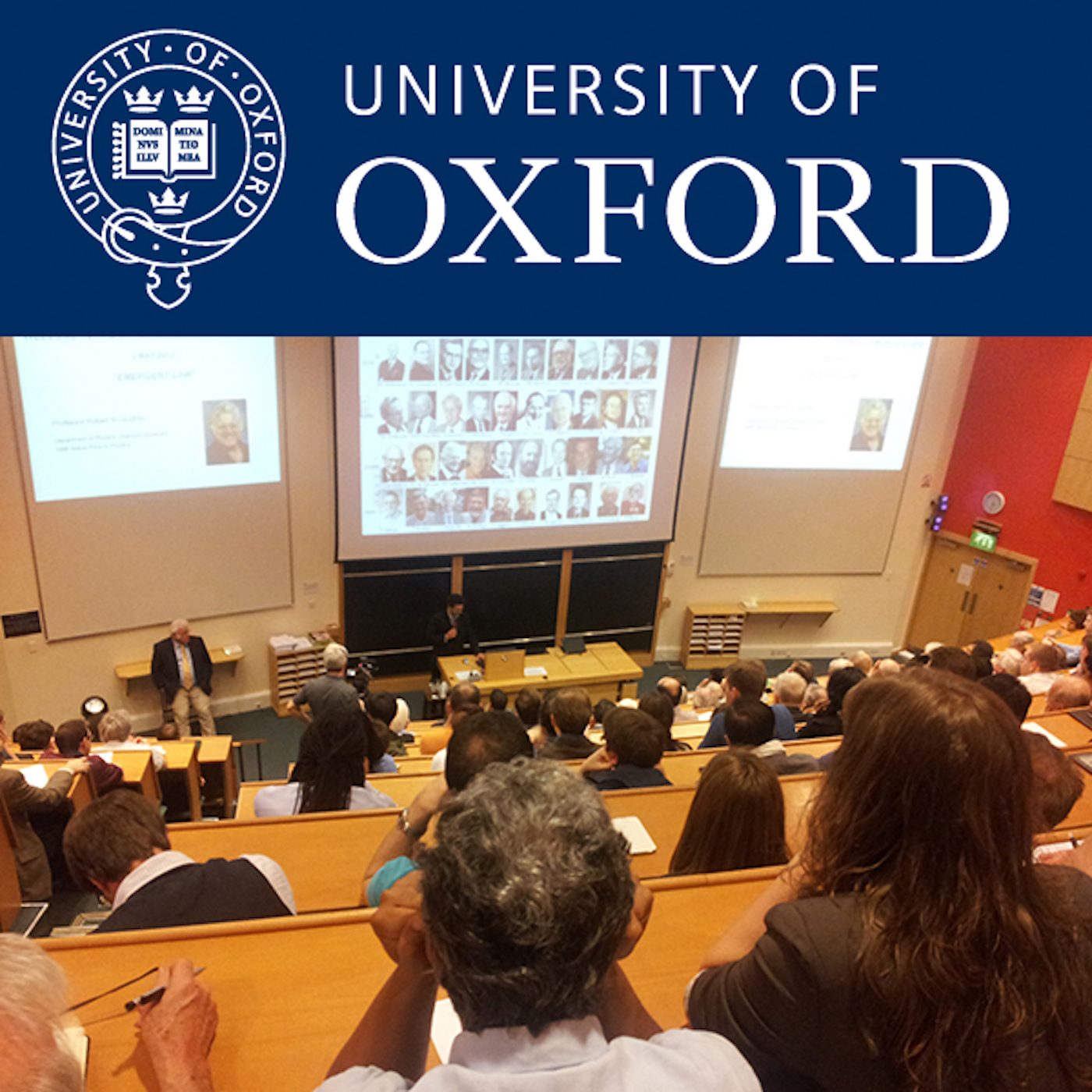
Oxford University
Oxford Physics Public Lectures
The Department of Physics public lecture series. An exciting series of lectures about the research at Oxford Physics take place throughout the academic year. Looking at topics diverse as the creation of the universe to the science of climate change. Features episodes previously published as:(1) 'Oxford Physics Alumni': "Informal interviews with physics alumni at events, lectures and other alumni related activities."(2) 'Physics and Philosophy: Arguments, Experiments and a Few Things in Between': "A series which explores some of the links between physics and philosophy, two of the most fundamen...
Be sure to visit the podcast's website and support the creator: podcasts.ox.ac.uk
Author
Oxford University
Category
Podcast website
Latest episode
Dec 21, 2023
Where to listen?
Podcasts in the app Replaio Radio Coming soonPodcasts are coming to the app soon. Install now and be the first to see a whole new take on podcasts
 Install for free
Android almost 10M downloads · 4.8 rating
iOS soon
Install for free
Android almost 10M downloads · 4.8 rating
iOS soon
Episodes
Starquakes Expose Stellar Heartbeats Video 27.06.2017 1:05:26
The 14th Hintze Biannual Lecture 4th May 2017 delivered by Professor Conny Aerts - Director, Institute of Astronomy KU Leuven Thanks to the recent space missions CoRoT and Kepler, a new era of stellar physics has dawned. Asteroseismology, the observation and interpretation of starquakes, has produced a number of surprises about the deep interiors of stars. These results have altered our view of th...
Curiosity’s Search for Ancient Habitable Environments at Gale Crater, Mars Video 27.04.2017 1:09:28
4th Annual Lobanov-Rostovsky Lecture in Planetary Geology delivered by Professor John Grotzinger, Caltech, USA The Mars Science Laboratory rover, Curiosity, touched down on the surface of Mars on August 5, 2012. Curiosity was built to search and explore for habitable environments and has a lifetime of at least one Mars year (~23 months), and drive capability of at least 20 km. The MSL science payl...
Spatio-temporal Optical Vortices Video 27.04.2017 57:08
Physics Colloquium 10th March 2017 delivered by Professor Howard Milchberg, University of Maryland, USA When an optical pulse propagating through a nonlinear medium exceeds a certain threshold power, it can focus itself and collapse, in theory, to a singularity. In practice, several physical mechanisms mitigate or arrest the catastrophic collapse and the pulse continues propagation as a filamentar...
Learning new physics from a medieval thinker: Big Bangs and Rainbows Video 27.04.2017 54:26
Physics Colloquium 24 February 2017 delivered by Professor Tom McLeish FRS, Department of Physics and Institute for Medieval and Renaissance Studies, Durham University, UK For the English polymath, Robert Grosseteste, light was the fundamental first form that gave dimensionality and stability to the material world. In a dozen scientific treatises written in the early 13th Century, he postulated a...
The applied side of Bell nonlocality Video 27.04.2017 50:10
Physics Colloquium 17 February 2016 delivered by Professor Valerio Scarani Since its formulation in 1964, Bell's theorem has been classified under "foundations of physics". Ekert's 1991 attempt to relate it to an applied task, quantum cryptography, was quenched by an approach that relied on a different basis and was allegedly equivalent. Ekert's intuition was finally vindicated with the discovery...
The Beauty of Flavour - Latest results from the LHCb experiment at the Large Hadron Collider Video 05.04.2017 52:33
Physics Colloquium 3 February 2017 delivered by Professor Val Gibson, Cambridge The Large Hadron Collider (LHC) has just completed another very successful year of data-taking, exceeding many of its design parameters, and collecting a huge amount of data. The LHCb experiment at the LHC is designed to search for new phenomena in heavy quark (beauty and charm) systems, which could ultimately explain...
From Materials to Cosmology: Studying the early universe under the microscope Video 05.04.2017 45:00
Physics Colloquium 27 January 2017 delivered by Professor Nicola Spaldin, ETH Zurich The behaviour of the early universe just after the Big Bang is one of the most intriguing basic questions in all of science, and is extraordinarily difficult to answer because of insurmountable issues associated with replaying the Big Bang in the laboratory. One route towards the answer -- which lies at the inters...
The Future of Particle Physics Panel Discussion Video 07.03.2017 1:10:10
Panel discussion with Prof John Womersley (STFC), Prof John Wheater (Department of Physics), Prof Ian Shipsey (Particle Physics), Prof Dave Wark (Particle Physics), Prof Daniella Bortoletto (Physics) and Prof Subir Sarkar (Particle Theory Group)
The Future of Particle Physics: The Particle Physics Christmas Lecture Video 07.03.2017 1:05:56
Professor John Womersley (STFC) gives the Particle Physics Christmas Lecture. In the past five years particle physicists have made major advances in understanding the nature of our universe – discovering the Higgs boson, and more recently detecting gravitational waves from a distant galaxy. Paradoxically we have also learned a lot more about what we don’t know: that the particles and forces we und...
Astronomy at the Highest Energies: Exploring the Extreme Universe with Gamma Rays Video 30.11.2016 45:38
Physics Colloquium 25 November 2016 delivered by Dr Jamie Holder The gamma-ray band of the electromagnetic spectrum probes some of the most extreme environments in the Universe. Photons of these very-high energies can only be produced by the interactions of subatomic particles that have been accelerated to almost the speed of light. This acceleration occurs in a surprisingly wide variety of astrop...
Exotic combinations of quarks - A journey of fifty years Video 17.11.2016 1:05:24
Physics Colloquium 11 November 2016 delivered by Professor Jon Rosner The early 1960s witnessed a wealth of elementary particles described in terms of simple combinations of a few more elementary units, dubbed quarks. The known mesons and baryons could all be described as states of quark-antiquark or three quarks. However, it was not understood why certain more elaborate combinations, such as (two...
Our Simple but Strange Universe Video 17.11.2016 54:51
The 13th Hintze Biannual Lecture delivered by Professor David Spergel Observations of the microwave background, the left-over heat from the big bang, the large-scale distribution of galaxies and the properties of distant supernova have led to a remarkable simple model for our universe. With only five parameters (the density of atoms, the density of matter, the age of the universe, the amplitude of...
Searching for - and finding! Gravitational Waves Video 01.11.2016 1:03:00
Physics Colloquium 27th October 2016 delivered by Professor Gabriela Gonzalez On September 14 2015, the two LIGO gravitational wave detectors in Hanford, Washington and Livingston, Louisiana registered a nearly simultaneous signal with time-frequency properties consistent with gravitational-wave emission by the merger of two massive compact objects. Further analysis of the signals by the LIGO Scie...
Visualizing Quantum Matter Video 01.11.2016 53:45
Physics Colloquium 28 October 2016 delivered by Professor Séamus Davis Everything around us, everything each of us has ever experienced, and virtually everything underpinning our technological society and economy is governed by quantum mechanics. Yet this most fundamental physical theory of nature often feels as if it is a set of somewhat eerie and counterintuitive ideas of no direct relevance to...
Atmospheric Circulation and Climate Change Video 01.11.2016 47:45
Physics Colloquium 21st October 2016 delivered by Professor Theodore (Ted) Shepherd Pretty much all that is known with any confidence about climate change concerns its energetic and thermodynamic aspects. Atmospheric circulation, which also involves consideration of dynamics, is much more uncertain yet plays a critical role in climate change at the regional scale. How to approach this issue repres...
The explosion mechanism of massive stars Video 27.10.2016 1:00:13
Physics Colloquium 14th October 2016 delivered by Professor Thierry Foglizzo The supernova explosion of massive stars is primarily powered by the gravitational contraction of their core into a neutron star, before the formation of a black hole. Despite numerous observations of supernovae in distant galaxies, the underlying mechanism is still a major challenge to theorists. Prof Foglizzo will revie...
Quantum Sensors sans Frontier Video 16.06.2016 49:22
Physics Colloquium 10th June 2016 delivered by Professor Swapan Chattopadhyay Tremendous advances have been made in the last two decades in precision ‘Quantum’ technologies and techniques in multiple disciplines e.g. cavity electrodynamics, atomic beam interferometry, SQUIDS, quantum optical “squeezed state” techniques for noise-free single photon detection, qubit-based quantum entanglement techni...
The Origins and Evolution of Exoplanet Atmospheres and Oceans Video 15.06.2016 57:20
3rd Annual Lobanov-Rostovsky Lecture in Planetary Geology delivered by Professor Raymond T Pierrehumbert. Atmospheres are dynamic entities, formed from the volatile substances that accrete when a planet is formed and later in its history, cooked out in the hot-high pressure interior of the planet, and exchanging with the interior through crustal processes (for planets which have a solid surface) o...
Bionic Hearing: the Science and the Experience Video 24.05.2016 1:03:10
Physics Colloquium 20th May 2016 delivered by Ian Shipsey Cochlear implants are the first device to successfully restore neural function. They have instigated a popular but controversial revolution in the treatment of deafness, and they serve as a model for research in neuroscience and biomedical engineering. After a visual tour of the physiology of natural hearing the function of cochlear implant...
Unveiling the Birth of Stars and Galaxies Video 18.05.2016 1:05:08
The 2016 Hintze Biannual Lecture delivered by Professor Robert Kennicutt Understanding the birth of stars is one of grand challenges of 21st century astrophysics, with impacts extending from the formation of planets to the birth and shaping of galaxies themselves. The challenge has been all the more difficult because the most active birth sites are largely hidden in visible light. Thanks to a new...
ECHO, ECHo, Echo, echo... When echoes overwhelm Landau damping Video 11.05.2016 53:11
Physics Colloquium 6th May 2016 delivered by Professor William Dorland The Liouville equation describing a collection of charged particles is time-reversible. In the weakly coupled limit, one can reduce this equation to a Fokker-Planck equation, which is irreversible. The problem of the fate of electromagnetic field fluctuations in a plasma in the limit of very weak irreversibility was addressed b...
The Unity of the Universe Video 09.03.2016 52:21
The Final Dennis Sciama Memorial Lecture delivered by Professor David Deutsch Dennis Sciama's 1959 book The Unity of the Universe was ostensibly about the Steady State theory, a cosmological/astrophysical theory which was to be comprehensively and irreversibly refuted by observations only a few years later. But it wasn't really about that. It was really about an idea that was not refuted and is de...
Engineering Defects in Diamond Video 04.03.2016 57:38
Physics Colloquium 26th February 2016 delivered by Professor Mark Newton Defects in diamond have great potential for use as quantum sensors and qubits1. Full exploitation of their optical and spin properties necessitates that we control their position, orientation and environment to optimise all of the desirable properties simultaneously. In this talk I will review our understanding of the product...
Optical Microscopy and Spectroscopy of Single Molecules and Single Plasmonic Gold Nanoparticles Video 04.03.2016 55:03
Physics Colloquium 19th February 2016 delivered by Professor Michel Orrit Optical signals provide unique insights into the dynamics of nano-objects and their surroundings. I shall present some of our experiments of the last few years. i) At low temperatures, single molecules present very sharp lines which enable quantum optical experiments or nanoscale probing, for example of mechanical deformatio...
Stellarators, Fusion Energy and the Wendelstein 7-X Experiment Video 19.02.2016 44:28
Physics Colloquium 29th January 2016 delivered by Professor Per Helender The Princeton astrophysicist Lyman Spitzer famously figured out how a magnetic field can be used to confine a fully ionised plasma in steady state. His solution, the so-called stellarator, involves a counter-intuitive twisting of the field without employing an electric current, and is mathematically related to the Berry phase...
Similar podcasts







Listen to the Oxford Physics Public Lectures podcast in Replaio
Radio and podcasts in one app - free, with no sign-up. Install today and do not miss the launch
Replaio is not a podcast publisher; show names, artwork and audio belong to their authors and are distributed through public RSS feeds.