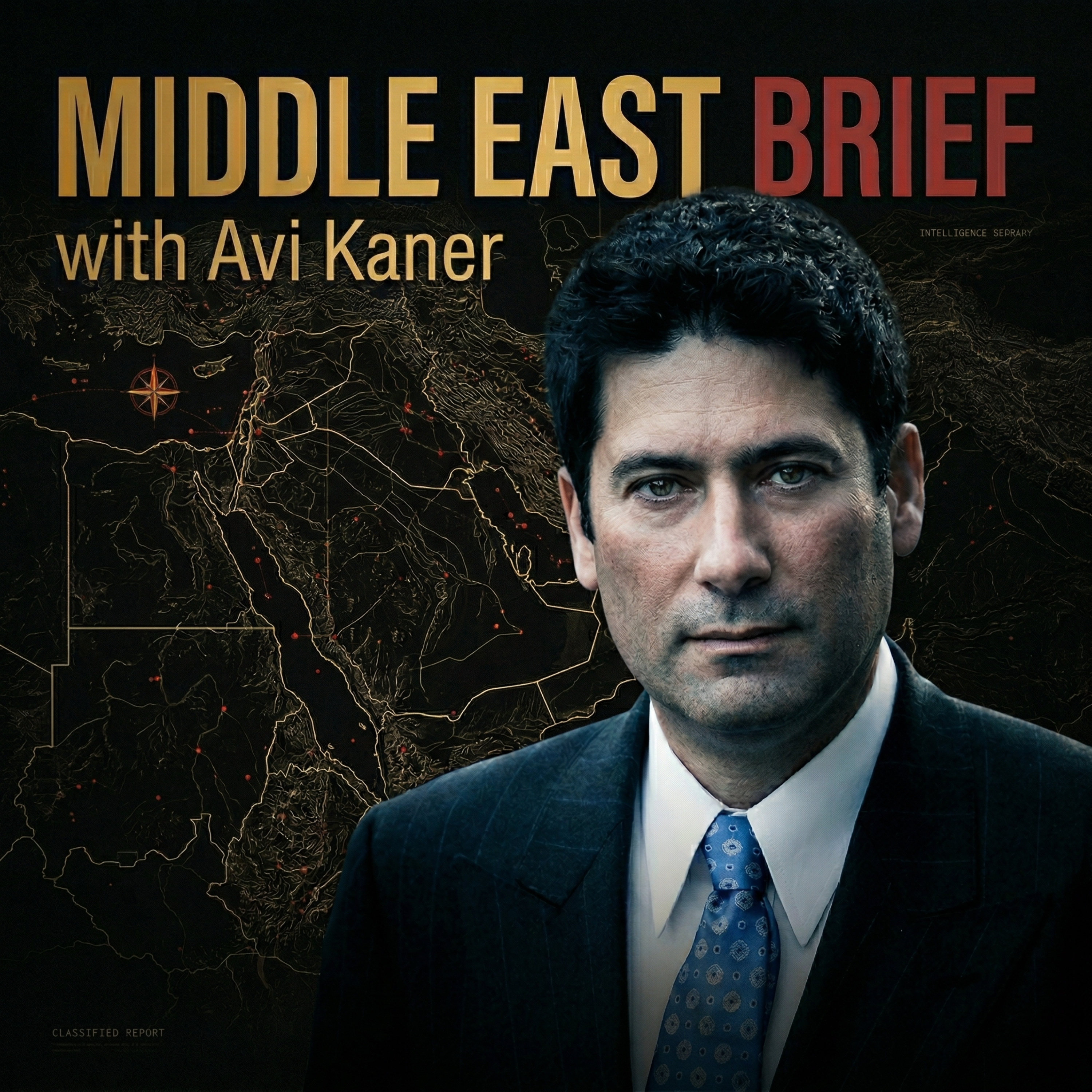
Avi Kaner
Middle East Brief with Avi Kaner
A daily 5-minute intelligence briefing on the Middle East, focusing on what actually matters. Clear analysis, no noise.
Be sure to visit the podcast's website and support the creator: podcasters.spotify.com
Where to listen?
Podcasts in the app Replaio Radio Coming soonPodcasts are coming to the app soon. Install now and be the first to see a whole new take on podcasts
 Install for free
Android 10M+ downloads · 4.7+ rating
iOS soon
Episodes
Israel and Somaliland: A Strategic Opportunity 28.04.2026 6:35
Today’s episode explores one of the most overlooked geopolitical developments in the world: Israel’s recognition of Somaliland. Why did it happen, and what could come next? In this episode, Avi Kaner explains: Why Israel became the first country to recognize Somaliland How people in Somaliland celebrated in the streets waving Israeli flags Why Israel’s appointment of an ambassador matters Why Sena...
Israel’s New Political Moment: Bennett and Lapid Unite 27.04.2026 6:27
Today’s episode explores a major political development in Israel: former prime ministers Naftali Bennett and Yair Lapid joining forces under a new alliance called Together . What does it mean, and why does it matter? In this episode, Avi Kaner explains: How Israel’s parliamentary system works Why 61 seats in the 120-member Knesset is the magic number Why fragmented opposition politics helped Netan...
Israel’s Druze: Loyalty, Sacrifice, and a Shared Future 26.04.2026 5:48
Today’s episode highlights one of the most remarkable communities in the Middle East: the Druze citizens of Israel. During the holiday period of Ziyarat al-Nabi Shuʿayb, centered at the shrine near Tiberias, Avi Kaner explores the history, loyalty, and sacrifice of the Druze community. In this episode: Who the Druze are and where they live Why their bond with Israel became historic How their servi...
From Taboo to the Oval Office: Israel-Lebanon Talks 24.04.2026 4:33
Today’s episode explores how something once unthinkable is now being discussed openly: high-level talks involving Israel and Lebanon. For decades, contact was taboo and often illegal. Movies were banned. Books were censored. Even the perception of contact could carry consequences. In this episode, Avi Kaner explains: How Lebanese anti-normalization laws shaped public life Examples of banned films...
Iran’s Fragile Economy: From Revolution to Collapse 23.04.2026 6:42
Today’s episode explores how a country rich in oil, talent, and history reached economic fragility. Poverty has spread. The currency has collapsed to an all-time low. And the risks may be growing. In this episode, Avi Kaner explains: How Iran’s economy changed after 1979 The impact of war, sanctions, and state control Why the IRGC became an economic power center How the rial collapsed from around...
The Indefinite Ceasefire Strategy 22.04.2026 5:22
Today’s episode explains why an indefinite ceasefire is a powerful strategy. In this episode, Avi Kaner breaks down a hybrid approach to dealing with the Iranian regime: Why extending a ceasefire while maintaining a blockade can increase pressure How time itself can become a strategic weapon Why no U.S. ground war may be the smarter path How economic pressure can weaken the regime faster than head...
From Remembrance to Rebirth: Israel’s Two Most Powerful Days 21.04.2026 3:39
Today’s episode explores one of the most emotional transitions in the world: Israel’s Memorial Day, followed immediately by Independence Day. Two national days. Opposite emotions. Connected forever. In this episode, Avi Kaner explains: The meaning of Yom HaZikaron Why sirens stop traffic across Israel How the nation remembers fallen soldiers and terror victims Why every celebration carries the mem...
Saudi Arabia Behind the Scenes 20.04.2026 6:58
Today’s episode explores why Saudi Arabia may be the most important quiet force shaping the Middle East right now. Not through headlines. Through influence. In this episode, Avi Kaner explains: Why Saudi Arabia pressed for the Israel-Lebanon ceasefire How billions will be invested to strengthen Lebanon’s army The quiet strategic overlap between Saudi Arabia and Israel against Iran How the Abraham...
Argentina's Javier Milei in Israel: Why This Visit Matters 19.04.2026 5:52
Today’s episode explores why Argentina's President Javier Milei’s visit to Israel matters far beyond protocol. This is not just a state visit. It is a statement of values, alignment, and historic friendship. In this episode, Avi Kaner explains: Why Milei’s first stop at the Western Wall was so symbolic The deep history between Argentina and Israel Argentina’s large and historic Jewish communit...
The Israel-Lebanon Ceasefire: What It Really Signifies 17.04.2026 3:44
Today’s episode breaks down the new Israel-Lebanon ceasefire agreement and why it means more than a temporary halt in fighting. This is not just about ten days. It is about the future of Lebanon. In this episode, Avi Kaner explains: The key terms of the 10-day ceasefire Why the Lebanese state is central to enforcement What “one state, one army” could mean in practice Israel’s retained right of sel...
Israel's Shekel at Record Highs 16.04.2026 4:05
Israel’s currency is reaching record highs. And it’s happening during war. In this episode, Avi Kaner explains why the shekel’s strength matters, what it signals, and the remarkable history behind Israel’s modern currency. How the ancient word “shekel” returned in modern Israel Israel’s first post-independence currency: the Israeli lira The launch of the New Israeli Shekel in 1985 Why currencies u...
A sovereign Lebanon, led by its institutions and protected by a strong national army 15.04.2026 4:42
Yesterday’s Israel-Lebanon talks in Washington were about more than diplomacy. They were about whether Lebanon can fully reclaim its sovereignty. In this episode, Avi Kaner explains why both Israel and Lebanon now have an interest in the same outcome: A sovereign Lebanon led by its institutions and protected by a strong national army. Why public talks would have been unimaginable a year ago How Ir...
The Saudi Pipeline That Changes the Gulf Game 14.04.2026 5:15
Everyone talks about the Strait of Hormuz. But Saudi Arabia built an alternative. In this episode, Avi Kaner explains the East-West Pipeline, also known as Petroline, and why it changes the strategic map of the Middle East. How the pipeline moves oil from the Gulf to the Red Sea Why it was built during the Iran-Iraq War Its estimated capacity today Recent Iranian regime attacks and rapid repairs W...
Why the Blockade of Iranian Ports Matters More Than Headlines 13.04.2026 5:05
The United States has announced a blockade starting today. But not of the Strait of Hormuz. Only of ships going to and from Iranian ports. That distinction changes everything. In this episode, Avi Kaner explains why targeting Iranian ports is more effective than other options. Why this is targeted pressure, not global disruption The key ports that drive Iran’s economy How the regime and IRGC depen...
France’s Iraq Embassy in a Seized Jewish House 12.04.2026 5:36
A Jewish family built a grand home in Baghdad, Iraq in 1937. France rented it. Today, it still occupies that same home as its embassy. But not by paying the family that built it. By paying the Iraqi government that seized it. In this episode, Avi Kaner tells the story of Beit Lawee, and the much larger story it represents: Who the Lawee family were Jewish life in Iraq before its collapse The Farhu...
Why Peace Between Israel and Lebanon Is Possible 10.04.2026 3:33
There was a time when Jewish tourists traveled to Lebanon. Beirut was a destination. Hotels, restaurants, nightlife. A Mediterranean city that drew people in. This isn’t ancient history. It’s within living memory. In this episode, Avi Kaner looks back at a very different reality between Israel and Lebanon—and what changed. The history of the Jewish community in Lebanon Personal roots in the Becca...
Hezbollah Explained: Power, Money, and Control 09.04.2026 4:05
Before we can understand what’s happening between Israel and Lebanon, we need to understand Hezbollah. Because Hezbollah is not just a militia. It’s a system. Part military. Part political. Part economic. And it sits at the center of power inside Lebanon. In this episode, Avi Kaner breaks down: What Hezbollah is and how it was formed How it grew from a militant group into a dominant force Its fina...
The Strait of Hormuz Opened. Iranian Regime Fragmented. 08.04.2026 3:06
At 8 PM, the United States set a clear deadline: reopen the Strait of Hormuz or face consequences. The Iranian regime complied. Oil dropped. Markets rallied. But attacks continued. So what actually happened? In this episode, Avi Kaner breaks down why the Strait reopening was real, but the system behind it did not fully align. Who is actually calling the shots inside the Iranian regime Why complian...
The 8 PM Deadline: Who Is the U.S. Really Negotiating With? 07.04.2026 3:38
A clock is now part of the conflict. At 8 PM Eastern, a public deadline set by the United States expires. Make a deal or face targeted strikes within hours. But a deeper question is emerging: Who is the United States actually negotiating with? This episode breaks down: Why deadlines compress decisions Why they increase risk Why power inside the Iranian regime may not sit with its public leaders An...
The Iran War on X: What Leaders Are Really Signaling 06.04.2026 6:36
Everyone is watching missiles. Fewer are watching the signals. On X, world leaders are communicating in real time. Not just to inform, but to signal. In this episode, Avi Kaner breaks down how the United States, Israel, and the Iranian regime use public messaging to shape perception, influence adversaries, and manage escalation. Why U.S. signals are fragmented Why the Iranian regime is speaking to...
The IRGC: Iran’s Real Power - Military, Money, and Control 05.04.2026 4:54
To understand how power works in Iran, you have to look beyond the government. You have to look at the Islamic Revolutionary Guard Corps, or IRGC. Created after the 1979 revolution, its purpose was not to defend the country. It was to defend the system. Today, it operates across multiple layers: internal security, regional operations, and a vast economic network spanning construction, energy, tele...
The Basij Militia: How Iranian Regime Maintains Control - And Where It Can Break 04.04.2026 4:53
To understand how the Iranian regime maintains control, you have to understand the Basij militia. Created after the 1979 revolution, the Basij is not just a security force. It is embedded inside society, operating in neighborhoods, universities, and workplaces to monitor, enforce, and deter dissent. But what makes it different is visibility. In many cases, Iranians know exactly who the Basij are....
The Iranian Diaspora and the Push for Regime Change 03.04.2026 4:19
A significant portion of the calls for regime change in Iran are coming from outside the country. From the Iranian diaspora. There are roughly 4–5 million Iranians living abroad, with even larger numbers when including the second generation. Many left after the 1979 revolution, while others followed during periods of war, repression, and economic decline. Today, parts of this global community are...
Trump’s Iran Speech: What Many Missed 02.04.2026 4:29
Most of the pre-speech predictions were wrong. Trump’s address on Iran wasn’t about a headline. It was about signaling. While early coverage focused on what was said or not said, the real takeaway was the structure of the message: pressure, optionality, and ongoing action. Overnight reactions followed predictable lines, but something else happened as well. Unsubstantiated claims spread rapidly onl...
Disinformation Warfare and the Iran Narrative Machine 01.04.2026 5:12
Disinformation is now a central battlefield in the Middle East. These campaigns shape perception in real time, influence public opinion, and impact policy decisions. At the same time, major platforms like Al Jazeera, backed by the Qatari regime, amplify and reinforce these narratives at global scale. This is not just a media problem. It is a strategic weapon.
Similar podcasts








Listen to the Middle East Brief with Avi Kaner podcast in Replaio
Radio and podcasts in one app - free, with no sign-up. Install today and do not miss the launch
Replaio is not a podcast publisher; show names, artwork and audio belong to their authors and are distributed through public RSS feeds.