Intellectual History
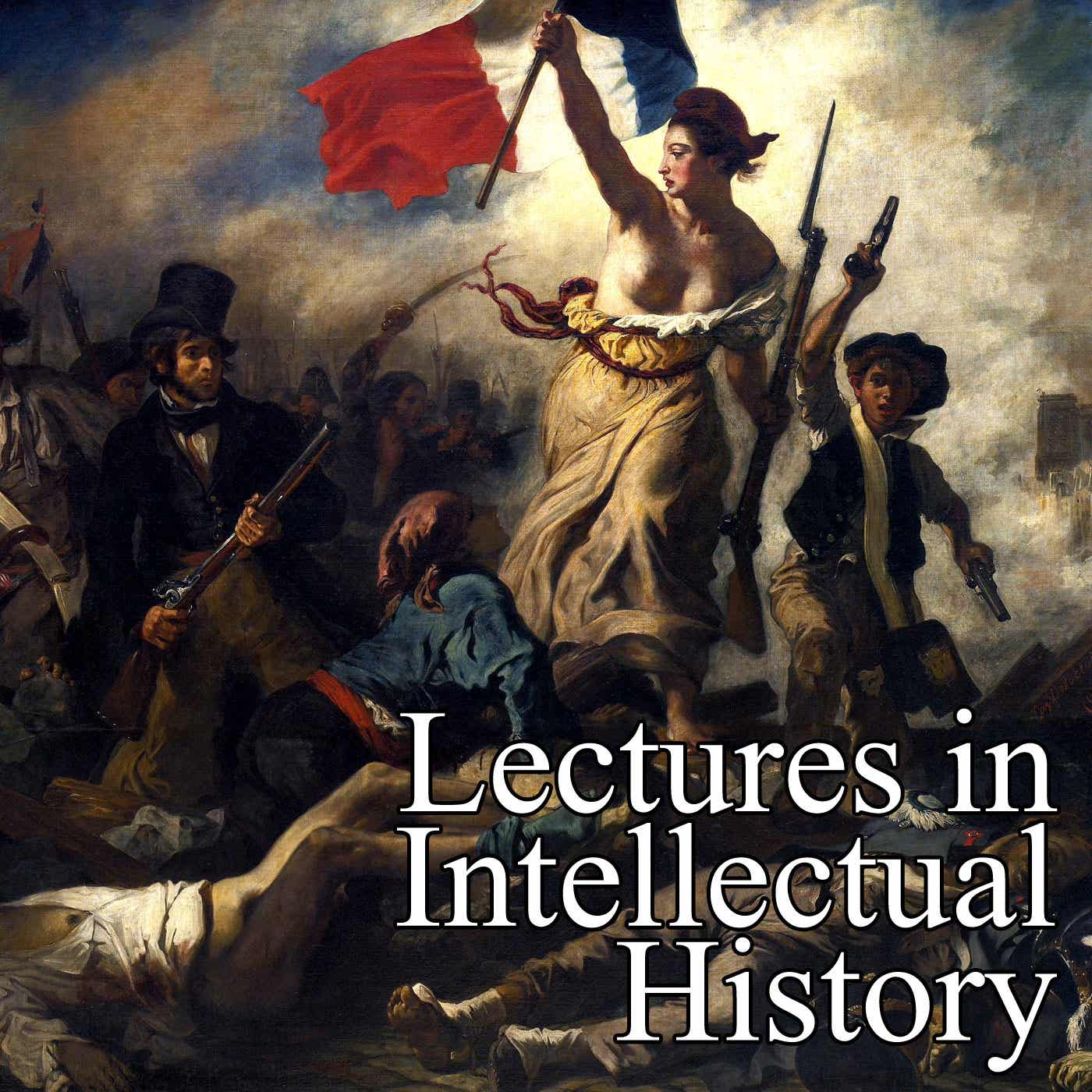
Lectures in Intellectual History
Recordings from the popular public lecture series featuring new work on all aspects of intellectual history. Hosted by the Institute of Intellectual History at the University of St Andrews. standrewsiih.substack.com
Author
Intellectual History
Category
Podcast website
Latest episode
Jul 6, 2026
Where to listen?
Podcasts in the app Replaio Radio Coming soonPodcasts are coming to the app soon. Install now and be the first to see a whole new take on podcasts
 Install for free
Android 5M+ downloads · 4.8 rating
iOS soon
Install for free
Android 5M+ downloads · 4.8 rating
iOS soon
Episodes
Rachel Foxley - The City and the Soul in James Harrington's Republicanism 21.10.2014 51:45
The political theorist James Harrington transformed and deployed many aspects of ancient thinking about the ethical character of the state in his political thought. In this paper, Rachel Foxley analyses Harrington's use of the correspondence between the city and the soul, arguing that this is a crucial mechanism enabling Harrington to attribute virtue to his ideal polity. This is a public episode....
Knud Haakonssen - Political Economy and Utopia, or the Paternalistic Enlightenment in Scotland 07.10.2014 55:23
Thomas Reid, the philosopher and founder of the Scottish School of Common Sense, did not publish much on politics, but his manuscripts reveal that he was deeply concerned with social, political and economic issues throughout his career. In this talk, Knud Haakonssen presents an analysis of Reid's hitherto unpublished Glasgow lecture notes, and shows that Reid was an acute commentator on contempora...
Andreas Hess - Exile from Exile: The Political Theory of Judith N. Shklar 23.09.2014 53:20
How does the concept of exile permeate the life and work of the formative political thinker Judith N. Shklar? In this talk, based on research for his forthcoming book entitled 'Exile from Exile', Andreas Hess explores how Shklar's ideas emerged, how her political theory developed, and the impact and legacy she left behind. This is a public episode. If you would like to discuss this with other subs...
Aileen Fyfe - Referees, Editors, and Printers in the Making of Scientific Knowledge 27.05.2014 50:54
Why is journal publication so important in the history of science, and how are they responsible for the making of scientific knowledge? In this lecture, Aileen Fyfe reveals the story behind the pages of the oldest scientific journal in existence, the Philosophic Transactions of the Royal Society. This is a public episode. If you would like to discuss this with other subscribers or get access to bo...
Greg Claeys - Mill, Malthus and Class: Family Values and the Harm Principle 06.05.2014 48:11
So much has been written about the harm principle central to John Stuart Mill's classic work On Liberty that any attempt to supplement seems superfluous. However, an anomaly in accounts of one aspect of the text requires rectifying. In this lecture, Greg Claeys emphasises the Malthusian context of Mill's treatment of marriage, and argues that in On Liberty Mill regards the family, not the individu...
Donald Winch - The Political Economy of Empire 04.02.2014 58:58
Historians of economics have always been attracted to the political economy of empire because it tells us so much about how serious economic thinking has been shaped by colonial themes. In this lecture, Donald Winch explores this importance of colonies, arguing that whilst the political economy of empire was eventually a theory of capitalist imperialism, it still owed a great deal to those who for...
John Robertson - Sociability between Natural Law and Sacred History, 1650-1800 28.01.2014 58:52
In this inaugural lecture of the Institute of Intellectual History at the University of St Andrews, Professor John Robertson asks how we can explain the concentration of interest, among the moral and political philosophers and historians of the Enlightenment, in the study of the formation and development of societies. This is a public episode. If you would like to discuss this with other subscribe...
David Armitage - Every Revolution is a Civil War 20.05.2013 53:26
According to Reinhart Koselleck, the eighteenth century witnessed the gradual and permanent separation of concepts of "civil war" and "revolution". Placing these ideas in a longer perspective – a longue durée that goes back to republican Rome and comes forward to our own times – challenges this narrative by showing that civil war was the genus of which revolution was only a species. This argument...
Colin Kidd - The Trials of Douglas Young: Hitler, Aristophanes and the SNP 17.04.2013 1:02:48
2013 sees the centenary of the birth of Douglas Young, one of the most influential figures in twentieth-century Scottish nationalism. Leader of the SNP from 1942 to the end of the Second World War, Young was imprisoned twice for refusing conscription – both military and industrial. He was also an eminent classicist, who translated some of the plays of Aristophanes into Lallans (Lowland Scots). In...
Mark Salber Phillips - On Historical Distance 13.03.2013 52:36
Ideas of historical distance have long been fundamental to Western conceptions of historical knowledge. In practice, however, distance seems to have dwindled into little more than a professional shibboleth - a way of defending the historian's labours against the simplifications of popular journalism or the shortcuts of the guided tour. In common usage, historical distance refers to a position of d...
Richard Whatmore - Democracy and Empire 05.03.2013 51:57
One of the great surprises of modern thought is the survival of democracy. Today the victory of democracy continues to be associated with the American and French Revolutions. But democracy was for the most part castigated by reformers and revolutionaries across Europe during the enlightenment era. Attempts to apply democratic ideas universally were generally ridiculed. In this lecture, Richard Wha...
Blair Worden - Two 17th Century Century Concepts of Liberty and their Legacy 23.01.2013 51:13
Over the quarter of a millennium from the later seventeenth century to the Great War, the phrase 'civil and religious liberty' was a pervasive feature of English political language. How and why had the phrase come into being? In 1600 it would have been unintelligible. The alliance of religious with civil liberty became possible only when religious liberty acquired a new meaning and became somethin...
Ian Hunter - The Mythos, Ethos, and Pathos of the Humanities 11.10.2012 42:13
Justifications of the humanities often employ a mythos that exceeds their historical dispositions and reach. This applies to justifications that appeal to an 'idea' of the humanities grounded in the cultivation of reason for its own sake. But the same problem affects more recent accounts that seek to shatter this idea by admitting an 'event' capable of dissolving and refounding the humanities in '...
James Moore - Calvinists, Socinians and Arminians: Reformation and natural rights in early modern political thought 11.10.2012 46:21
In this lecture, James Moore discusses three denominations of Protestant theology: Calvinism, or the dogmatic theology of the Reformed or Presbyterian churches; the theology of the Arminians or the Remonstrants in the Netherlands, the most important of whom for the purposes of this lecture is Hugo Grotius; and the theology of the Socinians, the most significant of whom was John Locke. It is a stor...
Manuela Albertone - Benjamin Franklin's Radical Agrarian Project 18.06.2012 58:52
Benjamin Franklin's interest in physiocracy and the radical implications of French economic ideas extended from Turgot and Condorcet to the British radical milieus. In this lecture, Manuela Albertone highlights Franklin's ability to deliver economic reflection and radical thought, and his passionate belief that only a new attention to the nature of land ownership and its role could combat the forc...
Keith Tribe - Karl Marx: 'Ricardian Socialist'? 09.05.2012 1:03:24
With the general loss of interest in Marx as an analyst of capitalism, argument over the development of his thinking, from his early writings to Capital Vol. I, has given way to a more or less uncritical acceptance of Capital as the centrepiece of his endeavours, and a neglect of its sources. However, in 1913 Lenin rightly noted that there were "three sources and component parts" of "Marxism": Ger...
Donald Winch - Arnold Toynbee's Industrial Revolution 30.04.2012 49:19
Arnold Toynbee's Oxford lectures on the 'Industrial Revolution' were once thought to have been responsible for coining and diffusing an idea that has remained essential to students of British history since the lectures were posthumously published in 1882. Toynbee has also been credited with transmitting an interpretation of the revolution that became known, in the words of E. P. Thompson, as 'clas...
Jeremy Jennings - Travels with Alexis de Tocqueville 17.04.2012 1:02:52
Demoracy in America' by Alexis de Tocqueville is possibly the most famous book about America, but what did Tocqueville see when he visited America and how did his visit influence his writing? In this lecture, Jeremy Jennings seeks to answer both of these questions and to cast light on how other French authors saw America in the nineteenth century. This is a public episode. If you would like to dis...
Peter Mandler - The sociological imagination in mid-twentieth century Britain and America 12.03.2012 56:19
How has the language of social science penetrated its way into the everyday discourse of educated people, particularly in the period after the Second World War? In this lecture, Peter Mandler examines the extent to which people in mid-twentieth century Britain and America used the conceptual tools of psychology, sociology and anthropology to view their personal 'issues' also as social 'problems'....
Nicola Miller - Reading Rousseau in Latin America 27.02.2012 49:48
It is well known that many of the leaders of the Wars of Independence invoked Rousseau in support of their challenge to colonial authority, but how exactly were Rousseau's works read and interpreted in early nineteenth-century Latin America? In this lecture, Nicola Miller identifies variations in how Rousseau's ideas were adopted and adapted by different actors, in different parts of the region, i...
Norman Vance - What gave you that idea Paddy? 06.02.2012 50:01
Is there such a thing as 'the Irish mind', or is that the ultimate Irish joke? If there is a distinctive Irish intellectual history, how did it develop in the face of the disruptions of a complicated and traumatic political and social history? Somehow, new ideas and initiatives keep bubbling up in every generation, but where do they come from? Is there an Irish intellectual aristocracy, or should...
Stefan Collini - The Very Idea of the University 05.12.2011 49:33
Stefan Collini offers a few brief reflections on the history and current state of the institution we call the university, and then goes on to propose a vocabulary and a perspective which enable us to discuss the role of such institutions in more fruitful terms than the clichés about 'contributing to economic growth' which currently dominate public debate on the topic. This lecture was given in mem...
Isabel Rivers - The Pilgrim's Progress in the Evangelical Revival 21.11.2011 1:13:50
First published in two parts in 1678 and 1683, 'Pilgrim's Progress' was to become the most popular religious work in English after the King James Bible. In this lecture, Isabel Rivers explores its fortunes in the evangelical revival of the eighteenth century: how it was made into a polemical text in the battles between Arminians and Calvinists; how it was used for pastoral purposes, both in print...
John Robertson - Sacred History and Political Thought 1650-1750 18.10.2011 1:04:19
How was the Hobbesian proposition - that man was not naturally sociable - answered by recourse to sacred history, the account of the ancient Hebrews and contemporary peoples found in the Old Testament? Focussing particularly on the Neapolitan historians Giambattista Vico and Pietro Giannone, in this lecture John Robertson shows how they adapted and extended the framework for the study of sacred hi...
Donald Winch - John Maynard Keynes: Economist as Biographer and Intellectual Historian 06.06.2011 57:00
Biography was an occupation which sustained Keynes throughout his life in parallel with his work as an economist, and it resulted in his 'Essays in Biography', first published in 1933 but expanded by later essays that make up the Royal Economic Society (RES) edition of this work. As Publications Secretary to the RES, Donald Winch has written a reappraisal of Keynes's work in this field to accompan...
Similar podcasts





Listen to the Lectures in Intellectual History podcast in Replaio
Radio and podcasts in one app - free, with no sign-up. Install today and do not miss the launch
Replaio is not a podcast publisher; show names, artwork and audio belong to their authors and are distributed through public RSS feeds.