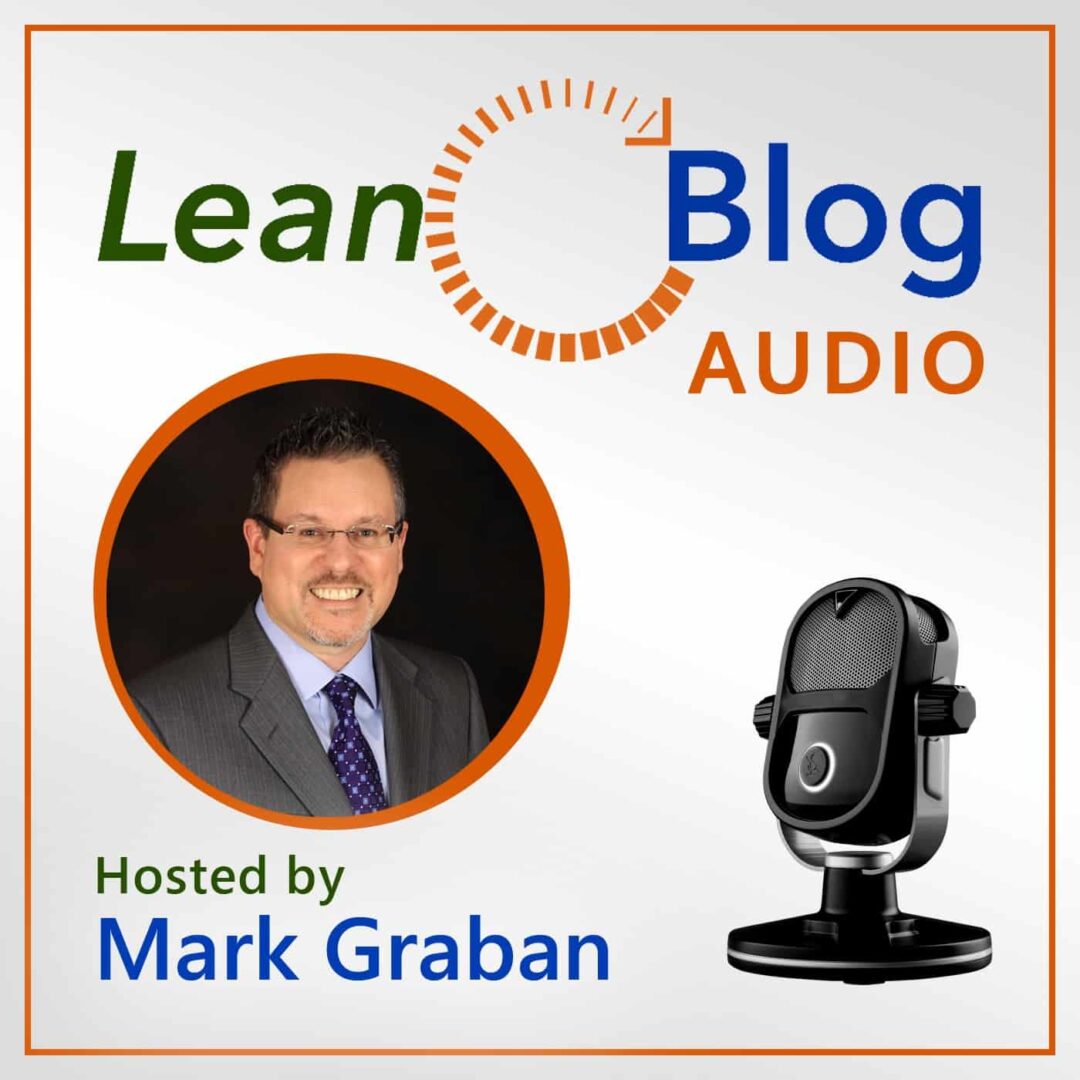
Mark Graban
Lean Blog Audio: Practical Lean Thinking, Psychological Safety, and Continuous Improvement
Mark Graban reads and expands upon selected posts from LeanBlog.org. Topics include Lean principles and leadership in healthcare, manufacturing, business, and the world around us, Learn more at http://www.leanblog.org/audio
Be sure to visit the podcast's website and support the creator: leanblog.org
Where to listen?
Podcasts in the app Replaio Radio Coming soonPodcasts are coming to the app soon. Install now and be the first to see a whole new take on podcasts
 Install for free
Android almost 10M downloads · 4.8 rating
iOS soon
Install for free
Android almost 10M downloads · 4.8 rating
iOS soon
Episodes
Why Kindness in Leadership Matters: Lessons from 'The Mistakes That Make Us' 01.10.2024 7:05
The blog post Today, I want to share a section from my book, The Mistakes That Make Us . I'm sharing an excerpt here in this post, and I'm also making it available as a podcast episode using an excerpt from the audiobook version. In this book, I explore how mistakes can actually be one of the best ways we learn and grow—whether it’s in business or life in general. The excerpt I’m about to share is...
Starbucks Mobile Ordering Chaos Again: Broken Processes, Inconsistent Service, and Misguided Quality Concerns 12.09.2024 5:47
I've blogged about this before , but I'm going back to the problems at Starbucks again with today's post. Starbucks has a new CEO who is talking about how the coffee shop experience is broken . Many aspects of the Starbucks mobile ordering process are broken. Well, the ordering process is fine... it's the fulfillment process that needs improving.
We’ve Stopped Punishing People for Mistakes. Now What? 04.09.2024 8:49
Read the blog post In many organizations, moving away from a culture of punishment when mistakes are made is a significant leap forward. It signals a shift toward understanding, systems thinking, and improvement. But once you've made that change, what's next? Do we need to replace punitive approaches with something better? If so, what? How do you ensure that your new approach leads to mean...
A Monthly Bonus for Zero Injuries in the Factory — What Could Go Wrong? 29.08.2024 5:36
Read the blog post A friend of mine–with a long history of Lean and Toyota Production System knowledge practice–recently shared a troubling story about a relative who works at a manufacturing plant. I'll call this factory team member “Guy.” Call me cynical, if you must, but I totally believe this story, so I'm sharing it here. And my friend has zero reason to make this up. Guy's factor...
The Power of Learning from Mistakes: Insights from ‘Lean Hospitals’ and ‘The Executive Guide to Healthcare Kaizen’ 27.08.2024 4:00
Read the blog post I've been writing about learning from mistakes for a long time, including my previous books before my latest, The Mistakes That Make Us . This idea isn't new, but it's essential–especially in fields like healthcare, where the stakes are incredibly high. From Lean Hospitals : “Mistakes are a reality in healthcare, and while we strive to prevent them, it's crucia...
The 5 Most Controversial Ideas in The Mistakes That Make Us 22.08.2024 8:54
Read the full blog post In writing The Mistakes That Make Us: Cultivating a Culture of Learning and Innovation , I wanted to challenge the way we think about mistakes, leadership, and organizational culture. Throughout my career, I've seen firsthand how the traditional responses to mistakes–punishment, fear, and blame–can stifle growth and innovation. The ideas I present in the book are meant...
From Football to Your Workplace: Why a Lone Wolf Can’t Transform An Organization 25.07.2024 10:41
Read the blog post and more Imagine an NFL team that has been on a decades-long streak of winless seasons. The owner, who has been at the helm for most of that period, always believes that finding the right coach will solve the team's woes. But it doesn't. Every few years (or sometimes more often), the owner blames and fires the coach and hires a new one, but the team continues to lose. In...
Understanding Slow Decisions: How "Motivational Interviewing" Can Help at Work 22.07.2024 6:35
The blog post Think about the last time you made a major career decision. I'm thinking of one of mine, in particular. Was it about leaving a job for a new one? Changing directions in your career altogether? Was it a debate about which of the job offers you would accept? How easy was that? How long did it take you? In hindsight, some of my career decisions took too long to play out. Afterward,...
Executive Summary on Cultivating Psychological Safety and Continuous Improvement 16.07.2024 8:08
The full blog post This post draws upon and summarizes content in my book, The Mistakes That Make Us: Cultivating a Culture of Learning and Innovation . Senior leaders must prioritize psychological safety and continuous improvement to foster an environment conducive to learning and innovation. Psychological safety is crucial for enabling employees to speak up about mistakes and ideas without fe...
Why Two Data Points Don't Show Trends: Understanding the Importance of Comprehensive Data Analysis in Workplaces and News 12.07.2024 7:19
The full blog post Two data points are not a trend. Two-data-point comparisons can be mathematically correct but practically meaningless. This is true in workplaces and news articles like this one . Multiple two-data-point comparisons (comparing last month to the previous month AND comparing it to the year before) don't paint the full picture the way a simple run chart would. If a hospital'...
The Suggestion Box is Dead, with a New Obituary 11.07.2024 4:06
The blog post with webinar link As a Throwback Thursday, I'm sharing this webinar that I did back in 2012, as hosted by Karen Martin... On this theme of “The Suggestion Box is Dead,” I thought to prompt ChatGPT to create an image of a burial scene and mournful employees...
Demystifying Toyota’s Andon System: How It Works and Common Misconceptions 05.07.2024 3:53
Episode blog post There's a common misconception about Toyota's “Andon” system, often expressed as: “When a team member pulls the cord, the line stops.” But that's not entirely accurate, as this enlightening Toyota video demonstrates...
I’ll Be Speaking, Learning, and Facilitating at the Global Lean Summit 01.07.2024 15:22
Blog post with links I'm very happy to be participating in Jared Thatcher ‘s “ Global Lean Summit ” event this September in Indiana. I'll be there to network and learn, which includes time visiting a Toyota Material Handling factory (an entire day!) I'll be speaking and facilitating: A workshop on Psychological Safety as a Foundation for continuous improvement A learning session fe...
Don't Digitize the Suggestion Box -- Improve a Better Way with Kaizen and KaiNexus 28.06.2024 3:06
The blog post Digital transformation is about rethinking and reinventing with digital tools. For over 13 years, KaiNexus has moved beyond the outdated suggestion box model. Traditional suggestion boxes, whether paper or digital, often fail (or usually fail!–ideas get locked away, reviewed by a select few, and lead to frustration. We believe in dynamic platforms that foster real-time communicatio...
Psychological Safety: Ensuring Every Voice is Heard, Not Necessarily Followed 26.06.2024 3:32
Blog post Psychological Safety means everybody gets their say, but it doesn't mean you get your way. Psychological Safety is an individual's belief, feeling, or perception that it's safe for them to speak up in a situation. When people are rewarded for speaking candidly, that leads to rigorous debate and better decisions. Psychological Safety doesn't mean freedom from being challe...
Join Me on Friday for The Mistakes That Make Us: A Book Birthday Event 25.06.2024 2:28
The blog post The LinkedIn event My latest book, The Mistakes That Make Us: Cultivating a Culture of Learning and Innovation , is turning one year old! Join me, along with my co-host Elisabeth Swan, for what we hope will be an engaging, insightful, and fun discussion about learning from mistakes. We'll be joined by special surprise guests who will share their unique perspectives and experienc...
Join Me at the Michigan Lean Consortium Annual Conference in August! 21.06.2024 2:00
The Blog Post I'm excited to share my breakout session at the Michigan Lean Consortium Annual Conference ! In this session, I dive into the critical role of Psychological Safety as a Foundation for Continuous Improvement . We explore how fostering an environment where team members feel safe to share ideas, take risks, and learn from mistakes can drive remarkable progress and innovation. Oh, an...
Mistakes and Errors: A Circular Definition; Leadership Matters 20.06.2024 6:25
Blog post link When writing or speaking, I use the words “mistake” and “error” interchangeably. The definitions in some dictionaries are comically circular. Dictionary.com defines an error as: “a deviation from accuracy or correctness; a MISTAKE, as in action or speech.” It also defines a mistake as: “an ERROR in action, calculation, opinion, or judgment caused by poor reasoning, carelessness,...
Upcoming Shingo Webinar on Learning From Mistakes and Psychological Safety 16.06.2024 10:59
Blog post link I'm excited that the Shingo Institute asked me to present a webinar on June 18th . Click here to register for the webinar They've also published an article that I wrote: Psychological Safety: The Key to Effective Andon Cord Pulls and Continuous Improvement The webinar description: Join us for an engaging webinar as we explore the transformative power of cultivating a cul...
The Pitfalls of Safety Bonuses in Lean Factories: A True Story 15.06.2024 5:13
Blog post I was talking recently with a trusted friend in the Lean community. He told me a story. It's certainly believable, even if it's second or third-hand to me. He had no reason to make up a story like this. A relative of his works in a U.S. factory. Yes, we still have factories here. I'll call this relative of my friend “Guy,” which is pronounced the American way, not the French...
Psychological Safety vs. Psychological Comfort: Understanding the Distinction 14.06.2024 5:11
Blog post link The Big Picture: In the Lean community and beyond, some people mistakenly equate “psychological safety” with being comfortable all the time. This misconception can undermine the true essence of psychological safety in the workplace. Psychological safety is not about constant comfort or shielding managers from discomfort. Synthesizing a few definitions of psychological safety, I say...
Preventing Surgical Errors: Effective Strategies Over Warning Signs in Operating Rooms 06.06.2024 2:55
The blog post IMAGE: A sign that reads "CAUTION: DON'T OPERATE ON THE WRONG SIDE" It's silly, right? I've never seen a sign like this in an operating room. And I'm not advocating for them. It's not the right approach for quality and patient safety. If warning signs actually prevented mistakes, and given that a vast majority of mistakes are caused by human factors (lik...
Celebrating 100 Years of Shewhart’s Control Charts: A Century of Quality Management 04.06.2024 5:31
The blog post TODAY marks the centennial of one of the most significant innovations in quality management: the control chart. 🎂 🎉 🎆 In the early 1920s, Walter A. Shewhart , working at Bell Labs, recognized the need for a statistical method to monitor and control manufacturing processes. On May 16, 1924, Shewhart created the first “control chart,” a tool that distinguished between common cause...
LinkedIn Poll on Barriers to Speaking Up: Fear and Futility 31.05.2024 3:09
The blog post Research by Ethan Burris shows that the top two reasons employees choose to keep quiet in the workplace are: 1️⃣ Futility 2️⃣ Fear Fear of getting in trouble is a big problem. But there are also many workplaces where people say, quite literally, “I'm not afraid to speak up, it just isn't worth the effort.” That's the Futility Factor. Please answer this poll question via...
My New Mistake-Proofing Course for TKMG Academy: Available Now! 29.05.2024 6:20
Episode page with links and more info I'm very happy to announce the release of my new Mistake-Proofing course , available NOW through Karen Martin and TKMG Academy . You can buy the course individually at TKMGAcademy.com for $129. Volume discounts are available for large teams or your entire workforce (for more information, email info@tkmgacademy.com ). The course is also part of the wonderf...
Similar podcasts




Listen to the Lean Blog Audio: Practical Lean Thinking, Psychological Safety, and Continuous Improvement podcast in Replaio
Radio and podcasts in one app - free, with no sign-up. Install today and do not miss the launch
Replaio is not a podcast publisher; show names, artwork and audio belong to their authors and are distributed through public RSS feeds.