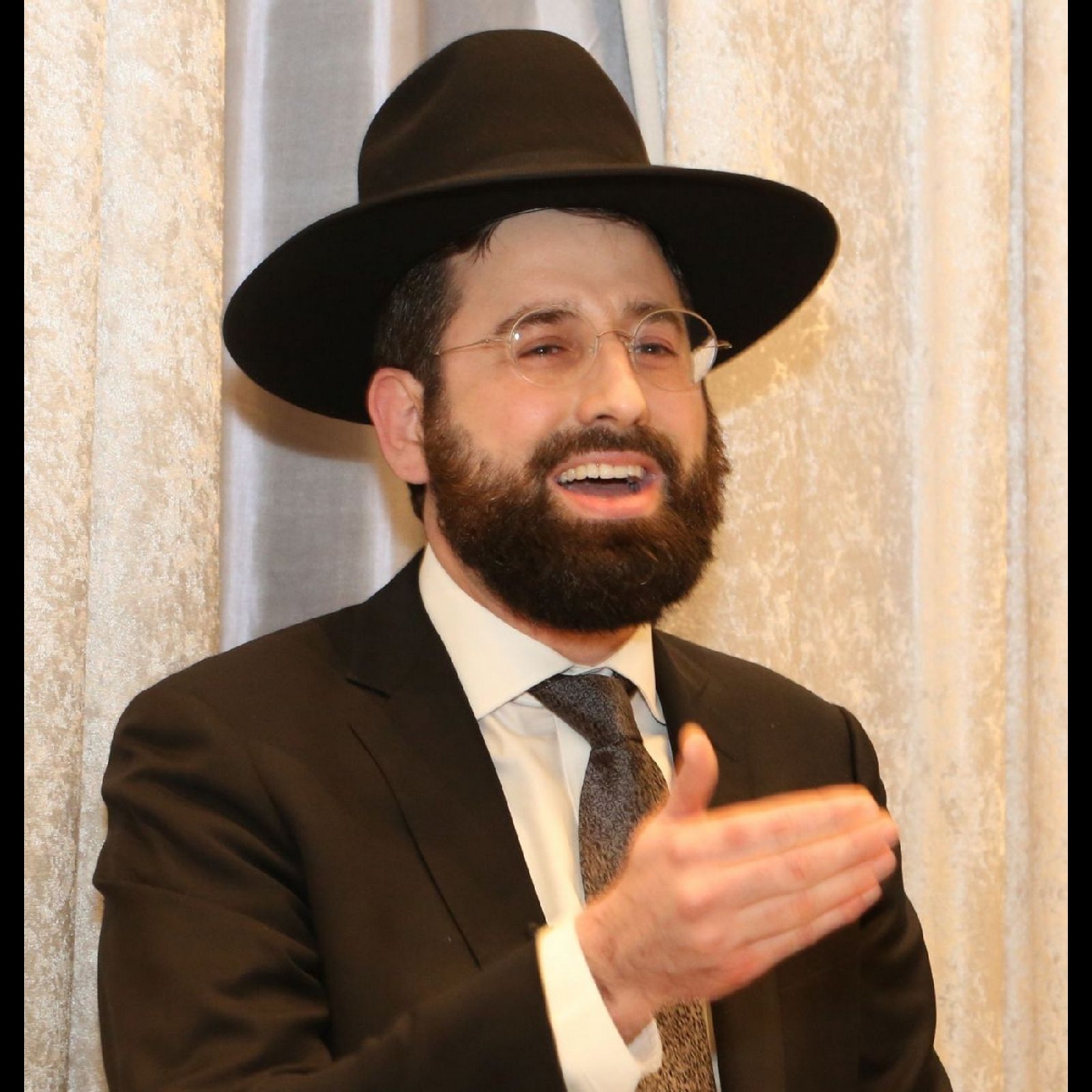
Rabbi Nadav Caine
Judaism for the Thinking Person
In addition to explicating individual chapters of the Torah using traditional sources to apply directly to our daily lives, Rabbi Caine or "Rav Nadav" (as he is affectionately known) teaches on topics such as The Soul, Mysticism, Theology, Ethics, Comparative Religion, Science & Religion, and Psychology of Religion. Rav Nadav studied religion and philosophy at Princeton, Harvard, and Stanford Universities. An award winning teacher and Conservative rabbi, he now serves as senior rabbi at a congregation in Ann Arbor, Michigan.
Author
Rabbi Nadav Caine
Category
Podcast website
Latest episode
May 11, 2026
Where to listen?
Podcasts in the app Replaio Radio Coming soonPodcasts are coming to the app soon. Install now and be the first to see a whole new take on podcasts
 Install for free
Android 5M+ downloads · 4.8 rating
iOS soon
Install for free
Android 5M+ downloads · 4.8 rating
iOS soon
Episodes
Changing our Relationship with Time from Productivity to Presence 01.11.2021 20:24
It hasn't been very long in human history (two or three generations) that we live our lives according to a clock rather than according to the processes of our lives (waking up, milking the cow, putting the hay in the barn, taking the goats for their grazing...). This has changed our relationship to God, to ourselves, and to each other. We judge ourselves by our productivity, how much we can get...
The Potentially Limitless Commandment of Honoring Parents As They Age 26.10.2021 15:48
In this dvar Torah, I share Talmudic stories of rabbis trying to honor their mothers in ways that are both comical and also poignant in their alluding to our individual (and often lonely) struggles to honor God and them, especially as they age, with seemingly no yardstick to compare ourselves and manage expectations.
Combatting the Curses Against Israel with History, not more Scapegoating 10.10.2021 29:29
The last sections of the book of Numbers deal with the local tribes, themselves fighting and displacing each other, refusing to grant the Israelite refugees safe passage through their lands. As a consequence of this moral failing, they lose the right to keep the land --an important message of Torah. In fact, coupled with their denials of safe passage, they hire the famous Near-Eastern Bilaam to...
Instagram, Depression and the Serpent Voice: ”And They Knew They Were Naked” 04.10.2021 19:19
The creation stories of Genesis blend mythological motifs with reflections on the moral consequences of human evolution. When we understand the serpent voice to be the appearance of the human inner voice --the beginnings of evolutionary, human self-consciousness, a consequence of eating of the fruit of the garden-- then the hiding that Adam does, not because they have disobeyed God (as one presum...
The Halakhah of Zoom Minyan: Adding Windows to the House of Israel 26.09.2021 25:15
Synagogues like mine have resorted to making virtual community over much of the pandemic. How do we do a heshbon nefesh of the experience: a reckoning of the pluses and minuses as we enter a new future of self-creation? What is the halakhah of it, what have we learned, what are the issues? In this Kol Nidrei sermon, I address these issues, as we consider who we wish to be as we enter the futur...
The Victim Triangle: Moving from Blame to Self-Creation, from Drama to Authenticity 17.09.2021 27:09
Our society is permeated with a victim mentality that presents itself as prophetic, but is punitive. Caught in the Victim Triangle, everyone must fit into a role of Victim, Persecutor, or Rescuer --both in individual dramas and in societal theory. Change presents itself only in the options of shifting roles in the triangle: persecutors must become victims, victims will fix things by teaching th...
It‘s Time to End the Fertility Bias: Our Shame in Shutting Out Those Without Children 10.09.2021 17:59
How often do people say to me, "Rabbi, Rosh Hashanah is not about prayers, theology and sermons -- it's about getting together with family!" or "My grandfather was a model Jew because he was committed to his grandchildren" or "One does not know true awe until one has had children." And how often have I as a rabbi said similar things at a bat mitzvah or baby naming from the bimah, or when explaini...
Saving One Life is Saving the World: Jewish Law and the Death Penalty 16.08.2021 15:55
In the parashah of "Shoftim" in Deuteronomy, we have the norms for shoftim v'shotrim, the judges and professional criminal justice system officials. We are commanded that tsedek tsedek tirdof, known as "justice, justice you shall pursue" though tsedek means "justice" in the sense of "righteousness," not in the sense of revenge. The parashah goes on to discuss capital crimes, an eye for an eye,...
The Depth of Loving Torah and Being Loved Through It: Being Taught is to Be Loved 02.08.2021 18:24
After Moshe recounts the 10 Commandments --the 10 "word-statements"-- in Deuteronomy chapter 5, we get the Shema and the Ve-Ahavta, we must Hearken to "these words," incribe them in our hearts, and return God's love by loving through teaching these words. What are the words? Given the context of chapter 5, it would make sense these are the 10 Commandments, perhaps to be the text of the mezuzah a...
Leading our Children to Transcendence 13.06.2021 14:11
The oldest, continually used blessing in the world is the Torah's "Priestly Blessing." May God bless you [with bounty] and guard you. May God's face radiate grace (of getting your needs met) upon you. May God turn God's face to you [when you don't get what you need] so [you do not feel alone but meet God there and] God places peace within you. The Rabbis stress that the person blessing is merel...
Reopening the Synagogue When People Are Coming up the Down Staircase 26.05.2021 12:57
How do we reopen the synagogue after over a year of being virtual? For some it's procedural: distance appropriately, follow guidelines, limit numbers, maybe wait on the food. But the Temple is not a gathering of bodies, it's a gathering of souls. How do we reopen appropriately to be a holy community, one that recognizes each other as souls? One of my favorite mishnayot speaks to this, and I w...
God the Mother 09.05.2021 13:37
Leviticus ends with a long list of horrifying predictions (or curses) of the vicious suffering of the Israelites when they eventually enter the Land and break the covenant. Western Civilization has been shaped by European Christian intellectuals who created the unchallenged image (and therefore a Western bias) that the God of the Old Testament is a God who is disposed toward anger and punishment,...
Ross Douthat, Biblical Impurity, and Antipathy toward the Temple 30.04.2021 14:59
Is Leviticus's insistence that those with skin afflictions (as well as having buried the dead) not go to Temple an exclusionary punishment for being sick? Or is that our modern reading which presumes that religion is exclusionary and judgmental? In this presentation, I use Ross Douthat's essay "Can the Meritocracy Find God? The secularization of America probably won’t reverse unless the intellig...
Jewish Law on Cremation and Burial, and What We're Facing as the Numbers Rise 22.04.2021 13:06
As the percentage of Jews opting for cremation has risen from around 2% to over 20% in twenty years, how do we balance the mitzvah of burial of Jewish remains with the prohibition on cremation?
The Tabernacle -- and our Lives-- as a Purposeful Composition 22.03.2021 13:30
Inspired by the teachings of the great American ceramicist, Richard DeVore, I examine what the mishkan tells us about the nature of artistic composition, drawing a stark contrast between Golden Calves and Purposeful Composition, in Exodus, and especially in how we live our lives.
Keruvim, Cherubim, Griffins, Sphinxes, and the angel Rafael 10.03.2021 12:42
What were the Keruvim, the two hybrid beast angels 10 cubits high protecting the Ark of the Covenant, and from between whom God speaks? I rehearse all the theories, and end with a Maimonidean vision of what the angel as an extension of God's presence really is.
The Building of the Tabernacle through the Lens of the Black Church 04.03.2021 15:49
Given that some of the most influential narratives and Torah legislation are but a few verses long, why is so much of the book of Exodus chapters and chapters of detailed, repetitive descriptions of the instructions and building of the Tabernacle (Mishkan), the priestly uniforms, the utensils, the hundreds of curtain rods and hooks? I answer this question through my reflecting on the observations...
Making Sense of the Most Disturbing Statement in the Bible 01.03.2021 4:28
No statement by God seems more morally challenging than the prophet Samuel's demand for the complete annhilation of the Amalekites and their animals, followed by his condemnation of Saul for failing to kill King Agag and the choicest of the animals. The Amalekites are equated with the nature of evil itself, and so the resurgence of evil and especially genocidal anti-Semitism throughout the rest o...
"God, Let me receive good counsel!" The 5 minute practice that will change your life 17.02.2021 5:13
In this 5 minute teaching, I read a poem by Zbigniew Herbert and then share a seriously short spiritual practice that involves receiving the deepest of advice. In that, I connect the prayer Hashkiveinu to the Mourners Kaddish to my own experience of practicing it.
Jonah versus Moshe: When Do We Hold the King Accountable and When Do We Move On? 02.02.2021 11:10
As America faces what to do and think about impeachment, I reflect on the dramatic difference between the book of Jonah and account of the final plagues in Exodus where God hardens Pharoah's heart. In the former, God is so anxious to accept an apology, move on, and look to the future that Jonah wants to refuse God's service, and in the other God prevents the moving on that Moshe is so anxious to...
Zikaron and the Filibuster: The Memory of Slavery and Dreaming God's Dream for America 24.01.2021 14:50
Parashah Bo repeatedly connects the memory of slavery to the establishment of Jewish rituals for all time, from the main features of the Passover seder to the First Fruit offerings in the Temple to ones we forget to associate with the memory of slavery like tefillin. (Later, even Shabbat will be firmly connected to the memory of slavery.) We in America have done the opposite by divorcing our ins...
Geneivat Daat: The Theft of Subjectivity by Media and its Pull Upon Us in the name of Justice 18.01.2021 16:36
I examine the sin of Geneivat Daat -- theft of another's consciousness through words that might be parse-able but lead another to think something is true which isn't-- as the prevalent sin in a world of fragmented media tailored to incite us, and I relate this to former Jewish Theological Seminar chancellor Arnold Eisen's insight that we readers cheer Moshe on in his riotous act in the name of jus...
The Dreams of Genesis and Our Dreams: Our Alignment with the God World 21.12.2020 19:30
The saga of Yosef is about dreaming beginning to end, with the parashah of Miketz as itself operating according to dream logic. Are dreams special in the Torah, unlike ours, as some kind of prophecy? Or is much of Genesis calling our attention to the God world all around us, the one we only know through "knowledge by inacquaintance" (Abraham Joshua Heschel)? Is it telling us that our convention...
Reuniting Religion and Psychology: Jacob's Dreams and the Therapeutic Uses of Psilocybin 06.12.2020 17:13
I relate Jacob's dream of the stairway to heaven and his dream of God-wrestling to the therapeutic uses of psilocybin to treat PTSD, depression, addiction, and end-of-life fear.
"It's Their Money!"- The Ketubah, Traditional Jewish Marriage, and the Defrauding of Rachel and Leah 30.11.2020 19:14
The stories of Jacob being defrauded by Lavan are taken to be the plot of the famous period of Jacob working for Lavan for 20 years before fleeing in the middle of the night. In this teaching, I show that this is a misunderstanding. Jacob has worked for 20 years for Lavan without being paid, but only 6 of those years are for Jacob and his arrangements with Lavan! The first 7 years are to earn m...
Similar podcasts







Listen to the Judaism for the Thinking Person podcast in Replaio
Radio and podcasts in one app - free, with no sign-up. Install today and do not miss the launch
Replaio is not a podcast publisher; show names, artwork and audio belong to their authors and are distributed through public RSS feeds.