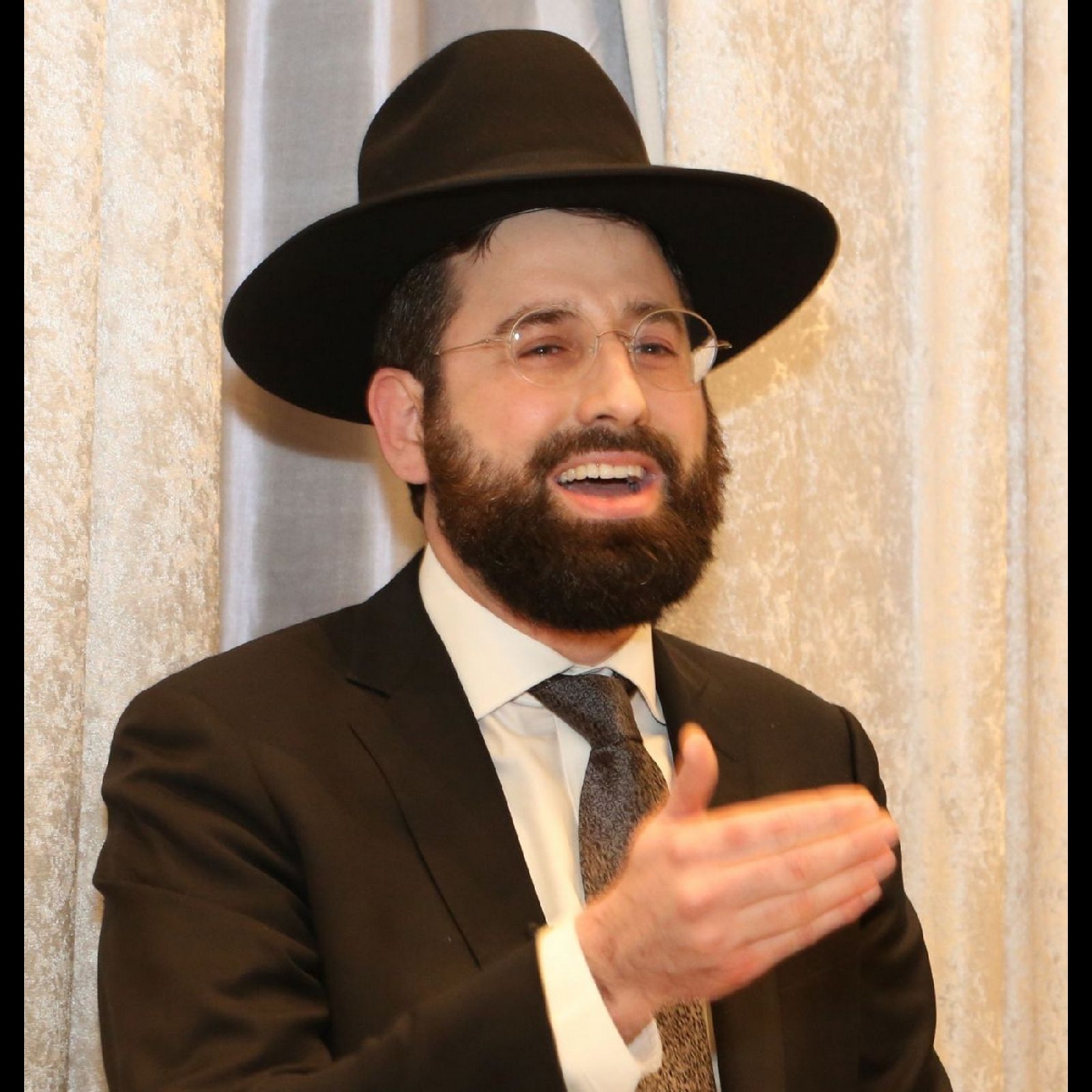
Rabbi Nadav Caine
Judaism for the Thinking Person
In addition to explicating individual chapters of the Torah using traditional sources to apply directly to our daily lives, Rabbi Caine or "Rav Nadav" (as he is affectionately known) teaches on topics such as The Soul, Mysticism, Theology, Ethics, Comparative Religion, Science & Religion, and Psychology of Religion. Rav Nadav studied religion and philosophy at Princeton, Harvard, and Stanford Universities. An award winning teacher and Conservative rabbi, he now serves as senior rabbi at a congregation in Ann Arbor, Michigan.
Author
Rabbi Nadav Caine
Category
Podcast website
Latest episode
May 11, 2026
Where to listen?
Podcasts in the app Replaio Radio Coming soonPodcasts are coming to the app soon. Install now and be the first to see a whole new take on podcasts
 Install for free
Android 5M+ downloads · 4.8 rating
iOS soon
Install for free
Android 5M+ downloads · 4.8 rating
iOS soon
Episodes
We're All Looking for Empathy after October 7th, Including Me! (Rosh Hashanah Sermon 2024) 06.10.2024 27:50
As a Conservative rabbi in one of the most progressive cities in America, it's been an incredibly painful year of feeling unable to ask for empathy from my own fellow Jews, as I see this year's events as Good vs Evil, and so many of my congregants want me to be condemning Israel while declaring moral equivalencies. And I know they, too, need from me what I cannot give them: validation for their p...
Writing G-d and the Danger of Idolatry 03.09.2024 17:06
This dvar Torah uses the amazing article by Rabbi David Golinkin on the history of the halakhah and the practice. It can be found at: https://schechter.edu/must-gods-name-be-written-in-english-as-g-d/
Did a Biblical Outlaw Understand the Arab-Israel Conflict Better than Today's Students? 14.07.2024 11:57
It is commonplace to hear today's Israel-Arab Conflict portrayed as an example of Settler-Colonial European Jews settling in the nation-state of indigenous-dwelling Palestinians. This is a modern invention and is not how the conflict was understood by local Arabs a hundred years ago, who did so in rational terms that match the Biblical arguments between the Israelites (Gideonites) and local Ammoni...
Amalekites, Gaza and the End of Megillat Esther on Purim 24.03.2024 14:54
As Purim became a holiday of tremendous festivities and lightheartedness, the Rabbis knew that the end of the Megillah in Chapter 9 has a dubious quality, that of a massacre on Haman's people. Is this a happy ending, a desirable ending, that of massacre, that of Jews finally (and really for its time, only possible in the Jewish imagination but not in practice) having power? So the Rabbis created...
The 19th Century Reform Rabbi Who Changed Physics 19.02.2024 9:11
The most influential rabbi you've never heard of? Based on an episode of the RadioLab podcast ("Relative Genius") and a biography in the Jewish Encyclopedia -- https://www.jewishencyclopedia.com/articles/12611-rebenstein-aaron -- I tell you about the extraordinary Rabbi Aaron David Bernstein who likely accomplished more in his lifetime by himself than your average Ivy League university!
The Israelites Left Egypt Armed: Gender & Chauvinism Preceding October 7 30.01.2024 16:10
In the second verse of Parashat Beshalach (the flight from Egypt and the crossing of the Sea of Reeds), the Torah states that the Israelites fled fully armed. I explore the traditional commentaries on why, and connect this to the haftarah (story of Deborah and Yael) and to the intelligence failures in Israel caused by male chauvinism.
Who Gets to Be a Spokesperson for Israel? The Soft of Heart and Slow of Speech 15.01.2024 13:46
The focus of the American and international conversation about the Hamas attack and its aftermath has been "Ceasefire or No Ceasefire" by which people mean (since there was a ceasefire prior to Hamas's breaking it) whether Israel should cease its counter offensive due to civilian casualties. Who gets to be a spokesperson for Israel at this time in our communities and in the world? Interestingly, t...
Tikkun Olam and Redeeming the Hostages 23.12.2023 16:56
As a Dvar Torah for Vayigash (Joseph's revealing himself to his brothers following Judah's speech), I explore the mitzvah of redeeming our captives and the limitations on the law "for the sake of Tikkun Olam." The conversation among American Jews about Gaza centers around "Ceasefire or No Ceasefire? What kind of Jew am I if I don't support stopping the bombing?" while the conversation in Israel is...
Halakhah and Aggadah: The Ten Stories We Tell PART TWO 01.12.2023 9:23
PART TWO of this Yom Kippur 2023 sermon, in which I share the result of my personal and rabbi experiences of the last 15 years: that the longer we live, the shorter our eulogy becomes; that life (like scripture) is a combination of halakhah (direct description of human behavior) and aggadah (our stories in which God is an invisible character); that the main point of Yom Kippur is to learn how to...
Halakhah and Aggadah: The Ten Stories We Tell PART ONE 23.11.2023 16:34
In this Yom Kippur 2023 sermon, I share the result of my personal and rabbi experiences of the last 15 years: that the longer we live, the shorter our eulogy becomes; that life (like scripture) is a combination of halakhah (direct description of action) and aggadah (our stories in which God is an invisible character); that the main point of Yom Kippur is to learn how to retell our stories so that...
Is There a Fear of God In This Place? Our Different Experiences of the Israel Gaza Conflict 06.11.2023 14:16
Using the stories of Avraham, Sarah, and Hagar in Vayera, I voice what it's like to have utterly different experiences of the Gaza conflict with our coworkers, friends, and family members, some of whom seem to embody Dara Horn's prophecy that the world loves to pity the dead Jews of the past while finding the living Jews of today an inconvenience, an Other, and deserving of sanctimonious antisemit...
The Commandment of Shevut: How Do We Handle its Inherent Subjectivity? 16.10.2023 18:02
In Deuteronomy, we are commanded to keep Shabbat as restfulness. Many are unaware that this does not just involve practicing the Shabbat observances and restrictions --Biblical and Rabbinic-- but the highly unusual special-to-itself halakhic category of "Shevut," usually translated as proactively keeping "the spirit of Shabbat." The category of observing "the spirit of Shabbat" is inherently sub...
The Kol Nidrei Ritual: Stepping into Your Future Self 26.09.2023 24:59
Drawing on the traditional meaning of the Kol Nidrei --"All Vows"-- prayer, plus the Mishnah and Talmudic tractates on the Nidrei (Nedarim: Vows), plus the philosophy of Ritual Drama and the recent psychological studies about Future Selves, Rabbi Caine constructs a vision of what the Yom Kippur experience is supposed to be, a drama of our envisioning our future selves and playing those parts throu...
Hineni Resolutions: I’m Ready but Are They? 24.09.2023 19:52
My Second Day 5784/2023 Rosh Hashanah Sermon explores the New Year's resolution ("neder" as in "Kol Nidrei") in Biblical, Talmudic, and Contemporary Jewish spirituality. What is the one resolution in your life that is "If not now, when?" and what can the Talmud tell us about how to be successful at it?
The Genders Within God, and Within Ourselves! 18.09.2023 23:26
My Rosh Hashanah 5784/2023 (first day) sermon examines the understanding of God's image as multiple genders in Jewish theology, mysticism, and Rabbinic midrash. What are the implications for transgender, nonbinary, and queer identifications? And equally, what are the implications for the self-understandings of everyday cisgender folk? Using the work of Joy Ladin, Charlotte Fonrobert, and Elliot Wo...
The Three Covenants: God Cares About God’s Brand. Do You? 24.07.2023 10:26
As we begin the journey to High Holidays, I look at Matot the end of the Book of Numbers, where God is fastidiously concerned that we get right our relationship with the God of Judaism and, even deeper, the true God of the Universe. When these fall short, we are asked through the Biblical spirituality of vows, do we even care about our own word and how we show up in this world? This is a teachin...
Is the Book of Numbers about Remote Work? 16.06.2023 13:41
Parashat Beha'alotkha begins with a memo to all the Israelites that doubles down on the top down hierarchy of Aharon and Moshe at the top, and then it continues with a series of amplified grumblings, complaints, and a continuation of the deterioration of the communal project and institution --now one year in-- that Exodus and Leviticus championed. The crux is that the top down structure operates...
Be Someone Else: Victor Turner and the Subversiveness of Ritual Performance 04.06.2023 13:29
The longest parashah of the Torah's is Numbers' Naso, which begins with the theme of the tabernacle of roving ritual performance, like a traveling theater group, and then describes four ritual dramas that take publicly: the financial penitent, the jealous husband, the addict, and the arrogant prince. What do these have in common? Rather than seeing ritual function to impose comformity and socia...
”Make Yourself a Wilderness” To Receive Torah 25.05.2023 10:51
The Rabbis are understandably preoccupied with why the Torah was given bemidbar Sinai, in the wilderness of Sinai, rather than in the Land of Israel. Entire commentary collections are devoted to this one profound fact. In fact, the fourth book of the Bible, Bemidbar, even means "In the wilderness" and often occurs just before the holiday of Shavuot, where we collectively re-experience the gift o...
Jubilee and the Passing on of Generational Wealth 19.05.2023 10:25
In this teaching, I note how there are two sorts of social legislation that emerge out of the Holiness Code of Leviticus (as well as other places): the kind that is aspirational --invitations to become a holy people through holiness of giving, holiness of speech, holiness of conduct, holiness of caring-- and the kind that is deeply uncomfortable structural change -- i.e. so aspirational that you...
Two Forms of Action: Embodying the Kabbalistic Forces of Netzach and Hod 08.05.2023 8:51
In honor of Lag B'Omer, I succinctly recount the Jewish mystical practice of embodying God's attributes during the period of Counting the Omer. Specifically, in the transition to the week of Lag B'Omer, we transition from practicing in our lives the form of leadership that involves pushing people, and yourself, to get through tasks, the kind of action in which you feel you're carrying people to t...
Torah In a Minute: What’s the Big Deal About the Lunar Calendar? 26.04.2023 1:24
Hope you're not having an Ecclesiastes month....
The Golden Calf and the Present Government in Israel 13.03.2023 18:15
Drawing on many articles, from the New Republic to Thomas Friedman, I use Nachmanides' commentary on a verse from the Golden Calf account, the verse that recounts Moshe's reaction to witnessing the events unfolding, with unflinching criticism of Aaron's (supposed) leadership, and using a rare Hebrew word to describe the scene, that sounds like the Nation is becoming Pharaoh. How apt. Text of some...
Jewish Law, Head Covering, and Knowing Before Whom You Stand 20.02.2023 22:14
Using Rabbi Jane Kanarek's 2019 CJLS (Conservative Movement) halakhic responsum, I explain the complex development of Jewish head covering for both men and for women. Though my conclusions from the sources are a bit different from Rabbi Kanarek's --who does not address issues of relative cultural gender standards-- I, like her, agree that the vast majority of Jews are uneducated to the halakhah o...
Similar podcasts







Listen to the Judaism for the Thinking Person podcast in Replaio
Radio and podcasts in one app - free, with no sign-up. Install today and do not miss the launch
Replaio is not a podcast publisher; show names, artwork and audio belong to their authors and are distributed through public RSS feeds.