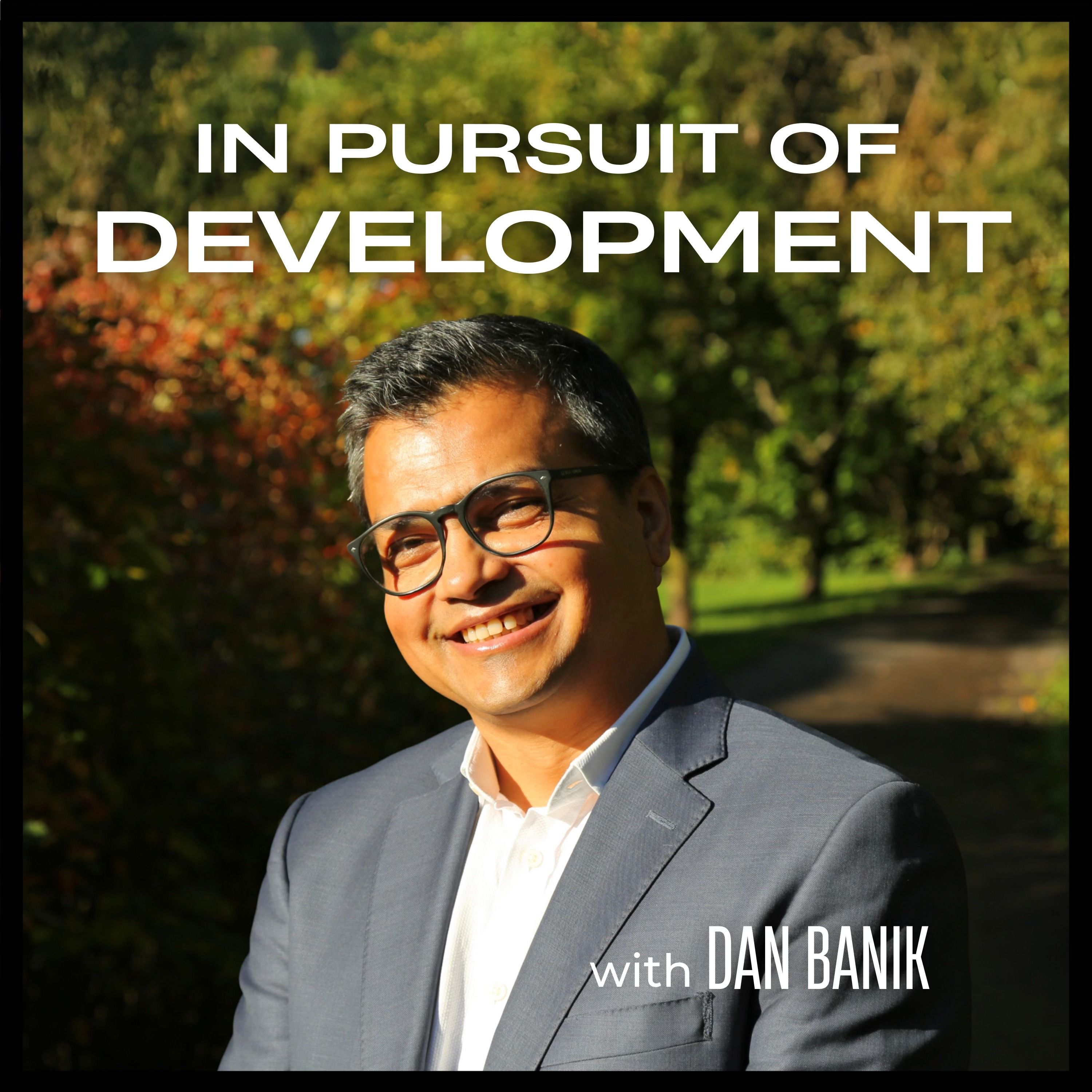
Dan Banik
In Pursuit of Development
Step into conversations that travel across continents and challenge the way you think about progress. From democracy and inequality to climate resilience and healthcare, Dan Banik explores how societies navigate the complex terrain of democracy, poverty, inequality, and sustainability. Through dialogues with scholars, leaders, and innovators, In Pursuit of Development uncovers how ideas travel, why policies succeed or fail, and what it takes to build a more just and resilient world. Expect sharp insights, candid reflections, and a global perspective that connects local struggles to universal a...
Author
Dan Banik
Category
Podcast website
Latest episode
Jun 17, 2026
Where to listen?
Podcasts in the app Replaio Radio Coming soonPodcasts are coming to the app soon. Install now and be the first to see a whole new take on podcasts
 Install for free
Android 5M+ downloads · 4.8 rating
iOS soon
Install for free
Android 5M+ downloads · 4.8 rating
iOS soon
Episodes
Making every dollar count — Ryan Briggs 26.04.2023 53:15
Effective altruism has been in the news of late. Sam Bankman-Fried, the CEO of the FTX cryptocurrency exchange, which collapsed in 2022, was for many years a leading voice for and financial sponsor of the effective altruist movement. He and others have argued for ‘longtermism’: the idea that positively influencing the distant future is a key moral priority of our time. As effective altruism and lo...
Patching development – Rajesh Veeraraghavan 19.04.2023 55:34
Many well-designed development programs do not deliver social benefits effectively, especially to marginalized citizens. While political will and good policy design are vital for a program’s success, they often run into resistance from local power systems. How states react to the local exercise of power that often comes into play at the “last mile” of project implementation appears to be particula...
Is economic growth the magic wand for ending poverty? — Charles Kenny 12.04.2023 54:01
Charles Kenny is a senior fellow at the Center for Global Development in Washington DC. He was previously at the World Bank, where his assignments included coordinating work on governance and anticorruption in infrastructure and natural resources, and managing investment and technical assistance projects covering telecommunications and the Internet. Charles has written several books, two of which...
A more fragmented world — Helen Clark 05.04.2023 46:09
Our guest on this very special (100th) episode is someone I greatly admire and needs very little introduction. Helen Clark has engaged widely in policy development and advocacy across the international, economic, social and cultural spheres. She was Prime Minister of New Zealand for nine years and has also served as the administrator of the United Nations Development Programme. Since 2019, she has...
The European Union and global development — Johanne Døhlie Saltnes 29.03.2023 47:53
The European Union is collectively the biggest provider of international aid in the world, contributing over € 50 billion a year to the fight against poverty and the advancement of global development. However, while the EU’s capacities and impact in foreign and security policy have been extensively discussed among scholars and policymakers, its role in promoting global development has attracted le...
Banking on Beijing — Axel Dreher 22.03.2023 57:44
China plays a crucial role in the development policies of many countries around the world. It offers grants and loans, and builds major infrastructure projects such as roads, bridges, power plants, parliament buildings, hotels, and football stadiums. A new book claims that that much of the conventional wisdom about Chinese development finance rests on untested assumptions, individual case studies,...
Africa’s youth in the race for climate action — Hilda Flavia Nakabuye 18.03.2023 54:29
Fridays For Future is a youth-led movement that began in August 2018. This movement was inspired by 15-year-old Greta Thunberg and other young activists, who sat in front of the Swedish parliament every school day for three weeks, to protest against the lack of action on the climate crisis. While Greta has become a household name, there are many other young activists around the world who are also...
Poverty and the new threat to prosperity — Indermit Gill 15.03.2023 49:49
The onset of the pandemic in 2020 marked a turning point in the 30-year pursuit of successful global poverty reduction. According to recent World Bank estimates , the incomes of the poorest 40 percent of the world’s population likely fell by 4 percent in 2020. And as a result, the number of people living in extreme poverty likely increased by 11 percent in 2020—i.e. it increased from 648 million...
Rethinking "evidence" — Eivind Engebretsen and Mona Baker 11.03.2023 54:53
In the past few decades, we have witnessed the rise and consolidation of “evidence-based medicine” among health professionals. This refers to a systematic approach to medicine in which doctors and other health care professionals use the best available scientific evidence from clinical research to help make decisions about the care of individual patients. But the COVID-19 pandemic has managed to tr...
Locally led development and the future of aid — Håvard Mokleiv Nygård 08.03.2023 1:02:27
The global development domain currently faces huge challenges. Apart from trying to stimulate economic growth and ensuring a fair distribution of the benefits of that growth, national governments and their international partners must also tackle complex conflicts, provide humanitarian assistance, and not least address the harmful impacts of climate disruption. What then should the role of external...
The Wild World of WhatsApp — Jamie Hitchen 01.03.2023 58:12
The role of social media in spreading political misinformation has received considerable attention. But various forms of social media also facilitate and enable participatory democracy across boundaries. They help to hold leaders to account as well as provide channels for airing the needs and demands of marginalised communities and vulnerable groups. These demands can sometimes even be propelled t...
Christmas special – The acronisation game 26.12.2022 8:46
While much of the success of the show is due to my fabulous guests, I am also lucky to have a wonderful team to assist me at the University of Oslo. I wish to in particular thank Kristoffer Ring, our IT guru, and Oda Fagerland, Bella Reid, and Eliska Sottova for research assistance and transcripts. My colleague Desmond McNeill , who was on the show earlier this year discussing the power of ideas a...
Just copy us! Why can’t the rest of the world be more like Scandinavia? — Harald Eia 21.12.2022 51:50
Scandinavian countries are well-known for high standards of living and many people wonder about the origins of the welfare state model in Scandinavia and why it has worked so well. The features of the welfare state in Denmark, Norway, and Sweden typically include high state spending, strong universal public services, and relatively high equality in gender roles. But what explains the success of th...
Contemporary state building and elite taxation in Latin America — Gustavo Flores-Macías 14.12.2022 58:12
While many Latin American states have experienced severe public-safety crises in the context of fiscal duress, elite engagement in state building has taken place in some countries but not in others. Why is that the case? In explaining the adoption of elite taxes for public safety, Gustavo Flores-Macías argues that the conventional crisis-centered explanations are insufficient. Whereas economic eli...
The power of the Chinese state: Examination, Autocracy, Stability, and Technology — Yasheng Huang 07.12.2022 55:05
Ever wondered why the state in China is so powerful? Yasheng argues that Keju — the Imperial civil service examination — has historically maximized a specific type of knowledge in the minds of the population such as memorization. It also reduced the scope of, or eliminated, alternative ideas. Keju made the state all powerful. The state was able to monopolize the very best of human capital. And in...
Show me the money: Why cash transfers matter for development — Ugo Gentilini 30.11.2022 49:37
Cash transfer schemes have grown in popularity in many parts of the world in the past few decades. Numerous studies find that cash transfer programs can be one of the most effective social protection tools at our disposal in the fight against poverty. There is now also growing empirical evidence of how cash transfers can provide quick relief during major economic crises. In addition to economic ef...
Crises of democracy — Adam Przeworski 23.11.2022 52:20
Democracy is valued by many people because it enables us to achieve freedom and political equality in addition to numerous economic and social goals. But democracy also allows us to decide from time to time by whom we wish to be governed. Through elections, we can place in office those who we expect to like and also remove from office those we do not like. Adam Przeworski argues that the essence o...
Silenced voices in global health — Address Malata 16.11.2022 1:06:23
Global health organizations are mainly located in the global North and experts from low- and middle-income countries are underrepresented in global health leadership positions. Thus, it is unsurprising that there has been considerable criticism and heated debate on who should represent the underrepresented. According to our guest this week, it is crucial to ask: Who Speaks for Whom and About What?...
The development bargain — Stefan Dercon 09.11.2022 1:01:21
Development is a gamble because success is not guaranteed when benefits materialize in the long-term and a host of factors may undermine elite positions. Some countries are able to settle on elite bargains that favour growth and development, and others are unable to reach such settlements. While elite bargains in China, Indonesia, Bangladesh, Ethiopia, Rwanda and Ghana ended up being development b...
Transforming our global food system — Gunhild Stordalen 02.11.2022 57:57
Over 2 billion people in our world lack access to adequate food, and over 3 billion people cannot afford a healthy diet. Between 2014 and the onset of the COVID-19 pandemic, the number of people going hungry and suffering from food insecurity had been gradually rising. The pandemic only made things worse. And the Ukraine war has further disrupted global supply chains. In 2021, 702-828 million peop...
Why we fight — Chris Blattman 26.10.2022 58:01
While there are millions of hostile rivalries around the world, only a fraction of these erupt into violence. It is easy to overlook the underlying strategic forces of war and to see war mainly as a series of errors and accidents. It is also easy to forget that war shouldn’t happen—and most of the time it doesn’t. Chris Blattman is a Professor at the University of Chicago in the Harris School of...
Africa's right to development — Mo Ibrahim 19.10.2022 54:24
Mo Ibrahim, a Sudanese-British entrepreneur, founded one of the largest mobile phone companies that operated on the African continent. In 2006, he established the Mo Ibrahim Foundation with the goal of fostering improved governance. The foundation publishes The Ibrahim Index of African Governance , which assesses governance performance in 54 African countries. It also awards the Ibrahim Prize fo...
The pursuit of liberty and prosperity along a narrow corridor — Daron Acemoglu 30.03.2022 52:28
In the bestselling book – Why Nations Fail: The Origins of Power, Prosperity, and Poverty ( 2012), Daron Acemoglu and James Robinson ask why some nations are rich and others poor, divided by wealth and poverty, health and sickness, food and famine. They claim that it is neither culture, weather, nor geography. Rather, they argue that economic success depends on man-made political and economic inst...
Can fixing dinner fix the planet? — Jessica Fanzo 23.03.2022 52:58
A complex web of factors affects our ability not only to meet nutritional needs, but also our efforts to sustain biodiversity and protect the environment. As the world's agricultural, environmental, and nutritional needs intersect—and often collide—how can nations, international organizations and consumers work together to reverse the damage by changing how we make, distribute, and buy food? And d...
The Life You Can Save — Peter Singer 16.03.2022 50:17
Peter Singer — one of the world’s most influential philosophers — is the Ira W. DeCamp Professor of Bioethics at Princeton University . Peter has written several influential books, including Animal Liberation , The Expanding Circle: Ethics and Sociobiology , The Most Good You Can Do, Why Vegan? Eating Ethically and The Life You Can Save: How To Do Your Part To End World Poverty . He is one of t...
Similar podcasts







Listen to the In Pursuit of Development podcast in Replaio
Radio and podcasts in one app - free, with no sign-up. Install today and do not miss the launch
Replaio is not a podcast publisher; show names, artwork and audio belong to their authors and are distributed through public RSS feeds.