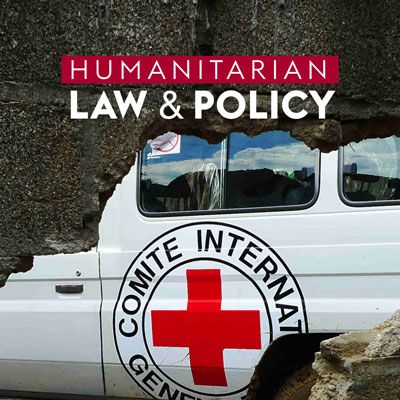
ICRC Law and Policy
ICRC Humanitarian Law and Policy Blog
The International Committee of the Red Cross (ICRC) Humanitarian Law & Policy blog is a unique space for timely analysis and debate on international humanitarian law (IHL) issues and the policies that shape humanitarian action.
Where to listen?
Podcasts in the app Replaio Radio Coming soonPodcasts are coming to the app soon. Install now and be the first to see a whole new take on podcasts
 Install for free
Android 5M+ downloads · 4.8 rating
iOS soon
Install for free
Android 5M+ downloads · 4.8 rating
iOS soon
Episodes
Back to basics: humanitarian principles in contemporary armed conflict 16.06.2022 8:45
As with many conflicts in the past, the Ukraine crisis has revived heated discussions on the humanitarian principles and their relevance in contemporary armed conflict. We have all been reminded how the principles, in particular the principle of neutrality, can lead to misunderstanding and even outrage – and why they nonetheless remain such a valuable compass and operational tool in highly polariz...
Left behind: reparations and assistance for families of missing and disappeared persons 02.06.2022 11:59
As people continue to go missing in all regions of the world, thousands of families are left behind. They do not know whether their loved ones are alive or dead, and go through phases of ambiguous loss during their search. Aggravating this emotional turmoil, family members also often face economic hardship, especially if the missing person was the main breadwinner. Many States have adopted laws wh...
In the hands of belligerents: status and protection under the Geneva Conventions 19.05.2022 13:50
When international armed conflict breaks out and people find themselves in the power of belligerent States, the four Geneva Conventions of 1949 activate with full force. By requiring humane treatment and criminalizing abuse, the Conventions serve as a bulwark against cruelty and reaffirm the notion that, even in war, there are limits. But the focus on these universal prohibitions can obscure anoth...
The Climate and Environment Charter for Humanitarian Organization, one year on 12.05.2022 9:36
“The scientific evidence is unequivocal: climate change is a threat to human well-being and the health of the planet. Any further delay in concerted global action will miss the brief, rapidly closing window to secure a liveable future.” The latest reports of the Intergovernmental Panel on Climate Change present the most urgent and alarming calls to actions we’ve had to date. Its analysis on impact...
Collateral damage from the use of indirect fire in populated areas – can it be avoided? 05.05.2022 13:26
Collateral damage is the unintended damage inflicted on humans, structures, animals and the natural environment that are not the target of the attack. The lack of precision in the delivery of explosive weapons may be the main source of collateral damage affecting the civilian population. In this post, Ove Dullum, Principal Scientist at the Norwegian Defence Research Establishment, describes the so...
How do IHL and Islamic law protect and ensure humanitarian assistance in Afghanistan? 28.04.2022 15:17
Against a backdrop of decades of conflict and crisis, Afghanistan’s regime change in August 2021 once again propelled the need for humanitarian assistance to the forefront. Not only have needs spiked, but various sanctions mean that some vital assistance is no longer administered as needed. Further complicating the situation, the country’s complex ethnographic, cultural and religious landscape lay...
Lifting the cloak of invisibility: civilians with disabilities in armed conflict 21.04.2022 15:30
Even with one in seven people worldwide living with some form of disability, this group has been largely invisible in the implementation of international humanitarian law (IHL) on the conduct of hostilities. Despite increasing recognition and calls for mainstreaming of the multiple and intersectional barriers and risks affecting persons with disabilities in armed conflict, their specific risks hav...
Beyond access: three considerations for food security and famine prevention during armed conflict 14.04.2022 13:46
Over the past year, millions of people living in conflict-affected areas have faced severe and acute food insecurity, and the numbers continue to rise. For many, seasonal food shortages are an intractable reality, but the situation is exacerbated by the increasing intensity and frequency of climate shocks, the long-term economic impacts of COVID-19, as well as the disruptive nature of insecurity a...
Looking for answers: accounting for the separated, missing and dead in international armed conflicts 11.04.2022 16:50
Armed conflicts affecting all regions of the world today continue to result in the separation of families and in people going missing and dying. Such heart wrenching loss also occurs in other situations of violence, in disasters and along migratory routes. In 2021, the ICRC registered more than 29,000 new cases of missing people, bringing the current number of cases we are following in 2022 to 173...
Displacement diplomacy: five ways to improve policy and practice on internal displacement in Africa 24.03.2022 15:53
Although internal displacement is a global problem, it has long been a particular concern for African governments. According to the most recent estimates, conflict and violence have uprooted 21.8 million people from their homes in sub-Saharan Africa, a rising trend driven each year by other factors such as natural hazard-induced disasters, climate risks, and a dearth of durable solutions. In this...
Armed conflict in Ukraine: a recap of basic IHL rules 17.03.2022 16:45
For the past two weeks, the world has watched a humanitarian crisis unfold across Ukraine. Many of our readers have reached out to us directly with questions on how the rules of war – international humanitarian law (IHL) – apply to the conflict. In this post, our Chief Legal Officer Cordula Droege outlines the key rules of IHL governing the conflict and emphasizes the ICRC’s call for all parties t...
Consumer drones in conflict: where do they fit into IHL? 15.03.2022 19:49
The skies over the conflict in Ukraine are filled with identical-looking consumer drones piloted by combatants and civilians alike – aircraft that promise to be a regular feature of war in the future. Few methods exist for telling small drones apart in airspace: combatants, unable to distinguish between drones that are a threat and those that aren’t, may direct attacks at civilian drone pilots. In...
In Bruges: the enduring relevance of IHL and the updated Commentaries 23.02.2022 9:03
Since its creation in 2000, the Bruges Colloquium on International Humanitarian Law has been jointly organized by the ICRC and the College of Europe, bringing together government representatives, international organizations, military practitioners, academics and civil society to grapple with the most urgent issues relating to the law of armed conflict. Its 22nd edition, held in October 2021, exami...
Revisiting the history of the Geneva Conventions 17.02.2022 10:41
With armed conflicts persisting in various parts of the globe and at risk of breaking out in others, it is crucial to take a step back. In this post, Boyd van Dijk, a McKenzie Fellow at the University of Melbourne, revisits the making of the Geneva Conventions and demonstrates why this history still matters today.
A new Solferino moment for humanitarians 10.02.2022 14:06
This year marks the 160th anniversary of the publication of Henri Dunant’s classic text, ‘A Memory of Solferino’, in 1862. Dunant’s powerful book inspired the founding of the International Red Cross and Red Crescent Movement and the First Geneva Convention of 1864. In this post, Hugo Slim, Senior Research Fellow at the University of Oxford, reflects on changes in warfare and humanitarian aid since...
Carve-out in Kabul: hard won resolution lifts humanitarian roadblock in Afghanistan 03.02.2022 10:08
On 22 December 2021, the United Nations Security Council voted unanimously to adopt a resolution on Afghanistan introducing, for the only the second time in 30 UN sanction regimes, an explicit humanitarian carve-out. For those providing humanitarian assistance and supporting basic human needs in Afghanistan, donors, and private partners, the exemption gives much-needed assurance that they can cont...
Explosive weapons with wide area effects: a deadly choice in populated areas 25.01.2022 16:43
The use of explosive weapons with a wide impact area in populated areas is one of the main causes of civilian harm in today’s armed conflicts. Despite their widespread and reverberating effects, they are the weapons predominantly in use in urban warfare today. In this post, part of our urban warfare series and marking the launch of a new ICRC report, ICRC Legal Adviser Eirini Giorgou unpacks the d...
Shifting the narrative: not weapons, but technologies of warfare 20.01.2022 15:45
Debates concerning the regulation of choices made by States in conducting hostilities are often limited to the use of weapons . . . but our understanding of weapons is outdated. New technologies – especially those with embedded artificial intelligence (AI) algorithms, even if non-weaponized – are significantly transforming contemporary warfare. The indirect influence of these technologies on warfa...
Four pathways of climate insecurity: a guide for humanitarians 13.01.2022 11:18
If the 2021 IPCC report is a code red for humanity, then humanitarian organizations are the first responders. Humanitarian organizations do not just deal with climate-related disasters, they also often work in regions where the combined impacts of climate change and conflict increase the challenges of both emergency relief and longer-term development. In this post, Kheira Tarif, Research Assistant...
Mine action in action: influencing law and policy on toxic remnants of war 21.12.2021 16:58
In conjunction with the movement to prevent the environmental impacts of armed conflict has come a growing recognition of the need to address the harm that has already occurred. Mine action, which aims to reduce the effects of landmines and explosive remnants of war (ERW), provides a valuable model for assisting victims of and remediating the environment contaminated by toxic remnants of war (TRW)...
Mitigating the environmental impacts of explosive ordnance and land release 16.12.2021 14:37
Environmental considerations are rightly gaining increased prominence and awareness. Environmental experts agree that unprecedented changes in climate and biodiversity are taking place, threatening nature and human livelihoods around the world. The humanitarian community increasingly understands the need to identify and assess how their operations affect the natural environment and to mitigate the...
Reporting sexual violence in a conflict zone 09.12.2021 8:00
Sexual violence is widespread and prevalent in many modern armed conflicts. Interviewing the people who have endured sexual violence is one of the most challenging tasks for any journalist. In this post to mark the 30th campaign of the 16 Days of Action, Drew Ambrose – one of Al Jazeera English’s most experienced and awarded foreign correspondents – describes his experience and technique for repor...
Sexual violence in armed conflict: the historical limits of humanitarian action & ICRC in the 20thC 02.12.2021 14:26
Despite clear legal prohibitions, sexual violence remains widespread and prevalent during armed conflicts and other situations of violence, with grave humanitarian consequences. Sexual violence is often utilized as a tactical or strategic means of overwhelming and weakening the adversary, whether directly or indirectly, by targeting the civilian population. In this post to mark the 30th campaign o...
Gender-based hate crime as an early warning indicator of escalating violence and armed conflict 30.11.2021 12:45
The spectrum of misogynistic violence between incels (‘involuntary celibates’) and non-State armed groups using extreme violence against women is based around the desire to restore ‘traditional’ gender norms of male dominance and maintain systemic inequality between men and women. This often manifests in gender-based hate crimes before escalating into community violence and armed conflict. In this...
Walking the talk on SGBV: an implementation checklist to narrow the gaps 25.11.2021 13:09
Thirty years ago today, 23 women launched the ‘16 Days of Action’ against gender-based violence.[1] Each year, this campaign begins on the 25th of November (International Day for the Elimination of Violence against Women) and ends on the 10th of December (Human Rights Day) to symbolically link these two days. In the three decades since, much has been achieved – we now have many international commi...
Similar podcasts





Listen to the ICRC Humanitarian Law and Policy Blog podcast in Replaio
Radio and podcasts in one app - free, with no sign-up. Install today and do not miss the launch
Replaio is not a podcast publisher; show names, artwork and audio belong to their authors and are distributed through public RSS feeds.