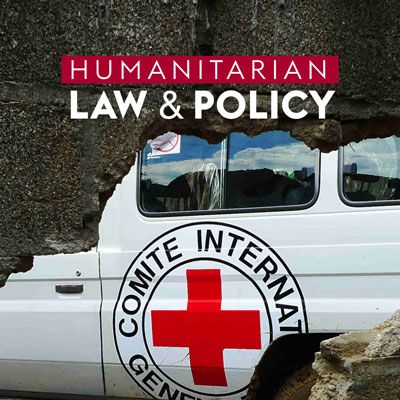
ICRC Law and Policy
ICRC Humanitarian Law and Policy Blog
The International Committee of the Red Cross (ICRC) Humanitarian Law & Policy blog is a unique space for timely analysis and debate on international humanitarian law (IHL) issues and the policies that shape humanitarian action.
Where to listen?
Podcasts in the app Replaio Radio Coming soonPodcasts are coming to the app soon. Install now and be the first to see a whole new take on podcasts
 Install for free
Android 5M+ downloads · 4.8 rating
iOS soon
Install for free
Android 5M+ downloads · 4.8 rating
iOS soon
Episodes
Canada’s first voluntary IHL report: a step forward with opportunities for improvement 30.01.2025 17:16
Canada recently published its first voluntary report on the implementation of international humanitarian law (IHL), highlighting its efforts to comply with IHL rules. However, the report overlooks key challenges and critical issues, leaving gaps that future reports should address. In this post, Professor Tiwa Fomekong examines the achievements described in Canada’s report alongside its omissions,...
‘Hybrid threats’, ‘grey zones’, ‘competition’, and ‘proxies’: When is it actually war? 16.01.2025 13:05
In an era of rising geopolitical tensions, terms like ‘hybrid threats,’ ‘grey zones,’ and ‘proxy warfare’ are frequently used to describe covert and ambiguous operations, suggesting they blur the lines between peace and armed conflict. From cyberattacks on civilian infrastructure to the damaging of undersea cables, these acts are often labeled as ‘hybrid warfare,’ raising questions about their leg...
War in cities: a solemn appeal from the International Red Cross and Red Crescent Movement 07.01.2025 8:55
Around the world, civilians in cities at war face immense risks. Urban warfare devastates lives and livelihoods, as people are killed and injured, critical infrastructure such as hospitals and water systems are damaged or destroyed, and entire communities are forced to flee. Disruptions to essential services amplifies the suffering of civilians and poses significant humanitarian challenges. As urb...
If you teach it, they’ll enroll: IHL education in Canadian law schools 17.12.2024 14:08
Members of armed forces receive international humanitarian law (IHL) training as a matter of course, but they are not the only actors who must apply this body of law; lawyers within governments, international organizations, and NGOs all have roles in this regard. Did they have the opportunity to study IHL? And contemporary armed conflicts have made IHL compliance an issue on university campuses ar...
The (im)possibility of responsible military AI governance 12.12.2024 15:20
During 2024, efforts to address the governance of military artificial intelligence (AI) have gained momentum. Yet in the same year, we have also witnessed the growing use of AI decision support systems during armed conflict, and it is becoming clearer that such systems may pose a significant challenge to peace and stability. These developments raise questions about the current approach toward mili...
Beyond prevalence: new approaches to measuring sexual- and gender-based violence prevention in conflict settings 05.12.2024 16:18
When discussing the measurement of sexual- and gender-based violence (SGBV) prevention in humanitarian settings, reactions often polarize around two main arguments: that measurement is impossible (“How can we measure what hasn’t happened?”), or that prevalence alone signals success (“Do you have data showing decreased perpetration?”). Both perspectives overlook the complexity of SGBV prevention –...
Trying to square the circle: the ICRC AI Policy 28.11.2024 20:47
The development of artificial intelligence (AI) technologies brings significant opportunities, and risks, for principled humanitarian action. While AI innovations advance at a pace that seemingly defies human capabilities to manage them responsibly, humanitarian organizations are chasing ‘AI for Good’, and struggling to find effective safeguards. In this post, ICRC Senior Policy Adviser Pierrick D...
What private businesses need to know about international humanitarian law 26.11.2024 15:46
Private businesses that operate in situations of armed conflict, do business with a government or other entity involved in an armed conflict, or may do so in the future, should be aware of relevant rules of international humanitarian law (IHL). In this post, the International Committee of the Red Cross (ICRC), Australian Red Cross Society and French Red Cross Society describe a new publication tha...
Climate action in conflict and fragile settings: closing the implementation gap 12.11.2024 17:12
Communities in conflict-affected areas are direly impacted by growing climate risks and shocks. Over the last few years, political will to strengthen climate action in these settings has been growing. Commitments need to be urgently translated into tangible outcomes for communities – and avenues to do so exist. In this post, and on the eve of COP29, Catherine-Lune Grayson and Amir Khouzam reflect...
Dehumanizing detention: degrading our collective humanity 07.11.2024 8:12
Language matters and the protections of international law are crucial when facing global trends of dehumanization. Dehumanizing narratives strip people of their dignity, making it easier to justify inhumane treatment, torture, and exclusion from legal protections. In this post, Terry Hackett, Head of Division on Persons Deprived of Liberty at the ICRC, emphasizes the urgent need to reject dehumani...
ICRC engagement with armed groups in 2024 31.10.2024 18:11
In line with its mandate, the ICRC engages with all parties to an armed conflict, including non-state armed groups. The ICRC has a long history of confidential humanitarian engagement with armed groups to alleviate and prevent the suffering of persons living in areas controlled by these groups. However, this engagement has become increasingly complex. Accordingly, the ICRC undertakes an annual int...
Applying IHL with a gender perspective in the planning and conduct of military operations 24.10.2024 21:42
Gender can still be a confusing and contested subject for international humanitarian law (IHL) and military practitioners. But just as practitioners keep abreast of astonishing technological advancement, and states continue to dedicate significant – and, in numerous contexts, increasing – national spending on defence and security, it is high time that the equal protection of civilians is invested...
The Geneva Conventions at 75: the role of the Int'l Conference in securing protection for civilians 22.10.2024 20:38
The 34th International Conference of the Red Cross and Red Crescent will take place 28-31 October 2024 in Geneva, Switzerland. At this meeting, states party to the 1949 Geneva Conventions and the components of the International Red Cross and Red Crescent Movement will meet to discuss humanitarian issues under this International Conference’s theme “Navigate uncertainty, strengthen humanity”. In the...
IHL and the challenge of maintaining food security in armed conflict 17.10.2024 15:00
Food insecurity remains a critical issue in modern armed conflicts, exacerbated by the mutually reinforcing effects of conflict, economic shocks, and climate change. In response, the ICRC's 2024 Challenges Report emphasizes how compliance with a broad range of rules of international humanitarian law (IHL) can help avoid acute food crises, and highlights a number of contemporary obstacles to achiev...
Internment by non-state armed groups: legal and practical limits 15.10.2024 10:44
Detention by non-state armed groups is a widespread, diverse, and legally complex occurrence in armed conflicts across the globe. In 2023, the ICRC assessed that around 70 non-state armed groups in non-international armed conflicts have detainees. The circumstances of detention can pose serious humanitarian concerns, including ill-treatment and inadequate living conditions for detainees. In this p...
Protecting essential service personnel is a vital part of humanitarian action 10.10.2024 12:58
Water and wastewater pipelines, electricity lines and telecommunication installations permeate contemporary urban landscapes and form complex, interdependent service networks, which populations rely on for their essential needs. Armed conflict can damage or disrupt these networks and the essential services they provide. In recent years, increasing attention has been paid to protecting critical civ...
Championing IHL compliance in contemporary armed conflict: the 2024 ICRC Challenges Report 09.10.2024 12:45
Since 2003, the ICRC has submitted a report on ‘International Humanitarian Law and the Challenges of Contemporary Armed Conflict’ to the International Conference of the Red Cross and Red Crescent, where the High Contracting Parties to the Geneva Conventions come together with the International Red Cross and Red Crescent Movement to discuss key matters of humanitarian concern and to make joint comm...
Will AI fundamentally alter how wars are initiated, fought and concluded? 26.09.2024 13:48
In the debate on how artificial intelligence (AI) will impact military strategy and decision-making, a key question is who makes better decisions — humans or machines? Advocates for a better leveraging of artificial intelligence point to heuristics and human error, arguing that new technologies can reduce civilian suffering through more precise targeting and greater legal compliance. The counter a...
Transcending weapon systems: the ethical challenges of AI in military decision support systems 24.09.2024 16:52
The military decision-making process is facing a challenge by the increasing number of interconnected sensors capturing information on the battlefield. The abundance of information offers advantages for operational planning – if it can be processed and acted upon rapidly. This is where AI-assisted decision-support systems (DSS) enter the picture. They are meant to empower military commanders to ma...
Procedures for internment review under the Fourth Geneva Convention: reflections from New Zealand 19.09.2024 17:41
The Fourth Geneva Convention was the first humanitarian law convention dedicated to protections for civilians during armed conflict. Amongst its numerous protective rules, it also provides the main rules of international humanitarian law (IHL) governing the exceptional practice of internment of protected persons – detention of such persons for security reasons during international armed conflict....
Conceive, standardize, integrate: distinctive emblems and signs under IHL 12.09.2024 12:44
When the very first Geneva Convention was adopted in 1864, it was the culmination of several interwoven humanitarian projects of the ICRC’s principal founder, Henry Dunant. One of those ambitions was the conception, standardization, and integration into what would become known as international humanitarian law (IHL) of the distinctive emblem of the Convention. Designed to signal the specific prote...
Why is the ICRC concerned by ‘harmful information’ in war? 10.09.2024 13:12
During armed conflict and other situations of violence, timely access to reliable information can save lives. Affected people need to know where danger and risks come from, how and where they can find assistance, and how to protect themselves and access needed services. At the same time, the information dimensions of conflict have become part of the digital frontlines, where harmful information ca...
The risks and inefficacies of AI systems in military targeting support 04.09.2024 16:59
Over the past decade, discussions surrounding artificial intelligence (AI) in the military domain have largely focused on autonomous weapon systems. This is partially due to the ongoing debates of the Group of Governmental Experts on Lethal Autonomous Weapons Systems of the Convention on Certain Conventional Weapons. While autonomous weapon systems are indeed a pressing concern, the critical reali...
The problem of algorithmic bias in AI-based military decision support systems 03.09.2024 18:13
Algorithmic bias has long been recognized as a key problem affecting decision-making processes that integrate artificial intelligence (AI) technologies. The increased use of AI in making military decisions relevant to the use of force has sustained such questions about biases in these technologies and in how human users programme with and rely on data based on hierarchized socio-cultural norms, kn...
Artificial intelligence in military decision-making: supporting humans, not replacing them 29.08.2024 18:09
The desire to develop technological solutions to help militaries in their decision-making processes is not new. However, more recently, we have witnessed militaries incorporating increasingly complex forms of artificial intelligence-based decision support systems (AI DSS) in their decision-making process, including decisions on the use of force. The novelty of this development is that the process...
Similar podcasts






Listen to the ICRC Humanitarian Law and Policy Blog podcast in Replaio
Radio and podcasts in one app - free, with no sign-up. Install today and do not miss the launch
Replaio is not a podcast publisher; show names, artwork and audio belong to their authors and are distributed through public RSS feeds.