Dirk Hoffmann-Becking
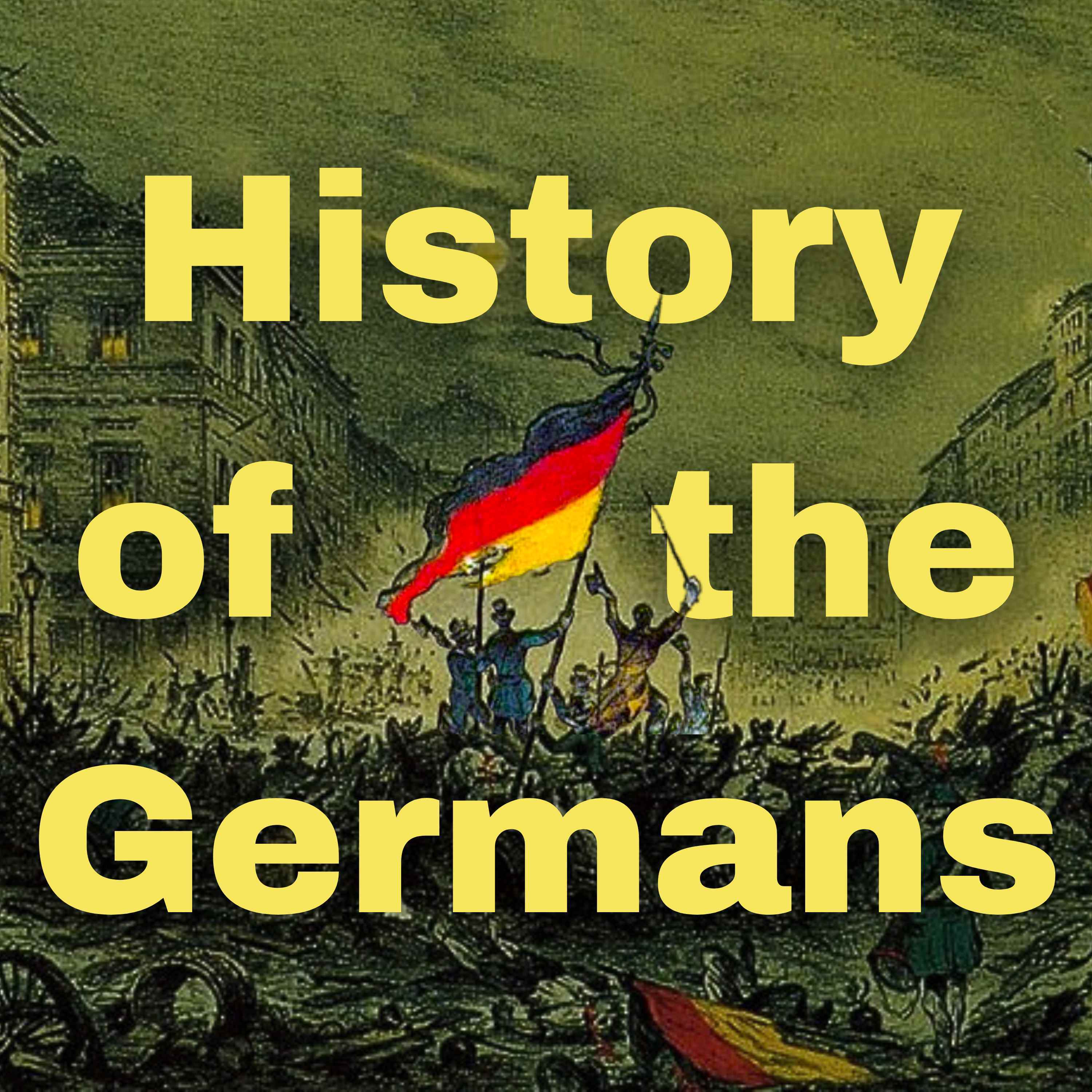
History of the Germans from the Middle Ages to Reunification
A narrative history of the German people from the Middle Ages to Reunification in 1991. Episodes are 25-35 min long and drop on Thursday mornings."A great many things keep happening, some good, some bad". Gregory of Tours (539-594)So far we have covered:Ottonian Emperors (# 1- 21)- Henry the Fowler (#1)- Otto I (#2-8)- Otto II (#9-11)- Otto II (#11-14)- Henry II (#15-17)- Germany in 1000 (#18-21)Salian Emperors(#22-42)- Konrad II (#22- 25)- Henry III (#26-29)- Henry IV/Canossa (#30-39)- Henry V (#40-42)- Concordat of Worms (#42)Early Hohenstaufen (#43-69)- Lothar III (#43-46)- Konrad III (#47-...
Author
Dirk Hoffmann-Becking
Category
Podcast website
Latest episode
May 21, 2026
Where to listen?
Podcasts in the app Replaio Radio Coming soonPodcasts are coming to the app soon. Install now and be the first to see a whole new take on podcasts
 Install for free
Android 5M+ downloads · 4.8 rating
iOS soon
Install for free
Android 5M+ downloads · 4.8 rating
iOS soon
Episodes
Ep. 120: The Hanseatic League (1143-1669) - Economics - Money, Money, Money 14.09.2023 34:43
This was supposed to be an episode where we talk about the challenges the Hanse was facing after the victory over the Danes and the Peace of Stralsund. But that is not to be. Listeners Mehmet and Nina pointed out a few gaps in what I had been talking about last week and now these need to be filled. It is all good talking about the trading network and the flow of goods across the Baltic and norther...
Ep. 119: The Hanseatic League - 14th century Politics -What is the Hanse? 07.09.2023 29:54
That was the question king Edward IV asked the representatives of the Steelyard in 1469. And he had a good reason to ask, because tensions between the English and the Hansa had escalated, ships were captured, and people got killed. He wanted to know who to negotiate with and in particular, who could sign a binding agreement that would put an end to this. The answer he got was not very satisfactory...
Ep. 118: The Hanseatic League - 14th century Politics -Pirates 31.08.2023 44:57
In 1878 workmen building the Speicherstadt, the magnificent city of warehouses in the harbour of Hamburg made a gruesome discovery. In the mud of the Grasbrook, an island at the entrance of the medieval harbour of Hamburg emerged two piles of wood connected by a wooden bar. An ancient beacon guiding ships. What made it so special was what was nailed on to the bar, human skulls. Whoever these men w...
Ep. 117: The Hanseatic League - 14th Century Politics -Embargoes 24.08.2023 35:23
The Hanseatic League undergoes a fundamental transformation in the second half of the 14th century. It turned from a guild of merchants trading across the Baltic and the North Sea into an alliance of trading cities. An alliance that has proven that it can fight and win wars against major territorial powers. That sits quite uncomfortably with the existing European rulers who wonder what to do with...
Ep. 116: The Hanseatic League - 14th century Politics -The War with Denmark Part II 17.08.2023 33:52
The Hanseatic League is first and foremost an organisation driven by commerce and commerce rarely sees the necessity of war. But in 1360 the organisation that had only just transitioned from a community of merchants to an alliance of cities found itself in gridlock with Waldemar Atterdag, Waldemar Dawn, king of Denmark. Waldemar’s objective throughout his 35-year reign was to rebuild the kingdom o...
Ep. 115: The Hanseatic League - 14th century Politics - The War with Denmark Part I 10.08.2023 36:36
By the end of the 13th century the key foundations of the Hanseatic League are laid. The trade routes that connect the Baltic to Western Europe are largely under the control of merchants who had come from Northern Germany and settled along the Baltic shore. Four great Kontors in Novgorord, Bergen, Bruges and London have been set up. The cities that make up the League, from Tallin to Cologne have g...
Ep. 114: The Hanseatic League (1143-1669) - The Economics - The London Steelyard 27.07.2023 20:48
If like many of you, you are listening to this podcast on your morning or evening commute and you happen to live in London, you may be one of the 20 million souls going through Cannon Street Station every year. Few of them will be aware that under their feet lay the vestiges of the great Hanseatic Kontor in London that goes back to 1176. If people know about the Steelyard, it is mainly through the...
Ep. 113: The Hanseatic League (1143-1669) - The Economics - Bergen and Bruges 20.07.2023 33:53
Today we will talk about the Bryggen, the famous Hanseatic Kontor or trading post in Bergen in western Norway. Bergen itself was never a member of the Hanseatic League, but like The St. Peter’s yard in Novgorod, the steelyard in London and the Kontor of Bruges, the Bryggen in Bergen was a key element of the Hanseatic trading network. The trade in stockfish from Bergen was never on the same scale a...
Ep. 112: The Hanseatic League (1143-1669) - The Economics - Grain and Beer 13.07.2023 39:19
This week we will kick off with the string of cities along the Baltic Coast from Lübeck up to Königsberg (modern day Kaliningrad). Who founded them and why? And why so many? Who were the people who came to live there, how did they organise themselves and most importantly, what did they produce and what did they trade? We will dwell on the most splendid of those, Gdansk or Danzig in German, the one...
Ep. 111: The Hanseatic League (1143-1669) - The Economics - The Copper Mines and Fisheries 06.07.2023 29:51
“on its eastern side the sea breaks through and cuts off the western side of Skaane; and this sea commonly yields each year an abundant haul to the nets of the fishers. Indeed, the whole sound is apt to be so thronged with fish that any craft which strikes on them is with difficulty got off by hard rowing, and the prize is captured no longer by tackle, but by simple use of the hands .” So writes t...
Ep. 110: The Hanseatic League (1143-1669) - The Economics - Riga, Tallinn, Dorpat, Narva 29.06.2023 28:45
“In the monastery of Segeberg there was a man of worthy life, and with venerable gray hair, Meinhard by name, a priest of the Order of Saint Augustine. He came to Livonia with a band of merchants simply for the sake of Christ and only to preach. For German merchants, bound together through familiarity with the Livonians, were accustomed to go to Livonia, frequently sailing up the Daugava River.” S...
Ep. 109: The Hanseatic League (12th century) - The Economics - Gotlandfahrer 22.06.2023 38:14
If I put the word Hanseatic into Google Search I get as result number 4 “Hanseatic King’s Lynn -Visit West Norfolk”. I can say with absolute confidence that there is not a single German individual, place or organisation that a small town in England would choose to not just associate with but incorporate itself into its history, safe for the Hanseatic League. They may play Zedoch the Priest at the...
Ep. 108: Colonisation of the East(700-1200) - From Saxony to Saxonies 08.06.2023 33:25
These last few episodes you may have wondered how all this hangs together. This week we will try to resolve this question. What we will talk about is how the great stem duchy of Saxony fell apart. And there are two stories about that. One is the story of Henry the Lion and his fall in 1180. That story has been repeated over and over again and put into a context of rivalry between the Welf and the...
Ep. 107: Colonisation of the East(700-1200) - The House of Wettin 01.06.2023 34:57
If you ever come to Dresden, and if you like art, architecture and history, you very much should, you may want to turn into Augustusstrasse right by the Residenzschloss. What you fnd there is the largest porcelain artwork in the world, 102 metres long and made from 23,000 Meissen porcelain tiles. This is the “Fürstenzug”, the procession of princes. It was made to celebrate 800 years of the House o...
Ep. 106: Colonisation of the East(700-1200) - How to make a Mark in Brandenburg 25.05.2023 29:43
This week we continue our walkabout of the major centres of power in the North of Germany that emerged during the 12th and 13th century. We talked about Holstein and Lübeck and now it is time to talk about the march of Brandenburg which means we need to talk about a character that had bit part roles on the podcast for quite some time, Albrecht the Bear. He was one of the longest lasting protagonis...
Ep. 105: Colonisation of the East(700-1200) - The Foundation of Lübeck 18.05.2023 33:07
This week we will look at one of the great mysteries of German medieval history, how Lübeck could become the second largest City in the Holy Roman empire within just 100 years from its foundation. Lübeck lies on a small river, the Trave that goes into a small Sea, the Baltic. Not only is the Baltic comparatively small, the peoples who live on its shores are no slouches. They have been famed for tr...
Ep. 104: Colonisation of the East(700-1200) - The Making of Holstein 11.05.2023 31:43
In today’s episode we finally get closer to the history of the Hanseatic League. We will take a look at some of the fundamental changes in the Saxon policy towards the east that were ushered in during the reign of Lothar of Supplinburg and shaped events for a long period thereafter. It is in these decades that the Saxon magnates will realise that raiding and plundering of the lands east of the Elb...
Ep. 103: Colonisation of the East(700-1200) - Lothar III gets things going for real 04.05.2023 38:10
This week we talk about what happens after the fight for independence is won. As had happened countless times before in history, precious freedoms gained in bloody struggles can be lost easily in the subsequent peace, not to the old adversary, but to new, homegrown usurpers. That is at least one way of telling the story, the other being, that every major political upheaval is followed by a period...
Ep. 102: Colonisation of the East(700-1200) - Investiture Controversy and its impact on the East 20.04.2023 29:25
This week we will hit the arguably most important set of events in medieval German history often summarised under the banner of the Investiture Controversy. The Investment Controversy came about through a confluence of three major strains, the rise in piety in the wake of improving economic conditions, the establishment of the papacy as a power separate and superior to temporal rulers and thirdly,...
Ep. 101: Colonisation of the East(700-1200) - Mecklenburg - Gottschalk and Adalbert 13.04.2023 28:29
This week we will follow the history of two men who could not be more different. On one side is Gottschalk, leader of the pagan Abodrites, who first comes to prominence as a brutal raider killing Saxons all across Holstein in revenge for his father’s killing. The other is Adalbert, son of a count, brother of the count palatinate of Saxony, friend and confidant of Henry III, a man who refused the o...
Ep. 100: Colonisation of the East(700-1200)- The (second) Saxon War 06.04.2023 23:09
As we go through the story of the Saxon Stem duchy in the 10th and 11th century, two or maybe three main strains of the story emerge, the gradually drifting away of Saxony from the empire, the relationship between Saxons and Wends and the antagonism between the archbishop of Hamburg and the magnates. As for the first part of the storyline, the conflict between Saxons and the empire we are now hitt...
Ep. 99: Colonisation of the East(700-1200) - Follow the Money 30.03.2023 30:03
This week we stumble into the next imperial succession where the Saxons are again standing on the side lines. On paper the new guy, Konrad II was a man after their own heart, fearsome warrior untroubled by bookish learning, but he was also a sponsor of the church. His son, Henry III was even more so, and there are many reasons why the Saxon magnates did not like the ecclesiastical princes. And it...
Ep. 98: Colonisation of the East(700-1200) - The Rift between Emperor and Saxon Princes 23.03.2023 27:38
This week we are talking about the rift that is opening up between the Saxons and the Empire. For 80 years Saxony had been the centre of imperial power and the Ottonians had been supportive of the Saxon nobles’ policy vis-à-vis the Wends and Poland. All that Is about to change. The new emperor Henry II, though a direct descendant of Henry the Fowler, was no Saxon. For three generations his family...
Ep. 97: Colonisation of the East(700-1200) - Rebellion! 16.03.2023 30:11
Now that we know the lay of the land it is time for action, and quite some action it will be. The Wends, the pagan Slavic peoples living east of the Elbe who found themselves ever more squeezed by their now Christian neighbours wake up one morning to find their oppressors fatally weakened. Events 2000 km south of Brandenburg create the once in a century opportunity to throw off the yoke of the Sax...
Ep. 96: Colonisation of the East(700-1200) - The Neighbours - Poland, Bohemia and Denmark 09.03.2023 33:42
This week we are still getting our bearings. Last week we saw the emergence of the Stem duchy of Saxony and the Eastern marches. This week we take a look at the most important neighbours to the East and North, the Bohemians, the Poles and the Danes. It is right around this time, the middle of the 10th century that these coalesce into political entities. As always none of this happens smoothly, so...
Similar podcasts








Listen to the History of the Germans from the Middle Ages to Reunification podcast in Replaio
Radio and podcasts in one app - free, with no sign-up. Install today and do not miss the launch
Replaio is not a podcast publisher; show names, artwork and audio belong to their authors and are distributed through public RSS feeds.