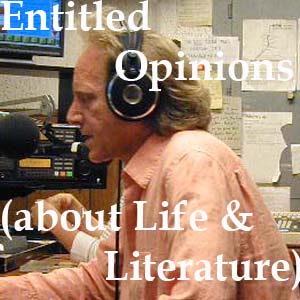
Robert Harrison
Entitled Opinions (about Life and Literature)
The narcotic of intelligent conversation
Author
Robert Harrison
Category
Podcast website
Latest episode
May 4, 2026
Where to listen?
Podcasts in the app Replaio Radio Coming soonPodcasts are coming to the app soon. Install now and be the first to see a whole new take on podcasts
 Install for free
Android 5M+ downloads · 4.8 rating
iOS soon
Install for free
Android 5M+ downloads · 4.8 rating
iOS soon
Episodes
Hans Sluga on Michel Foucault 18.04.2012
Autobiographical notes from Professor Sluga's departmental website: I was born and grew up in Germany and though I have lived since then in the English-speaking world I remain considerably influenced by German culture and thought. Through an early education in the classical languages I became interested in philosophy (both ancient Greek and German). I initially pursued that interest at the Univers...
Ursula Heise on Extinction 11.04.2012
Ursula Heise received Master's degrees from UC-Santa Barbara and the University of Cologne in Germany before receiving her PhD from Stanford University in 1993. She specializes in contemporary American and European literature and literary theory; her major fields of interest are theories of modernization, postmodernization and globalization, ecology and ecocriticism, literature and science, narrat...
Stephen Hinton on Nietzsche and Wagner 30.11.2011
STEPHEN HINTON is Avalon Foundation Professor in the Humanities at Stanford University. Professor of Music and, by courtesy, German, he also serves as the Denning Family Director of the Arts Initiative and the Stanford Institute for Creative and the Arts (SiCa). From 2006-2010 he was Senior Associate Dean for Humanities & Arts in the School of Humanities and Sciences, and from 1997-2004 chairman o...
Dr. Larry Zaroff on Medicine and the Humanity 23.11.2011
Larry Zaroff is a Senior Research Scholar with the Center for Biomedical Ethics and also a Consulting Professor in the Department of Anesthesiology and the Program in Human Biology. Recently, he was selected to receive the Human Biology Award for Excellence in Faculty Advising. He has also been chosen as Associated Students of Stanford University (ASSU) Teacher of the Year. He teaches courses in...
Richard Martin on Homeric Epics 16.11.2011
Richard Martin is Antony and Isabelle Raubitschek Professor of Classics at Stanford University. He received his PhD from Harvard University in 1981 and has also taught at Harvard, Princeton, and Berkeley. Among his publications are the books "Healing, Sacrifice, and Battle: Amechania and Related Concepts in Early Greek Poetry" (1983), "The Language of Heroes: Speech and Performance in the Iliad"...
Georges Lavaudant on a Life in Theater 16.11.2011
Georges Lavaudant is one of the most renowned theater directors in France today. Over the course of his career, he has directed the Théâtre national populaire at Villeurbanne and the Théâtre de l'Odéon-Théâtre de l'Europe, among others. He has directed and acted in countless plays and operas over the years. Some of his productions include Lorenzaccio (1973), King Lear (1975), Mr. Puntila and his M...
Martin Lewis on Geography 09.11.2011
Martin W. Lewis is lecturer in international history and interim director of the program in International Relations at Stanford University. He graduated from UC Santa Cruz with a degree in Environmental Studies in 1979, and received a Ph. D. from UC Berkeley in geography in 1987. His dissertation, and first book, "Wagering the Land: Ritual, Capital, and Environmental Degradation in the Cordillera...
Denise Gigante on John Keats 02.11.2011
Denise Gigante is a professor in the English Department at Stanford University and teaches eighteenth and nineteenth-century British literature with a focus on Romanticism. Her books include "The Keats Brothers: The Life of John and George" (Harvard UP, 2011), "Life: Organic Form and Romanticism" (Yale UP, 2009), "The Great Age of the English Essay: An Anthology" (Yale UP, 2008), "Taste: A Litera...
Richard Saller on the Ancient Rome 25.10.2011 1:02:48
Richard Saller is the Vernon R. and Lysbeth Warren Anderson Dean of the School of Humanities & Sciences at Stanford University. He is also the Kleinheinz Family Professor of European Studies as well as Professor of Classics and History. Dean Saller received Bachelor’s degrees in both History and Greek at the University of Illinois in […]
Adrian Daub on Hegel 19.10.2011
Adrian Daub is Assistant Professor of German at Stanford University. He received his B.A. from Swarthmore College in 2003 and his Ph. D. in Comparative Literature from the University of Pennsylvania in 2008. He is the author, among other things, of a German-language study on the cultural reception of four-handed piano playing, "Zwillingshafte Gebärden - Zur kulturellen Wahrnehmung des vierhändige...
Patrick Hunt on the Rosetta Stone 12.10.2011
Patrick Hunt earned a Ph. D. from the Institute of Archaeology, UCL, University of London in 1991. He has been teaching humanities, the arts, archaeology and mythology at Stanford University since 1993. His Hannibal Expedition was sponsored in 2007-2008 by the National Geographic Society’s Expedition Council. He is Director of the Stanford Alpine Archaeology Project 1994-2011. Hunt’s 12 published...
Thomas Sheehan on Phenomenology 05.10.2011
Thomas Sheehan is Professor of Religious Studies at Stanford and specializes in contemporary European philosophy and its relation to religious questions, with particular interests in Heidegger and Roman Catholicism. Before coming to Stanford he taught at Loyola University of Chicago since 1972. He received his B.A. from St. Patrick's College and his Ph. D. from Fordham University. He has been the...
Sonia Korn-Grimani on her memoir of the Holocaust 25.04.2011
In this conversation Christy Wampole talks to Sonia Korn-Grimani about her memoir recounting her experiences during her escape from Nazi-Germany and during the German occupation of Belgium. Sonia was born in 1931 and has lived all over the world, she has a PhD in French literature and is an accomplished singer. The episode includes some of her recordings.
Stuart Edelstein on the Human Brain 05.04.2011
Stuart J. Edelstein received a Ph. D. in Biochemistry from the University of California (Berkeley) in 1967. Following a post-doctoral year at the Pasteur Institute in the laboratory of Jacques Monod, he joined the faculty of Cornell University in the Section of Biochemistry, Molecular and Cell Biology, where he became Professor in 1977 and served as Chairman from 1978 to 1980. He was a Visiting Sc...
Jay Kadis on Psychedelic Rock 29.03.2011
Jay Kadis was born in Oakland, California. He has played guitar since high school, initially with Misanthropes, a popular bay area band of the late 1960s, whose highlights included playing the Fillmore Auditorium and opening for Muddy Waters. Jay has written and performed original rock music with several bands, including Urban Renewal and Offbeats. He has built home studios, recorded and produced...
Sarah Carey on Italian Cinema 22.03.2011
Sarah Carey specializes in nineteenth and twentieth-century Italian literature, visual culture and cinema. She received her B.A. from Stanford University in 2002, her M.A. from UCLA in 2007, and her Ph. D. from UCLA in 2010. Her current book project analyzes how photography has met with artistic and literary aspirations in order to collectively explore Italy's own “autobiography.” Such a study, wh...
Rush Rehm on Greek Tragedy 15.03.2011
Professor of Drama and Classics at Stanford University, Rush Rehm is the author of Aeschylus' Oresteia: A Theatre Version (Melbourne 1978), Greek Tragic Theatre (Routledge: London 1992), Marriage to Death: The Conflation of Wedding and Funeral Rituals in Greek Tragedy (Princeton 1994), The Play of Space: Spatial Transformation in Greek Tragedy (Princeton 2002), and Radical Theatre: Greek Tragedy a...
Blair Hoxby on Aristotle’s Poetics 08.03.2011 1:01:39
Blair Hoxby studies the literature and culture of the long seventeenth century. Two of his foremost interests are the commercial culture and the theatrical practices of the period. His book Mammon’s Music: Literature and Economics in the Age of Milton (New Haven: Yale University Press, 2002) examines the impact of the commercial revolution on writings […]
Lyonel Trouillot on Haiti and Haitian literature 01.03.2011
Lyonel Trouillot was born in Port-au-Prince in 1956. Although several members of his family were lawyers and he studied law at university, he eventually identified and pursued a greater passion: writing. A poet, novelist, journalist, literary critic, and writer of song lyrics, Trouillot is a prolific member of the Haitian writing community. Several of his books have been published by the reputable...
Christy Wampole on the Nouveau Roman 22.02.2011
The Nouveau Roman flourished in France roughly from the 1950s through the 1970s. The loosely associated figures who acted as protagonists of the New Novel include Alain Robbe-Grillet, Nathalie Sarraute, Jean Ricardou, Claude Simon, Michel Butor, Marguerite Duras, and others. The New Novel took issue with the conventions of the nineteenth-century realist novel, best represented by Honoré de Balzac...
Alexander Nehamas on Beauty 15.02.2011
Alexander Nehamas received his Ph. D. from Princeton in 1971 and joined the faculty of the philosophy department at Princeton in 1990. He is also Professor of the Humanities and of Comparative Literature. His interests include Greek philosophy, philosophy of art, European philosophy and literary theory. His books include The Art of Living: Socratic Reflections from Plato to Foucault (2000) and Onl...
Nicholas Halmi on the Romantic symbol 08.02.2011
Nicholas Halmi is University Lecturer in Romantic Literature at Oxford University and a Fellow of University College, Oxford. He is a Visiting Professor in English at Stanford during Winter quarter 2011. His research interests include the Enlightenment and Romantic literature, philosophy, and visual culture; the reception of classical antiquity; the history of literary theory and criticism; the co...
Héctor Hoyos on Roberto Bolaño 01.02.2011
Héctor Hoyos holds a Ph. D. and an M.A. from Cornell University. He was born in Bogotá, where he studied philosophy and literature at the Universidad de los Andes. He is preparing two book-manuscripts, entitled Beyond Bolaño: The Global Latin American Novel and El deber de la travesura: César Aira y la crítica cultural. His interests include visual culture and critical theory, as well as comparati...
Mace Perlman on the Commedia dell'Arte 25.01.2011
Mace Perlman is an actor, teacher, director, and translator whose theatrical training began with two years under Marcel Marceau at his International School of Mimodrama in Paris. Following studies at Stanford University (BA in Humanities Special Programs: Baroque Studies, MA in Humanities), Mace trained and worked for six years at the Piccolo Teatro in Milan under the master director, Giorgio Stre...
Similar podcasts








Listen to the Entitled Opinions (about Life and Literature) podcast in Replaio
Radio and podcasts in one app - free, with no sign-up. Install today and do not miss the launch
Replaio is not a podcast publisher; show names, artwork and audio belong to their authors and are distributed through public RSS feeds.