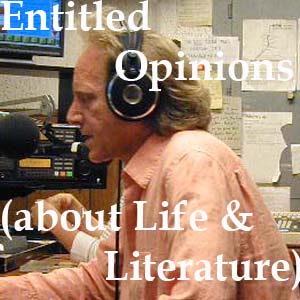
Robert Harrison
Entitled Opinions (about Life and Literature)
The narcotic of intelligent conversation
Author
Robert Harrison
Category
Podcast website
Latest episode
May 4, 2026
Where to listen?
Podcasts in the app Replaio Radio Coming soonPodcasts are coming to the app soon. Install now and be the first to see a whole new take on podcasts
 Install for free
Android 5M+ downloads · 4.8 rating
iOS soon
Install for free
Android 5M+ downloads · 4.8 rating
iOS soon
Episodes
Alexander Key on Medieval Islamic thought 18.04.2018
Professor Alexander Key received his Ph. D. in Arabic and Islamic Studies from Harvard University's Department of Near Eastern Languages and Civilizations in May 2012 and started working at Stanford that same year. Professor Key is a scholar of Classical Arabic literature whose interests range across the intellectual history of the Arabic and Persian-speaking worlds from the seventh century onward...
Andrew Hui on aphorism 09.04.2018
Dr Andrew Hui is an Assistant Professor of Literature at Yale-NUS College. He received his PhD from Princeton University in the Department of Comparative Literature and is a graduate of St John’s College, Annapolis. From 2009-2012, he was a postdoctoral fellow at Stanford University, where he taught in the Introduction to Humanities Program. He has also studied at Yale Divinity School, Scuola Norm...
Lena Herzog on dying languages 02.02.2018
Lena Herzog is a visual artist and photographer who lives in Los Angeles. Born in the Ural mountains of Russia, she moved to the city of St. Petersburg (then Leningrad) to study Languages and Literature at Leningrad University. She immigrated to the United States in 1990 and worked at Stanford University two years later as a research consultant. She then completed her BA in Philosophy at Mills Col...
Richard Rorty on the future of philosophy 22.09.2017
Richard Rorty is considered one of the greatest philosophers of the twentieth century. He is credited with reviving the philosophical school of American pragmatism and challenging the accepted pieties of analytic philosophy. He championed “quietism,” which he says attempts “to dissolve, rather than solve” sets of problems that should now be considered obsolete. This November 23, 2005, interview is...
Hiatus Announcement 20.07.2017
Entitled Opinions is on hiatus
Is Henry David Thoreau a philosopher, too? Andrea Nightingale votes yes. 12.07.2017
On the 200th birthday of Henry David Thoreau, Robert Harrison and Professor Andrea Nightingale engage in a lively conversation about Walden. This year our nation celebrates the bicentennial of Henry David Thoreau. But few of the commemorations have considered Thoreau as a philosopher, focusing instead on Thoreau as a champion of civil disobedience and the author of Walden. With this broadcast, Ent...
William Hurlbut on gene editing 06.07.2017 1:01:40
A conversation with William Hurlbut on the ethical implications of CRISPR-Cas9 and human intervention in the genetic makeup of life. William B. Hurlbut, MD, is Adjunct Professor of Neurobiology at the Stanford Medical School. After receiving his undergraduate and medical training at Stanford University, he completed postdoctoral studies in theology and medical ethics, studying with […]
Eric McLuhan on Marshall McLuhan 05.07.2017
An internationally-known and award-winning lecturer on communication and media, Dr. McLuhan has over 40 years’ teaching experience in subjects ranging from high-speed reading techniques to literature, communication theory, media, culture, and Egyptology. He has taught at many colleges and universities throughout the United States, Canada and abroad. In addition to co-authoring “Laws of Media” in 1...
Great albums of 1967 with Jay Kadis and Thomas Harrison 20.06.2017
Jay Kadis was born in Oakland, California. He has played guitar since high school, initially with Misanthropes, a popular bay area band of the late 1960s, whose highlights included playing the Fillmore Auditorium and opening for Muddy Waters. Jay has written and performed original rock music with several bands, including Urban Renewal and Offbeats. He has built home studios, recorded and produced...
Michaela Hulstyn on Drugs in Literature 07.06.2017
Dr. Michaela Hulstyn is a lecturer in the Structured Liberal Education program at Stanford University. She earned her PhD from Stanford in 2016 in French, where she taught both language and literature. She has been published in Modern Language Notes and Women in French Studies, among other places. Her research interests center on 20th and 21st century French and Francophone literature, philosophy...
Sam Ginn on the Singularity 27.05.2017
Sam Ginn is a second year undergraduate student at Stanford University. He is a computer science major interested in human consciousness and whether human consciousness is artificially replicable. Sam is also a participant in the philosophical reading group at Stanford and he is a devotee of Martin Heidegger's thought. In this show Sam discusses the Singularity, and the importance of Martin Heideg...
Hans Sluga on Trump's “Empire of Disorientation” 20.05.2017
Who is Donald Trump, and what does he stand for? Do we know? Does he himself know? Or is he caught in that precarious state of disorientation that characterizes our current political predicament? The public discourse is heated, the language inflammatory. Philosopher Hans Sluga of the University of California, Berkeley, brings a cool head and rational thinking to his interview about our 45th pres...
“I Am Not a Man, I Am Dynamite” : Peter Sloterdijk on Nietzsche 15.12.2016
Peter Sloterdijk is one of the most controversial thinkers in the world. In many ways, he is the heir of Friedrich Nietzsche, who is sometimes said to have inaugurated the 20th century. On Entitled Opinions, host Robert Harrison opens his discussion with Sloterdijk with the sound of an explosion, and Nietzsche’s words, “I am not a man, I am dynamite.” Sloterdijk says the words had helvetic echoes...
“Mary Shelley is a dissenting voice”: Inga Pierson on Frankenstein and the Age of Science 29.06.2016
“Mary Shelley is a dissenting voice”: Inga Pierson on Frankenstein and the Age of Science January 2018 marks the 200th anniversary of the publication of Mary Shelley's Frankenstein: or, The Modern Prometheus, and the occasion has been commemorated with celebrations, conferences, retrospectives, editorials, and more. Clearly, the book belongs to the twenty-first century, as much as it did the ninet...
“It has happened. So it can happen again.” Philip Gourevitch on genocide 15.06.2016
“It has happened. So it can happen again." Philip Gourevitch on genocide We live in an era of genocides. Author Philip Gourevitch is one of its experts, probing how genocide happens, how the murderers rationalize their participation, and how they live with themselves later. With his new research, he reports the on the survivors, who now continue their lives alongside those who have murdered their...
Rebecca Pekron on Arthur Rimbaud 08.06.2016
Dr. Rebecca Pekron recently received her doctorate from the Humanities Center at Johns Hopkins University. Her dissertation "Que reste-t-il? [What remains?]" Poetic Approaches to Immortality: Baudelaire and After explores the concept of immortality in the funerary poetry of the nineteenth century. Dr. Pekron graduated from Stanford in 2005 with a B.A. in Comparative Literature and an M.A. in F...
A conversation about Joseph Conrad's The Shadow Line with Monika Greenleaf and Rush Rehm 01.06.2016
Monika Greenleaf is a comparative literature scholar who teaches in the Department of Slavic and the Department of Comparative Literature here at Stanford. She is of Polish extraction herself and specializes in Polish and Russian literature. She is the author of Pushkin and Romantic Fashion as well as editor of Russian Subjects: Nation, Empire, and the Culture of Russia's Golden Age. Her forthcomi...
Valerie Kinsey on Public Memory 25.05.2016
Valerie earned her PhD in Rhetoric from the University of New Mexico in Albuquerque in 2015. She currently teaches in the Program in Writing and Rhetoric at Stanford and is working on a book about public memory and the defeat of the Equal Rights Amendment.
Alice Kaplan on Albert Camus and “The Stranger” 18.05.2016
Alice Kaplan came to Yale in 2009 after many years at Duke University, where she was the founding director of the Duke University Center for French and Francophone Studies and a professor of Romance Studies, Literature, and History. Her first book, Reproductions of Banality (1986), was a theoretical exploration of French fascism. Since then she has published books on Céline’s anti-semitic pamphlet...
Monika Greenleaf on Joseph Conrad's Polish Roots 11.05.2016
Monika Greenleaf is a comparative literature scholar who teaches in the Department of Slavic and the Department of Comparative Literature here at Stanford. She is of Polish extraction herself and specializes in Polish and Russian literature. She is the author of Pushkin and Romantic Fashion as well as editor of Russian Subjects: Nation, Empire, and the Culture of Russia's Golden Age. Her forthcomi...
Thomas Mullaney on the Invention of the Chinese Typewriter 04.05.2016
Thomas S. Mullaney is Associate Professor of Chinese History at Stanford University. He is the author of Coming to Terms with the Nation: Ethnic Classification in Modern China and principal editor of Critical Han Studies: The History, Representation and Identity of China’s Majority. He received his BA and MA degrees from the Johns Hopkins University, and his PhD from Columbia University under the...
Jean-Marie Apostolidès on Guy Debord, Situationism, and Psychogeography 27.04.2016
Jean-Marie Apostolidès was educated in France, where he received a doctorate in literature and the social sciences. He taught psychology in Canada for seven years and sociology in France for three years. In 1980 he came to the United States, teaching at Harvard and then Stanford, primarily French literature and drama. He is interested in avant-garde artistic movements such as dada, surrealism, and...
Poet Maria Stepanova on Memory and Russia’s “Schizoid Present” 20.04.2016
Poet Maria Stepanova on Memory and Russia’s “Schizoid Present” “It is something very intimate, the way we communicate with the dead.” The Guardian called 2021 “the year of Stepanova” for good reason. Russian poet Maria Stepanova’s new book, In Memory of Memory (New Directions), translated by Sasha Dugdale, has been long-listed for the International Booker Prize. Given the incandescent reviews, it...
Andrea Nightingale on J.A. Baker's “The Peregrine” 13.04.2016
Prof. Andrea Nightingale has worked primarily on Greek and Roman philosophy and literature. She has also written on the philosophy and literature of ecology (in the modern and postmodern periods). She has been awarded a fellowship at the Stanford Humanities Center, an ACLS Fellowship, and a Guggenheim Fellowship. She is a Harvard Senior Fellow for the Hellenic Center (2010-2014). Her publicati...
Aishwary Kumar on Gandhi and Ambedkar – Part 2 06.04.2016
Aishwary Kumar is assistant professor of history at Stanford and works as an intellectual and political historian of modern South Asia. He works in areas of legal and political thought, political philosophy and democratic culture, religion, caste, and moral psychology, in addition to global histories of empire, constitutionalism, and citizenship. A parallel set of his interests concerns the...
Similar podcasts




Listen to the Entitled Opinions (about Life and Literature) podcast in Replaio
Radio and podcasts in one app - free, with no sign-up. Install today and do not miss the launch
Replaio is not a podcast publisher; show names, artwork and audio belong to their authors and are distributed through public RSS feeds.