Goalhanger
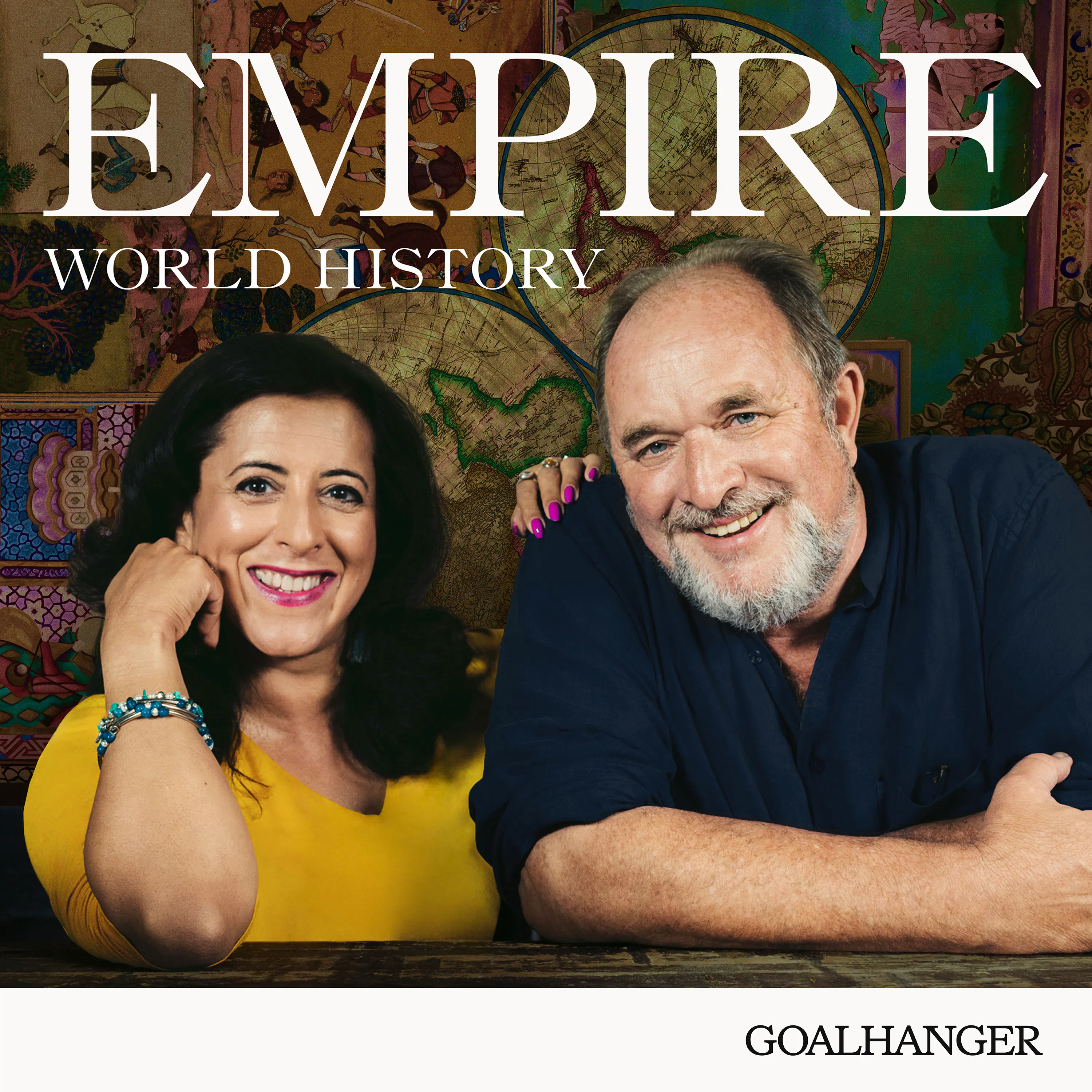
Empire: World History
The rise and fall of empires and the events that shaped world history. William Dalrymple and Anita Anand explore the intricate stories of revolutions, imperial wars, and the people who built and lost empires. From the British Empire to the Ottomans to Ancient India, history is shaped by power struggles and territorial conquests. How does it continue to affect the world today? Empire Club : Become a member of the Empire Club to receive early access to miniseries, ad-free listening, early access to live show tickets, bonus episodes, book discounts, our exclusive newsletter, and access to our mem...
Where to listen?
Podcasts in the app Replaio Radio Coming soonPodcasts are coming to the app soon. Install now and be the first to see a whole new take on podcasts
 Install for free
Android 5M+ downloads · 4.8 rating
iOS soon
Install for free
Android 5M+ downloads · 4.8 rating
iOS soon
Episodes
187. The Birth of Britain 18.09.2024 53:12
With the accession of James I and VI in 1603, Scotland was assimilated into the composite monarchy of the United Kingdom. James, an eccentric, insecure and rambling figure, preoccupied with witches, was himself an alien in his new English court. Even at this stage though, it seems unlikely that the two nations would be legally combined under one parliament. But, with Scottish interests abroad cons...
186. Scotland: A Nation in Crisis 16.09.2024 53:25
When charting the rise of Scotland’s global influence, few events have been as tragically remarkable as the Darien Scheme of 1698, which saw woefully unprepared Scottish pioneers attempt to settle and colonise the Isthmus of Panama. Scotland during this period was a country bound to England under one crown, originally that of James I and VI, though still in its own right a sovereign state. However...
185. The God Kings of Angkor Wat 11.09.2024 53:20
In the 9th century AD, two years after the Holy Roman Empire was established in Western Christendom, another world-shaking empire was rising in the east, more powerful even than that of Charlemagne and far wealthier. Born in what is today Northern Cambodia but long before the horrors of the Khmer Rouge, the mighty Khmer empire dominated most of mainland Southeast Asia, stretching as far north as s...
184. The Buddhist Merlin 09.09.2024 33:17
While in the West the legends of King Arthur were being born, a Buddhist tantric magician of immense magical powers - Vajrabodhi - was enshrining himself as the Merlin of first India, and then China. Undeniably one of the most extraordinary characters of the 8th century, Vajrabodhi would play a crucial role in transporting Buddhism to the Chinese court, along with Indian scholarship. After being s...
183. The Poet Kings: Taking Hinduism to Southeast Asia 04.09.2024 48:35
India’s transformation of the ancient world is indisputable, and tangible evidence of this can be found in the magnificent Hindu and Buddhist temples scattered across the landscapes of South East Asia. But what was the process by which India transported its vast empire of art, culture, architecture, technology, religion and even writing to South East Asia? The story largely derives in the ascent o...
182. The Lady Macbeth of China 02.09.2024 51:16
Having garnered absolute power through bloody means, Empress Wu Zetian begins seeing apparitions, haunted by her violent schemes. With her husband incapacitated, the Empress at first held counsel on his behalf from behind a curtain. But she soon officially proclaimed herself a divine ruler. Working alongside a prominent Buddhist monk, she built temples and universities in China, creating a new hol...
181. The Dragon Empress: China’s Game of Thrones 28.08.2024 34:14
The inculcation of Buddhism from India as the state religion in China was enabled by the violent rise of China’s only ever woman Emperor. Raised by pious Buddhist parents, Wu Zetian left a trail of bodies in her wake as she charted a path to absolute power. From a lowly ranked concubine in the imperial harem to the corridors of power, she used Buddhism to legitimise her unprecedented claim to rule...
180. Gold & God: Connecting India & Ancient Rome 26.08.2024 41:09
It was actually India, not China, that was the greatest trading partner of the Roman Empire. During this era, it’s clear that sea travel was the fastest, most economical and safest way to move people and goods in the pre-modern world, costing about a fifth of the price of equivalent land transport. The Golden Road of early east–west commerce, in other words, lay less overland, through a Persia oft...
179. The Golden Road: Rise of the Indosphere 21.08.2024 41:58
For a millennium and a half, India was a confident exporter of its diverse civilisation, creating around it a vast empire of ideas. Indian art, religions, technology, astronomy, music, dance, literature, mathematics and mythology blazed a trail across the world, along a Golden Road that stretched from the Red Sea to the Pacific. Listen as Anita and William discuss his new book and the rise of the...
178. The Vietnam War: Nixon, Vietnamisation, and the Fall of Saigon 19.08.2024 55:13
With Richard Nixon now in the White House and not wanting to have his presidency consumed by Vietnam like his predecessor’s was, he begins to search for ways to disentangle America from the war. It begins with Vietnamisation and an attempt to reduce South Vietnamese reliance on the Americans, but soon he goes to China and starts making moves on the world stage to reduce Soviet and Chinese support...
177. The Vietnam War: Lyndon Johnson, Americanisation, and Operation Rolling Thunder 14.08.2024 56:57
With the death of JFK, Lyndon B. Johnson took over the Presidency and immediately had to wrestle with America’s relationship with Vietnam after the killing of Diem. Right from the start he prophesised that it would be his downfall and so it was. He consistently resented it and the distraction it was from his domestic agenda, the Great Society. Over his five years in charge, LBJ Americanised the wa...
176. The Vietnam War: The Rise of Ho Chi Minh 12.08.2024 1:02:10
Vietnam, or Indochina as it was known, had been under French colonial rule since the nineteenth century. This was until the Vietnamese nationalist group, the Viet Minh, took on the French in 1946. Ho Chi Minh, son of a Confucian scholar, former chef in Boston, and lover of French literature, was at their head. The fighting came to an end in 1954 with the Geneva conference splitting the country in...
175. The CIA vs Fidel Castro 07.08.2024 54:06
Following the fall of Batista, the Cuban revolution took a more radical turn. Castro was not a communist to begin with, but as those around him became increasingly Marxist, the CIA’s desire to regain control of the island grew. With the failure of JFK’s Bay of Pigs invasion, events escalated into the Cuban Missile Crisis as the USSR brought nuclear weapons to America’s doorstep. Listen as Anita an...
174. The Cuban Revolution 05.08.2024 56:59
It’s 1959 and the swaggering Cuban revolutionary, Fidel Castro, has just overthrown the unpopular American backed dictator, Fulgencio Batista. Che Guevara, the Marxist physician whose face would become an internationally recognised symbol of resistance, is at his side. But how did the small Caribbean nation go from a profitable outpost of the Spanish empire to a heady American party island, rife w...
173. The Korean War: Dividing the Peninsula 31.07.2024 50:54
The Korean War was a brutal affair. It is estimated that 3,000,000 people were killed in the conflict that absolutely devastated the Korean Peninsula. And the legacy of it is still with us today; it was over the course of this war that the division between North and South solidified into two separate nations. It was also at this time that Kim Il Sung rose to prominence, establishing North Korea's...
172. The Birth of North Korea 29.07.2024 46:58
Whilst we know the Korean Peninsula is split into two quite separate countries, North Korea and South Korea, that has not always been been the case. Korea was an independent, singular nation until the Japanese colonised it at the start of the 20th century. This collapsed after the Second World War, at which time the USA and Russia swept in to create their own spheres of influence, separated by the...
171. The Bengal Famine: Chaos in Calcutta 24.07.2024 43:51
By 1943, the price of rice was beyond unaffordable for most in Bengal, and people were dying in the streets. Despite government censorship of letters, news spread about the famine and the tide turned with the introduction of a new Viceroy. Yet when aid eventually did arrive from other regions of India, it was so chaotically handled that some food shipments were halted at the station. Listen as Ani...
170. The Bengal Famine: A Disaster on the Horizon 22.07.2024 44:07
In 1942, in the midst of the Second World War, the British administration feared that Japanese forces would take India as part of their campaign. To prevent access to resources in the event of a potential invasion, colonial forces enacted a “denial policy”, confiscating rice and destroying boats. This, along with a cyclone and political unrest, led to starvation in the countryside of Bengal, forci...
169. Freedom Fighters Betrayed: Colonising the Philippines 17.07.2024 41:51
By the end of the Spanish-US war, the Philippines was on the menu. Two battles played out simultaneously on the archipelago: and old and a new empire fought for power over a colony, whilst Filipinos fought for independence. The Philippines honoured the US in their new constitution and flag. But they were betrayed, and a young revolutionary, Emilio Aguinaldo, led the Filipino people in the brutal w...
168. Teddy Roosevelt Takes on the Old World 15.07.2024 50:27
In 1898, whilst his boss was on a break at the osteopath, Teddy Roosevelt basically started a war. A master of the press, he managed to whip up war fever amongst jingoists in Congress, leading the United States to declare war on imperial Spain. Building on an established independence movement in Cuba, the US was ambiguous about its intentions. Was it liberation or colonisation that it wanted for t...
167. Paradise Lost: The Taking of Hawaii 10.07.2024 47:21
On 7th July 1898, President McKinley formally annexed Hawaii, making it a colonial territory of the USA. It was not until 21st August, 1959, that it became the 50th state. Orchestrated by the American planter class in Hawaii, led by Sanford Dole, this annexation was the culmination of a process throughout the 19th century which pushed the native Hawaiian population to the side for commercial gain....
166. How To Hide An Empire 08.07.2024 39:43
Not everyone agrees that the USA should be classed as an empire. But in the late 1800s, after white settlers had colonised western states, America turned to acquiring overseas territories in what could be described as an imperial project. And one surprising commodity catalysed the project… bird poo. Joining Anita and William to answer questions like “how did shit shape the American empire?” and mo...
165. A Massacre at Dawn 03.07.2024 51:09
Arizona Territory, April 30, 1871. The canyon known as Aravaipa lies still in the predawn darkness, the only sounds to be heard in the early-morning calm the song of birds and the lilt of running water as it courses its way toward the nearby San Pedro River. But upon this paradise all hell is about to break loose. With Native American land being squeezed and squeezed by settlers, and relations bec...
164. How the West was Won: The Truth Behind the Westerns 01.07.2024 49:56
A whole genre of movies is based on a relatively short period of nineteenth-century American history. But what is the real story behind battles between Native Americans and white settlers during westward expansion? In the aftermath of the Mexican-American War, settlers flooded to the newly acquired territory and before long, violence was commonplace. Images of battles fought on horseback continue...
163. The Tattooed Girl: From Mormon to Native American 26.06.2024 42:26
In 1850, 13-year-old Olive Oatman and her family set off on the perilous journey by foot from Missouri to Arizona. Olive and her little sister were captured by a group of Native Americans and then sold to another. Yet rather than being treated as slaves, the girls were treated with kindness and welcomed as kin. But her version of her story was to be twisted and rewritten in the years that followed...
Similar podcasts







Listen to the Empire: World History podcast in Replaio
Radio and podcasts in one app - free, with no sign-up. Install today and do not miss the launch
Replaio is not a podcast publisher; show names, artwork and audio belong to their authors and are distributed through public RSS feeds.