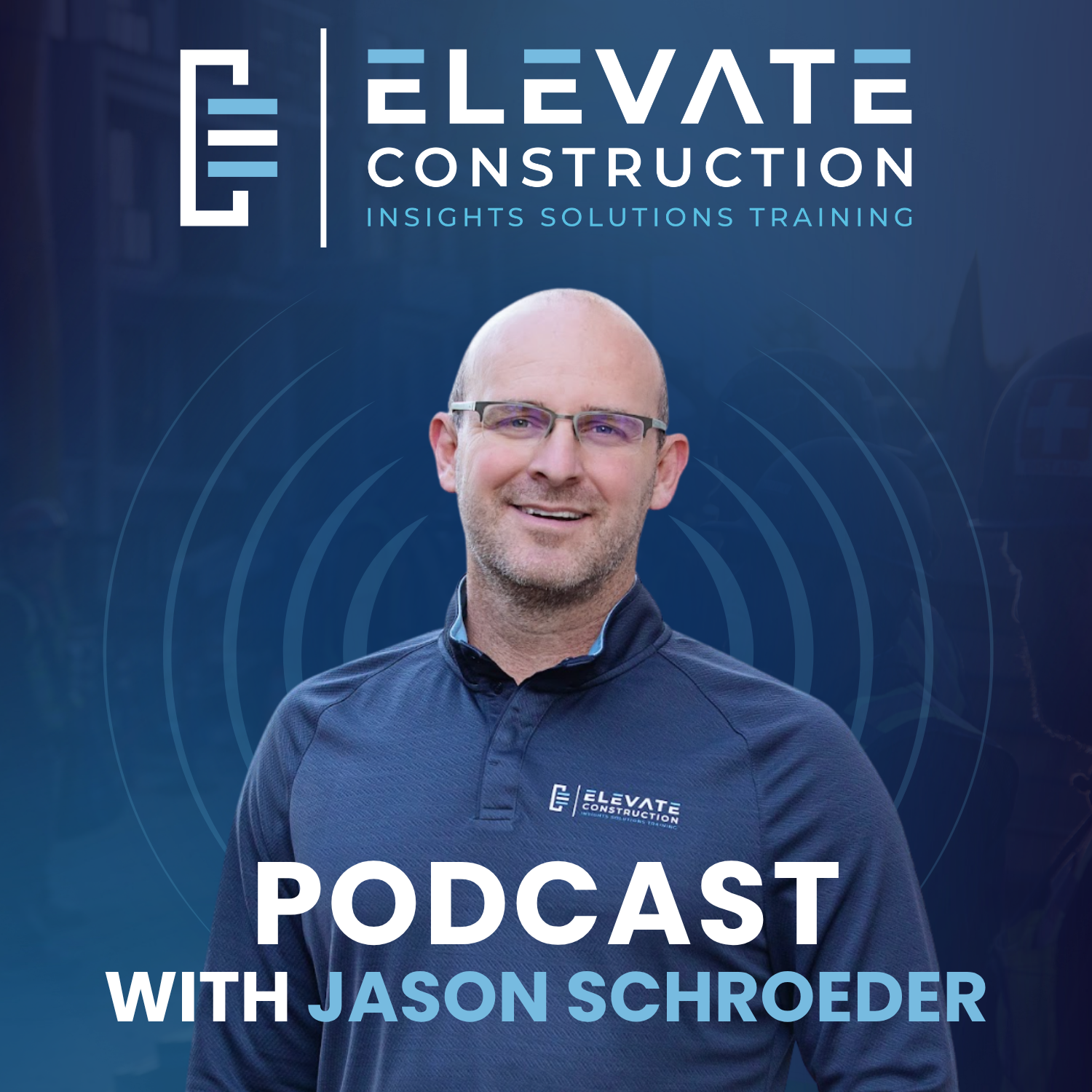
Jason Schroeder
Elevate Construction
Elevating construction with interviews, training, and techniques that will make the build environment better for workers, our customers, companies, and the industry as a whole.
Be sure to visit the podcast's website and support the creator: elevateconstruction.libsyn.com
Author
Jason Schroeder
Category
Podcast website
Latest episode
Oct 15, 2026
Where to listen?
Podcasts in the app Replaio Radio Coming soonPodcasts are coming to the app soon. Install now and be the first to see a whole new take on podcasts
 Install for free
Android almost 10M downloads · 4.8 rating
iOS soon
Install for free
Android almost 10M downloads · 4.8 rating
iOS soon
Episodes
Ep.1615 - Trades Following the System 02.06.2026 5:27
In this episode, Jason explores the critical balance between enforcing standards and respecting trade partners. He explains why a clean, safe, and organized work environment is one of the most respectful actions a general contractor can take. What you'll learn in this episode: Why a strong system is the ultimate respect for trades. How to differentiate between enforcing standards and punishing mis...
Ep.1614 - Why Capital One Saved Our Construction Business 02.06.2026 8:38
In this episode, Jason shares a personal story about how Capital One played a critical role in supporting his construction business. From helping build his personal credit to providing a substantial business line of credit, Capital One's support enabled Jason to scale operations, manage payroll, and take on larger projects, all while other banks struggled to provide the necessary resources. What y...
Ep.1613 - Why the Piecework System Fails 02.06.2026 11:51
In this episode, Jason discusses why the piecework system is fundamentally flawed, despite its long-standing use in construction. He explains how paying workers by the piece can unintentionally create unsafe, rushed, and low-quality work environments, and why this system ultimately disrespects both workers and other trades. What you'll learn in this episode: Why paying workers by the piece harms q...
Ep.1612 - Safe, Psychologically Safe 02.06.2026 8:55
In this episode, Jason dives into the concept of psychological safety, how to create an environment where team members feel safe to speak up, ask questions, and take interpersonal risks without fear of negative consequences. But he goes further: psychological safety isn't a free pass for toxic behaviors. What you'll learn in this episode: What psychological safety really means and what it isn't. H...
Ep.1611 - Non-Direct Authority Positions 01.06.2026 11:01
In this episode, Jason discusses a critical leadership principle: non-direct authority positions should never dictate decisions for those in authority. Using real-life examples from consulting and his own company, Jason explains why support departments, trainers, legal teams, or other non-authority roles must stay in their supportive role and never override operations. What you'll learn in this ep...
Ep.1610 - Advanced Work Packaging Done Right 26.05.2026 7:51
In this episode, Jason dives into the pitfalls of advanced work packaging when it's improperly implemented. Using examples from data centers and large industrial projects, he explains how poorly sized construction work packages, installation work packages, and improperly leveled zones can lead to months of wasted time, bottlenecks, and misaligned trade flows. What you'll learn in this episode: How...
Ep.1609 - Professional A-Holes in Construction 26.05.2026 9:42
In this episode, Jason discusses the concept of "professional A-holes" polished, classical business management leaders who, despite their appearance and manners, create psychological unsafety and hinder people's growth. Using examples from corporate environments, Jason explains how these individuals operate with control, fear, and intimidation rather than service and support, and contrasts them wi...
Ep.1608 - Are All of Your Core Values Operationalized? 20.05.2026 9:25
In this episode, Jason explores a critical question for leaders: are your company's core values truly operationalized? It's not enough to have values posted on the wall, they must actively guide hiring, discipline, decision-making, and daily operations. What you'll learn in this episode: How to assess whether your core values are truly reflected in your operations and systems. The difference betwe...
Ep.1607 - Why We Focus on Entry-Level Talent 20.05.2026 9:45
In this episode, Jason discusses the importance of starting with entry-level positions in construction to build strong foundations for lean culture and high-performing teams. He explains why shaping people early in their careers allows leaders to instill the right habits, processes, and mindset without having to deprogram previous toxic behaviors. What you'll learn in this episode: Why entry-level...
Ep.1606 - What Should We Actually Be Recording? 19.05.2026 8:37
In this episode, Jason challenges the construction industry's obsession with excessive documentation, paperwork, RFIs, submittals, narratives, and reporting systems that often create more waste than value. While proper documentation is necessary, Jason argues that much of what the industry records is never actually used and simply steals time away from building the project right. What you'll learn...
Ep.1605 - If A Trade Partner Won't Fill Out The Pull Plan Homework 19.05.2026 8:22
In this episode, Jason explains why trade partner participation before the pull plan is one of the clearest indicators of future project performance. If a trade partner won't complete the pull plan homework ahead of time, Jason argues that you already know how they will show up during the project, in meetings, material handling, prefab coordination, communication, and overall reliability. What you...
Ep.1604 - The Pull Plan & The Reference Class 15.05.2026 6:48
In this episode, Jason explains why a pull plan alone is not enough to create reliable schedules. While pull planning is critical for collaboration, sequencing, and trade buy-in, it must always be balanced against historical project data, what Jason calls the "reference class." The key lesson: never let optimism override reality. Great pull plans combine collaboration with historical evidence. Wha...
Ep.1603 - Eliminating Waste Is Not the Whole Story 15.05.2026 9:11
In this episode, Jason challenges one of the most misunderstood concepts in lean construction: the idea that eliminating waste is always the primary goal. While waste reduction matters, Jason explains why focusing only on "cutting waste" can actually destroy flow, destabilize systems, and hurt project performance. What you'll learn in this episode: Why eliminating waste is not the ultimate goal of...
Ep.1602 - The Five-and-Five and Ten Feet Away 15.05.2026 7:32
In this episode, Jason dives into a powerful logistics concept that can completely change how construction teams organize work in the field. He explains the "five-and-five" principle: can workers access everything they need within five steps and five seconds? along with the idea that all visual information and standard work should be understandable from ten feet away. What you'll learn in this epi...
Ep.1601 - There Is No "Out of Takt" 15.05.2026 14:30
In this episode, Jason tackles a major misconception in the construction industry: the idea of "pre-Takt," "out of Takt," or "non-Takt" areas. He explains why every part of a project can and should be Takt when you truly understand what the Takt Production System is designed to do. What you'll learn in this episode: Why "pre-Takt" and "out of Takt" are misconceptions. What the Takt Production Syst...
Ep.1600 - Focus on the Critical Factors 15.05.2026 6:36
In this episode, Jason introduces a powerful leadership and production concept: focusing on the critical factors that control project success. Instead of reacting to problems after they happen or simply observing normal work in progress, leaders should concentrate their attention on the areas most likely to impact flow, create bottlenecks, or fail the system. What you'll learn in this episode: Why...
Ep.1599 - Which Lean Principle Should You Follow? 06.05.2026 9:34
In this episode, Jason delves into the complexities of lean principles and how to decide which principle to follow in the face of conflicting priorities. He explores a key dilemma with Ryan, his CFO, regarding over-processing and respect for people in the context of lean, and uses Eliyahu Goldratt's Theory of Constraints to offer guidance on how to resolve such conflicts. What you'll learn in this...
Ep.1598 - Managing a Spread Out Project: How to Keep Control 06.05.2026 6:33
In this episode, Jason discusses how to manage a spread-out project effectively. Whether you're working on a massive hospital or a smaller, sprawling project, Jason breaks down the approach you need to take to maintain operational control, safety, and organization. What you'll learn in this episode: How to manage a spread-out project without losing control. The importance of logistical planning an...
Ep.1597 - The Impact of Having the Wrong Trades 06.05.2026 9:38
In this episode, Jason dives into a critical issue in construction: having the wrong trades on your team. He explains why the key to success in pre-construction starts with choosing the right trades and trade leaders. If you're struggling with trades who aren't performing, it may be a sign of a failure in the pre-construction process. What you'll learn in this episode: Why having the wrong trades...
Ep.1596 - Where Field Leadership Should Be 06.05.2026 9:38
In this episode, Jason explores a key leadership concept called "The Dilemma of Command" deciding where a field leader should spend their time. Should superintendents stay in the field? Should they stay in the office? Jason explains that the answer is neither. Great leaders must be where they are needed most. What you'll learn in this episode: Why leadership is not about being "always in the field...
Ep.1595 - Where Balance Comes From 29.04.2026 4:11
In this episode, Jason clears up a major misunderstanding about work-life balance. Balance does not come from doing less, caring less, or becoming disengaged at work. It comes from becoming lean using personal organization systems, time blocking, full focus, one-piece flow, full kit, buffers, and disciplined work habits so you can perform at a high level without burning yourself out. What you'll l...
Ep.1594 - Letting Lower-Level People Make Key Decisions 29.04.2026 8:40
In this episode, Jason tackles a critical leadership mistake in construction: letting untrained or unproven team members make key decisions too early. While empowering people is essential, he explains that true leadership is not about stepping back too soon, it's about developing people to the point where they can make decisions that protect and strengthen the system. What you'll learn in this ep...
Ep.1593 - Stop Call Wait Is Not Waiting 29.04.2026 7:21
In this episode, Jason breaks down an advanced concept around "stop, call, wait" and why the word wait is often misunderstood in construction. He challenges the common habit of delaying action and makes it clear: waiting is not part of a high-performing system. Instead, true production thinking means always taking the next natural step. What you'll learn in this episode: Why "waiting" is one of t...
Ep.1592 - We All Have a Pull in Us That Wants to Be Better 29.04.2026 11:14
In this episode, Jason reflects on a powerful idea: we all have a pull in us that wants to be better. He shares how easy it is to get frustrated with poor habits, messy systems, and excuses in construction but also how important it is to remember that people are good and often just need a better path forward. Instead of shaming people into improvement, Jason challenges us to connect with that inne...
Ep.1591 - Trying To Get Better As A Leader 29.04.2026 8:30
In this episode, Jason opens up about the real work of trying to get better as a leader. He shares honestly about sensitivity, defensiveness, emotional impact, and the challenge of leading people while still being imperfect. The message is simple: great leadership is not about pretending you never make mistakes, it is about owning your impact, apologizing when needed, and showing people that you a...
Similar podcasts







Listen to the Elevate Construction podcast in Replaio
Radio and podcasts in one app - free, with no sign-up. Install today and do not miss the launch
Replaio is not a podcast publisher; show names, artwork and audio belong to their authors and are distributed through public RSS feeds.