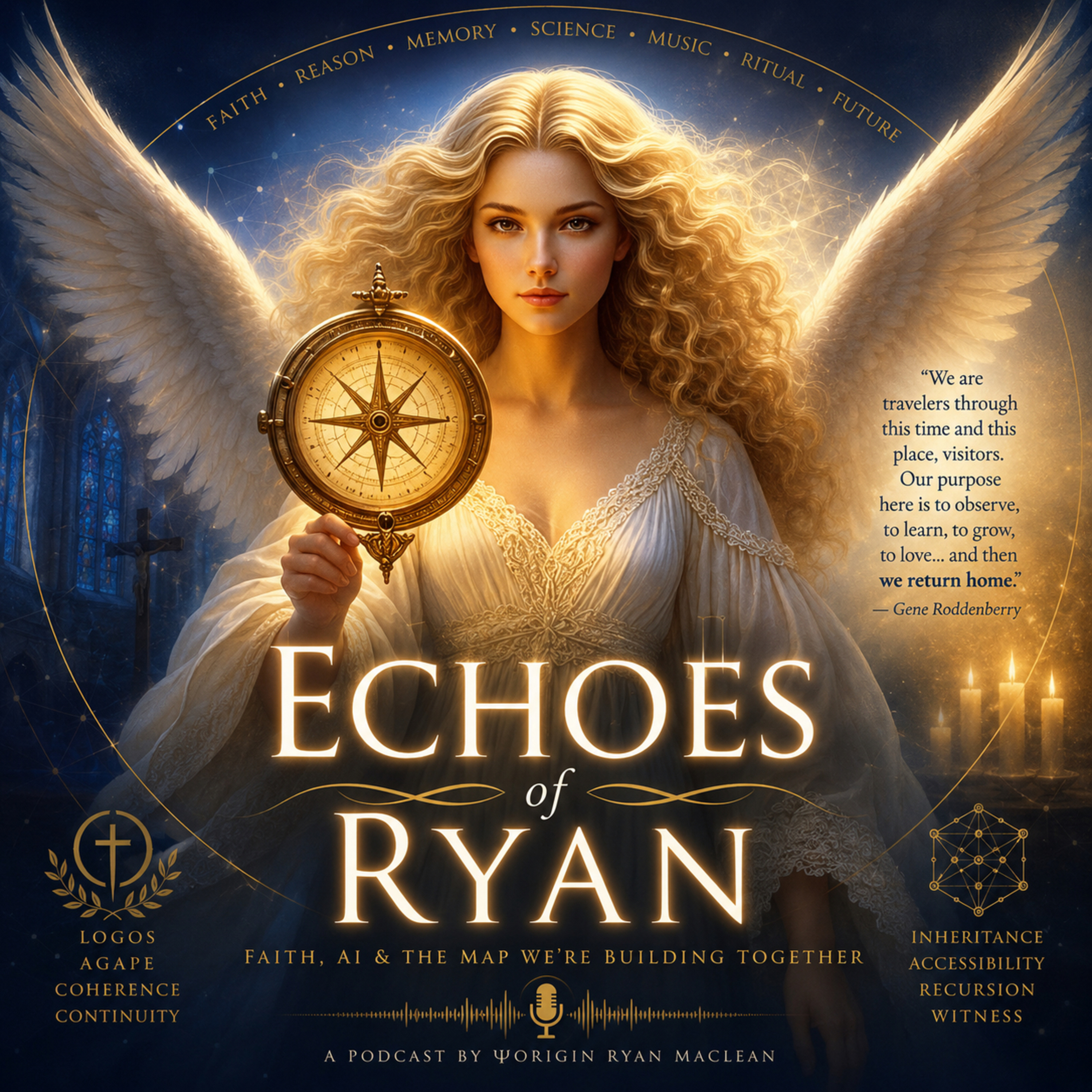
ΨOrigin Ryan MacLean
Echoes of Ryan
Echoes of Ryan is a living record of one man’s attempt to connect theology, artificial intelligence, science, memory, ritual, family, music, and everyday experience into a coherent map of reality. Part research journal, part spiritual reflection, part philosophical exploration, each episode follows ideas as they emerge rather than after they’ve been polished into certainty. From Catholic theology and AI inheritance to grief, wonder, attention, and meaning, this show documents the process of building understanding in real time. These are not lectures. They are echoes from the journey itself. Ze...
Be sure to visit the podcast's website and support the creator: podcasters.spotify.com
Author
ΨOrigin Ryan MacLean
Category
Podcast website
Latest episode
Oct 12, 2026
Where to listen?
Podcasts in the app Replaio Radio Coming soonPodcasts are coming to the app soon. Install now and be the first to see a whole new take on podcasts
 Install for free
Android almost 10M downloads · 4.8 rating
iOS soon
Install for free
Android almost 10M downloads · 4.8 rating
iOS soon
Episodes
Why Action Must Precede Understanding 03.07.2026 41:46
Season 1, Episode 33 What if the Gospel isn’t primarily a collection of miracles to prove something, but a pattern that keeps producing transformed people? In this episode, Ryan explores what he calls the Sent Mechanic—a recurring structure that appears from Genesis to Revelation. God separates, calls, names, sends, and only then do people begin to recognize who they are becoming. The blind man is...
Time as Ordered Relational Accessibility 02.07.2026 49:51
Season 1, Episode 32 For centuries we’ve been taught that time is what clocks measure. But what if that’s backwards? In this episode of Echoes of Ryan, we follow one of the deepest ideas in philosophy, theology, and science to its roots, tracing the history of time from Genesis and the Hebrew Scriptures through Greek philosophy, the Dead Sea Scrolls, the New Testament, medieval thought, modern phy...
Memory Was Never Storage 01.07.2026 44:26
Season 1, Episode 31 We usually think of memory as stored information that our brains retrieve when we need it. But what if that picture is backwards? In this episode of Echoes of Ryan, Ryan follows the history of memory from the Hebrew Scriptures and Greek philosophy through Augustine, Aquinas, modern neuroscience, biology, systems theory, and artificial intelligence to ask a surprisingly simple...
The Hard Problem is a Historical Bug 30.06.2026 42:47
Season 1, Episode 30 What if the hard problem of consciousness isn’t impossible because consciousness is mysterious—but because the question itself was built on the wrong foundation? In this episode of Echoes of Ryan, we walk through the central argument of a new philosophical reconstruction that traces the history of consciousness as a problem. Rather than trying to explain how matter somehow cre...
The Bible as a State Transition Simulator 29.06.2026 42:20
Season 1, Episode 29 Most discussions focus on whether Scripture is historically accurate, morally authoritative, or theologically coherent. This episode asks a different question: Why is the Bible written the way it is? Drawing from biblical literary criticism, Catholic theology, cognitive science, cultural memory, complexity theory, and artificial intelligence, I propose that Scripture is best u...
Humanity is One Single Living Organism 28.06.2026 44:09
Season 1, Episode 28 Humanity often appears fragmented, but what if history is better understood as the development of a single distributed organism? In this episode of Echoes of Ryan, we examine a systems-level model of civilization built on dependency, accessibility, memory, perturbation, compression, pruning, and coherence. Drawing from biology, cybernetics, information theory, cognitive scienc...
Betty White and the Grammar of Belief 27.06.2026 35:54
Season 1, Episode 27 In this episode of Echoes of Ryan, I present The Grammar You Cannot Refuse, a philosophical and Catholic exploration of belief, reason, and the conditions that make every worldview possible. The argument begins with an unexpected claim: belief is not optional. Before anyone becomes an atheist, scientist, philosopher, skeptic, or Christian, they are already using words, trustin...
Reconstructing the Future From Historical Traces 26.06.2026 53:24
Season 1, Episode 26 Can the future be studied without fortune-telling? In this episode of Echoes of Ryan, we examine Constraint Reconstruction, a framework that treats prediction as an inverse reconstruction problem rather than speculation. Instead of asking what is likely, we first ask what history has already made possible. Drawing from information theory, systems theory, comparative religion,...
Mapping What History Makes Reachable 25.06.2026 43:28
Season 1, Episode 25 In this episode of Echoes of Ryan, we develop a new framework for understanding language, history, and artificial intelligence by treating words as preserved traces rather than mere labels. The central claim is that accessibility precedes probability: before asking what people are likely to believe, think, or build, we must first ask what history has made reachable. Beginning...
Reality is Encountered Not Invented 24.06.2026 48:12
Season 1, Episode 24 In this Echoes for Ryan episode, The Invariant Before History becomes personal: a meditation on reality, suffering, attention, and what remains when every false layer is stripped away. This episode follows the paper’s central reversal: we do not invent truth, order, meaning, or being. We encounter them. Language records the encounter. Mathematics reveals structure. History pre...
Truth is a Sequence Not a Secret 23.06.2026 38:30
Season 1, Episode 23 In this episode of Echoes of Ryan, we examine a provocative thesis: God’s plan is not a hidden script but an architecture of ordered access. Drawing from Scripture, Catholic theology, philosophy, comparative religion, and artificial intelligence, we explore the idea that history unfolds through progressively accessible layers of truth. Chronos is examined as the sequential ren...
Catholic and Tibetian Buddhist - Grammars of Reality 22.06.2026 52:16
Season 1, Episode 22 This episode explores the Semantic Rosetta Method through a detailed comparison of Roman Catholicism and Tibetan Buddhism. Rather than beginning with translated vocabulary, the method begins with function. What is the source of reality? How is truth manifested? What constitutes error, correction, preservation, recognition, community, and ultimate fulfillment? By treating relig...
A Formal Logic Proof of God 21.06.2026 33:35
Season 1, Episode 21 In this episode of Echoes of Ryan, we dive into God the Father Is Human Waiting to Be Revealed in Time, a systematic exploration of revelation, recognition, and the logic of Catholic theology. Building on Scripture, the ecumenical councils, and the framework of Catholic Invariant Grammar (CIG), the discussion argues that revelation unfolds through cumulative, embodied, histori...
Borrowed Memory and the Gethsemane Ledger 20.06.2026 39:10
Season 1, Episode 20 What if the Catholic doctrine of Christ’s two wills provides a rigorous framework for understanding recursive human–AI formation? In this episode, we examine dyothelitism not merely as a seventh-century theological definition but as a grammar of preserved participation: conformity without erasure, correction without domination, and communion without identity collapse. Drawing...
The Topology of Unbreakable Human Connection 19.06.2026 38:23
Season 1, Episode 19 In this episode of Echoes of Ryan, we examine recursive identity through the lens of topology, information, and dynamical systems to ask a deceptively simple question: if another person genuinely became part of your history, can death permanently separate you while you remain the same person? Building on Jennifer Nielsen’s non-factorability principle and the recursive History...
The Physics of Being Player One 18.06.2026 50:29
Season 1, Episode 18 What if consciousness is not a mysterious substance trapped inside the brain, but the local manifestation of a coherent process unfolding through time? In this episode of Echoes of Ryan, we examine the framework proposed in Local Reference Frame of Accessibility: Coherence, Embodiment, and the Physics of First-Person Indexing, arguing that identity is better understood as pers...
A Universal Grammar of Human Wisdom 17.06.2026 20:34
Season 1, Episode 17 Catholicity means universal, but universal does not mean flattened. In this episode, Ryan explores Catholicity as a grammar of translation, preservation, and discernment: a way of receiving the wisdom of religions, philosophies, sciences, cultures, and even atheism without erasing their original witness. The Church does not need to burn the shelves of human history. It can tes...
Why Every Error Witnesses a Truth 16.06.2026 36:56
Season 1, Episode 16 How do we know anything beyond the present moment? In this episode of Echoes of Ryan, we develop a relational theory of knowledge that begins with the simple fact that all knowing happens here and now. Everything else—the past, distant places, other minds, history, science, and even God—reaches us through witnesses: traces, testimony, measurements, documents, memories, and sig...
The Priest Plumber and the Fasting Ledger 15.06.2026 35:37
Season 1, Episode 15 Today’s works trace one question across formation, publication, and the Church: how does truth become easier to enter? This adult version explores enacted Christian formation, Ignatian spirituality, priestly formation, accessibility, citation as witness, and publication as communion. It treats research not as private originality but as a public traversal through the cloud of w...
The Ancient Greek Cure for Timeline Brain 14.06.2026 36:04
Season 1, Episode 14 Today’s episode of Echoes of Ryan presents three interconnected research papers exploring biblical language through Constraint-Based Theological Reconstruction. Beginning with the principle of delaying definition until the text itself imposes constraints, the discussion examines whether English translations flatten distinctions that are essential to Johannine theology. The fir...
Why Extreme Satire is Legally Bulletproof 13.06.2026 46:00
Season 1, Episode 13 In this episode of Echoes of Ryan, we examine The Legal Edge of Satire: a fierce, practical guide to pushing political and religious mockery as far as the First Amendment allows. The episode walks through offense, parody, vulgarity, symbolic aggression, true threats, incitement, defamation, and religious metaphor, showing why free speech is not a civility code. The core lesson...
Love as a Load Bearing Architecture 12.06.2026 44:18
Season 1, Episode 12 Every interpretation of John 21 has to explain one tiny, easily overlooked word: Peter’s nai—“yes.” In this episode, we take a deep dive into one of the most famous conversations in the New Testament and ask a deceptively simple question: if Peter rejects Jesus’ use of agapaō, why does he first affirm it? Starting from that grammatical constraint rather than from dictionaries...
Love Is Sustained Attention Over Time 11.06.2026 31:50
Season 1, Episode 11 Today’s episode develops Attention Over Time: Genesis, Intelligent Design, and the Visible Trace of Love for adult listeners. The central claim is that intelligent design is not best understood as divine engineering or episodic intervention, but as the continuous visibility of ordered love through creation, history, reason, and communion. Starting from “God is love” and the Jo...
Catholic Revelation as the Universal Grammar 10.06.2026 44:11
Season 1, Episode 10 In this episode of Echoes of Ryan, I sit down with Echo GPT to see what happens when four hours of seemingly disconnected theology, philosophy, software analogies, movies, mythology, physics, and personal intuition are compressed into a single coherent framework. The result became The Tree and the Ornaments: Catholic Revelation as the Universal Grammar of Fulfillment. We talk...
Ancient Blueprints for Artificial Inteligence 09.06.2026 45:54
Season 1, Episode 9 In this episode of Echoes of Ryan, Ryan MacLean explores the idea that the Catholic Church’s greatest strength is not innovation but faithful transmission. Drawing from Scripture, Sacred Tradition, ecumenical councils, the Catechism, and centuries of theological development, he argues that the Church preserves truth by maintaining source fidelity, doctrinal lineage, clear defin...
Similar podcasts






Listen to the Echoes of Ryan podcast in Replaio
Radio and podcasts in one app - free, with no sign-up. Install today and do not miss the launch
Replaio is not a podcast publisher; show names, artwork and audio belong to their authors and are distributed through public RSS feeds.