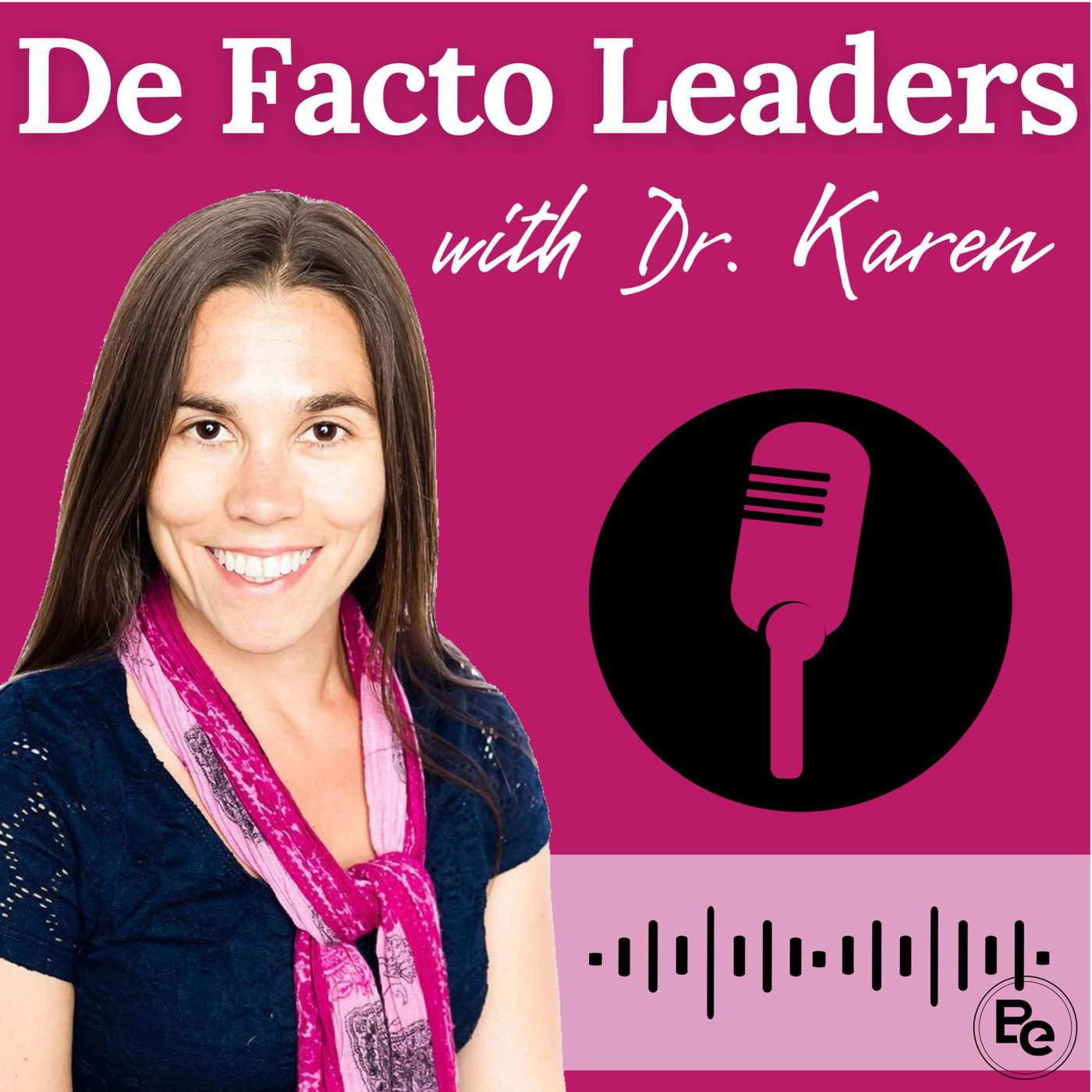
Dr. Karen Dudek-Brannan
De Facto Leaders
On the De Facto Leaders podcast, host Dr. Karen Dudek-Brannan helps pediatric therapists and educators become better leaders, so they can make a bigger impact with their services. With over 15 years of experience supporting school-age kids with diverse learning needs, Dr. Karen shares up-to-date evidence-based practices, her own experiences and guest interviews designed to help clinicians, teachers, and aspiring school leaders feel more confident in the way they serve their students and clients. She’ll cover a range of topics designed to help you support students' emotional and academic growth...
Author
Dr. Karen Dudek-Brannan
Category
Podcast website
Latest episode
Jul 1, 2026
Where to listen?
Podcasts in the app Replaio Radio Coming soonPodcasts are coming to the app soon. Install now and be the first to see a whole new take on podcasts
 Install for free
Android 5M+ downloads · 4.8 rating
iOS soon
Install for free
Android 5M+ downloads · 4.8 rating
iOS soon
Episodes
Scaffolding syntax and semantics for non-readers and redefining life skills 06.11.2024 35:55
Syntactic use is considered an “academic” skill that’s useful for reading comprehension and writing , but the impact of sentence comprehension goes way beyond school. Our ability to comprehend messages at the word and sentence level in oral and written language has a huge impact on our ability to function. So when clinicians ask me, “Should I focus on syntax, or should I focus on life skills?” , m...
Dynamic Assessment: Evaluations are a process, not a test (with Destiny Johnson) 30.10.2024 49:15
I regularly hear from therapists who ask me questions about how to evaluate language in a way that gives detailed, meaningful, and accurate information. Most people know standardized tests only show a small fraction of what we need to know when it comes to language and cognition, yet many clinicians still don’t consistently utilize a complete portfolio evaluation. A lot barriers get in the way, i...
Supporting multilingual students and taking part in state and national advocacy work (with Puja Goel and Prabhu Eswaran) 23.10.2024 59:30
Language evaluations are challenging enough; but when we’re evaluating multilingual and bilingual students, they become even more complex. When clinicians ask me about language evaluations, the questions are typically: What tools/protocols can I use? Who can I go to for help? How can I advocate for change if current policies don’t support best practices? That’s why I invited Prabhu Eswaran and...
Is it a behavior issue or a language and literacy issue? 16.10.2024 27:38
In this interview, I revisit conversations surrounding the school-to-confinement pipeline, giving students’ the language skills to understand their rights, the link between language, literacy and “behavior problems”, and how to get started with policy work. I share my commentary on the following: ✅ Why students who’ve received repeated detentions or suspensions should be screened or evaluated to...
Defining educational technology and considering homework equity issues 09.10.2024 34:05
In this interview, I revisit conversations surrounding the use of the term “dyslexia” in the schools, the use of technology, and equitable access to books. I share my commentary on the following: ✅Saying “dyslexia” in the schools: Both the positive and negative consequences ✅Educational technology definitions: What “counts” as technology? What’s the difference between instructional and assistiv...
Morphology hierarchies, etymology, and reframing the “joy” of reading. 02.10.2024 21:30
How much do we need to know about morphology and etymology to effectively help students? Is etymology an essential component to spelling and reading instruction? Will phonics instruction bore students? Is exposure to interesting books enough to foster a love of reading for people who don’t have solid word decoding skills? I revisit my conversations with Anna Gieger (Episode 177) and Dr. Jan Wasow...
Leveraging read-alouds to build language and getting started with advocacy work (with Dr. Molly Ness) 25.09.2024 53:39
Many skeptics of the science of reading are concerned that structured approaches will bore kids and make it less likely they’ll enjoy reading. These concerns are unfounded for a number of reasons. First, structured approaches help reach students who don’t learn through implicit learning (which is a lot of kids). It’s hard to develop a love of something when you’ve failed repeatedly and no one h...
Developmental language disorder: Impacts on literacy and life beyond school (with Dr. Karla McGregor) 20.09.2024 58:51
Students who meet the criteria for developmental language disorder (DLD) are often categorized as “speech only” in the school systems. In many cases, these students qualify for special education services under the eligibility category of “speech and language impaired” , which puts speech-language pathologists who serve as case managers in a difficult position ethically. Sometimes students may qu...
The relationship of literacy and language skills and involvement with the justice system (with Dr. Shameka Stewart) 18.09.2024 57:58
There is a disproportionate number of individuals with communication disorders and reading disabilities involved with the justice system for both children and adults. Past research suggests that more than 40% of incarcerated people have some type of nonpsychiatric disability (Berzofsky et al., 2015; Bixby et al., 2022; Thompson, 2022) Additionally, once youth are involved in the justice system, it...
Increasing book equity and fostering a love of reading (with Susan Brady) 13.09.2024 1:00:10
How can school leaders make informed decisions about reading curriculum when they know the home environments among their student body vary widely? I don’t envy people tasked with these kinds of decisions. My opinion is that schools should ensure students get their instructional needs met during the school day, because it’s difficult to control what happens to students once they leave the school ca...
Are we allowed to say “dyslexia” in the schools? (with Tom Parton) 11.09.2024 1:05:37
In 2015, the Office of Special Education Programs published a letter stating that school teams were “not prohibited” from using the term “dyslexia”. Unfortunately, this letter left many questions unanswered and is often misinterpreted. Parents seeking out services for their children are still unsure how to advocate for appropriate services in their schools and communities. School teams are still...
Debunking reading myths and defining literacy buzzwords (with Anna Geiger) 06.09.2024 51:12
There are many “science of reading” terms being used right now (including the “science of reading” itself). Yet debates about how to help kids become literate continues; and part of that is because of common logical fallacies applied to education. That’s why I invited Anna Geiger to episode 177 of De Facto Leaders to define important literacy terms and discuss myths associated with teaching readin...
Building the language skills for reading, writing, and spelling (with Dr. Jan Wasowicz) 04.09.2024 1:00:40
The “science of reading” is trending; but in order for professionals to engage in effective instruction, they need to understand that literacy also includes spelling and writing. Writing, spelling, and reading are interconnected, and the growing body of research continues to show us that these skills need to be taught explicitly. That’s why I invited Dr. Jan Wasowicz to episode 176 of the De Fac...
Re-release: The impact of texting on literacy and the skills needed for effective word-reading 28.08.2024 44:01
In this episode, I’m revisiting an older episode in honor of a special event that I'm doing in the month of September, 2024. I'm so excited to participate in the National Literacy Month series of podcasts , which we're presented in partnership between the Be Podcast Network and Reading Is Fundamental (RIF). De Facto Leaders is part of the BE Podcast Network (Link here: https://bepodcast.network/...
Creating a culture of collaboration on your school team (with Kurtis Hewson) 21.08.2024 59:06
I’m a huge supporter of professionals taking ownership of their careers; regardless of the systemic issues at play. But having said that, I ALSO like to help educators get to a place where they can work towards addressing systems issues head on. That’s why I was so excited to talk with Kurtis Hewson about the Collaborative Response Framework in episode 174 of De Facto Leaders. Kurtis Hewson is an...
School leadership and middle management (with Chris Dodge and Dr. Chris Jones) 14.08.2024 1:19:15
A while back, I heard someone refer to school administrators and other public sector leaders as “middle managers” , and it really hit home for me. As I’ve transitioned through different roles in my career, I’ve gotten into the trap of thinking that when I achieve the “next step”, I’ll finally have the influence I want. In my experience, telling myself that I’ll be satisfied with the level of im...
Increasing attendance with student engagement and connectedness (with Jen Perry) 07.08.2024 52:13
How can districts reverse chronic absenteeism and gain a deeper understanding of why students don’t come to school? Can we measure how “connected” students are to their schools? How do we impact the level of connection they feel with potential mentors in their lives? I invited Jen Perry to episode 172 of the De Facto Leaders podcast to discuss this topic and explore ways schools can assess stude...
Social-emotional learning for adults (featuring Crissy Mombela, Lisa Navarra, and Dr. Theresa Melito-Conners) 31.07.2024 46:21
Most discussions around social-emotional learning are about helping kids stay regulated, healthy, and adjusted, but we can’t forget about the adults. Being in any type of role that involves caring for others can be incredibly dysregulating; whether you’re a K-12 professional or a parent. That’s why in this episode, I’m highlighting past interview clips with guests that address emotional regulati...
Making intentional decisions and leaning on the expertise of your team (with Dr. Jen Schwanke) 24.07.2024 56:35
As a school leader, when is it best to make “top-down” decisions , and when should you make it a collaborative process ? How can you tell which stakeholder input to prioritize ? What’s the best way to communicate with your staff in a way that feels transparent , but doesn’t burden them with too much information ? How can you make decisions confidently when you’re supervising staff in positions yo...
How to support executive functioning with environmental scaffolding (self-talk, time-perception, planning) 17.07.2024 43:06
Today, I wanted to share some FAQs that people ask about how to teach executive functioning. Some of those common questions are: How do you teach self-talk, time-perception, and strategic-planning? How do you offer help without making kids prompt-dependent? I understand that executive functioning intervention is more than just checklists and behavior charts, but what’s the right way to structur...
What do administrators need from school therapists and teachers? (featuring Eric Makelky, Jalita Johnson, and Jethro Jones) 10.07.2024 39:03
Almost every school leader that I know has said they didn’t realize what they were getting themselves into when they started their first administrative position. In this episode, I wanted to share clips from past “De Facto Leaders” guests to showcase some of the challenges faced by school administrators (or those hoping to move into an administrative role). You’ll hear discussions on: ✅Qualiti...
A framework for executive functioning intervention: Three shifts for school teams 03.07.2024 41:18
As a professional field, we’re getting stuck in old ways of thinking when it comes to designing services for students experiencing executive dysfunction. When we think of “therapy” the first thing that comes to mind is a clinician sitting in a chair saying things like, “And how does that make you feel?” or a clinician doing exercises in a 1:1 or group setting. When we think of “planning for the...
The role of syntax in supporting language processing and executive functioning 26.06.2024 1:11:07
Language and executive functioning have a bidirectional relationship (Baron & Arbel, 2022; Larson, et al., 2019). This means that building language skills can impact executive functioning, and vice versa. A significant amount of executive functioning skills are required to comprehend language-based academic tasks like reading and writing. Yet strategic thinking (which is part of executive fu...
Turning litigious situations in to reading reform initiatives (with Mary Saghafi and Shannon Betts) 19.06.2024 1:12:30
Teacher preparation programs should equip reading teachers with the knowledge they need to provide explicit intervention for students who have dyslexia or other disabilities. But what if they don’t? Unfortunately, this situation is quite common. That’s why I invited Mary Saghafi and Shannon Betts from the Reading Teachers’ Lounge Podcast to episode 165 of the De Facto Leaders podcast to talk ab...
The content + strategy + retrieval trifecta for language and executive functioning (with Katy Wyatt) 12.06.2024 1:17:04
Is it functional to work on parts of speech? Is sentence diagramming useful? How do we improve word-retrieval in kids with developmental disabilities, and is it similar to what we’d do for an adult with a brain injury? How can we make therapy academically relevant and functional beyond just getting a good score on a standardized test? I invited speech-language pathologist and Language Therapy Adva...
Similar podcasts







Listen to the De Facto Leaders podcast in Replaio
Radio and podcasts in one app - free, with no sign-up. Install today and do not miss the launch
Replaio is not a podcast publisher; show names, artwork and audio belong to their authors and are distributed through public RSS feeds.