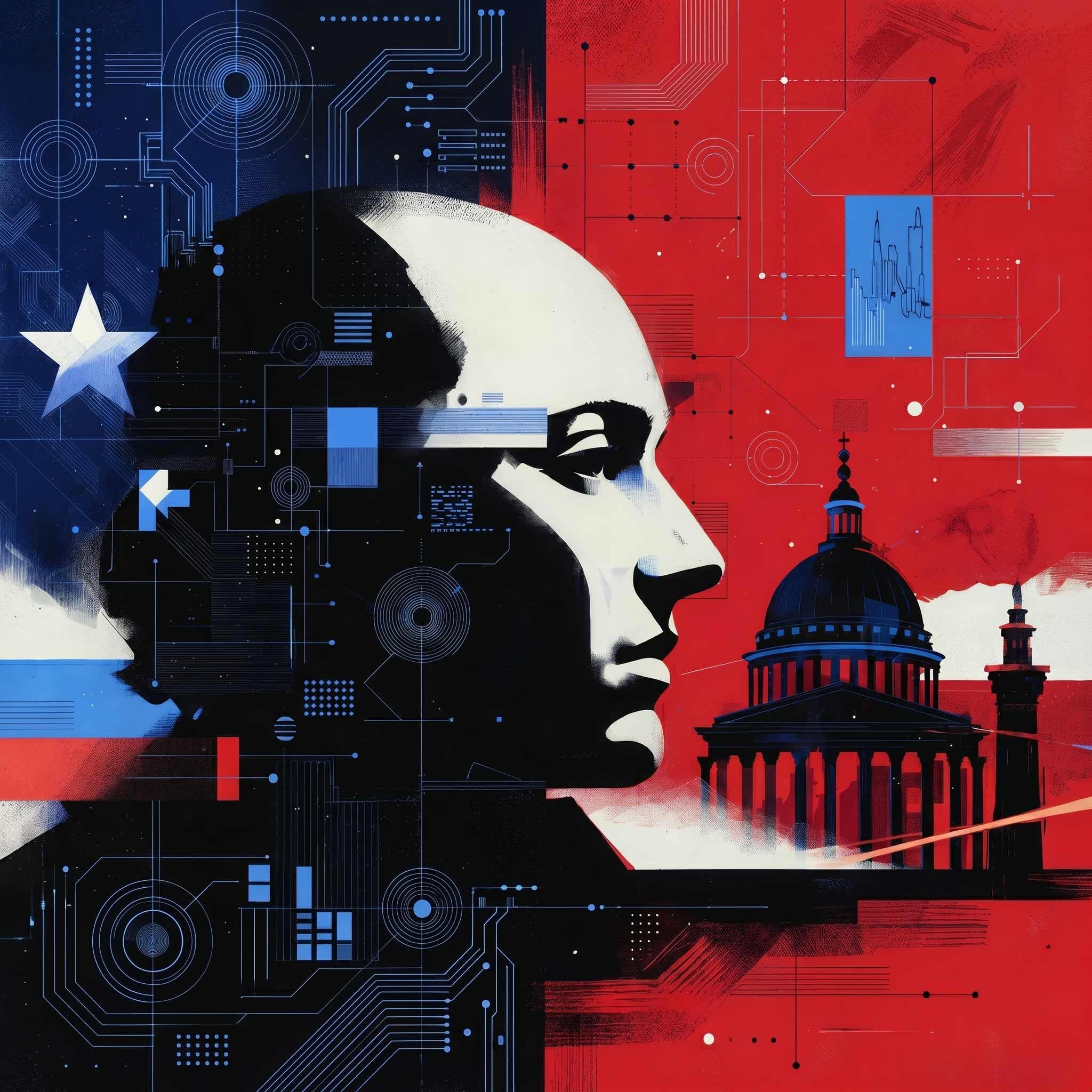
Jeff Kellick
Consequential Actions Podcast
Our overall goal is to help ourselves and the audience understand the rationale behind the actions of our collective past in order to learn from and address (effectively) the consequences of our present, and of our future. Help others understand what preceded us in various disciplines of study so that we will not waste our efforts reinventing what is already working, or by repeating and perpetuating our faults; but rather to refine the successes and correct the failures. We should learn from others, in their own words, to understand their motivations and determine their effectiveness over time...
Be sure to visit the podcast's website and support the creator: jeffkellick.substack.com
Author
Jeff Kellick
Category
Podcast website
Latest episode
Nov 7, 2026
Where to listen?
Podcasts in the app Replaio Radio Coming soonPodcasts are coming to the app soon. Install now and be the first to see a whole new take on podcasts
 Install for free
Android almost 10M downloads · 4.7+ rating
iOS soon
Episodes
The Loyal Opposition: The Anti-Federalists and the Ratification of the Constitution 07.11.2026 52:15
The Loyal Opposition: The Anti-Federalists and the Ratification of the Constitution Richmond, June 1788. Patrick Henry asks who authorized the men at Philadelphia to write "We, the people" instead of "We, the states" — and warns the convention to "guard with jealous attention the public liberty." The Constitution's critics lost, and the votes were close: a margin...
Kevin Gutzman on James Madison and the Constitution 05.11.2026 1:06:03
Kevin Gutzman on James Madison and the Constitution At twenty-five, James Madison moved the Virginia Convention past mere toleration to "the free exercise of religion." Eleven years later, he went to Philadelphia to ask for a veto over every law of every state — and came home with a federal union instead. Historian Kevin Gutzman calls Madison not the father of the Constitution but its un...
Not a Red Line but a Lever: Who Decides Who Governs Europe? 03.11.2026 38:54
The Federalist Papers and the European Union: Who Decides Who Governs? On the night of October 30, riot police lined the street outside Poland's Constitutional Tribunal in Warsaw. One of the tribunal's own judges had suspended its president and his deputy, Poland's president had turned his plane around to confront the judges, and the government pointed to a ruling from the Court of Jus...
From a League of Friendship to We the People: The Constitutional Convention of 1787 01.11.2026 58:16
From a League of Friendship to We the People: The Constitutional Convention of 1787 Philadelphia, Monday, July 2, 1787. The states answer one motion in turn, an equal vote for every state in the second branch of the new legislature, and the tally comes back five to five, with Georgia divided. Roger Sherman of Connecticut names what the vote has shown: "We are now at a full stop." James M...
Chris Gambino, Independent for PA House District 143 | Closed Primaries 29.10.2026 1:11:28
Chris Gambino, Independent for PA House District 143 | Closed Primaries In some Bucks County homes, a husband and wife register in opposite parties before every primary. They do not disagree: in Pennsylvania only party members may vote in a party's primary, and where one party is sure to win, the primary decides the seat. More than one Pennsylvania voter in eight belongs to neither party. Chris Ga...
In All Cases Whatsoever: The Case Against Nationalizing SpaceX 27.10.2026 46:06
Starlink, Ukraine and the Call to Nationalize SpaceX | Youngstown v. Sawyer In October, the satellite link guiding Ukraine's drones began dropping out above about 100 miles per hour, and no one would own the decision. Elon Musk wrote that the U.S. military and ultimately the President decide the limits on Starshield; Secretary of State Marco Rubio said no one at the White House ordered a slowd...
From the Rights of Englishmen to the Laws of Nature: The Road to the Declaration 25.10.2026 56:45
From the Rights of Englishmen to the Laws of Nature: The Road to the Declaration In June 1776, Thomas Jefferson's draft of the Declaration called its truths "sacred and undeniable." Those two words were struck through, and a new one was written above them: self-evident. A self-evident truth needs no charter, no statute, and no ancient constitution. In 1765 the colonists stood on thei...
Liberty by Default: Ken Krawchuk's Education Plan and the Governor's Veto 22.10.2026 1:15:49
Ken Krawchuk Interview: The Libertarian Running for Pennsylvania Governor Twelve days before Pennsylvania chooses a governor, Libertarian nominee Ken Krawchuk takes up the history of the week: New England towns that voted their own taxes and refused one laid by a governor they had not chosen. This is the interview episode for Week 17 of Self-Evident: The Road to 1776, "Self-Government Before...
Incorporation: Does the Bill of Rights Bind the States? Kian v. Florida 20.10.2026 42:39
Incorporation: Does the Bill of Rights Bind the States? Kian v. Florida In 1789 James Madison asked Congress to bar the states from violating the rights of conscience, the freedom of the press, and trial by jury in criminal cases. He called it the most valuable amendment on the list. The Senate struck it out. This term the Supreme Court decides whether Florida may convict a man of a felony with a...
The Mayflower Compact to the Town Meeting: How Colonial New England Governed Itself. “Self-Government Before Theory” 17.10.2026 46:57
The Mayflower Compact to the Town Meeting: How Colonial New England Governed Itself In November 1620, the Mayflower dropped anchor far outside the only patent its passengers held. Before anyone went ashore, forty-one men promised to make just and equal laws and to obey them. The paper named no office and stated no right. The habit it began lasted a century and a half. New Englanders elected their...
The Houthis vs. Saudi Arabia: Who Can End Yemen’s War? 13.10.2026 44:47
The Houthis vs. Saudi Arabia: Who Can End Yemen's War? On Saturday a Houthi missile struck Riyadh's airport and killed thirteen people, one of them an American. In Yemen, tribal mediators have spent the whole war bringing the dead home to their families before anyone speaks of terms. Episode 16B sets the war in Yemen and over Saudi Arabia beside the condolence rite of the Haudenosaunee Gre...
Did the Iroquois Shape the Constitution? The Great Law of Peace 10.10.2026 33:24
Did the Iroquois Shape the Constitution? The Great Law of Peace In 1744 an Onondaga speaker told three English colonies to unite as his forefathers had. Franklin printed the speech. When the colonists designed a union, they did not copy it. This is Episode 16 of Self-Evident: The Road to 1776, and it opens Week 16 of the series. It corresponds to Article 16, published October 5 on consequentialact...
Peter McPhee on the French Revolution: Robespierre, the King's Trial, and the Terror 08.10.2026 1:04:46
Who Decides When the Emergency Ends? Peter McPhee on the French Revolution In 1793, France gave sweeping emergency powers to a few committees. Historian Peter McPhee explains why, and why ending them became a deadly question. This is the interview episode for Week 15 of Self-Evident: The Road to 1776, "The Fork in the Road": Voltaire, Rousseau, and the Two Enlightenments. Tuesday's e...
The Draft Was Never Repealed. Here Is What Changes in December 06.10.2026 1:13:15
Automatic Draft Registration (Dec. 2026) and the History of the American Draft This December, Selective Service registration becomes automatic. The duty to sign up moves from the man to the government, and the agency that has to run it withdrew its implementing rules in July without ever publishing them. When a majority decides the country needs soldiers and will not wait for volunteers, what exac...
Does Majority Consent Make You Free? Voltaire, Rousseau & the General Will 04.10.2026 1:28:28
Self-Evident: The Road to 1776 — Ep. 15 Voltaire vs. Rousseau: Toleration, Consent & the General Will In 1762 a Protestant cloth merchant was broken on the wheel in Toulouse for a murder that never happened. Voltaire spent three years getting the verdict overturned, and the case became the occasion for his Treatise on Tolerance. That same summer, Rousseau’s Social Contract was burned in Geneva...
What Did Your Straight Ticket Buy? Both Parties' Platforms, Graded 01.10.2026 42:56
What Did Your Straight Ticket Buy? Both Parties' Platforms, Graded. A Contemporary Bonus Episode to the series: Parties, Ideologies, and Systems. A party-line vote is a vote for a party, and the one formal statement a party adopts of what it stands for is its convention platform. Almost nobody reads it. Bob Dole said he never read his own. This episode reads them. Each of the two major parties...
Humboldt County's Cannabis Fines & the Civil Jury | Jared McClain, Institute for Justice 24.09.2026 1:13:32
Self-Evident: The Road to 1776 — Episode 14i Prosecutor One Day, Judge the Next: Inside America's In-House Courts | Jared McClain Montesquieu wrote that there is no liberty if the power of judging is joined to the power of carrying out the law. Jared McClain, a senior attorney at the Institute for Justice, works on the far side of that problem: a county hearing officer hired by the county that...
Massie, Hegseth & the Epstein Petition: Why Congress Stopped Checking 22.09.2026 51:01
Self-Evident: The Road to 1776 — Episode 14B The House Didn’t Vote No. It Just Went Home. On September 15, 2026, Rep. Thomas Massie read eight articles of impeachment against Secretary of Defense Pete Hegseth on the House floor and gave notice of them as a question of the privileges of the House — a rule that puts the question on a two-legislative-day clock. The House did not take it up, and it di...
Everyone Quotes Montesquieu Almost Nobody Reads Past the First Page 19.09.2026 1:23:07
Montesquieu and the Separation of Powers: The Spirit of the Laws Explained In 1748, a retired French magistrate published The Spirit of the Laws anonymously. Within three years, the Church banned it; within forty, Americans on both sides of the constitutional ratification fight relied on it to make their case. This episode explores Book 11, Chapter 6—the most quoted yet misunderstood passage of 18...
Socialist Calculation Debate Explained: Menger, Mises, Hayek and "I, Pencil" in 2026 16.09.2026 1:05:01
Self-Evident: The Road to 1776 — Episode 13B Nobody Knows How to Make a Pencil. So What Is a Price Actually Telling You? In December 1958, Leonard Read published an essay in the voice of a pencil, and its claim still holds. Not one person in the pencil’s global supply chain knows how to make one, and the pencil gets made anyway. Something tells each of those people what to do, and much of what rea...
Adam Smith and Adam Ferguson: The Wealth of Nations, An Essay on the History of Civil Society, and the Militia Question 13.09.2026 1:32:01
Self-Evident: The Road to 1776 — Episode 13 Adam Smith Made the Case for the Free Market. Then, in the Same Book, He Wrote the Strongest Objection to It. Two men were born in Scotland in 1723, a county apart. They joined the same Edinburgh club, kept the same friends, and worked from the same premise about what commercial life does to a people. They never agreed about the remedy. Every account of...
David Evans of Sentiero Ventures on Artificial Intelligence, Lyapunov Time, and the Knowledge Problem | Self-Evident Week 12 10.09.2026 1:08:26
Self-Evident: The Road to 1776 — Episode 12i I Asked an AI Investor Whether a Machine Could Set Every Rent in New York. He Said It Absolutely Could. David Evans is the founder and managing partner of Sentiero Ventures, an early-stage venture fund outside Dallas that invests in business software where artificial intelligence is the core of the product. He has been writing software since the early 1...
NYC Municipal Grocery Stores, the Rent Freeze, and Federal Equity Stakes: Hume's Knowledge Problem in 2026 09.09.2026 57:55
Self-Evident: The Road to 1776 — Episode 12B A City Promised Groceries 30% Below Retail. Somebody Still Has to Decide 30% Below What. In July, New York City published a request for proposals for five publicly funded, privately operated grocery stores. A core basket sells at thirty percent below retail, reset once a month. The information session was August 5. Proposals are due at four o’clock on O...
Hutcheson, Hume, and the Scottish Enlightenment: Undesigned Order Before It Had a Name 05.09.2026 1:25:38
Self-Evident: The Road to 1776 — Episode 12 The Country That Made David Hume Refused to Hire Him In the spring of 1745 a man of thirty-four sat down in Edinburgh to defend himself anonymously against charges of atheism and skepticism, because a chair had come open at the university in his own city and he wanted it. It did not work. The clergy organized, the town council gave the post to William Cl...
James Ostrowski on the 1689 Arms Clause, the NY SAFE Act Reversal, and Government Takes 80% 02.09.2026 1:20:30
Self-Evident: The Road to 1776 — Episode 11i I Asked a Forty-Year Appellate Lawyer What a Court Is For. He Said It Is a Bureaucracy. James Ostrowski is a trial and appellate lawyer in Buffalo, New York, in his forty-second year of practice. He took degrees from SUNY Buffalo and Brooklyn Law School, sat in Murray Rothbard’s private seminar, wrote the Cato study “Thinking about Drug Legalization” in...
Similar podcasts


Listen to the Consequential Actions Podcast podcast in Replaio
Radio and podcasts in one app - free, with no sign-up. Install today and do not miss the launch
Replaio is not a podcast publisher; show names, artwork and audio belong to their authors and are distributed through public RSS feeds.