
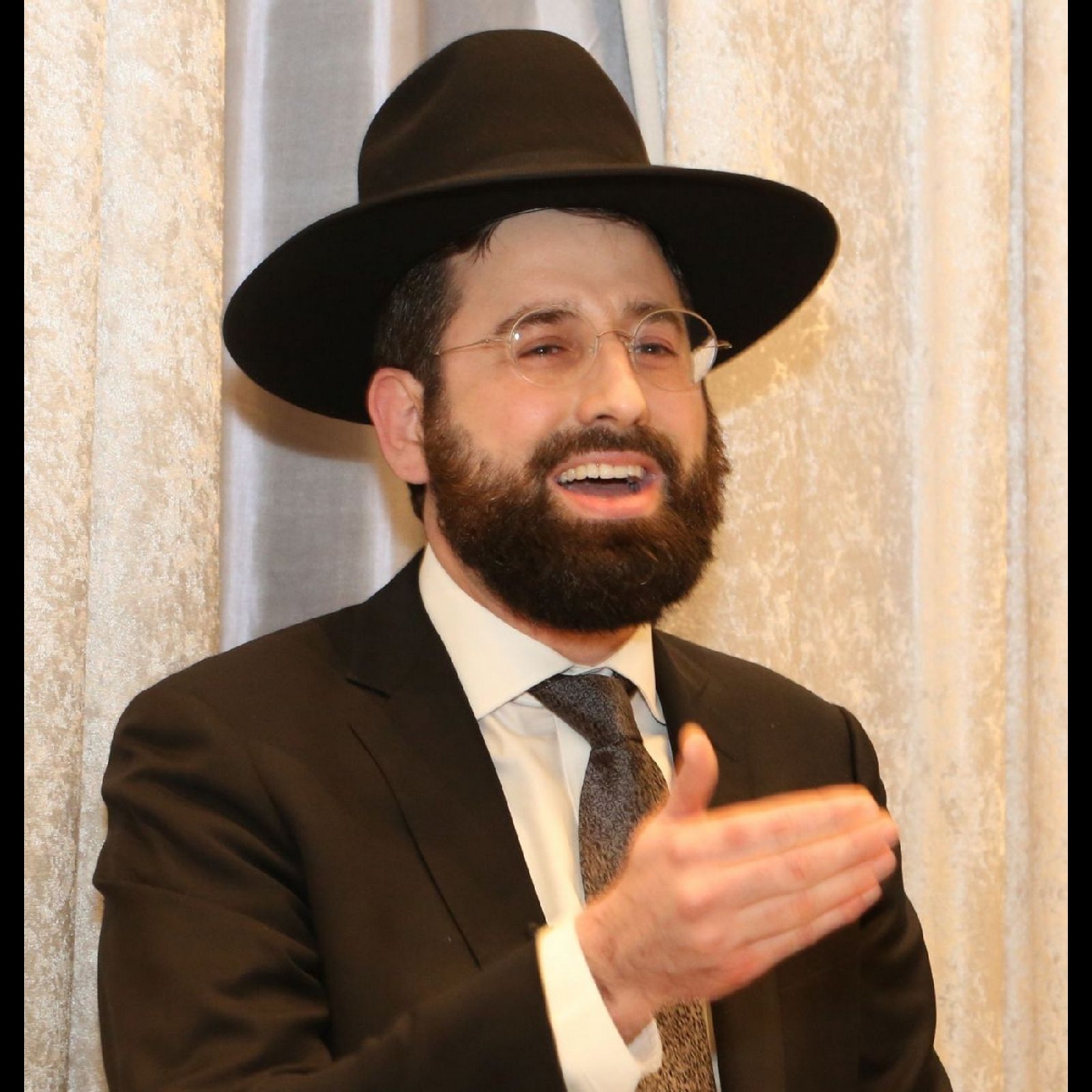
Torah Teacher Ariel ben-Lyman HaNaviy
Complete Parashah Library (Messianic)
These 105 podcast episodes represent the complete 54 Parashat HaShavua (Weekly Torah Portions) as produced by myself, Torah Teacher Ariel. Visit my home site at TetzeTorah.com for more Messianic resources. While you are there, we invite you to fill in your name and email address to subscribe to Ariel’s Weekly Messianic Newsletter to receive the written commentaries delivered to you by email, and as a bonus, you will also receive the email-exclusive written commentary to the Haftarah portion!
Be sure to visit the podcast's website and support the creator: www.tetzetorah.com
Author
Torah Teacher Ariel ben-Lyman HaNaviy
Category
Podcast website
Latest episode
Jan 10, 2026
Where to listen?
Podcasts in the app Replaio Radio Coming soonPodcasts are coming to the app soon. Install now and be the first to see a whole new take on podcasts
 Install for free
Android almost 10M downloads · 4.8 rating
iOS soon
Install for free
Android almost 10M downloads · 4.8 rating
iOS soon
Episodes
29 Acharei Mot (Part C) - After the death - Leviticus 16:1-18:30 10.01.2026 34:03
Yeshua’s Bloody Atonement Sacrifice Obvious by now with the arrival of Yom Kippur, comes this central aspect of our relationship with our Holy God: atonement. Why is atonement so important to HaShem? Apparently, ever since the incident in the Garden of Eden, mankind has carried within himself the sinful propensity of that first act of disobedience, and consequently, the sinful results as well. Our...
29 Acharei Mot (Part D) - After the death - Leviticus 16:1-18:30 10.01.2026 34:22
The thrust of this week's commentary has been presented in an effort to educate the two camps: Jews and Gentile Christians. Many Messianic as well as non-Messianic Jews still struggle with the intended meaning of "what it means to be a new creation in Messiah, walking out his Torah in our lives"; moreover, many non-Jewish Christians struggle with this issue as well. By default, the world does not...
30 K’doshim - Holy people - Leviticus 19:1-20:27 10.01.2026 44:18
Walking in K’dushah Apart from being an attribute of God—one that we inherit intrinsically with our trusting faithfulness in the Messiah, holiness is also meant to be a lifestyle. This is why I keep using the phrase ‘trusting faithfulness’ rather than simple ‘faith’. The latter implies a one-time action on our part, which forever sets into motion a spiritual truth that will be fully actualized at...
31 Emor (Part A) - Speak - Leviticus 21:1-24:23 10.01.2026 37:10
The thrust of the priestly instructions of chapters 21 and 22 is summed up in the final verses of chapter 22: “You are to keep my mitzvot and obey them; I am ADONAI. You are not to profane my holy name; on the contrary, I am to be regarded as holy among the people of Isra'el; I am ADONAI, who makes you holy, who brought you out of the land of Egypt to be your God; I am ADONAI.” These words are ext...
31 Emor (Part B) - Speak - Leviticus 21:1-24:23 10.01.2026 40:46
Mo’eydim (Festivals) The most easily recognized feature of our parashah this week is the listing of the Mikra’ey Kodesh, that is, the Holy Convocations. Since we carry studies on each individual Festival at my web sites, I will provide highlights from each one for us here in Parashat Emor. The Feasts of ADONAI are just that: Feasts of ADONAI! They are not man’s feasts; they are not Isra'el’s feast...
31 Emor (Part C) - Speak - Leviticus 21:1-24:23 10.01.2026 43:23
Shavu’ot (Pentecost) – the giving of the Torah, the giving of the Ruach HaKodesh, firstfruits, ecclesiology Rosh HaShanah/Yom T’ruah (New Year/Feast of Trumpets) – eschatology
31 Emor (Part D) - Speak - Leviticus 21:1-24:23 10.01.2026 50:27
Succoth (Feast of Tabernacles/Ingathering) – worship, praise, redemption, eschatology, thanksgiving, celebrating the harvest of righteousness in our lives An Eye for an Eye Before I close out the parashah, I want to briefly share some Talmudic quotes that revolve around an issue found in chapter 24 verses 17-22: Version: NAS Lev 24:17-22 17. 'And if a man takes the life of any human being, he shal...
32 B’har (Part A) - On Mount - Leviticus 25:1-26:2 10.01.2026 46:33
“Speak to the children of Yisra'el, and tell them, When you come into the land which I give you, then shall the land keep a Shabbat to ADONAI. Six years you shall sow your field, and six years you shall prune your vineyard, and gather in the yield of it; but in the seventh year shall be a Shabbat of solemn rest for the land, a Shabbat to ADONAI: you shall neither sow your field, nor prune your vin...
32 B’har (Part B) - On Mount - Leviticus 25:1-26:2 10.01.2026 44:23
Working and Resting All of this can seem fairly insignificant to us living with the Western mentality. But this was extremely important to those living in the Land, during the time of the TaNaKH when the Torah acted as the living Constitution as well as a daily guide for godly living. Here couched within this tiny parashah we see an awesome display of the mercy and compassion that HaShem has for a...
33 B’chukkotai (Part A) - By my regulations - Leviticus 26:3-27:34 10.01.2026 38:29
We have finally come to the last portion of Vayikra, known as Parashat B’chukkotai (say “b-choo-koh-tie”; the “ch” is as the “ch” in Bach). The root word from which our Torah portion’s title is taken is “choke,” and it means “statute, ordinance, limit, something prescribed. ” This should not be confused with its counterpart “Torah” which is also sometimes translated along these same lines. I under...
33 B’chukkotai (Part B) - By my regulations - Leviticus 26:3-27:34 10.01.2026 28:42
These are very important questions, which need answering, if we are to understand one of the primary purposes for the giving and doing of the Torah. Before I give my opinions as a Torah Teacher I want to share the opinions of one of the greatest sages of Isra'el’s past, Rabbi Moshe ben-Maimon (Maimonides, a.k.a., RaMBaM). The Mishneh Torah, a code of Jewish law, was compiled between 1170 and 1180,...
33 B’chukkotai (Part C) - By my regulations - Leviticus 26:3-27:34 10.01.2026 30:11
It is my understanding that the errors surrounding one’s relationship to Torah can be corrected once a person resolves the issues surrounding identity and legalism, begins to understand the intended nature and function of the Torah in the first place, and then faithfully applies it to their own lives. Because the Messiah has already come, the Torah is now a document meant to be lived out in the li...
33 B’chukkotai (Part D) - By my regulations - Leviticus 26:3-27:34 10.01.2026 31:56
Torah Observance is a matter of the heart. It always has been and always will be. The Torah Proper (first Five Books of Moshe) instructed the people of Isra’el to “love ADONAI your God with all their heart, all your being and all your resources” (Deuteronomy 6:5). This is where “Shomer Mitzvot” begins—by loving HaShem, and accepting Him on His terms. By this, I mean accepting His means of covenant...
34 B’midbar - In the desert - Numbers 1:1-4:20 10.01.2026 42:05
The Worth of a Man Rashi (Rabbi Shlomo Yitzchaki) notes at the beginning of the Book that God counted the nation at every significant turn because he loves it. So too, the fact that the people were counted as individuals proves the infinite worth of every Jew, and sets the precedent for God’s undying love to see every one of his created subjects return to a loving relationship with him through his...
35 Naso - Take - Numbers 4:21-7:89 10.01.2026 1:00:34
I personally believe that our sages had some wise things to say about the Torah, considering the fact that they lived in an era when the knowledge of the Messiah was either suppressed or rejected. However, we who know the Blessed Name of the Messiah Yeshua, and the power of his fellowship, can add further insight to this ancient benediction. 'Y’varekh’kha ADONAI v’yishmerekha. [May ADONAI bless yo...
36 B’ha'alotkha (Part A) - When you set up - Numbers 8:1-12:16 10.01.2026 39:10
In Yesha'yahu 11:1-5, we are given a vivid description of the coming Messiah. All rabbinical sources, as well as Christian scholars agree that this passage is a prophecy concerning the long-awaited Savior. The "Branch of Yishai" is a reference to his bloodline. Yishai (Jesse) was the father of Dah-vid the King. It was a well-known fact that the Messiah was to be born from Dah-vid's loins. The Tora...
36 B’ha'alotkha (Part B) - When you set up - Numbers 8:1-12:16 10.01.2026 28:15
In the opening few verses of our current parashah, we learn that the actual, removable lamps, which rest upon each branch, “face” inward towards the central shaft, and consequently towards the center lamp as well (picture an “Aladdin’s type” lamp with a handle on one end and a spout at the opposite end where the wick protrudes). Rashi confirms this in his commentary to these p’sukim: Our Sages fur...
36 B’ha'alotkha (Part C) - When you set up - Numbers 8:1-12:16 10.01.2026 33:31
In Genesis chapter one, verses 1-5, the Hebrew word “Torah” can be found if we count every 50th letter. Now, we must remember that Hebrew reads right-to-left, so our Hebrew word “Torah”, consisting of the four letters “Tav”, “Vav”, “Resh”, and “Heh” (T-V-R-H) would look like this in our text (beginning with the first “Tav” that we find: H-(49 spaces)-R-(49 spaces)-V-(49 spaces)-T In Exodus chapter...
37 Shlach L’kha (Part A) - Send on your behalf - Numbers 13:1-15:41 10.01.2026 43:06
Shabbat Violation The Torah helps to paint a picture of work and rest, slavery and freedom, which spiritually amounts to life and death. How so? In the Renewed Covenant book of Galatians, Rabbi Sha’ul tell us: "Don’t delude yourselves: no one makes a fool of God! A person reaps what he sows. Those who keep sowing in the field of their old nature, in order to meet its demands, will eventually reap...
37 Shlach L’kha (Part B) - Send on your behalf - Numbers 13:1-15:41 10.01.2026 38:36
Garment of Praise The portion this week contains Judaism’s first mitzvah (commandment) concerning the tzitzit, that is, the tassel that adorns a modern observant Jewish person’s clothing. Chapter 15:37-41 clearly teaches the offspring of Avraham to attach a “ribbon of blue” to the extremity or “wing” (Heb: kanaf) of their garments. It is easy to assume that these p’sukim (verses) are meant to be a...
37 Shlach L’kha (Part C) - Send on your behalf - Numbers 13:1-15:41 10.01.2026 41:10
Traditions play an important part of our daily walk as new creations in Messiah Yeshua. In my opinion, some traditions enhance that walk, while other traditions hinder it. Logic dictates that if a tradition comes directly from the Torah, then HaShem designed it to enhance our walk. According to Jewish tradition, men wear a tallit to signify obedience to the above-mentioned mitzvah, to signify the...
37 Shlach L’kha (Part D) - Send on your behalf - Numbers 13:1-15:41 10.01.2026 42:23
Menachot 42b And for what purpose do the Rabbis use the expression ‘That ye may look upon it’? — They require it for the following teaching: ‘That ye may look upon it, and remember’, that is, look upon this precept and remember another precept that is dependent upon it, namely, the reading of the Shema’. As we have learnt: From what time in the morning may the Shema’ be read? From the time that on...
37 Shlach L’kha (Part E) - Send on your behalf - Numbers 13:1-15:41 10.01.2026 11:28
Conclusions If you are still not sure you understand the true intent behind Torah observance (which includes the command to wear fringes), I suggest reading my introductory teachings in this series. They are available at this web site, or you may write to me personally. As you seek to become more obedient to HaShem's Torah, by adding the mitzvah of the tzitzit, here is the traditional blessing by...
38 Korach - Korah - Numbers 16:1-18:32 10.01.2026 46:05
This is Parashat Korach. This is the telling of the story of the disloyalty of Korach, son of a Levite, and that rebellious bunch that followed him. I call it disloyalty owing to the fact that this complaint of Korach's was an audience designed to address the current leadership of Moshe and Aharon. However, knowing Korach’s heart, a better-suited term might be open mutiny! A summary of the story g...
39 Hukkat (Part A) - Regulation - Numbers 19:1-22:1 10.01.2026 39:48
Parah Adumah - A Unique Commandment The mitzvah of the Red Heifer (referred to in Judaism as Parah Adumah, literally “Red Cow”) is a peculiar command indeed. A couple of details make this mitzvah unique. To begin with, the participants are commanded to slaughter and burn completely this female cow without blemish. If you will recall from reading Vayikra, touching a dead animal’s carcass renders on...
Similar podcasts







Listen to the Complete Parashah Library (Messianic) podcast in Replaio
Radio and podcasts in one app - free, with no sign-up. Install today and do not miss the launch
Replaio is not a podcast publisher; show names, artwork and audio belong to their authors and are distributed through public RSS feeds.
