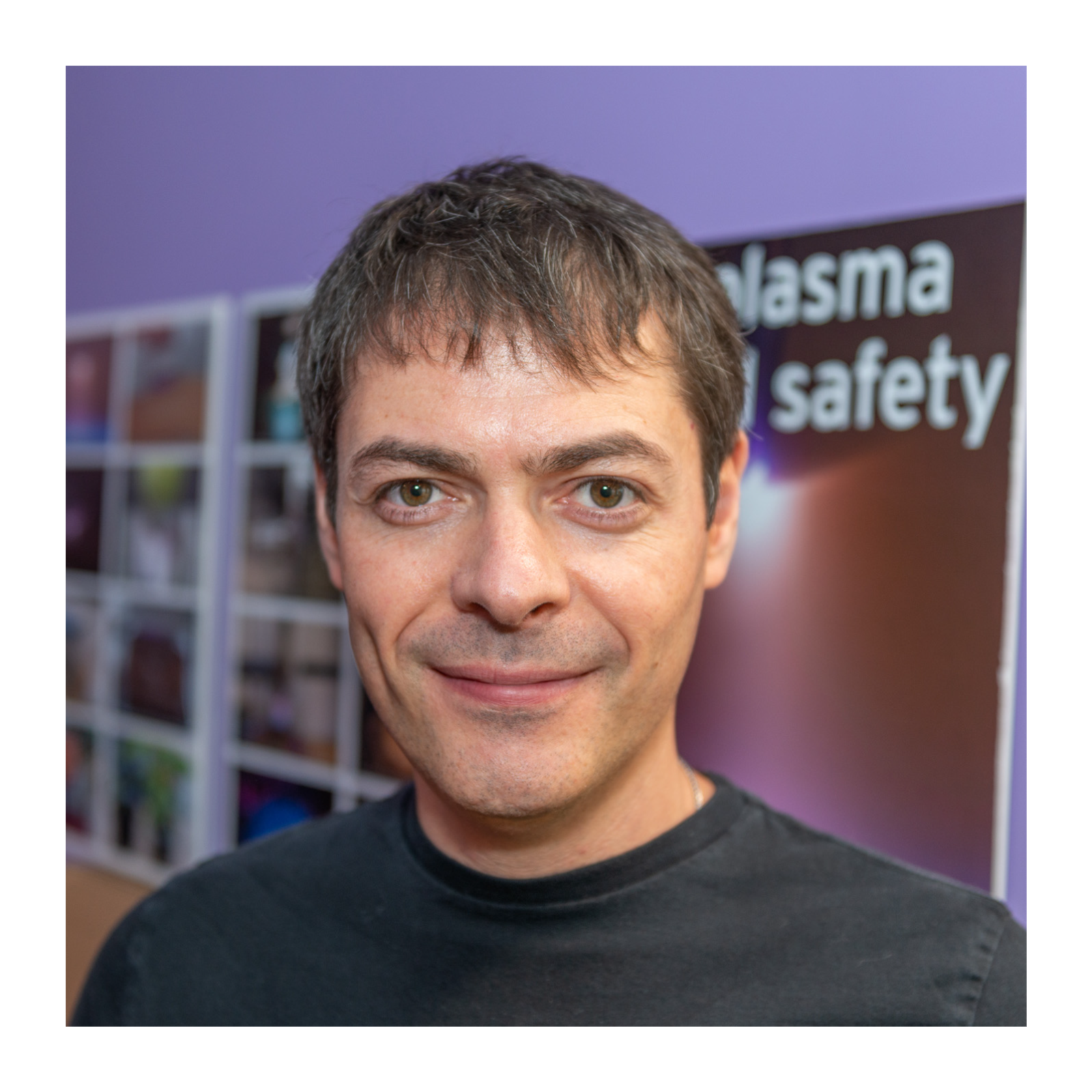
Gregory Fridman
Chat with Greg Fridman
I'm Greg Fridman, a PhD in Bioengineering and an expert in non-equilibrium plasmas. This channel is a space for direct chats about the things that actually matter: the future of biotech, the fascinating physics of plasmas, and the unfiltered reality of the scientific life. No jargon, no gatekeeping—just the science. Subscribe to join the conversation as we explore how bioengineering is reshaping our world and what it’s really like to work at the edge of discovery.
Be sure to visit the podcast's website and support the creator: rss.com
Where to listen?
Podcasts in the app Replaio Radio Coming soonPodcasts are coming to the app soon. Install now and be the first to see a whole new take on podcasts
 Install for free
Android 10M+ downloads · 4.7+ rating
iOS soon
Episodes
Plasma art? (answering viewer's question) 02.04.2026 17:22
Why are transient luminous events so rare? In this video, I respond to a question from @giangnguy1 and dig into the physics behind sprites, jets, elves, and other strange flashes in the upper atmosphere. Along the way, I talk about why lightning appears white, how different gases produce different plasma colors, and what determines how plasmas are generated here on Earth and in space. I also zoom...
The Real Future of Medical Devices (Not What You Think) 31.03.2026 26:43
What is the future of medical devices? Most discussions focus on hype — AI, robotics, or breakthrough technologies. But real progress in medical devices is shaped by something else entirely: engineering constraints, regulatory pathways, and clinical realities. In this episode, I break down: • Why medical device innovation is slower than people expect • What actually drives adoption in healthcare •...
How to Read a Scientific Paper Like a Real Scientist 28.03.2026 17:53
Scientific papers are often treated as final answers. But real scientists read them very differently. In this episode, I explain how researchers actually evaluate scientific papers: • Why the abstract can be misleading • Why figures are often the most important part of a paper • How to evaluate methods and experimental design • How to distinguish correlation from causation • Why limitations matter...
The Viral Lightning Photo Is Misleading (Here’s What They Actually Measured) 26.03.2026 6:13
A recent Smithsonian Magazine article claims scientists captured “ultraviolet sparkles” coming from treetops during thunderstorms — and the image used is dramatic, cinematic… and completely unrelated to how the science was actually done. In this video, I break down the original research paper and explain: • What the scientists actually measured • Why ultraviolet emissions behave the way they do in...
Am I a Scientist? (A Viewer Asked Me This…) 24.03.2026 17:56
A viewer asked me a simple question: “Are you a scientist?” It turns out, the answer isn’t as straightforward as it seems. In this video, I explore what it really means to be a scientist—starting with a comparison to photography, where not everyone who takes pictures considers themselves a photographer. I also touch on the work of Marcel Duchamp and how art challenges our definitions of identity a...
A Viewer Asked: Do Pressurized Plasmas Exist? 21.03.2026 10:00
A viewer asked a great question: “You mentioned atmospheric plasmas and plasmas in vacuum. Do people research pressurized plasmas?” 00:00 Intro 00:35 Question about high pressure plasmas 01:02 About this channel 01:39 High, medium, low pressure plasmas 02:09 Spark plug in your ICE engine 04:47 Paschen's law 07:19 Industrial high pressure systems 08:36 Modern research directions 09:46 Closing remar...
The Science of Sterilization: Heat, Radiation, Chemicals, and Plasma 19.03.2026 18:12
Sterilization is fundamental to modern medicine, but most people don’t realize how complex it really is. In this episode, I break down how sterilization actually works and where different technologies succeed or fail. We discuss: • What sterilization really means (and how it differs from disinfection) • Heat sterilization and autoclaves • Chemical sterilants like ethylene oxide and hydrogen peroxi...
Plasma Bioengineering Myths 17.03.2026 21:17
Bioengineering is full of oversimplifications. In this episode, I break down common myths that show up in research papers, startups, and even academic labs: • “More power = more effect” • “In vitro results translate directly to patients” • “Reactive species are always harmful” • “If it works once, it scales” • “Plasma is just oxidation” We’ll talk about dose-response behavior, mechanistic rigor, n...
From Lab to Prototype: The Ugly Middle of Innovation 14.03.2026 24:56
Most technologies don’t fail in the lab. They fail in the messy middle — between promising data and a working prototype. In this episode, I talk about: • Why elegant theory breaks under engineering constraints • The first prototype shock • Thermal, electrical, and materials challenges • The TRL funding gap • Iteration discipline and kill criteria • When to pivot vs when to persist Having spent ove...
Reactive Oxygen & Nitrogen Species: What They Really Are (And Why They Matter) 12.03.2026 25:04
Reactive Oxygen and Nitrogen Species (RONS) are central to plasma medicine, sterilization science, and environmental remediation. But what are they really? In this episode, I break down: • What makes a species “reactive” • The major oxygen and nitrogen radicals • How atmospheric pressure plasma generates them • Why lifetimes and dose matter • Measurement challenges and common misconceptions • Wher...
4 Plasma Questions You Should Be Asking 10.03.2026 16:35
In this chat, I answer 4 big questions about plasma physics inspired by a thoughtful viewer comment: 1. Should plasma appear on phase diagrams? 2. Does plasma move like a gas — or something else entirely? 3. What elements and compounds are most interesting to turn into plasma? 4. Are transient luminous events like sprites and blue jets scientifically important? Plasma is often called the fourth st...
How Science Really Gets Funded in the U.S. 07.03.2026 26:56
How does science really get funded in the United States? In this episode, I break down: • How federal agencies allocate research funding • What reviewers actually look for • The difference between academic and industry incentives • Why “high-risk, high-reward” is more nuanced than it sounds • How funding shapes the direction of scientific research Having spent over a decade as a research professor...
PFAS: What Actually Works (And What Doesn’t) — An Engineer’s Perspective 05.03.2026 8:43
PFAS are often called “forever chemicals.” But what does that really mean? In this episode, I break down PFAS from an engineering perspective: • Why carbon-fluorine bonds are so difficult to break • The difference between removal and destruction • Why filtration is not the same as elimination • What incineration, electrochemistry, and plasma actually do • Where the real technical challenges lie Th...
Bioengineering vs. Med School: Which is harder? 03.03.2026 6:06
I get asked this a lot: "Greg, with your background, why didn't you just go to Medical School?" In this video, I’m sharing the personal reason I chose the lab over the clinic. It comes down to one thing: Scale. I wanted to build the technologies that would empower doctors to heal things we previously thought were "unhealable." If you’re a student or just curious about the path of a scientist, this...
Atmospheric Plasma Surface Modification of Textiles Explained 28.02.2026 11:50
Plasma isn’t just for rockets or fusion research — it’s used to treat fabrics for clothing every day. In this episode, I explain how atmospheric pressure non-thermal plasma modifies textile fibers at the nanometer scale to improve dyeing, adhesion, antimicrobial performance, and moisture wicking — all without heat damage or chemical baths. We cover: • Surface activation • Nano-scale etching • Func...
The End of Food Recalls? Plasma-Activated Water Explained 26.02.2026 3:16
What if the secret to safer, fresher food wasn't a new chemical, but just a different kind of water?
The Reality of Plasma Weapons: Physics vs. Video Games 24.02.2026 7:09
We see plasma weapons everywhere in gaming—especially in the Final Fantasy universe—but how would they work in our world? In this video, we analyze the energy requirements, magnetic containment, and heat management needed to turn the 4th state of matter into a tactical tool.
What is Plasma? The 4th State of Matter Explained 21.02.2026 7:12
What is plasma? Most people think of blood or TV screens, but in physics, plasma is a high-energy "soup" of charged particles. From lightning bolts to the surface of the Sun, we explore the science behind the most common state of matter in the cosmos.
Advice to My 17-Year-Old Self: 3 Lessons in Engineering & Life 20.02.2026 4:12
I recently had the opportunity to speak with three cohorts of seniors at Bexley High School in Columbus, OH, about my journey in plasma physics and engineering. While we talked a lot about science, the most important part of the day was sharing the "human" side of a technical career.
The Molecule That Protects Your Blood and Poisons Your Air 20.02.2026 2:11
What if I told you there’s a molecule inside you right now acting as a microscopic assassin? In this video, we explore the strange world of Peroxynitrite.
Is the "Lightning Pen" the End of Acne? 20.02.2026 3:57
Tired of harsh chemicals and endless plastic bottles in your skincare routine?
Why Physics Might Be the Future of Cancer Treatment 20.02.2026 4:23
What if we could treat cancer without the "sledgehammer" approach of traditional chemotherapy?
Organ-on-a-Chip: The End of Animal Testing 20.02.2026 3:29
What if we could test a new drug on a human heart or lung without ever putting a patient at risk?
The End of Chronic Wounds? Cold Plasma Explained. 20.02.2026 4:04
Imagine a wound that hasn't healed for months, or even years. For millions of people dealing with chronic ulcers and "superbug" infections, this is a daily reality. In this chat, I’m breaking down why some wounds simply refuse to close and how we’re using non-equilibrium plasma (what I call "cold lightning") to fix them. We’re moving beyond traditional bandages and antibiotics to a future where ph...
Physics, Biology, and the Illusion of Chaos 20.02.2026 5:36
I recently received a great question from a viewer about how studying non-equilibrium plasmas—what I call "cold lightning"—changes the way I look at the world.
Similar podcasts








Listen to the Chat with Greg Fridman podcast in Replaio
Radio and podcasts in one app - free, with no sign-up. Install today and do not miss the launch
Replaio is not a podcast publisher; show names, artwork and audio belong to their authors and are distributed through public RSS feeds.