Dr. Jason Edwards
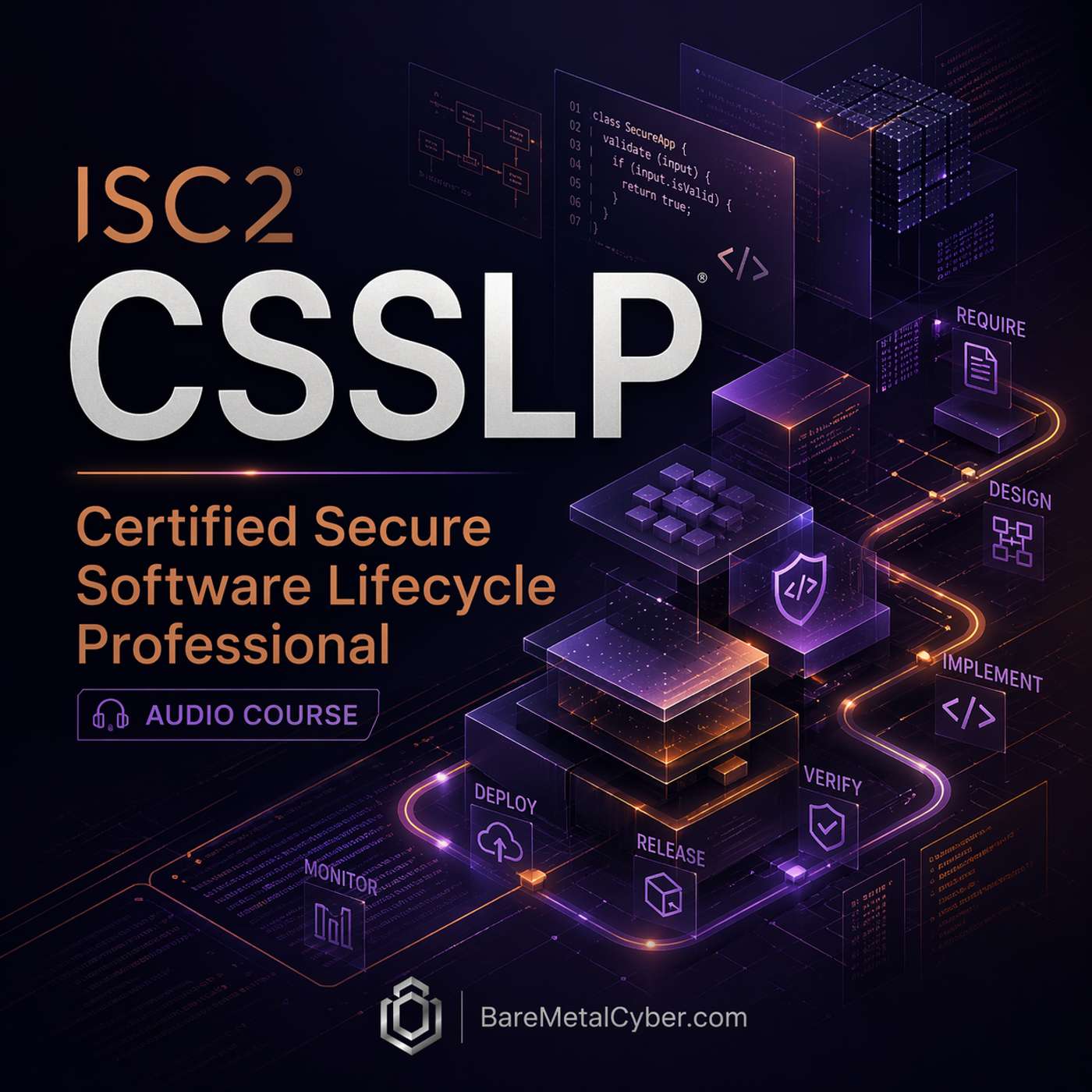
Certified: The ISC2 CSSLP Audio Course
This audio-only CSSLP prep course is built for busy security professionals who want to study anywhere, without a screen. Across 70 tightly focused episodes, you’ll walk the full Certified Secure Software Lifecycle Professional exam blueprint, from requirements and architecture to implementation, testing, operations, and supply chain risk. Each episode is structured as a guided journey: clear concepts, concrete examples, pitfalls to avoid, and quick mental rehearsals you can follow along with in real time. You’ll hear practical takes on exam strategy, secure design principles, SDLC integration,...
Where to listen?
Podcasts in the app Replaio Radio Coming soonPodcasts are coming to the app soon. Install now and be the first to see a whole new take on podcasts
 Install for free
Android 5M+ downloads · 4.8 rating
iOS soon
Install for free
Android 5M+ downloads · 4.8 rating
iOS soon
Episodes
Episode 45 — Verify Documentation and Uncover Undocumented System Behavior 30.11.2025 12:36
Documentation is often treated as a static description of a system, yet the CSSLP exam expects you to recognize that written artifacts must be validated against reality. This episode focuses on comparing policies, standards, procedures, and runbooks with what systems actually do, especially around data flows, interfaces, and security controls. You will hear how to design verification activities th...
Episode 44 — Conduct Penetration and Fuzz Testing With Purpose 30.11.2025 12:41
Penetration testing and fuzzing provide deep, focused insight into how systems behave under hostile conditions, and the CSSLP exam emphasizes the need for clear objectives and disciplined execution. This episode explains how to define rules of engagement for penetration tests, including in-scope systems, allowed techniques, safety boundaries, and success criteria that mirror realistic attacker goa...
Episode 43 — Automate DAST and IAST for Continuous Coverage 30.11.2025 12:34
Dynamic application security testing and interactive application security testing are powerful when configured and integrated correctly, and CSSLP questions often explore whether they are being used thoughtfully rather than just switched on. This episode describes how DAST exercises running applications from the outside while IAST instruments code paths from within, and why combining both offers a...
Episode 42 — Design Targeted Attack Surface Test Cases Clearly 30.11.2025 13:14
Attack surface testing delivers the most value when each test case has a crisp hypothesis about how an exposed element might fail, and the CSSLP exam reflects this focus on precision. This episode explores how to move from a high-level inventory of endpoints, protocols, and entry points to specific test ideas that target authentication gaps, input handling flaws, misconfigurations, and privilege e...
Episode 41 — Plan a Cohesive Security Testing Strategy Upfront 30.11.2025 13:45
Security testing is most effective when it grows out of a deliberate strategy rather than a scattered collection of tools and ad hoc activities, and the CSSLP exam tests your ability to recognize that structure. This episode explains how to define the scope of a security testing strategy by listing in-scope systems, interfaces, environments, and data flows, and then mapping them to the main catego...
Episode 40 — Secure the Build Pipeline and Protect Artifacts 30.11.2025 12:38
Build and release pipelines have become prime targets for attackers, and the CSSLP exam increasingly reflects the need to treat them as critical security assets. This episode outlines the components of a typical pipeline, from source repositories and build runners to artifact registries and deployment mechanisms, and explains how each stage can be hardened. You will hear why locking down runners,...
Episode 39 — Integrate Components Safely to Minimize Hidden Couplings 30.11.2025 12:36
Modern systems depend on many interacting components, and the CSSLP exam emphasizes whether those integrations are designed to limit risk rather than amplify it. Core ideas in this episode include maintaining a comprehensive inventory of components and dependencies, defining stable contracts between them, and isolating interactions with process boundaries, network controls, and least-privilege con...
Episode 38 — Treat Identified Risks and Track Remediation Through Closure 30.11.2025 12:54
Risk treatment is the process of moving from awareness to action, and CSSLP exam scenarios frequently test whether you can manage that journey in a disciplined, traceable way. Attention is placed on triaging risks based on impact, likelihood, exposure time, and business criticality, rather than reacting to whichever issue is most visible or recent. You will hear how to choose between treatment opt...
Episode 37 — Implement Application Security Controls That Actually Work 30.11.2025 12:29
Application security controls only deliver value when they are correctly implemented, consistently enforced, and aligned with realistic use cases, and the CSSLP exam often probes for gaps between intentions and execution. Focus here is on controls such as authentication checks, authorization filters, input validation layers, encryption modules, logging, rate limiting, and content security policies...
Episode 36 — Analyze Code to Uncover Latent Security Risks 30.11.2025 12:38
Code analysis is where design assumptions meet implementation reality, and the CSSLP exam expects you to understand how careful review reveals risks that are not obvious from diagrams or requirements alone. This episode explains how to approach a codebase with a structured mindset, starting from entry points that accept untrusted input, paths that handle authentication and sessions, and modules th...
Episode 35 — Sanitize Inputs and Handle Errors Without Leaks 30.11.2025 12:45
Input sanitization and careful error handling protect systems from both direct exploitation and inadvertent information disclosure, and this combination appears repeatedly across CSSLP domains. Attention is directed toward validating data at boundaries using schemas, length checks, format constraints, and whitelists where feasible, while recognizing the limitations of simple deny lists. You will h...
Episode 34 — Apply Secure Coding Fundamentals Across Languages and Stacks 30.11.2025 11:30
Secure coding fundamentals are language-agnostic habits that reduce entire classes of vulnerabilities, and CSSLP questions routinely distinguish between code that applies these fundamentals and code that does not. Key concepts covered here include input validation, output encoding, secure use of libraries and frameworks, safe memory management, and avoidance of insecure constructs such as direct s...
Episode 33 — Exam Acronyms: Quick Audio Reference for Learners 30.11.2025 14:07
Acronyms compress key ideas into a few letters, and the CSSLP exam uses them heavily, expecting you to recall what they stand for and how they relate to secure software lifecycles. Focus is placed on expanding the most common terms you will encounter, such as CIA, AAA, RBAC, ABAC, SSO, MFA, TLS, PKI, DLP, DRM, SDLC, SSDLC, SAST, DAST, IAST, RASP, EDR, and XDR. Each acronym is paired with a concise...
Episode 32 — Model Constraints and Operational Architecture for Reality 30.11.2025 12:40
Systems rarely run in ideal conditions, and the CSSLP exam frequently explores how well designs account for the constraints and operational realities they will face. Attention here centers on identifying and modeling key limitations such as latency budgets, throughput requirements, cost ceilings, geographic deployments, regulatory boundaries, and staffing levels. You will hear how to capture these...
Episode 31 — Conduct Architectural Risk Assessments That Drive Mitigations 30.11.2025 13:07
Architectural risk assessments sit at the point where design intent meets real-world threats, and the CSSLP exam expects you to recognize when these assessments are thorough, repeatable, and tied to actual decisions. The focus here is on defining a clear scope that includes critical assets, trust boundaries, external dependencies, and sensitive data flows, rather than simply listing components on...
Episode 30 — Evaluate Attack Surface Using Intelligence and Context 30.11.2025 13:11
Attack surface evaluation tells you where a system is exposed and how attractive those exposures are to real adversaries, and the CSSLP exam expects you to blend technical discovery with contextual understanding. This episode sets out a disciplined approach to enumerating assets, interfaces, entry points, and privilege levels, including transient elements like temporary endpoints, debug modes, and...
Episode 29 — Model Threats Effectively Using STRIDE and PASTA 30.11.2025 12:16
Threat modeling is one of the most powerful analytical tools in the CSSLP toolkit, and structured methods like STRIDE and PASTA help you apply it consistently. This episode explains how to define the scope of a threat model by identifying assets, actors, trust boundaries, and critical data flows. STRIDE is broken down into its categories of spoofing, tampering, repudiation, information disclosure,...
Episode 28 — Apply Virtualization and Trusted Computing to Strengthen Platforms 30.11.2025 13:12
Virtualization and trusted computing concepts give you tools to isolate workloads, prove platform integrity, and protect secrets, and the CSSLP blueprint expects familiarity with these capabilities. This episode introduces how hypervisors, containers, and micro-VMs segment workloads and limit blast radius when something goes wrong. You will hear how minimal images, removal of unnecessary tools, an...
Episode 27 — Select Identity and Credential Technologies That Scale 30.11.2025 12:56
Identity and credential technologies underpin almost every control discussed in the CSSLP, yet many exam scenarios hinge on subtle choices about how those technologies are selected and deployed. This episode reviews the main categories of authentication factors, the difference between traditional passwords and modern phishing-resistant methods, and the tradeoffs between usability and assurance. Yo...
Episode 26 — Perform Secure Interface Design for Trustworthy Integrations 30.11.2025 11:53
Secure interfaces act as contracts between components, teams, and organizations, and the CSSLP exam frequently tests whether those contracts are designed to resist misuse and failure. This episode explores how to define an interface’s purpose, data flows, preconditions, and postconditions in unambiguous terms so there is no confusion about what the integration is allowed to do. Attention is given...
Episode 25 — Establish Secure Architecture and Foundational Design Choices 30.11.2025 12:25
Architecture decisions set the long-term security posture of a system, and CSSLP questions often explore whether those decisions create strong or fragile foundations. This episode explains how to articulate architectural goals that balance security, performance, reliability, and operability, and how to choose patterns that align with those goals. You will hear how to segment trust zones, define cl...
Episode 24 — Recap Checkpoint Covering Domains One Through Three 30.11.2025 13:50
Early CSSLP domains lay the groundwork for how you think about requirements, architecture, and design, and a structured recap helps reinforce those connections before you move deeper into the blueprint. This episode revisits the central themes from the first three domains, including security principles like confidentiality, integrity, availability, resiliency, core identity and authorization conce...
Episode 23 — Set Enforceable Third-Party and Supplier Security Requirements 30.11.2025 13:21
Third-party relationships extend your attack surface and regulatory obligations, and the CSSLP exam expects you to treat supplier security as an integral part of the software lifecycle. This episode explains how to define clear, enforceable security requirements for suppliers by starting with the data they handle, the services they deliver, and the privileges they receive. You will hear how to exp...
Episode 22 — Build Robust Security Requirement Traceability From Start 30.11.2025 12:55
Traceability is the connective tissue that links risks, requirements, designs, tests, and evidence, and the CSSLP exam expects you to understand how that chain is constructed and maintained. This episode introduces the idea of assigning stable identifiers to risks, controls, and requirement statements, so each item can be tracked from initial analysis through to implementation and verification. Yo...
Episode 21 — Develop Realistic Misuse and Abuse Cases for Resilience 30.11.2025 13:28
Misuse and abuse cases push you to think like an attacker or a stressed user, and the CSSLP exam regularly checks whether you can anticipate negative behaviors before they appear in production. This episode explains how to start from normal use cases and systematically invert them, asking how legitimate features could be misused to bypass controls, overload resources, or expose sensitive informati...
Similar podcasts







Listen to the Certified: The ISC2 CSSLP Audio Course podcast in Replaio
Radio and podcasts in one app - free, with no sign-up. Install today and do not miss the launch
Replaio is not a podcast publisher; show names, artwork and audio belong to their authors and are distributed through public RSS feeds.