Jason Edwards
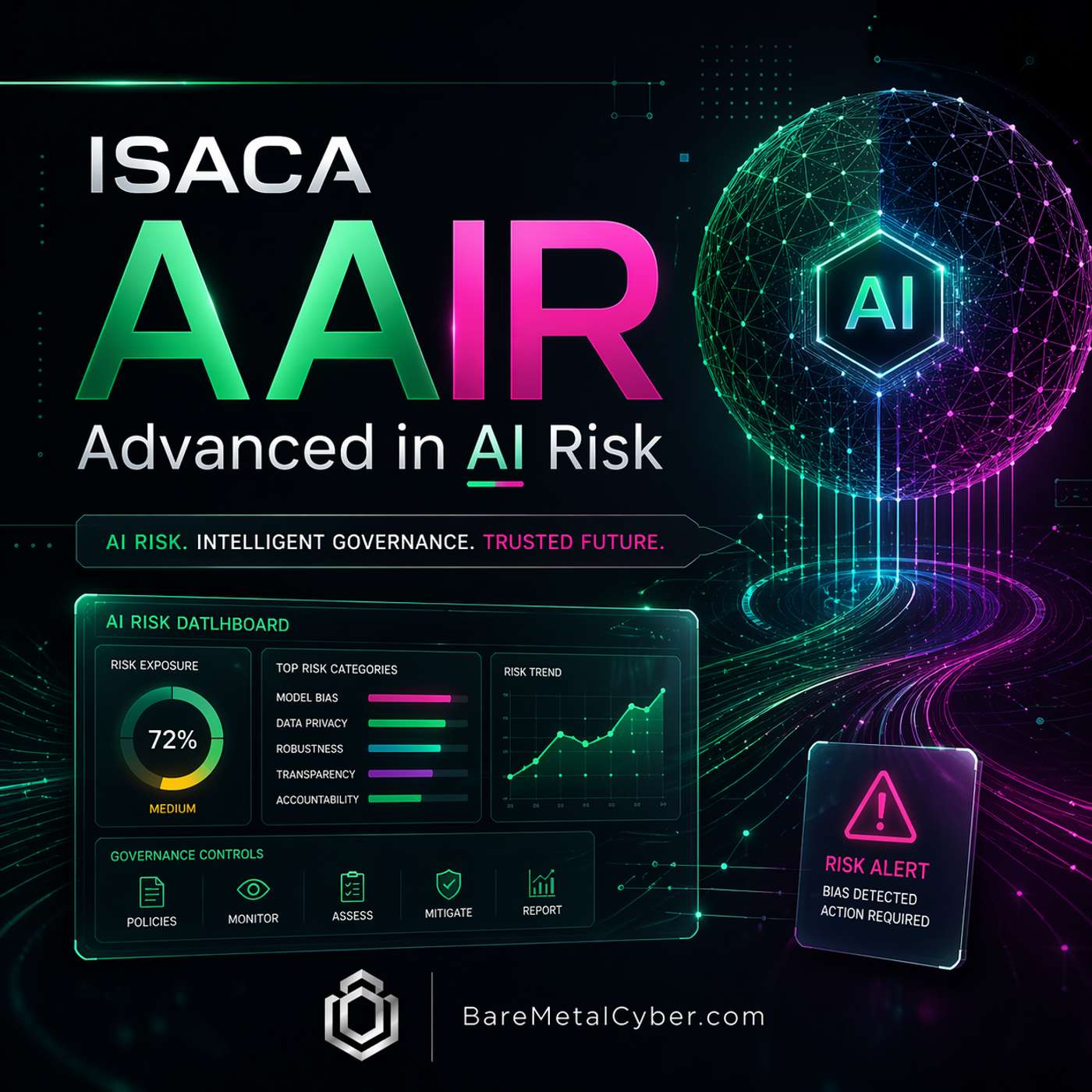
Certified: The ISACA AAIR Audio Course
Welcome to Certified: The ISACA AAIR Audio Course. If you’re here, you’re probably seeing AI show up everywhere: in products, in internal tools, in vendor roadmaps, and in executive conversations that expect quick answers. I built this course for people who need to evaluate AI systems responsibly, even when they don’t have time to become machine learning specialists. Across these episodes, we’ll translate AI concepts into assurance language you can use: governance, controls, evidence, risk, and accountability. You’ll learn how to ask better questions, how to recognize weak assurances, and how...
Where to listen?
Podcasts in the app Replaio Radio Coming soonPodcasts are coming to the app soon. Install now and be the first to see a whole new take on podcasts
 Install for free
Android 5M+ downloads · 4.8 rating
iOS soon
Install for free
Android 5M+ downloads · 4.8 rating
iOS soon
Episodes
Episode 17 — Use COBIT-Style Controls for AI: Objectives, Practices, and Assurance Thinking (Domain 1) 14.02.2026 18:29
Applying the COBIT framework to AI governance provides a structured, objective-based approach to control design that is central to ISACA’s methodology in Domain 1. This episode explains how to adapt COBIT’s governance and management objectives to the specific technical requirements of artificial intelligence. For the AAIR certification, candidates should understand how to use control objectives to...
Episode 16 — Integrate AI Risk into ERM: Shared Language, Shared Processes, Shared Metrics (Domain 1) 14.02.2026 19:26
AI risk should not be treated as a technical silo but must be integrated into the broader Enterprise Risk Management (ERM) framework, a core principle of Domain 1. This episode discusses how to align AI-specific risks with existing corporate risk categories such as operational, financial, and legal risk. For the AAIR exam, it is vital to understand the value of using a shared taxonomy and centrali...
Episode 15 — Classify AI by Impact: High-Risk Uses, Critical Decisions, and Safety Roles (Domain 1) 14.02.2026 18:12
Not all AI systems require the same level of scrutiny, and Domain 1 emphasizes the need to classify systems based on their potential impact. This episode focuses on the criteria used to identify high-risk AI, such as systems involved in critical infrastructure, medical diagnostics, or hiring decisions that affect legal rights. For the AAIR exam, understanding the distinction between low-risk admin...
Episode 14 — Inventory AI Systems Completely: Models, Data, Vendors, and Shadow AI (Domain 1) 14.02.2026 17:23
You cannot manage the risk of what you do not know exists, making a complete AI inventory a prerequisite for effective governance in Domain 1. This episode explores the challenges of tracking AI across the enterprise, including identifying embedded AI in third-party software and discovering "shadow AI" deployed by business units without IT approval. For the certification, candidates must know the...
Episode 13 — Create AI Documentation Expectations: What Evidence Must Always Exist (Domain 2) 14.02.2026 17:50
Within Domain 2, maintaining comprehensive documentation is not just a best practice but a fundamental requirement for proving control during an audit or regulatory inquiry. This episode details the specific types of evidence that must be curated throughout the AI lifecycle, including model cards, data provenance records, and testing logs. For the AAIR exam, candidates need to understand how docum...
Episode 12 — Build Standards for Responsible AI: Ethics, Fairness, Transparency, and Oversight (Domain 1) 14.02.2026 15:16
Responsible AI standards go beyond basic compliance to address the ethical implications of algorithmic decision-making, a key focus for the AAIR certification. This episode defines the four pillars of responsible AI: fairness to prevent bias, transparency to ensure explainability, accountability through human oversight, and robustness to ensure safety. For the exam, it is crucial to know how these...
Episode 11 — Write Practical AI Policies: What Is Allowed, Restricted, and Prohibited (Domain 1) 14.02.2026 14:33
Drafting effective AI policies is a core requirement for Domain 1, as it provides the enforceable framework for organizational behavior. This episode explores the three-tier approach to policy development: identifying allowed use cases that promote innovation, restricted uses that require specific governance approvals, and prohibited activities that violate legal or ethical boundaries. For the AAI...
Episode 10 — Set AI Risk Appetite and Tolerance That Leaders Can Defend (Domain 1) 14.02.2026 13:55
Defining risk appetite and tolerance is a critical exercise that allows leadership to communicate the level of risk the organization is willing to accept in pursuit of AI innovation. In this episode, we distinguish between risk appetite—the high-level statement of risk preference—and risk tolerance, which provides specific, measurable thresholds for individual AI projects. For the AAIR certificati...
Episode 9 — Align AI Use Cases to Strategy: Value, Constraints, and Risk Boundaries (Domain 1) 14.02.2026 13:55
Every AI project should begin with a clear understanding of how it supports the organization’s strategic objectives while remaining within acceptable risk boundaries. This episode focuses on the alignment of AI use cases with business strategy, emphasizing the need to balance potential value against technical and ethical constraints. On the AAIR exam, candidates are often tested on their ability t...
Episode 8 — Establish AI Governance That Works: Committees, Charters, and Authority Lines (Domain 1) 14.02.2026 14:55
Building a robust governance structure requires more than just policies; it requires the formal establishment of committees and charters that define how decisions are made. This episode covers the creation of AI steering committees and the drafting of governance charters that outline the scope, objectives, and authority of AI oversight bodies. For the AAIR exam, you must understand how these struc...
Episode 7 — Define AI Risk Ownership Clearly: Roles, Accountability, and Decision Rights (Domain 1) 14.02.2026 15:48
Clear accountability is the cornerstone of any effective governance framework, particularly in the rapidly evolving field of AI. In this episode, we define the various roles involved in the AI risk landscape, from the AI system owner and data steward to the chief risk officer and the end-user. For the AAIR certification, it is essential to understand who holds the decision rights for model deploym...
Episode 6 — Connect AI Outcomes to Business Harm: Money, Safety, Trust, and Law (Domain 1) 14.02.2026 15:58
The ultimate goal of AI risk management is to protect the organization from tangible harm, a core focus of Domain 1. This episode examines how technical AI failures translate into business consequences, including financial loss, threats to physical safety, erosion of customer trust, and legal liability. For the exam, candidates must be able to link specific AI behaviors—such as an incorrect medica...
Episode 5 — Recognize Where AI Goes Wrong: Errors, Bias, Drift, and Misuse Risks (Domain 3) 14.02.2026 14:56
Domain 3 focuses on the specific failure modes of AI systems, requiring candidates to recognize and mitigate a wide array of technical and operational risks. This episode explores the critical concepts of model drift, where performance degrades as real-world data evolves away from the training set, and algorithmic bias, which can lead to discriminatory outcomes. We also address the risks of halluc...
Episode 4 — Explain AI in Plain English: Models, Data, Training, and Inference Basics (Domain 1) 14.02.2026 14:06
Foundational technical knowledge is the bedrock of Domain 1, as you cannot govern what you do not understand. This episode clarifies complex AI terminology, defining models as mathematical representations and explaining how data serves as the primary fuel for these systems. We distinguish between the training phase, where the model learns patterns from historical data, and the inference phase, whe...
Episode 3 — Build a Spoken Study Plan That Covers Every AAIR Practice Area (Non-ECO Orientation) 14.02.2026 13:18
Effective preparation for the AAIR certification requires a structured study plan that mirrors the depth and breadth of the actual practice areas. This episode provides a blueprint for organizing your study sessions, focusing on the three primary domains: AI Governance, AI Risk Program Management, and the AI Lifecycle. We explain how to allocate time based on your personal professional background...
Episode 2 — Understand the AAIR Exam: Format, Scoring, Rules, and Retake Policies (Non-ECO Orientation) 14.02.2026 14:45
Navigating the logistics of the AAIR exam is as crucial as mastering the technical content itself to ensure a successful testing experience. In this episode, we break down the exam structure, including the number of items, the weighted distribution of the domains, and the specific scoring methodology used by ISACA. Understanding the rules regarding identification, remote proctoring environments, a...
Episode 1 — Start Strong with AAIR: What AI Risk Really Means at Work (Non-ECO Orientation) 14.02.2026 15:25
Starting your journey toward the ISACA AI Fundamentals and Risk (AAIR) certification requires a fundamental shift in how you view corporate technology. This episode introduces the overarching concept of artificial intelligence risk, moving beyond traditional cybersecurity to include systemic, ethical, and operational hazards. For the exam, candidates must understand that AI risk is not a standalon...
Similar podcasts







Listen to the Certified: The ISACA AAIR Audio Course podcast in Replaio
Radio and podcasts in one app - free, with no sign-up. Install today and do not miss the launch
Replaio is not a podcast publisher; show names, artwork and audio belong to their authors and are distributed through public RSS feeds.