Jason Edwards
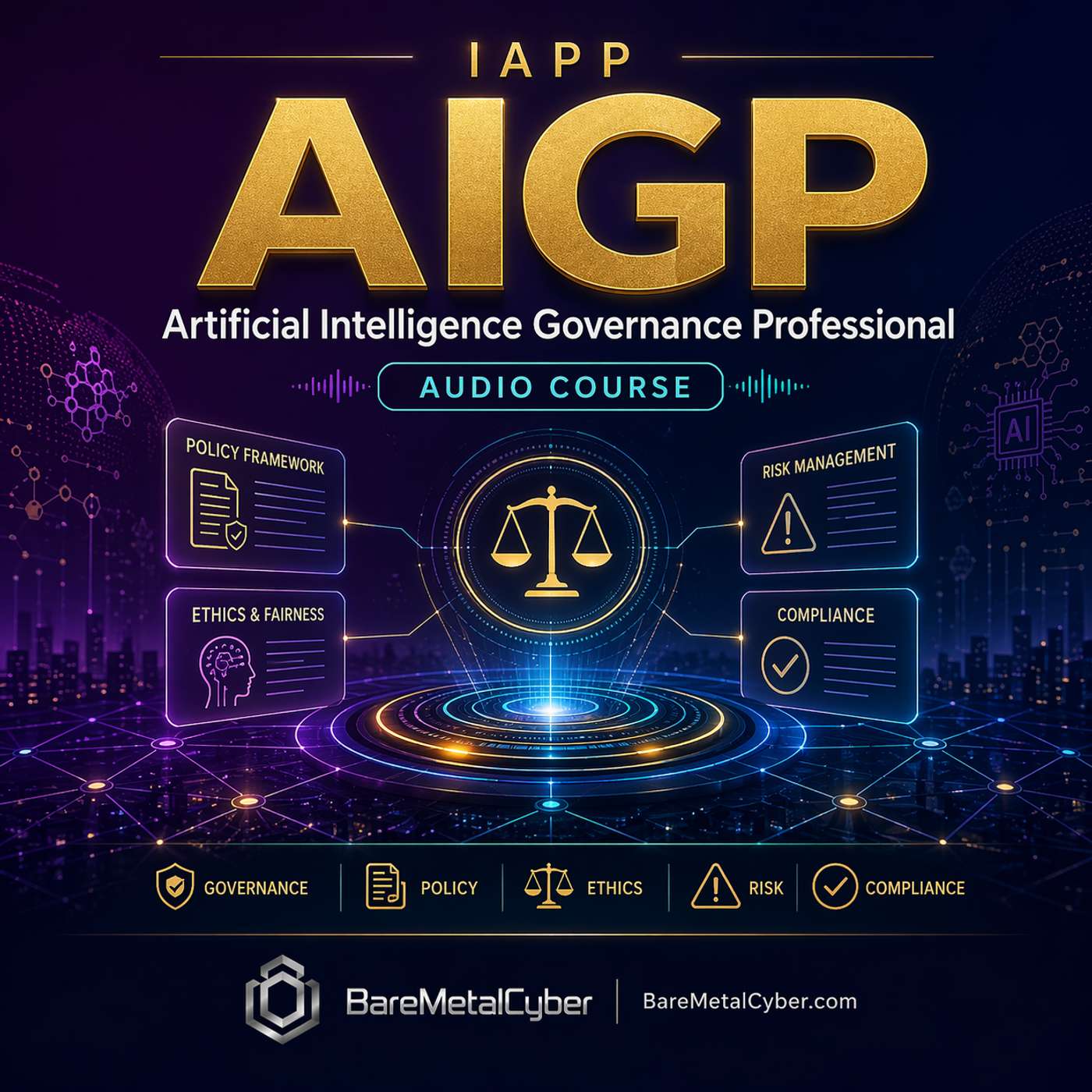
Certified: The IAPP AIGP Audio Course
Certified: The IAPP AIGP Audio Course is built for professionals who need a practical path into AI governance without having to stop their day job to get there. It is a strong fit for privacy professionals, compliance teams, risk managers, security leaders, legal and policy staff, product managers, consultants, and anyone else who now has AI oversight in their role. The course assumes you are motivated and capable, but not necessarily deep in technical machine learning work. It starts from clear foundations and then moves into the governance, risk, accountability, and decision-making issues th...
Where to listen?
Podcasts in the app Replaio Radio Coming soonPodcasts are coming to the app soon. Install now and be the first to see a whole new take on podcasts
 Install for free
Android 5M+ downloads · 4.8 rating
iOS soon
Install for free
Android 5M+ downloads · 4.8 rating
iOS soon
Episodes
Episode 34 — Strengthen AI Designs Through Use-Case Evaluation, Benchmarking, Pilots, and Testing 04.04.2026 17:39
This episode shows how design quality improves when organizations challenge assumptions before full deployment. You will examine how use-case evaluation helps confirm that the proposed system actually fits the business need, how benchmarking can compare candidate models or methods against defined performance and risk criteria, how pilots reveal workflow problems in limited settings, and how testin...
Episode 33 — Identify and Mitigate Design Risks with Harms Matrices, Risk Hierarchies, and Stakeholder Mapping 04.04.2026 15:55
This episode explains how structured risk tools can improve design quality by forcing teams to think beyond technical accuracy and consider who could be affected, how harm could occur, and which risks deserve the most attention first. You will learn how harms matrices help teams catalog possible negative outcomes, how risk hierarchies help prioritize those outcomes based on severity and likelihood...
Episode 32 — Build Human Oversight, Metrics, Thresholds, Feedback, and Controls into Design 04.04.2026 17:22
This episode focuses on designing governance into the system from the beginning by defining how people will supervise the AI, what measurements will show whether it is behaving acceptably, and what thresholds will trigger review, intervention, or shutdown. You will learn why human oversight must be specific to the use case, why metrics should reflect real business and risk outcomes rather than raw...
Episode 31 — Design AI Systems with Clear Purpose, Requirements, Architecture, and Model Choice 04.04.2026 16:58
This episode explains how sound AI governance starts with disciplined design choices instead of jumping straight to tools or model hype. You will learn how to define the system’s purpose in business terms, translate that purpose into clear functional and nonfunctional requirements, and choose an architecture and model approach that fit the use case, data environment, risk level, and operational co...
Episode 30 — Perform Impact Assessments Early to Shape Safer AI Design Decisions 04.04.2026 16:44
This episode focuses on impact assessments as early governance tools that shape design choices before risk becomes harder and more expensive to control. You will examine how an effective assessment looks beyond technical ambition and asks who may be affected, what harms could occur, what data is involved, how the system will be used, what safeguards are needed, and whether the use case should proc...
Episode 29 — Define Business Context and Use Cases Before Building Any AI System 04.04.2026 16:35
This episode explains why good AI governance begins before model selection, procurement, or experimentation by forcing clarity about the business context and intended use case. You will learn how a well-defined use case identifies the problem to be solved, the users involved, the decision being supported or automated, the data needed, the stakeholders affected, and the consequences of error or mis...
Episode 28 — Review the Governance Foundations and Legal Duties Most Likely to Matter 04.04.2026 17:19
This episode pulls together the major governance foundations and legal duties that repeatedly appear across AI oversight programs and exam scenarios. You will review why accountability, documented risk assessment, role clarity, lawful data use, transparency, security, human oversight, testing, monitoring, and incident response keep showing up regardless of industry or tool type. The AIGP exam rewa...
Episode 27 — Understand ISO 22989, ISO 42001, and ISO 42005 in AI Governance 04.04.2026 16:40
This episode introduces three ISO standards that matter because they help organizations describe AI consistently, build management systems, and guide governance practices in a more formal and auditable way. You will learn that standards can serve different purposes, with some focused on shared terminology and concepts, some focused on management system requirements, and others focused on governanc...
Episode 26 — Use the NIST AI RMF and Playbook to Structure Governance 04.04.2026 16:34
This episode explains how the NIST AI Risk Management Framework and its supporting playbook can help organizations turn broad governance goals into a structured operating model. You will learn how the framework supports governance, mapping, measurement, and management activities, and why that matters for identifying risks early, assigning responsibility, documenting decisions, and improving contro...
Episode 25 — Apply OECD Trustworthy AI Principles, Frameworks, Policies, and Recommended Practices 04.04.2026 18:03
This episode introduces the practical value of broad AI principles and recommended practices by showing how they guide governance choices even when they are not written as strict technical rules. You will review common themes such as human-centered design, fairness, robustness, transparency, accountability, and responsible stewardship, then connect those themes to policy development, role definiti...
Episode 24 — Compare Enforcement, Penalties, and Duties for Providers, Deployers, Importers, and Distributors 04.04.2026 18:31
This episode examines how governance obligations differ across entities that create, introduce, distribute, or use AI systems, and why those differences matter when legal accountability is assigned. You will review how providers often carry duties tied to design, documentation, and conformity, while deployers must govern implementation, context of use, monitoring, and user impacts. Importers and d...
Episode 23 — Understand the Distinct Requirements That Apply to General-Purpose AI Models 04.04.2026 15:42
This episode explains why general-purpose AI models can create governance challenges that differ from narrow, single-use systems. You will learn how models designed for many downstream uses can raise broader concerns involving transparency, documentation, capability limits, downstream integration, misuse risk, and the difficulty of predicting every context in which the model may be deployed. The A...
Episode 22 — Govern Human Oversight, Transparency, Notification, and Quality Management Requirements 04.04.2026 17:57
This episode focuses on governance requirements that exist to keep AI systems understandable, reviewable, and controllable in real use. You will examine what meaningful human oversight looks like, when transparency must extend beyond internal teams to affected individuals or customers, why notification requirements matter when people interact with or are evaluated by AI, and how quality management...
Episode 21 — Operationalize AI Law Requirements for Risk Management, Documentation, and Record Keeping 04.04.2026 15:48
This episode explains how legal requirements become real controls only when an organization turns them into repeatable operational practices. You will learn how risk management requirements connect to intake reviews, impact assessments, testing thresholds, issue escalation, and approval decisions, while documentation and record keeping requirements support traceability, accountability, and defensi...
Episode 20 — Map AI Risk Classifications from Prohibited Uses to Minimal Risk 04.04.2026 19:18
This episode introduces risk classification as a way to organize governance effort according to the seriousness of potential harm and the nature of the use case. You will review the basic idea behind categories that range from prohibited uses through high-risk and limited-risk uses down to minimal-risk activity, while also learning that labels only help when they are tied to real obligations, cont...
Episode 19 — Interpret Consumer Protection and Product Liability Risks in AI Systems 04.04.2026 18:44
This episode explains how AI can create consumer protection and product liability risk even when a system is marketed as helpful, innovative, or low friction. You will learn why misleading claims about accuracy, safety, neutrality, or suitability can become governance problems, and how harm may arise when users reasonably rely on outputs that are incomplete, wrong, or poorly explained. The AIGP ex...
Episode 18 — Apply Nondiscrimination Law to AI in Employment, Credit, Housing, and Insurance 04.04.2026 17:13
This episode connects AI governance to nondiscrimination obligations in some of the highest-stakes domains organizations face. You will examine how AI systems used in employment, credit, housing, and insurance can create legal and ethical exposure when they rely on biased data, flawed proxies, unequal error rates, or decision processes that disadvantage protected groups. The AIGP exam may present...
Episode 17 — Understand How Intellectual Property Law Shapes AI Training and Use 04.04.2026 18:49
This episode explains how intellectual property concerns affect AI long before a tool reaches production. You will learn why training data rights matter, how copyrighted or proprietary material can raise licensing and infringement questions, and why generated outputs may create separate concerns involving ownership, attribution, trade secrets, and unauthorized reuse. For the AIGP exam, the importa...
Episode 16 — Protect Sensitive and Special Category Data When AI Uses Biometrics 04.04.2026 16:57
This episode focuses on one of the most sensitive areas in AI governance: the use of biometric data and other sensitive or special category data in systems that identify, infer, classify, or monitor people. You will explore why these data types demand heightened controls, including stronger purpose definition, restricted access, clear legal justification where required, careful retention limits, a...
Episode 15 — Master Controller Obligations for AI Impact Assessments, Rights, Transfers, and Records 04.04.2026 18:26
This episode examines the obligations that often fall on controllers or comparable responsible entities when AI systems process personal data. You will review why impact assessments matter for higher-risk processing, how individual rights can be affected by automated systems, what cross-border transfers may require in regulated environments, and why recordkeeping is central to proving accountabili...
Episode 14 — Embed Data Minimization and Privacy by Design into AI Systems 04.04.2026 18:06
This episode explains how privacy by design becomes operational when teams make deliberate choices about what data an AI system truly needs, when it needs it, and how long it should be kept. You will learn why data minimization is not just a legal slogan but a practical way to reduce exposure, improve governance, and narrow the blast radius when something goes wrong. The episode examines design de...
Episode 13 — Navigate Transparency, Choice, Lawful Basis, and Purpose Limits in AI 04.04.2026 18:08
This episode addresses core privacy and governance concepts that often become more complicated when AI systems process large volumes of data or make consequential inferences. You will review what transparency means in practice, when individuals may need meaningful notice, how user choice can apply depending on context, why lawful basis matters for certain data processing regimes, and how purpose l...
Episode 12 — Manage Third-Party AI Risk Through Assessments, Contracts, Procurement, and Acceptable Use 04.04.2026 17:25
This episode focuses on third-party AI risk, which becomes critical when organizations buy, license, or embed tools they did not build themselves. You will examine how procurement reviews, vendor assessments, contract terms, and acceptable use rules help control risks involving data handling, model transparency, security testing, retraining practices, subprocessors, and responsibility for failures...
Episode 11 — Update Privacy, Security, Data Governance, and IP Policies for AI 04.04.2026 18:36
This episode explains why existing enterprise policies often need revision before an organization can govern AI responsibly. You will learn how privacy policies must address new data uses, how security policies must account for model abuse, prompt injection, data leakage, and access control, how data governance policies must define quality, retention, lineage, and approved sources, and how intelle...
Episode 10 — Establish Life Cycle Policies That Drive Oversight and Accountability End to End 04.04.2026 18:03
This episode introduces lifecycle governance as the discipline of controlling AI from idea through retirement instead of reacting only at deployment. You will review why policies must cover intake, use-case approval, design, data selection, testing, validation, release, monitoring, incident handling, change management, and decommissioning if an organization wants end-to-end accountability. The exa...
Similar podcasts







Listen to the Certified: The IAPP AIGP Audio Course podcast in Replaio
Radio and podcasts in one app - free, with no sign-up. Install today and do not miss the launch
Replaio is not a podcast publisher; show names, artwork and audio belong to their authors and are distributed through public RSS feeds.