Dr. Jason Edwards
Certified: The CompTIA Security+ Audio Course
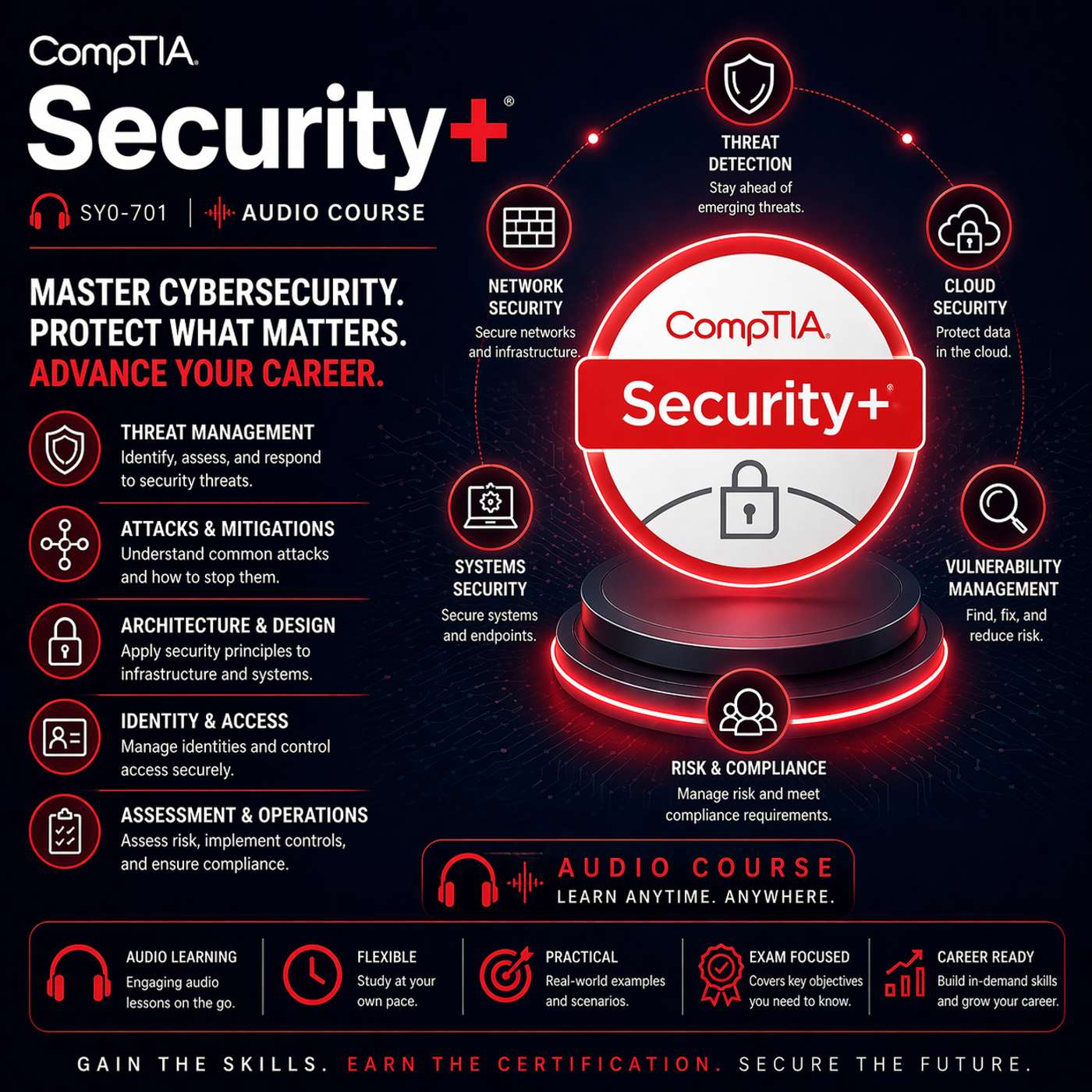
Certified - Security+ 701 is your completely free audio companion for mastering the CompTIA Security+ SY0-701 certification exam. Developed by BareMetalCyber.com, this immersive Audio Course transforms every domain of the official exam objectives into clear, practical, and exam-ready lessons you can learn anywhere—whether commuting, exercising, or studying at home. Each episode delivers focused explanations, real-world examples, and proven study strategies designed to build confidence and help you pass on your first attempt. Structured for busy professionals and new learners alike, the series...
Be sure to visit the podcast's website and support the creator: baremetalcyber.com
Author
Dr. Jason Edwards
Category
Podcast website
Latest episode
Apr 28, 2026
Where to listen?
Podcasts in the app Replaio Radio Coming soonPodcasts are coming to the app soon. Install now and be the first to see a whole new take on podcasts
 Install for free
Android almost 10M downloads · 4.8 rating
iOS soon
Install for free
Android almost 10M downloads · 4.8 rating
iOS soon
Episodes
Episode 98: Continuity of Operations and Capacity Planning (Domain 3) 15.06.2025 17:39
Even the most secure systems are useless if they can’t operate under pressure, and this episode explores the intersection of cybersecurity with business resilience through Continuity of Operations Planning (COOP) and capacity planning. COOP ensures that essential functions can continue during emergencies, whether that’s a DDoS attack, natural disaster, or internal failure, by defining alternate wo...
Episode 97: Platform Diversity and Multi-cloud Architecture (Domain 3) 15.06.2025 17:30
Relying on a single technology stack or vendor can introduce systemic risk, and in this episode, we explore how platform diversity and multi-cloud strategies enhance both security and resilience. Platform diversity means using a range of operating systems, software solutions, or infrastructure types to avoid monocultures that attackers can exploit with a single technique. If every system uses the...
Episode 96: Disaster Recovery Site Considerations (Domain 3) 15.06.2025 18:30
Disaster recovery planning ensures that when critical infrastructure goes offline—whether due to cyberattack, natural disaster, or hardware failure—business operations can resume with minimal disruption. In this episode, we focus on the different types of recovery sites: hot, warm, and cold. Hot sites are fully functional environments that mirror production and allow near-instant failover; warm si...
Episode 95: High Availability and System Resilience (Domain 3) 15.06.2025 17:26
Security isn’t just about keeping attackers out—it’s also about keeping services running when they try to bring you down. In this episode, we examine high availability (HA) and resilience strategies that ensure critical systems continue operating during failures, attacks, or overload scenarios. Techniques like active-active clustering, redundant power supplies, geographic failover, and load-balanc...
Episode 94: Methods to Secure Data (Part 3) (Domain 3) 15.06.2025 16:58
In this final installment on data protection methods, we focus on segmentation and permission restrictions—two strategic approaches that limit both exposure and access. Segmentation involves dividing networks, databases, or storage environments into discrete zones or tiers, isolating sensitive information from general-purpose systems and minimizing lateral movement opportunities for attackers. Thi...
Episode 93: Methods to Secure Data (Part 2) (Domain 3) 15.06.2025 17:04
Beyond encryption, organizations have additional tools to secure data in contexts where usability, compliance, or performance requirements call for alternatives. In this episode, we explore hashing, tokenization, and data masking—each serving a unique purpose in reducing data exposure while supporting operations like analytics or software testing. Hashing protects integrity and is commonly used fo...
Episode 92: Methods to Secure Data (Part 2) (Domain 3) 15.06.2025 18:41
Beyond encryption, organizations have additional tools to secure data in contexts where usability, compliance, or performance requirements call for alternatives. In this episode, we explore hashing, tokenization, and data masking—each serving a unique purpose in reducing data exposure while supporting operations like analytics or software testing. Hashing protects integrity and is commonly used fo...
Episode 91: Methods to Secure Data (Part 1) (Domain 3) 15.06.2025 19:11
Protecting data effectively starts with strong core methods that control access and visibility, and in this episode, we focus on geographic restrictions and encryption as frontline tools. Geographic restrictions help limit who can view or interact with data based on their physical or network location—often used in regulatory compliance, fraud prevention, or content delivery controls. This can invo...
Episode 90: Data Sovereignty and Geolocation (Domain 3) 15.06.2025 17:07
Where data physically resides has become a legal and operational priority for organizations operating in an increasingly globalized and regulated world. In this episode, we examine data sovereignty—the concept that data is subject to the laws and regulations of the country where it’s stored—and how this impacts storage decisions, cloud architecture, and compliance. Geolocation factors, such as sel...
Episode 89: General Data Considerations – States of Data (Domain 3) 15.06.2025 19:02
Data security isn’t just about what kind of data you’re protecting—it’s also about when and where that data is at any given time. In this episode, we explore the three states of data: at rest, in transit, and in use. Data at rest resides on storage media—like hard drives, databases, or backup tapes—and is commonly protected by full-disk or file-level encryption. Data in transit moves across networ...
Episode 88: Data Classification Strategies (Part 2) (Domain 3) 15.06.2025 18:35
Building on the foundation from part one, this episode explores public and private data categories, the importance of policy-driven classification, and how to implement classification effectively across diverse environments. Public data—intended for broad distribution—still requires oversight to prevent tampering, impersonation, or misuse in social engineering. Private data, especially when it inc...
Episode 87: Data Classification Strategies (Part 1) (Domain 3) 15.06.2025 18:35
Data classification provides the foundation for applying security controls based on risk and sensitivity, and in this episode, we examine the first part of a two-part discussion on classification strategy. We start by defining common classification tiers such as “sensitive,” “confidential,” “restricted,” and “critical,” each of which guides access control, encryption requirements, and handling pro...
Episode 86: Human vs. Non-human Readable Data (Domain 3) 15.06.2025 17:35
Not all data is meant for human eyes, and in cybersecurity, understanding the distinction between human-readable and non-human-readable data formats is vital for applying the right protection. This episode explains how human-readable data—like documents, emails, or spreadsheets—poses a higher risk of exposure and misuse when accessed by unauthorized users, and must often be protected with strong a...
Episode 85: Data Types and Their Protection (Domain 3) 15.06.2025 19:22
Data is not monolithic—its classification and context determine how it should be secured. In this episode, we explore different types of data, including regulated data like personal health information (PHI), payment card information (PCI), and personal identifiable information (PII), as well as trade secrets, intellectual property, and public-facing information. Each type has different legal, oper...
Episode 84: Selecting Effective Security Controls (Domain 3) 15.06.2025 18:30
Choosing the right security controls is not about applying everything—it’s about applying the right things, in the right places, at the right time. This episode guides you through the process of selecting and tailoring controls based on risk assessments, threat models, compliance requirements, and operational goals. We discuss how frameworks like NIST SP 800-53, ISO 27001, and CIS Controls provide...
Episode 83: Advanced Secure Access Solutions (Domain 3) 15.06.2025 19:48
Traditional perimeter security isn’t enough in a world of mobile users, cloud resources, and third-party integrations. In this episode, we explore advanced secure access solutions, starting with Software-Defined Wide Area Networking (SD-WAN), which replaces traditional WAN technologies with application-aware routing and policy-based control across diverse internet paths. SD-WAN not only improves p...
Episode 82: Secure Communication and Remote Access (Domain 3) 15.06.2025 19:24
As remote work and distributed systems become the norm, securing communication across potentially hostile networks is more important than ever. In this episode, we explore secure communication methods including Virtual Private Networks (VPNs), TLS encryption, and IPSec tunneling. We discuss how VPNs provide confidentiality and integrity over public connections, while TLS protects browser-based and...
Episode 81: Firewalls and Security Gateways (Domain 3) 15.06.2025 19:31
Firewalls are one of the oldest and most trusted tools in network defense, but today’s environments require more than just simple packet filtering. In this episode, we dive into the evolution of firewall technologies, from traditional layer 3 firewalls to next-generation firewalls (NGFWs) that inspect application-layer traffic, enforce content policies, and integrate with threat intelligence feeds...
Episode 80: Port Security and Authentication Protocols (Domain 3) 15.06.2025 20:19
Every port on your network is a potential doorway, and port security ensures those doors stay locked unless explicitly authorized. In this episode, we examine how technologies like 802.1X enforce port-level access control, requiring users or devices to authenticate before they can transmit any data. We explore how protocols such as EAP (Extensible Authentication Protocol) and RADIUS (Remote Authen...
Episode 79: Load Balancers and Sensors (Domain 3) 15.06.2025 19:24
Load balancers and network sensors are often associated with performance and visibility—but they are just as critical to your security architecture. In this episode, we explore how load balancers not only distribute traffic to prevent bottlenecks but can also terminate SSL connections, enforce session persistence, and isolate backend services from direct public exposure. These features allow them...
Episode 78: Device Attributes and Network Appliances (Domain 3) 15.06.2025 20:27
Security isn’t just about policies and firewalls—it’s also about the capabilities and placement of the physical and virtual devices enforcing them. In this episode, we explore key device attributes such as active vs. passive monitoring, inline vs. tap-based deployment, and the role each plays in threat detection and response. Active devices like intrusion prevention systems (IPS) interact with and...
Episode 77: Connectivity and Failure Modes (Domain 3) 15.06.2025 21:04
Connectivity powers modern organizations, but with it comes risk—especially when failure modes are not considered in the security design. In this episode, we explore what happens when devices or services fail, and how the design of fail-open vs. fail-closed systems can either preserve functionality or protect data. A fail-open configuration may allow traffic to flow even when security services are...
Episode 76: Infrastructure Security Foundations (Domain 3) 15.06.2025 21:32
Securing infrastructure starts with design decisions about where and how devices are placed, how data flows, and where trust boundaries begin and end. In this episode, we focus on device placement and network zoning, exploring how separating front-end, back-end, and management traffic can prevent attackers from using one compromised segment to access others. Concepts like jump servers, demilitariz...
Episode 75: Architecture Security Considerations (Part 3) (Domain 3) 15.06.2025 21:33
In this final installment on architectural considerations, we focus on risk transference, ease of recovery, and the practical realities of patch availability and compute resources. Risk transference involves shifting some security or operational responsibilities to third parties—such as cloud providers, insurers, or managed service vendors—through contracts or service-level agreements (SLAs). Whil...
Episode 74: Architecture Security Considerations (Part 2) (Domain 3) 15.06.2025 21:37
Responsiveness, scalability, and ease of deployment are three more pillars that heavily influence secure architecture decisions, especially in environments where adaptability is key. In this episode, we examine how responsive systems are designed to detect, isolate, and recover from security incidents quickly—often using real-time monitoring, automation, and predefined response playbooks. We then...
Similar podcasts







Listen to the Certified: The CompTIA Security+ Audio Course podcast in Replaio
Radio and podcasts in one app - free, with no sign-up. Install today and do not miss the launch
Replaio is not a podcast publisher; show names, artwork and audio belong to their authors and are distributed through public RSS feeds.