Dr. Jason Edwards
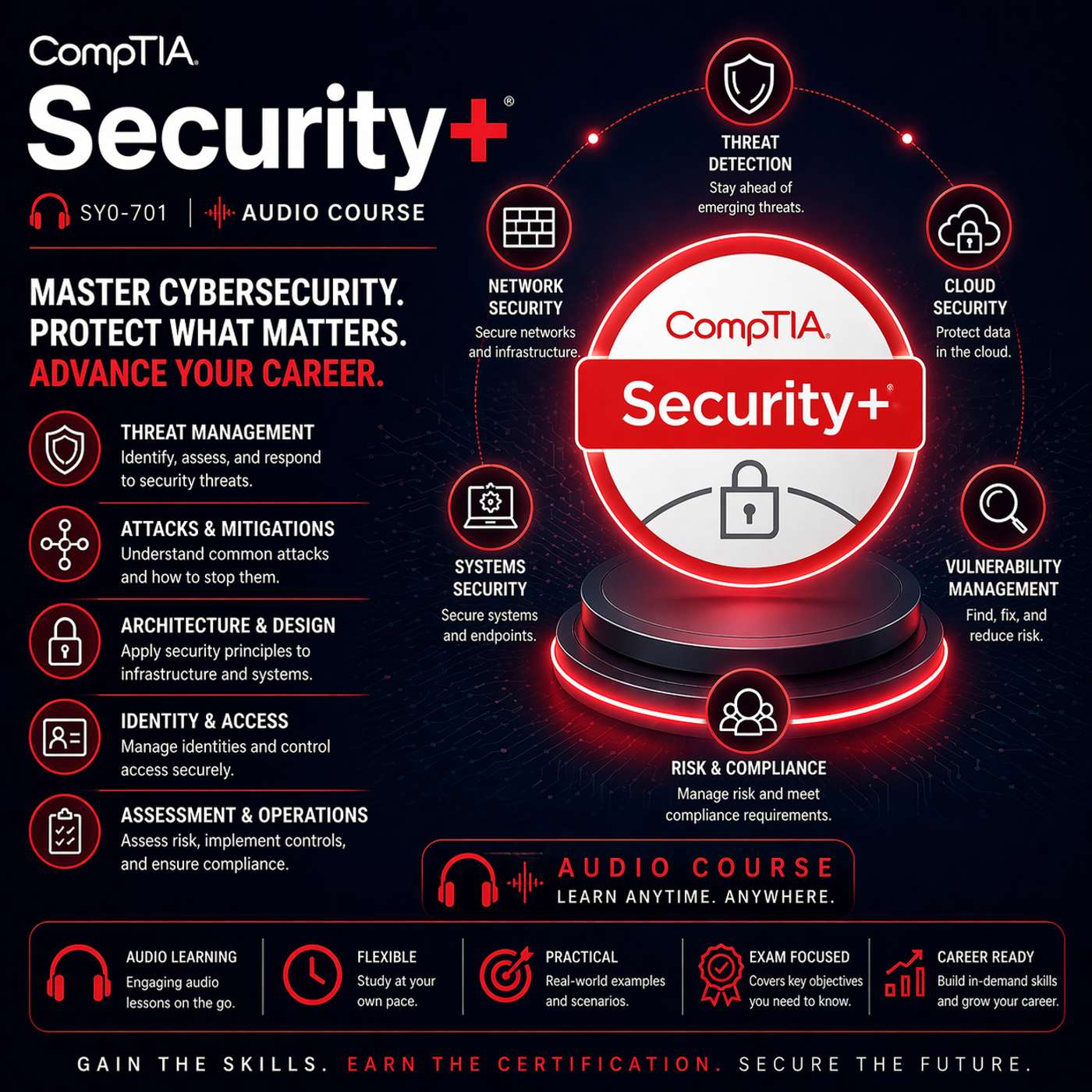
Certified: The CompTIA Security+ Audio Course
Certified - Security+ 701 is your completely free audio companion for mastering the CompTIA Security+ SY0-701 certification exam. Developed by BareMetalCyber.com, this immersive Audio Course transforms every domain of the official exam objectives into clear, practical, and exam-ready lessons you can learn anywhere—whether commuting, exercising, or studying at home. Each episode delivers focused explanations, real-world examples, and proven study strategies designed to build confidence and help you pass on your first attempt. Structured for busy professionals and new learners alike, the series...
Be sure to visit the podcast's website and support the creator: baremetalcyber.com
Author
Dr. Jason Edwards
Category
Podcast website
Latest episode
Apr 28, 2026
Where to listen?
Podcasts in the app Replaio Radio Coming soonPodcasts are coming to the app soon. Install now and be the first to see a whole new take on podcasts
 Install for free
Android almost 10M downloads · 4.8 rating
iOS soon
Install for free
Android almost 10M downloads · 4.8 rating
iOS soon
Episodes
Episode 173: Leveraging Log Data (Part 1) (Domain 4) 16.06.2025 24:27
Logs are the record books of your infrastructure, capturing who did what, when, and where—and in this episode, we explore how to extract value from them. We start with common log types including firewall logs, application logs, operating system logs, and security-specific logs like authentication events, audit trails, and IDS alerts. Each source provides a different lens on activity, and together...
Episode 172: Forensic Evidence Preservation and E-Discovery (Domain 4) 16.06.2025 21:46
Once digital evidence is collected, preserving it and producing it responsibly are the next critical steps—and in this episode, we focus on maintaining evidentiary integrity through preservation and e-discovery. Preservation involves storing forensic images, logs, or artifacts in tamper-resistant formats with strong access controls and documented retention procedures. We discuss legal holds, which...
Episode 171: Forensics – Data Acquisition and Reporting (Domain 4) 16.06.2025 22:35
Capturing and reporting digital evidence is a delicate process that must be repeatable, verifiable, and legally defensible. In this episode, we focus on how to perform data acquisition properly—whether imaging a hard drive, collecting volatile memory, or retrieving logs from cloud services—and how to ensure that the resulting data is both complete and forensically sound. We explain the role of too...
Episode 170: Digital Forensics Foundations (Domain 4) 16.06.2025 25:30
When a security incident occurs, understanding what happened—and proving it—requires digital forensics. In this episode, we cover foundational concepts of digital forensics, including data acquisition, chain of custody, preservation, and documentation. Acquiring data from endpoints, servers, or cloud environments must be done carefully to avoid altering evidence, while maintaining chain of custody...
Episode 169: Root Cause Analysis and Threat Hunting (Domain 4) 16.06.2025 24:51
Stopping an incident isn’t enough—you have to understand how it happened and whether something deeper is still lurking. This episode explores root cause analysis and threat hunting as advanced investigative tools that move teams from reaction to prevention. Root cause analysis aims to determine the exact failure—whether it’s a missed patch, user error, misconfiguration, or policy gap—that allowed...
Episode 168: Incident Response Training and Testing (Domain 4) 16.06.2025 25:13
A well-written incident response plan is only useful if your team knows how to execute it—and the best way to build that confidence is through training and testing. In this episode, we explore various training methods including role-based instruction, tabletop exercises, and simulated attacks (also called purple team or red team exercises). Tabletop exercises walk stakeholders through scenarios wi...
Episode 167: Incident Response – Lessons Learned (Domain 4) 16.06.2025 23:34
Every incident is a learning opportunity, and the final step of the response lifecycle—lessons learned—ensures that your team emerges stronger, smarter, and better prepared. In this episode, we explore how to conduct structured post-incident reviews that examine not just what happened, but how and why it happened, how the team responded, and what can be improved. This includes identifying gaps in...
Episode 166: Incident Response Process (Part 2) (Domain 4) 16.06.2025 25:25
Following detection and analysis, the next phases in an incident response plan are containment, eradication, and recovery—critical steps that stop the spread of an attack and restore operations. Containment involves isolating affected systems, blocking malicious traffic, disabling compromised accounts, and ensuring the attacker cannot escalate further. Eradication is the process of removing malwar...
Episode 165: Incident Response Process (Part 1) (Domain 4) 16.06.2025 26:05
A strong incident response process can mean the difference between a contained event and a catastrophic breach—and in this episode, we break down the first half of the response lifecycle: preparation, detection, and analysis. Preparation involves building an incident response plan (IRP), assigning roles and responsibilities, and creating playbooks that guide teams when things go wrong. Detection i...
Episode 164: Considerations for Security Automation (Part 2) (Domain 4) 16.06.2025 24:58
Continuing our discussion on automation pitfalls, this episode focuses on the risk of single points of failure, technical debt, and long-term support challenges. Centralized automation platforms can become mission-critical dependencies—if they crash or misfire, entire workflows may halt, leaving your organization blind or exposed. We also examine how quick, untracked scripts—created to solve urgen...
Episode 163: Considerations for Security Automation (Part 1) (Domain 4) 16.06.2025 23:41
As powerful as automation is, it’s not without challenges—and in this episode, we dive into the complexity and cost considerations that come with security automation projects. Poorly scoped automation can introduce more problems than it solves, especially when it relies on fragile scripts, inconsistent APIs, or tools that don’t integrate cleanly. We explore how hidden costs—such as testing time, s...
Episode 162: Benefits of Security Automation (Part 2) (Domain 4) 16.06.2025 26:25
Building on the first part of our automation series, this episode explores how security automation improves scalability, incident reaction time, and team productivity. We examine real-world examples where automated alerts trigger isolation of infected systems, revoke compromised credentials, or update firewall rules within seconds—long before a human analyst could intervene. Automation enables sys...
Episode 161: Benefits of Security Automation (Part 1) (Domain 4) 16.06.2025 27:28
Security automation offers more than just saved time—it fundamentally transforms how teams operate by embedding consistency, speed, and scalability into their daily processes. In this episode, we cover the benefits of automation in efficiency and standardization, highlighting how routine tasks like user onboarding, policy enforcement, patch verification, and incident alerting can be executed insta...
Episode 160: Continuous Integration and API Automation (Domain 4) 16.06.2025 27:41
Security needs to move at the speed of development, and that’s where continuous integration (CI) and API-driven automation come in. In this episode, we explore how CI pipelines integrate security testing—like static and dynamic analysis—into every code commit, helping developers catch vulnerabilities before deployment. These pipelines rely heavily on APIs to automate everything from dependency sca...
Episode 159: Technical Debt in Automation (Domain 4) 16.06.2025 27:32
As security teams automate more of their operations, they often accumulate technical debt—shortcuts, fragile code, or undocumented scripts that create long-term risk. In this episode, we explore how automation projects can suffer from the same pitfalls as software development, including lack of version control, insufficient testing, and poor documentation. These issues can lead to unexpected failu...
Episode 158: Automation and Scripting in Security (Domain 4) 16.06.2025 28:12
In modern cybersecurity, manual processes can’t keep up with the scale and speed of threats—making automation and scripting essential for operational success. In this episode, we explore how security teams use scripting languages like PowerShell, Python, and Bash to automate repetitive tasks such as log analysis, user provisioning, backup validation, and alert triage. Automation platforms like SOA...
Episode 157: Privileged Access Management (PAM) (Domain 4) 16.06.2025 26:38
Privileged accounts are the crown jewels of any IT environment, and their misuse—whether accidental or malicious—can lead to devastating breaches. This episode focuses on Privileged Access Management (PAM), a framework for controlling, auditing, and minimizing access to high-value accounts like system administrators, domain controllers, or cloud root users. We discuss just-in-time access (JIT), wh...
Episode 156: Secure Password Management (Domain 4) 16.06.2025 28:56
Passwords continue to serve as a primary access method for many systems, and in this episode, we examine what secure password management really looks like—from user behavior to backend storage. We begin with best practices for password creation: encouraging long, complex passphrases instead of short, hard-to-remember strings, and enforcing limits on reuse, age, and failed attempts. We then cover t...
Episode 155: MFA Authentication Factors (Domain 4) 16.06.2025 26:44
Multifactor authentication is only as strong as the diversity and reliability of the factors it uses. In this episode, we explore each authentication factor category in depth: something you know (such as a password or PIN), something you have (like a hardware token or smartphone), something you are (biometric identifiers like a fingerprint or facial recognition), and somewhere you are (geolocation...
Episode 154: Multifactor Authentication (MFA) Implementations (Domain 4) 16.06.2025 25:03
Multifactor Authentication (MFA) is one of the most effective ways to prevent unauthorized access, and in this episode, we break down how to implement it effectively across different environments. We cover common MFA factors—something you know (password), something you have (token or device), and something you are (biometrics)—as well as less common ones like geolocation and user behavior. We exam...
Episode 153: Advanced Access Controls and Least Privilege (Domain 4) 16.06.2025 25:07
Access controls must go beyond static roles to enforce the principle of least privilege in real time, and this episode explores how to implement more advanced models that do just that. We cover context-aware access policies based on location, time-of-day, device type, and user behavior—often deployed in zero trust environments to restrict access dynamically. We also explore just-in-time (JIT) acce...
Episode 152: Access Control Models (Part 2) (Domain 4) 16.06.2025 23:17
In this second installment on access control models, we focus on more adaptive and scalable approaches: Role-Based Access Control (RBAC), Rule-Based Access Control, and Attribute-Based Access Control (ABAC). RBAC assigns access based on predefined job roles, simplifying management in structured environments by aligning permissions with functions like HR, finance, or IT. Rule-Based Access Control a...
Episode 151: Access Control Models (Part 1) (Domain 4) 16.06.2025 18:26
Access control models define who can access what, under which conditions—and in this episode, we begin our exploration with Mandatory Access Control (MAC) and Discretionary Access Control (DAC). MAC is rigid and centralized, often used in government or military systems where sensitivity labels and clearance levels determine access, and individual users cannot modify permissions. DAC, by contrast,...
Episode 150: Interoperability and Attestation (Domain 4) 16.06.2025 21:57
As organizations adopt more diverse platforms, cloud services, and third-party integrations, the ability for systems to work together securely—known as interoperability—becomes mission-critical. In this episode, we explore how interoperability ensures that identity providers, authentication protocols, logging systems, and access controls function consistently across environments. Standards like SA...
Episode 149: Single Sign-On (SSO) and Protocols (Domain 4) 16.06.2025 15:29
Single Sign-On (SSO) allows users to access multiple systems with a single set of credentials, enhancing both convenience and security when implemented with care. In this episode, we explain how SSO functions by relying on a centralized identity provider that issues authentication tokens to various applications, removing the need for users to log in repeatedly. We explore the protocols that power...
Similar podcasts







Listen to the Certified: The CompTIA Security+ Audio Course podcast in Replaio
Radio and podcasts in one app - free, with no sign-up. Install today and do not miss the launch
Replaio is not a podcast publisher; show names, artwork and audio belong to their authors and are distributed through public RSS feeds.