Jason Edwards
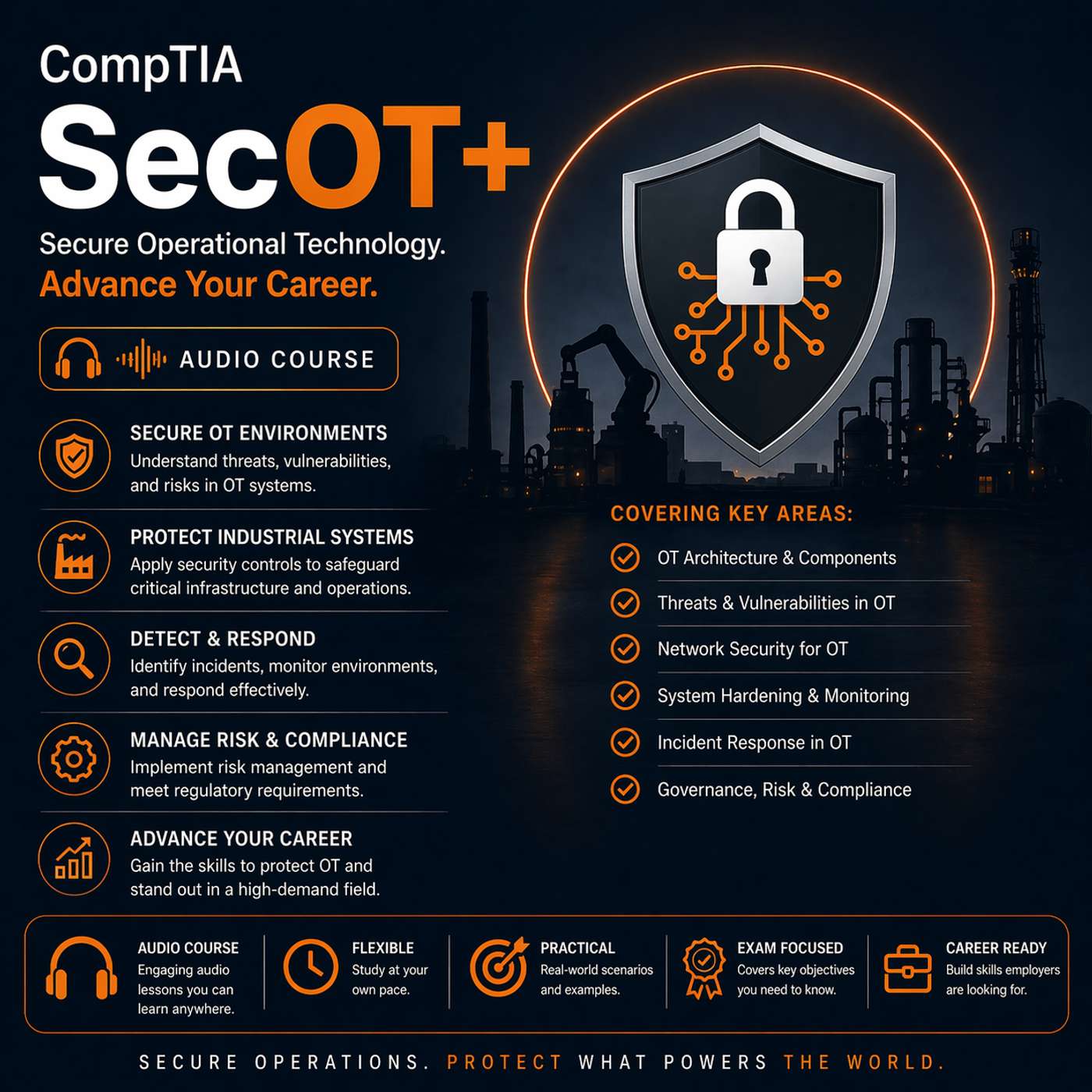
Certified: The CompTIA SecOT+ Audio Course
Certified: The CompTIA SecOT Certification Audio Course is built for security practitioners and aspiring operators who need a practical, audio-first path into day-to-day security work. If you’re early career in cybersecurity, moving from IT into security operations, or stepping into a SOC-adjacent role, this course is designed to meet you where you are. You don’t need a lab rack or a perfect study schedule. You need clear explanations, realistic context, and a steady cadence that fits commutes, workouts, and the hours in between meetings. In Certified: The CompTIA SecOT Certification Audio Cou...
Where to listen?
Podcasts in the app Replaio Radio Coming soonPodcasts are coming to the app soon. Install now and be the first to see a whole new take on podcasts
 Install for free
Android 5M+ downloads · 4.8 rating
iOS soon
Install for free
Android 5M+ downloads · 4.8 rating
iOS soon
Episodes
Episode 38 — Define OT SLAs: Internal Versus External Expectations That Protect Uptime 23.02.2026 14:31
This episode teaches how to define Service Level Agreements that reflect OT priorities, because uptime protection depends on clear expectations about response, restoration, and communication when systems fail. You’ll learn the difference between internal SLAs, which align teams across engineering, operations, IT, and security, and external SLAs, which bind vendors and service providers to measurab...
Episode 37 — Build OT Service Agreements: Procurement Requirements and What MSAs Must Cover: 23.02.2026 14:21
This episode explains how service agreements shape OT security and resilience, because contracts determine what vendors can do, what they must do, and what evidence you can demand when something goes wrong. You’ll learn how procurement requirements should address OT realities, including site access rules, remote access methods, maintenance windows, incident notification obligations, and the need f...
Episode 36 — Manage Stakeholders in OT: Trust, Communication, and Change Acceptance 23.02.2026 16:33
This episode teaches stakeholder management as a core OT security skill, because security outcomes depend on trust and adoption, not just technical correctness. You’ll learn how to identify stakeholder groups across operations, engineering, maintenance, safety, quality, IT, vendors, and leadership, then map what each group values so communication is aligned to real incentives like uptime, safety,...
Episode 35 — Use the RACI Model in OT: Clear Ownership Across Engineering, Ops, and Security 23.02.2026 12:22
This episode explains how the RACI model prevents confusion in OT by making ownership explicit, which is critical when incidents, patch decisions, and access approvals collide with safety responsibilities. You’ll define Responsible, Accountable, Consulted, and Informed in operational terms, then apply those roles to common OT security activities like controller logic changes, firewall rule updates...
Episode 34 — Develop Practical Roadmaps: Sequencing Improvements Without Production Disruption 23.02.2026 13:18
This episode teaches how to turn a list of security “needs” into a practical OT roadmap that respects uptime, safety approvals, vendor constraints, and the reality that plants do not stop because security wants a clean implementation window. You’ll learn how to sequence improvements by grouping work into dependency-aware phases, such as visibility first, access governance next, segmentation reinfo...
Episode 33 — Benchmark OT Security Progress: Baselines, Targets, and Evidence That Holds Up 23.02.2026 13:37
This episode explains how to benchmark OT security progress in a way that executives can trust, operators can tolerate, and auditors can validate, because “we think we’re better” is not a defensible position after an incident. You’ll learn how to build a baseline that is measurable and repeatable, including asset coverage, segmentation reality, access pathways, logging visibility, and change contr...
Episode 32 — Build a Cybersecurity Program in OT: Risk Levels, Registry, and Maturity Assessment 23.02.2026 15:01
This episode teaches how to build an OT cybersecurity program that is anchored in risk reality, where safety, uptime, and long equipment lifecycles require structure without creating friction that stops work. You’ll learn how to define risk levels in OT terms by connecting threat scenarios to operational consequences, then capture those risks in a registry that supports prioritization instead of b...
Episode 31 — Navigate Legal and Regulatory Drivers: Compliance Pressure and Non-Compliance Fallout 23.02.2026 15:42
This episode explains how legal and regulatory drivers shape OT security decisions, not as abstract compliance theory, but as concrete constraints that influence budgets, timelines, reporting duties, and acceptable residual risk. You’ll learn how to interpret common compliance pressure signals in real environments, such as mandated audits, contractual obligations, sector expectations, and regulato...
Episode 30 — Prioritize Safety Outcomes: Loss of Life, Environmental Harm, and Reliability Expectations 23.02.2026 13:51
This episode centers safety as the primary outcome driver in OT security, because the most important consequences are not always the most visible on a dashboard. You’ll learn how to frame security decisions around prevention of injury, avoidance of environmental harm, and preservation of reliable control, which helps you choose answers that respect OT’s core mission even when the scenario is descr...
Episode 29 — Translate OT Business Impact: Financial, Reputational, Quality, and Operational Consequences 23.02.2026 13:51
This episode explains how to communicate OT risk and incident impact in business language without losing technical accuracy, a skill that matters for governance decisions and appears frequently in exam scenarios. You’ll learn how OT disruptions translate into direct financial costs like downtime, scrap, rework, and overtime, as well as indirect costs like delayed shipments, contract penalties, an...
Episode 28 — Balance Security Versus Operations: Governance Structures and Decision Authorities 23.02.2026 12:54
This episode teaches how decision authority works in OT, because many SecOT+ questions are really asking who must be involved, who can approve, and what sequence preserves safety and uptime. You’ll learn why governance structures matter, including how steering committees, change advisory boards, and site leadership roles influence whether security controls are adopted smoothly or resisted as disru...
Episode 27 — Align OT Security to Business Objectives: Risk Appetite, Continuity, and Recovery 23.02.2026 13:25
This episode explains how OT security priorities should be anchored to business objectives so security becomes a reliability partner instead of an external requirement bolted on after incidents. You’ll learn how to translate risk appetite into OT terms by discussing what downtime costs, what safety thresholds exist, and what kinds of disruption the business is willing to tolerate during maintenanc...
Episode 26 — Explain OT GRC Value: Security That Supports Operations, Not Fights Them 23.02.2026 13:11
This episode teaches governance, risk, and compliance in OT as a practical operating system for decisions, rather than paperwork that competes with production. You’ll define GRC in plain terms, then connect it to OT outcomes like safe change, predictable maintenance windows, and controls that operators can actually follow under real constraints. We discuss why “security says no” fails in OT and ho...
Episode 25 — Understand Privatized Backbones and Autonomous Systems: Security and Resilience Impacts 23.02.2026 14:47
This episode explains how privatized networks, carrier backbones, and autonomous system routing influence OT connectivity and resilience, especially when remote sites, telemetry, or vendor support depend on complex upstream paths you do not directly control. You’ll learn what an autonomous system represents at a high level and why routing policy, peering decisions, and upstream failures can change...
Episode 24 — Place OT Workloads in Cloud and Edge: Public, Private, Hybrid, and Vendor Services 23.02.2026 16:03
This episode teaches how OT workloads are increasingly split across on-prem, edge, and cloud locations, and how to reason about security and resilience when data and control functions move outside the traditional control network. You’ll define public, private, and hybrid cloud models in a way that ties directly to OT realities, including latency sensitivity, outage tolerance, regulatory constraint...
Episode 23 — Evaluate AI in OT Security: ML, Generative AI, and Operational Risk Tradeoffs 23.02.2026 16:07
This episode explains how to evaluate AI claims in OT security without falling into hype or blanket rejection, because the exam and the real world both reward balanced judgment grounded in operations. You’ll distinguish machine learning used for anomaly detection and prediction from generative AI used for summarization, automation, and decision support, then connect each to the data quality constr...
Episode 22 — Use Containers, SDN, and Middleware in OT: Benefits, Risks, and Failure Modes 23.02.2026 18:19
This episode teaches how containers, software-defined networking, and middleware can improve OT agility and visibility while also creating new trust dependencies that must be governed like safety-relevant engineering changes. You’ll define containers as packaging and runtime isolation rather than full virtualization, then connect that to practical concerns like image provenance, patching cadence,...
Episode 21 — Apply Modern OT Patterns: Virtual Machines, Hypervisors, Switching, and Virtual PLCs 23.02.2026 18:03
This episode explains how virtualization shows up in modern OT environments and why SecOT+ questions increasingly assume you understand the operational and security tradeoffs of running critical workloads on shared compute. You’ll define virtual machines, hypervisors, and virtual switching in OT terms, focusing on what changes when controllers, historians, and engineering tools share CPU, memory,...
Episode 20 — Manage Legacy OT Hardware and Ports: Physical Exposure, Protocol Limits, and Access 23.02.2026 18:37
This episode focuses on the hardware and physical-access side of OT security, because legacy ports and exposed cabinets can turn a secure network design into an easy bypass. You’ll review common legacy interfaces and why they exist, then connect them to realistic risks such as unauthorized local programming, inline taps, casual misuse during maintenance, and “temporary” connections that become per...
Episode 19 — Compare Legacy OT Constraints: Embedded, Proprietary, RTOS, and General-Purpose OSs 23.02.2026 18:09
This episode explains why legacy OT platforms behave differently from modern IT endpoints, and how those differences change what “reasonable security” looks like on the SecOT+ exam. You’ll compare embedded systems, proprietary platforms, RTOS environments, and general-purpose operating systems by focusing on update mechanisms, logging capability, resource constraints, and vendor support realities...
Episode 18 — Operate OT Wireless Reliably: VHF, AIS, VSAT, M-Bus, 802.15.4, and 802.11 23.02.2026 19:08
This episode teaches the practical realities of wireless in OT, where reliability, coverage, and interference management can be as important as classic confidentiality concerns. You’ll review why different wireless technologies exist, what they are commonly used for, and how constraints like bandwidth, latency, terrain, and licensing shape operational expectations for VHF, AIS, and VSAT links. We...
Episode 17 — Handle Building Automation Networks: BACnet, KNX, and Profinet in Mixed Environments 23.02.2026 17:39
This episode explains why building automation and industrial automation frequently overlap in modern facilities, and how that overlap creates security and operational decisions that show up in realistic exam scenarios. You’ll learn what BACnet and KNX are used for, how they support control of building systems, and why legacy deployment patterns can leave them exposed through broad broadcast behavi...
Episode 16 — Use OPC DA and OPC UA Safely: Data Exchange, Trust, and Interoperability 23.02.2026 16:45
This episode teaches OPC as a common interoperability layer that can simplify integration while also creating trust dependencies that the SecOT+ exam expects you to recognize. You’ll differentiate OPC DA from OPC UA at a practical level, focusing on how each handles data access, platform assumptions, and typical deployment patterns between control networks, historians, and business-facing systems....
Episode 15 — Engineer Ethernet OT Communications: EtherCAT, Modbus TCP, and CIP/EtherNet/IP 23.02.2026 17:52
This episode explains why Ethernet in OT is not “just networking,” and how industrial Ethernet protocols bring timing, topology, and failure-mode assumptions that influence both security controls and incident response choices. You’ll learn how Modbus TCP maps familiar concepts to IP networks while still inheriting many security limitations, then contrast that with EtherCAT’s real-time orientation...
Episode 14 — Secure Serial Protocol Reality: Modbus RTU, Profibus, Data Highway Plus, and DNP3 23.02.2026 20:21
This episode teaches how common serial protocols behave in the real world, and why security decisions in OT frequently start with understanding what the protocol can and cannot do. You’ll review Modbus RTU fundamentals like function codes, register reads and writes, and the lack of built-in authentication, then compare that mindset to Profibus and Data Highway Plus environments where determinism,...
Similar podcasts







Listen to the Certified: The CompTIA SecOT+ Audio Course podcast in Replaio
Radio and podcasts in one app - free, with no sign-up. Install today and do not miss the launch
Replaio is not a podcast publisher; show names, artwork and audio belong to their authors and are distributed through public RSS feeds.