Jason Edwards
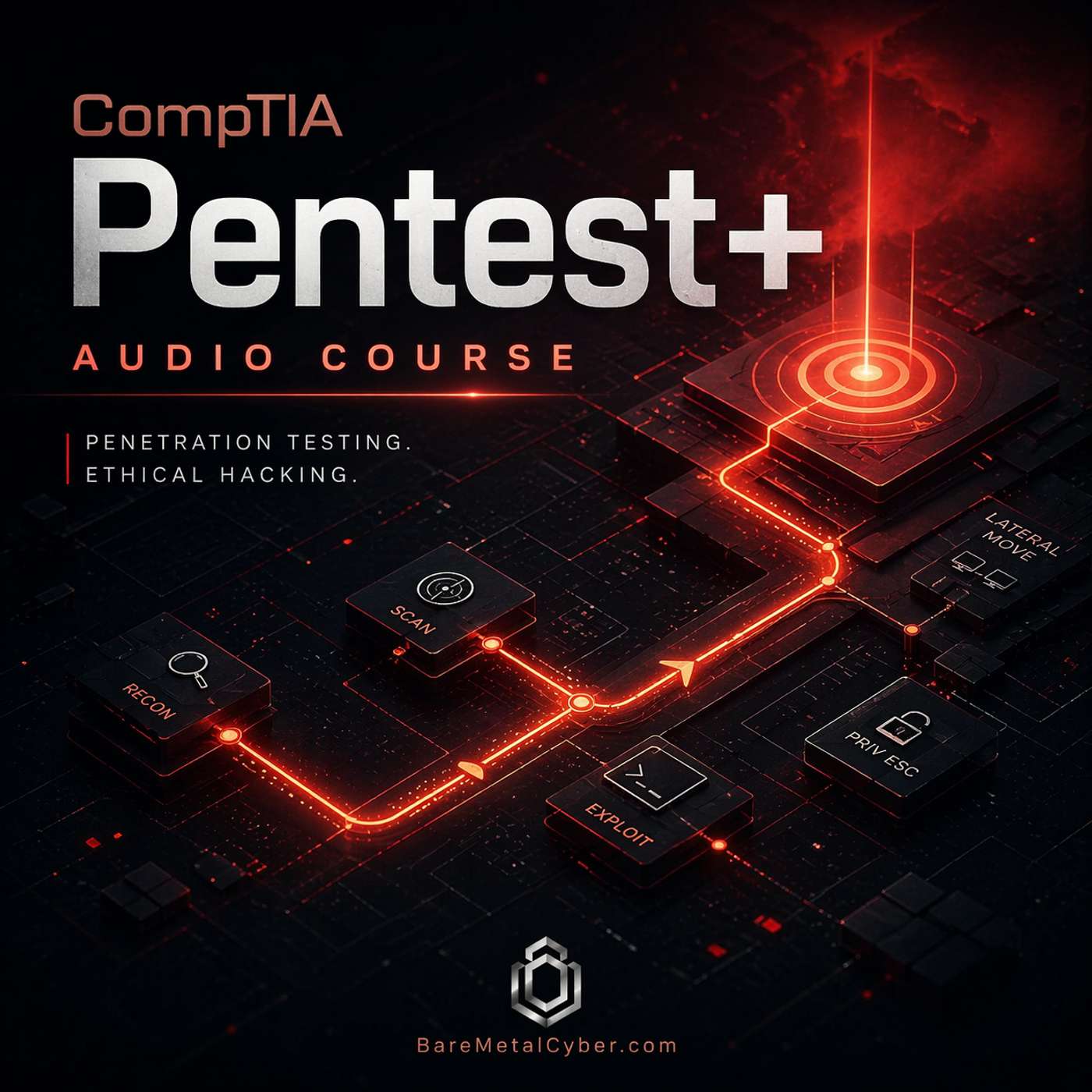
Certified: The CompTIA PenTest+ (Plus) Audio Course
This PrepCast series is a comprehensive, audio-first preparation program designed to help learners build the judgment, terminology fluency, and decision-making skills required for modern penetration testing scenarios. Rather than focusing on tools, commands, or hands-on labs, the series emphasizes how to think like a tester under real-world constraints: interpreting scope and rules of engagement, selecting safe and defensible next steps, validating findings responsibly, and communicating risk in clear business-aligned language. Each episode is structured to reinforce engagement flow, from plan...
Where to listen?
Podcasts in the app Replaio Radio Coming soonPodcasts are coming to the app soon. Install now and be the first to see a whole new take on podcasts
 Install for free
Android 5M+ downloads · 4.8 rating
iOS soon
Install for free
Android 5M+ downloads · 4.8 rating
iOS soon
Episodes
Episode 21 — OSINT: People and Org Footprints 06.01.2026 19:19
This episode focuses on how publicly available information about people and organizational structure can reveal access paths, technology choices, and security maturity without touching a single system. You’ll learn how job postings, role descriptions, vendor partnerships, and organizational charts hint at platforms in use, privilege distribution, and operational priorities. We’ll cover how naming...
Episode 20 — Active Recon Fundamentals 06.01.2026 17:37
This episode explains active reconnaissance as controlled interaction used to confirm what exists, what is reachable, and what services respond, while staying within scope and minimizing disruption. You’ll learn how host discovery, service discovery, and cautious fingerprinting differ in purpose, and how response states like open, closed, and filtered imply different next steps and different level...
Episode 19 — Passive Recon Fundamentals 06.01.2026 18:17
This episode teaches you how passive reconnaissance builds a reliable starting picture of an organization’s exposure without directly interacting with target systems. You’ll learn what kinds of public information tend to be useful, including organizational structure clues, technology fingerprints from internet-facing artifacts, domain and certificate signals, and common leakage sources such as cod...
Episode 18 — Recon vs Enumeration 06.01.2026 17:11
This episode clarifies a common source of confusion by separating reconnaissance from enumeration and showing how each phase changes what the “best next step” looks like. You’ll learn that reconnaissance is broad information gathering used to form hypotheses and narrow focus, while enumeration is deeper, targeted detail collection used to confirm specific services, users, routes, and access bounda...
Episode 17 — Remediation Recommendations That Fit 06.01.2026 17:38
This episode focuses on turning findings into recommendations that actually reduce risk, rather than generic advice that sounds correct but fails in practice. You’ll learn how to identify root causes, select control types that match the problem, and propose remediation steps that are realistic for the environment and constraints described. We’ll cover technical controls like hardening, patching, s...
Episode 16 — Reporting: What a Strong Report Includes 06.01.2026 16:38
This episode teaches you how to structure a penetration test report so it is usable, credible, and actionable for both leadership and technical teams. You’ll learn what belongs in the executive summary, methodology, detailed findings, and remediation sections, and how to write each part in clear language that ties technical conditions to business outcomes. We’ll cover what makes a finding strong,...
Episode 15 — MITRE ATT&CK in PenTesting Context 06.01.2026 17:29
This episode explains how to use MITRE ATT&CK as a shared language for describing adversary behaviors without turning your thinking into taxonomy memorization. You’ll learn the difference between tactics, which describe high-level goals, and techniques, which describe the methods used to achieve them, and how mapping observed actions to behaviors improves reporting clarity and remediation plan...
Episode 14 — OWASP: Top 10 and MASVS 06.01.2026 18:58
This episode gives you the OWASP vocabulary and mental models that repeatedly show up in application-focused scenarios, including web and mobile contexts. You’ll learn how the OWASP Top 10 groups common web risks into categories like broken access control, injection, insecure design, security misconfiguration, and identification and authentication failures, and why those labels matter when selecti...
Episode 13 — Methodologies: PTES and OSSTMM 06.01.2026 18:55
This episode teaches you how to recognize and apply penetration testing methodologies conceptually, so you can map scenario cues to the right structure without turning it into memorization. You’ll learn how PTES provides a practical sequence from planning and intelligence gathering through execution and reporting, and how OSSTMM emphasizes measurement, completeness, and operationally grounded test...
Episode 12 — Communication During Testing 06.01.2026 16:17
This episode builds the communication habits that keep an engagement safe, efficient, and credible, especially when findings affect availability or require rapid stakeholder decisions. You’ll learn how to tailor updates for different audiences, such as technical owners, leadership, legal, and operations teams, and how to communicate progress without oversharing sensitive details. We’ll cover escal...
Episode 11 — Ethics and Mandatory Reporting 06.01.2026 17:49
This episode prepares you to handle high-stakes situations ethically and professionally when you encounter sensitive data, signs of active compromise, or illegal content during authorized work. You’ll learn how ethical principles translate into concrete decisions, such as collecting the minimum evidence necessary, avoiding unnecessary exposure of personal or regulated data, and stopping activity t...
Episode 10 — Engagement Types and Constraints 06.01.2026 17:18
This episode explains how different engagement types shape goals, methods, risks, and constraints, helping you choose correct actions when scenarios shift across network, web, API, wireless, cloud, mobile, physical, and social contexts. You’ll learn the typical objectives for each type, what evidence looks like, and which common pitfalls occur when you apply the wrong mental model, such as treatin...
Episode 9 — Legal Docs You Must Recognize 06.01.2026 16:33
This episode teaches you to recognize the core engagement documents and understand what authority and responsibilities each one establishes, because exam scenarios often test whether you know what enables action and what restricts it. You’ll distinguish common documents such as statements of work, master service agreements, nondisclosure agreements, authorization letters, and terms of service cons...
Episode 8 — ROE Deep Dive 06.01.2026 16:05
This episode focuses on rules of engagement as the operational playbook that turns a broad scope into specific allowed actions, timing, and escalation procedures. You’ll learn how ROE defines permitted and prohibited techniques, testing windows, communication channels, and stop conditions, and how those details change the correct decision even when multiple technical options could work. We’ll cove...
Episode 7 — Scoping the Engagement 06.01.2026 15:51
This episode teaches you how to interpret and apply engagement scope so you can choose defensible actions that remain authorized and aligned to objectives. You’ll break down scope elements such as target ranges, domains, applications, user populations, exclusions, and success criteria, then learn how those elements control what is “best” in a scenario. We’ll cover common scope pitfalls, including...
Episode 6 — Your Daily Listening Study Loop 05.01.2026 12:58
This episode gives you a practical daily listening routine that turns short, consistent sessions into real retention and exam readiness without requiring labs or long study blocks. You’ll learn how to set a single focus goal for each session, actively listen by predicting what comes next, and use immediate recall to convert passive exposure into usable knowledge. We’ll cover spaced repetition in a...
Episode 5 — Risk Language: Severity vs Impact vs Likelihood 05.01.2026 17:58
This episode teaches you to talk about risk the way security leaders and exam questions expect, by separating technical severity from business impact and likelihood. You’ll define each term in plain language, then learn how they interact when prioritizing findings and recommending remediation, including situations where a high-severity vulnerability has limited impact due to compensating controls,...
Episode 4 — Scope, ROE, and Staying Legal 05.01.2026 15:57
This episode focuses on boundaries and authorization, because many missed questions come from selecting an action that would be effective but not permitted. You’ll learn how to interpret scope statements, target lists, exclusions, testing windows, and stop conditions, then translate them into practical decision rules you can apply under pressure. We’ll cover rules of engagement concepts like escal...
Episode 3 — Tool Purpose Map (No Commands) 05.01.2026 17:02
This episode gives you a tool-purpose map that helps you answer tool-related questions without memorizing syntax or command flags. You’ll learn to group tools by outcomes, such as discovery, enumeration, validation, exploitation support, and reporting, and recognize what a tool name is signaling about intent and phase. We’ll explain how OSINT tools support passive intelligence collection, how scan...
Episode 2 — The PenTest Workflow as a Timeline 05.01.2026 16:11
This episode builds a mental timeline for penetration testing so every action fits the right phase and you stop losing points to phase confusion. You’ll walk through the engagement from authorization and rules through reconnaissance, enumeration, vulnerability discovery, validation, exploitation, post-exploitation, and reporting, focusing on what each phase is trying to prove and what it is explic...
Episode 1 — How PenTest+ Questions Work 05.01.2026 15:39
This episode trains you to read scenario-based questions like a tester, not like a trivia quiz. You’ll learn how to identify the decision being asked for, such as best next step, most effective control, primary risk, or strongest justification, and how to separate the narrative “noise” from the few details that determine the correct answer. We’ll cover the common signal words that change what an o...
Welcome to the PenTest+ Audio Course 05.01.2026 2:12
This PrepCast series is a comprehensive, audio-first preparation program designed to help learners build the judgment, terminology fluency, and decision-making skills required for modern penetration testing scenarios. Rather than focusing on tools, commands, or hands-on labs, the series emphasizes how to think like a tester under real-world constraints: interpreting scope and rules of engagement,...
Similar podcasts







Listen to the Certified: The CompTIA PenTest+ (Plus) Audio Course podcast in Replaio
Radio and podcasts in one app - free, with no sign-up. Install today and do not miss the launch
Replaio is not a podcast publisher; show names, artwork and audio belong to their authors and are distributed through public RSS feeds.