Jason Edwards
Certified: The CompTIA DataAI Audio Course
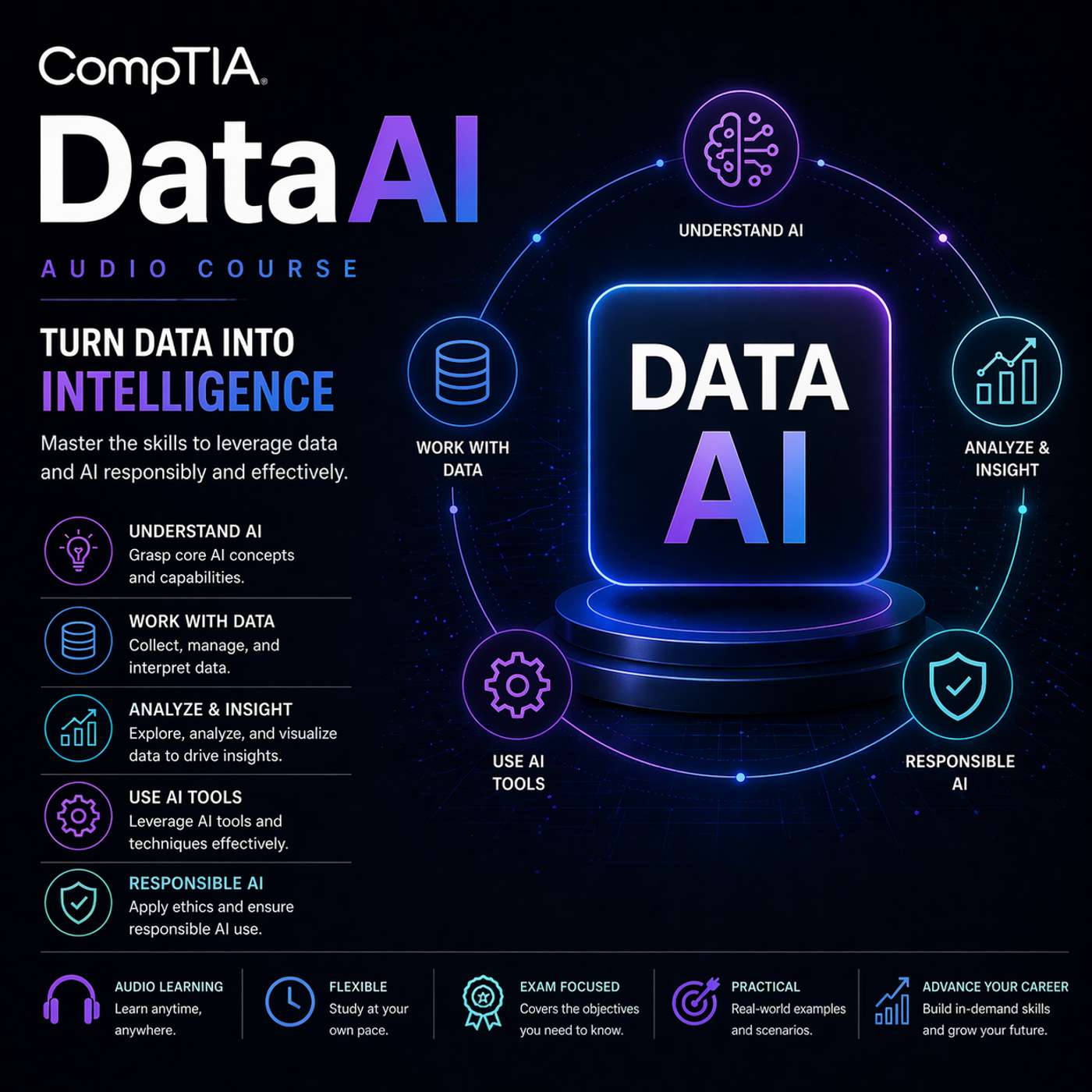
Certified: The CompTIA DataAI Certification Audio Course is an audio-first study companion built for busy professionals who want a clear path into data and AI work without getting lost in jargon. It’s designed for analysts, early-career data practitioners, IT and cybersecurity pros expanding into AI, and managers who need enough technical fluency to lead data projects confidently. If you’ve worked with dashboards, spreadsheets, or basic scripting and you’re ready to understand how data becomes models and decisions, this course meets you where you are. You don’t need an advanced math background...
Where to listen?
Podcasts in the app Replaio Radio Coming soonPodcasts are coming to the app soon. Install now and be the first to see a whole new take on podcasts
 Install for free
Android 5M+ downloads · 4.8 rating
iOS soon
Install for free
Android 5M+ downloads · 4.8 rating
iOS soon
Episodes
Episode 21 — Use logs, exponentials, and the chain rule to interpret learning dynamics 22.02.2026 14:03
This episode connects logarithms, exponentials, and the chain rule to the real mechanics of model training so you can answer DY0-001 questions that blend math intuition with practical troubleshooting. You’ll review why log transforms stabilize variance and turn multiplicative relationships into additive ones, which shows up in both feature engineering and loss functions. We’ll explain exponentials...
Episode 20 — Apply gradients and derivatives where they matter in model training 22.02.2026 18:07
This episode explains gradients and derivatives as the engine behind many training processes, helping you answer DY0-001 questions that ask why optimization behaves the way it does. You’ll learn how a loss function measures error, how the gradient points toward the direction of steepest increase, and why training typically moves in the opposite direction to reduce loss. We’ll connect this to gradi...
Episode 19 — Use eigenvalues and decompositions to understand variance and structure 22.02.2026 17:14
This episode introduces eigenvalues and matrix decompositions as practical tools for understanding structure in data, which connects directly to dimensionality reduction, feature engineering, and interpreting variance. You’ll learn the intuition behind eigenvectors as directions and eigenvalues as “how much” variance or influence exists along those directions, then connect that to why techniques l...
Episode 18 — Think in vectors and matrices: dot products, norms, and distance metrics 22.02.2026 19:41
This episode builds the linear algebra intuition that underpins many DataAI concepts, especially similarity, optimization, and how algorithms “see” data. You’ll learn how vectors represent feature rows, how matrices represent datasets and transformations, and why the dot product is more than a formula because it captures alignment between patterns. We’ll connect norms to magnitude and regularizati...
Episode 17 — Detect outliers and anomalies responsibly without destroying signal 22.02.2026 16:39
This episode explains outlier and anomaly handling in a way that prepares you for both exam questions and real project decisions where “remove it” is often the wrong first answer. You’ll define outliers versus anomalies, then connect detection methods to context, such as whether you expect extreme values to be legitimate rare events, data entry errors, or signals of fraud and failure. We’ll discus...
Episode 16 — Handle missing data properly: MCAR, MAR, NMAR, and imputation implications 22.02.2026 17:59
This episode teaches missing-data reasoning at a level that fits the exam, where the key skill is choosing a defensible handling method based on why data is missing, not just how much is missing. You’ll distinguish MCAR, MAR, and NMAR, and you’ll learn how each mechanism changes the risk of bias if you drop rows, fill values, or build models that implicitly treat “missing” as information. We’ll co...
Episode 15 — Understand sampling and bias: stratification, weighting, and representativeness 22.02.2026 18:50
This episode focuses on sampling choices and bias because DY0-001 frequently tests whether you can recognize when data does not represent the real world you plan to predict. You’ll learn the difference between random sampling, stratified sampling, and convenience sampling, and you’ll connect each approach to common risks like underrepresenting minority classes, missing rare events, or amplifying a...
Episode 14 — Use entropy, information gain, and Gini to reason about split quality 22.02.2026 18:03
This episode explains how decision trees choose splits and why the exam cares about your ability to reason about impurity reduction, not memorize formulas. You’ll define entropy, information gain, and the Gini index as measures of how mixed a node is, then connect them to the practical goal of creating child nodes that are more “pure” than the parent. We’ll discuss how these measures behave with c...
Episode 13 — Diagnose confusion matrices quickly and spot threshold-driven tradeoffs 22.02.2026 17:23
This episode turns the confusion matrix into a fast decision tool you can use under exam time pressure, helping you translate counts into meaning and meaning into action. You’ll learn how true positives, false positives, true negatives, and false negatives map to common outcomes, and how small threshold changes can shift the error profile in ways that matter more than a single score. We’ll walk th...
Episode 12 — Understand classification metrics deeply: precision, recall, F1, ROC, and AUC 22.02.2026 20:11
This episode builds a clear, test-ready understanding of classification metrics, because DY0-001 questions often hinge on choosing the right metric for the decision, not just knowing the definition. You’ll review precision, recall, and F1 in terms of false positives and false negatives, then connect those tradeoffs to real operational consequences like alert fatigue, missed fraud, or unsafe approv...
Episode 11 — Compare regression performance measures: RMSE, MAE, MAPE, and R-squared 22.02.2026 18:25
This episode teaches how to compare common regression metrics in a way that matches how the DY0-001 exam expects you to reason about error, fit, and practical impact. You’ll define RMSE, MAE, MAPE, and R-squared, then connect each one to what it rewards and what it hides, such as RMSE’s sensitivity to large errors, MAE’s more even penalty, MAPE’s pitfalls with small or zero values, and R-squared’s...
Episode 10 — Make sense of regression outputs: coefficients, residuals, significance, and fit 22.02.2026 14:53
This episode teaches you how to read regression output like an analyst instead of treating it as a wall of numbers, which is a core DY0-001 skill for both modeling and evaluation questions. You will interpret coefficients in context, including how units and scaling affect meaning, and you’ll learn why sign and magnitude matter only when the model assumptions and feature design make sense. We’ll co...
Episode 9 — Read confidence intervals correctly and avoid classic interpretation traps 22.02.2026 15:09
This episode focuses on confidence intervals because they show up across statistics, experimentation, and model reporting, and the exam often tests whether you can interpret them correctly under pressure. You will learn what a confidence interval represents in frequentist terms, how it relates to sampling variability, and why it is not a statement that a parameter has a specific probability of bei...
Episode 8 — Choose the right statistical test fast: t-test, chi-squared, ANOVA, correlation 22.02.2026 17:11
This episode gives you a quick selection framework for common statistical tests and the kinds of questions each test answers, which is essential for efficient DY0-001 problem solving. You will learn to start from the variable types and the question being asked—difference in means, association between categories, comparison across multiple groups, or relationship strength between numeric variables—...
Episode 7 — Interpret hypothesis tests: p-values, alpha, power, and common failure modes 22.02.2026 15:04
This episode teaches hypothesis testing in a way that matches how the DY0-001 exam expects you to interpret results and avoid classic misreadings. You will define null and alternative hypotheses, then connect p-values and significance levels to decision thresholds, emphasizing what a p-value does and does not say about truth, importance, or causality. We’ll explain statistical power and how sample...
Episode 6 — Turn randomness into insight with Monte Carlo simulation and bootstrapping 22.02.2026 15:12
This episode explains how Monte Carlo simulation and bootstrapping help you make decisions when analytic solutions are messy or when you need uncertainty estimates from limited data. You will learn the core idea of using repeated sampling to approximate distributions of outcomes, then connect that to common exam contexts like estimating confidence around a metric, stress-testing assumptions, or co...
Episode 5 — Use Bayes’ theorem confidently for evidence updates and conditional reasoning 22.02.2026 13:34
This episode focuses on Bayes’ theorem as a practical reasoning tool for updating beliefs when you see new evidence, which is a recurring skill in data and AI decision-making. You will define prior, likelihood, and posterior in plain terms and learn to translate word problems into a clean conditional probability setup without getting trapped by confusing phrasing. We’ll work through scenarios that...
Episode 4 — Apply probability distributions correctly: PMF, PDF, CDF, and expectations 22.02.2026 15:51
This episode builds the probability foundations you need for many DY0-001 questions by making distributions feel practical instead of abstract. You will distinguish discrete and continuous variables, then connect that distinction to the probability mass function (PMF) and probability density function (PDF), including what you can and cannot interpret directly from each. We’ll walk through cumulati...
Episode 3 — Use smart test-taking tactics for tricky CompTIA wording and time pressure 22.02.2026 13:59
This episode teaches test-taking tactics tailored to CompTIA’s wording patterns, where success often depends on interpreting constraints and selecting the “best” action rather than a technically possible one. You will learn how to identify signal words that change the meaning of an item, such as “first,” “most appropriate,” or “given limited data,” and how to quickly map those signals to a decisio...
Episode 2 — Build a spoken study plan that matches CompTIA DataAI learning objectives 22.02.2026 14:21
This episode focuses on building a realistic study plan that aligns to the CompTIA DataAI DY0-001 learning objectives, with an emphasis on retention and exam readiness rather than volume. You will learn how to translate the blueprint into a weekly rhythm that balances concepts, practice questions, and short review loops, so your knowledge is durable under exam conditions. We’ll define what “object...
Episode 1 — Master the DY0-001 exam structure, question styles, rules, and timing 22.02.2026 15:00
This episode explains how the CompTIA DataAI DY0-001 exam is structured and why understanding the exam’s mechanics is a measurable advantage on test day. You will break down typical question styles, including scenario-based prompts and items that blend data fundamentals with applied AI decisions, and you will practice reading for what the question is actually asking versus what it is describing. W...
Similar podcasts







Listen to the Certified: The CompTIA DataAI Audio Course podcast in Replaio
Radio and podcasts in one app - free, with no sign-up. Install today and do not miss the launch
Replaio is not a podcast publisher; show names, artwork and audio belong to their authors and are distributed through public RSS feeds.