Jason Edwards
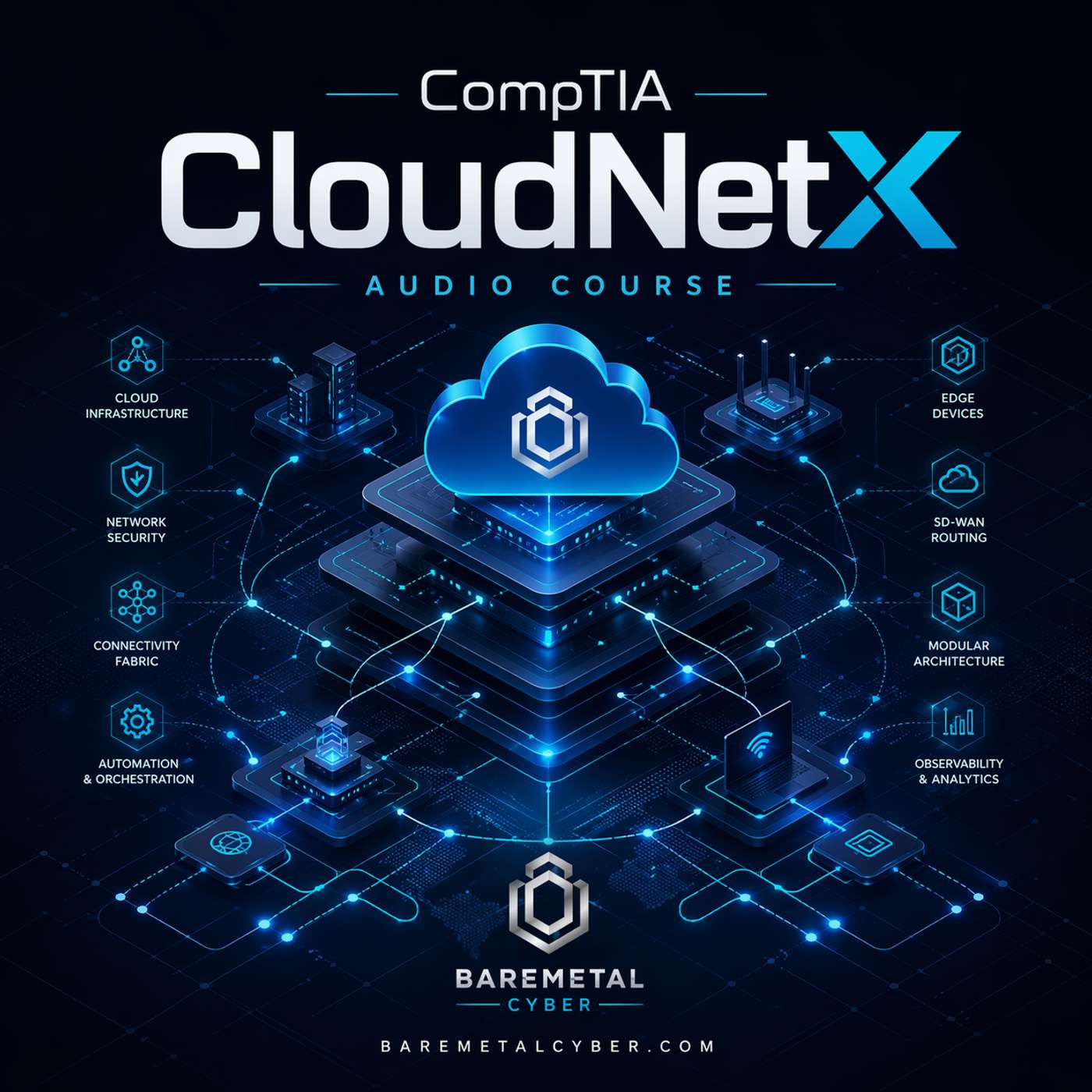
Certified: The CompTIA CloudNetX Audio Course
The CloudNetX PrepCast is an exam-focused audio course designed to teach you how to think like a network architect operating in modern hybrid environments. Rather than memorizing protocols or vendor features in isolation, this course trains you to interpret scenario-based questions, identify constraints, and select designs that balance security, availability, performance, and cost the way the CloudNetX exam expects. Each episode builds practical architectural reasoning skills, covering topics such as routing intent, segmentation strategy, identity-driven access, cloud interconnects, resilience...
Where to listen?
Podcasts in the app Replaio Radio Coming soonPodcasts are coming to the app soon. Install now and be the first to see a whole new take on podcasts
 Install for free
Android 5M+ downloads · 4.8 rating
iOS soon
Install for free
Android 5M+ downloads · 4.8 rating
iOS soon
Episodes
Episode 45 — Transit Gateways: hub routing without spaghetti networks 16.01.2026 14:46
Transit gateways appear in CloudNetX scenarios as a way to scale connectivity in cloud and hybrid designs without creating an unmanageable web of peerings and custom routes. This episode defines a transit gateway as a centralized routing hub that connects multiple networks through standardized attachments, enabling hub-and-spoke designs with controlled route sharing. The first paragraph focuses on...
Episode 44 — Service Endpoints: private access patterns for managed services 16.01.2026 21:06
Service endpoints appear in CloudNetX scenarios as private connectivity options for managed services, and this episode explains how they reduce exposure while simplifying access patterns. It defines a service endpoint as a mechanism that keeps traffic between a private network and a provider-managed service on the provider’s private backbone rather than traversing the public internet. The first pa...
Episode 43 — Application Gateways: what they do beyond routing and firewalling 16.01.2026 21:20
Application gateways show up in CloudNetX scenarios when traffic decisions must be made with application context rather than only IP and port, and this episode explains what they add beyond routing and firewalling. It defines an application gateway as a Layer 7-aware control point that can terminate and re-establish connections, perform request-based routing, and apply policy based on hostnames, p...
Episode 42 — SSH vs RDP: secure management assumptions the exam tests 16.01.2026 20:29
Remote management protocols appear in CloudNetX scenarios as design signals about administrative needs, exposure risk, and operational controls, and this episode clarifies how to choose between SSH and RDP responsibly. It defines SSH as a secure remote shell approach commonly used for command-line administration and automation, and it defines RDP as a remote desktop approach used when graphical to...
Episode 41 — Bastion Hosts: safe admin access paths in hybrid designs 16.01.2026 18:42
Administrative access is a high-value pathway in hybrid environments, and CloudNetX scenarios often test whether you can design that pathway with minimal exposure and strong accountability. This episode defines a bastion host as a controlled jump point that mediates administrative access to internal systems, reducing the need to expose management ports directly to untrusted networks. The first par...
Episode 40 — WireGuard in Hybrid: why it’s referenced and when it fits 16.01.2026 20:30
WireGuard appears in CloudNetX objectives as an example of a modern VPN approach, and this episode explains why it is referenced and what it implies in hybrid designs. It introduces WireGuard as a lightweight VPN protocol emphasizing simplicity, strong cryptography, and reduced complexity relative to older stacks, with a design that often maps cleanly to peer-to-peer connectivity and straightforwa...
Episode 39 — Split Tunneling: security and performance tradeoffs in plain language 16.01.2026 18:28
Split tunneling is frequently tested as a tradeoff decision because it changes where traffic flows and which security controls see it, and this episode explains that decision clearly. It defines split tunneling as allowing some device traffic to go directly to the internet while other traffic traverses the encrypted tunnel to enterprise networks or security services. The first paragraph focuses on...
Episode 38 — VPN Types: site-to-site vs point-to-site vs remote access 16.01.2026 21:23
VPN scenarios in CloudNetX require distinguishing connectivity intent, trust scope, and operational impact, and this episode provides clear models for the main VPN types. It defines site-to-site VPNs as persistent encrypted tunnels connecting networks, typically used to link offices, data centers, or cloud environments into a unified routing domain. It defines point-to-site VPNs as connecting indi...
Episode 37 — Cloud Interconnects: Direct Connect, ExpressRoute, SDCI selection logic 16.01.2026 21:43
Private cloud interconnects appear in CloudNetX scenarios as mechanisms to improve predictability, reduce exposure to the public internet, and support compliance-driven connectivity requirements. This episode introduces cloud interconnects in vendor-neutral terms as dedicated or provider-managed private paths between enterprise networks and cloud environments. The first paragraph focuses on why in...
Episode 36 — Satellite Links: latency reality and use cases that fit 16.01.2026 21:31
Satellite connectivity shows up in CloudNetX scenarios as an option of necessity, chosen when terrestrial connectivity is unavailable or when geographic reach outweighs performance constraints. This episode defines satellite links as long-distance access paths that can connect remote sites, maritime locations, or disaster recovery environments where other circuits are impractical. The first paragr...
Episode 35 — Cellular Links: when constraints make cellular the best answer 16.01.2026 21:56
Cellular connectivity appears in CloudNetX scenarios as a pragmatic option when traditional wired connectivity is unavailable, delayed, or insufficiently resilient, and this episode explains when cellular becomes the best design choice. It defines cellular links as flexible access paths that can provide rapid deployment and geographic reach, often used for temporary sites, remote workers, or backu...
Episode 34 — WAN Selection Framework: MPLS, SD-WAN, DIA, metro, dark fiber 16.01.2026 22:58
WAN choices in CloudNetX scenarios require aligning connectivity options to business outcomes, operational constraints, and performance requirements rather than selecting the most modern-sounding technology. This episode introduces a selection framework that evaluates common WAN options in practical terms. It describes MPLS as a provider-managed approach that can deliver predictable paths and stab...
Episode 33 — Production vs Non-Production: separation, blast radius, and governance 16.01.2026 23:00
Separation between production and non-production is a recurring architectural requirement because it reduces risk, supports governance, and prevents testing from becoming an outage. This episode defines production as the environment that must meet strict availability, integrity, and accountability expectations, while non-production environments exist to support development, testing, and validation...
Episode 32 — GENEVE: where encapsulation shows up and what it implies 16.01.2026 22:22
Encapsulation shows up in CloudNetX scenarios because modern segmentation and service chaining often rely on tunnels that carry one network inside another, and this episode explains GENEVE as a flexible encapsulation approach in that broader category. It introduces GENEVE at a conceptual level as an encapsulation method designed to carry tenant traffic across shared infrastructure while attaching...
Episode 31 — VXLAN: what overlays enable and why architects use them 16.01.2026 22:56
VXLAN appears in modern network design scenarios as a way to extend segmentation across large environments without relying on traditional Layer 2 scaling limits. This episode introduces VXLAN as an overlay approach that carries Layer 2 segments over a Layer 3 underlay, enabling flexible placement of workloads while preserving logical separation. The first paragraph focuses on what overlays enable:...
Episode 30 — VLAN Segmentation: what it solves and common design traps 16.01.2026 21:57
VLANs remain a common segmentation mechanism in campus and data center scenarios, and this episode explains what VLAN segmentation solves and where it commonly goes wrong. It defines VLANs as a way to separate broadcast domains at Layer 2 while allowing shared physical infrastructure, and it explains how VLANs support organizational separation, reduce unnecessary broadcast traffic, and establish b...
Episode 29 — Segmentation Fundamentals: why segmentation fails and how to make it stick 16.01.2026 21:50
Segmentation is a foundational security and resilience strategy in CloudNetX scenarios, but it frequently fails in real environments due to unclear requirements and unmanaged exceptions. This episode defines segmentation as the practice of separating assets into groups with controlled, explicitly allowed flows, with the goal of limiting blast radius and simplifying enforcement. The first paragraph...
Episode 28 — Traffic Flows: designing for north/south versus east/west 16.01.2026 21:04
Traffic flow direction is one of the fastest ways to interpret a scenario and choose appropriate controls, and this episode builds a practical model for north/south and east/west design. It defines north/south flows as traffic that enters or leaves an environment, typically involving users, the internet, or external services, and it defines east/west flows as traffic moving between internal servic...
Episode 27 — Network Zones: trusted, untrusted, and screened subnet decisions 16.01.2026 21:08
Network zoning is a recurring theme in CloudNetX scenarios because it provides a simple, defensible way to structure trust and control access. This episode defines trusted zones as segments reserved for internal systems with strict controls and limited exposure, untrusted zones as areas where traffic originates from unknown or uncontrolled sources, and screened subnets as buffer zones designed to...
Episode 26 — Spine-and-Leaf: what it optimizes and when it’s justified 16.01.2026 20:07
Spine-and-leaf designs appear in CloudNetX content as a scalable approach for environments with heavy east/west traffic, and this episode explains what the architecture optimizes and why it is used. It defines leaf switches as the edge of the fabric that connect endpoints and services, and spine switches as the high-speed backbone that interconnects all leaf switches in a consistent pattern. The f...
Episode 25 — Picking a Topology: star, mesh, hub-and-spoke, point-to-point 16.01.2026 21:21
Topology selection in CloudNetX scenarios is about matching connectivity structure to traffic patterns, resilience needs, and operational capacity, and this episode explains how to make that selection deliberately. It defines star topologies as centralizing connectivity around a core device or site, mesh topologies as providing multiple direct paths between nodes, hub-and-spoke as consolidating ro...
Episode 24 — Network Virtual Interfaces: what vNICs imply for control and visibility 16.01.2026 21:21
Virtual network interfaces are the attachment points where workloads connect to networks and where many policy decisions are enforced, making them central to CloudNetX design scenarios. This episode defines a vNIC as a logical interface that carries addressing, routing, and security policy context for a virtual machine or similar workload, and it explains why vNIC configuration affects segmentatio...
Episode 23 — Container Networking Basics: why workloads change network assumptions 16.01.2026 20:54
Containerized workloads change network assumptions because services become more dynamic, more distributed, and often more dependent on naming and policy than on fixed endpoints. This episode introduces container networking at a conceptual level, explaining why multiple workloads can share a host while still needing isolation, why virtual interfaces and logical networks become the norm, and why ser...
Episode 22 — BGP Design Thinking: peering intent, policy, and stability 16.01.2026 21:49
BGP design in CloudNetX scenarios is rarely about memorizing attributes and more about understanding peering intent, route control, and operational stability. This episode explains BGP as a mechanism for expressing routing policy between networks, where the primary objective is to control what routes are exchanged, which routes are preferred, and how failures are handled without destabilizing conn...
Episode 21 — OSPF vs BGP: which problem each one is solving 16.01.2026 21:43
OSPF and BGP appear in CloudNetX scenarios as signals about routing scope and intent, and this episode clarifies the distinct problems each protocol solves. It defines OSPF as an interior routing approach designed for controlled environments where the goal is efficient path selection within an organization, and it defines BGP as a policy-based routing approach used to exchange routes between disti...
Similar podcasts







Listen to the Certified: The CompTIA CloudNetX Audio Course podcast in Replaio
Radio and podcasts in one app - free, with no sign-up. Install today and do not miss the launch
Replaio is not a podcast publisher; show names, artwork and audio belong to their authors and are distributed through public RSS feeds.