Jason Edwards
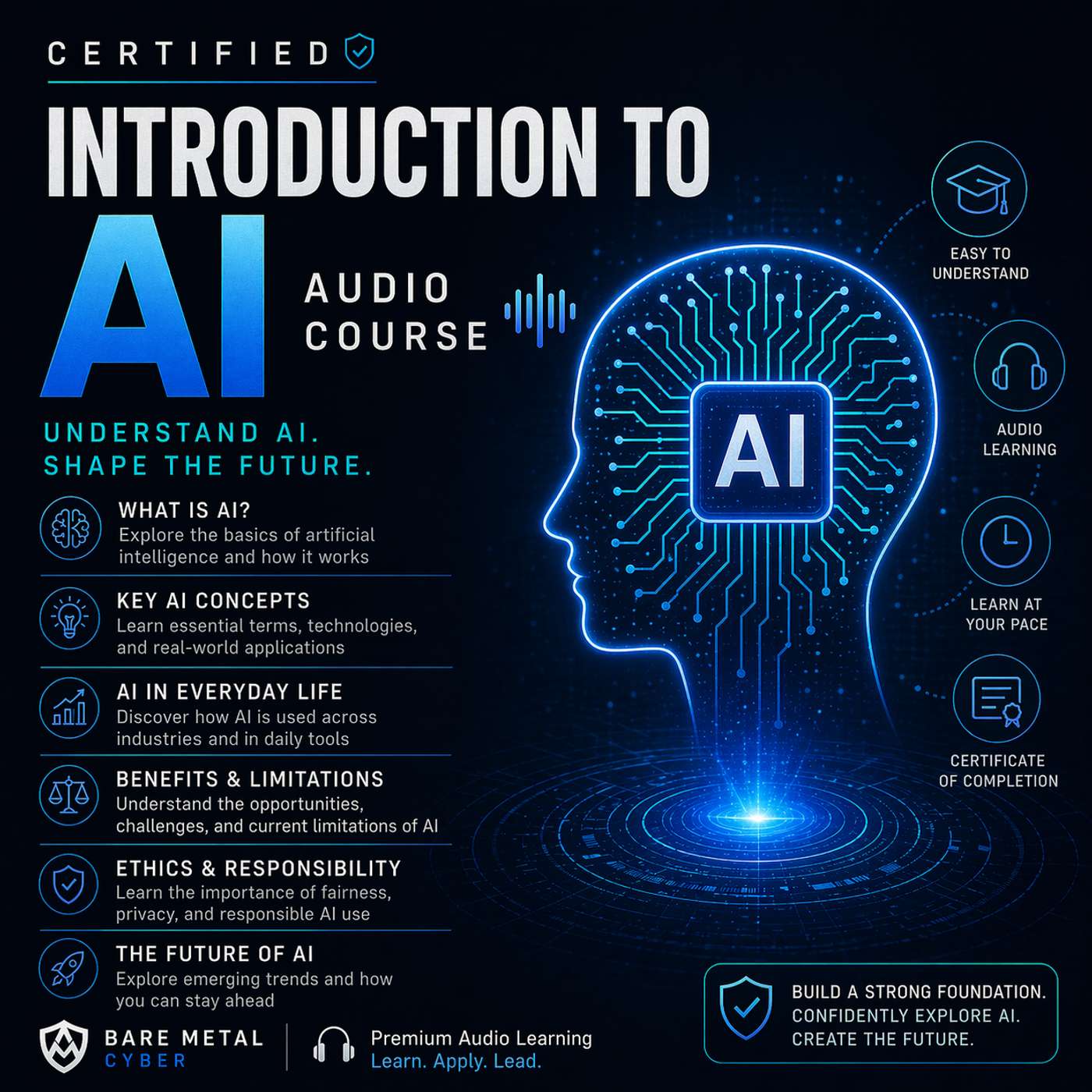
Certified - Introduction to AI Audio Course
The Introduction to Artificial Intelligence Audio Course is your complete, audio-first guide to understanding the principles, possibilities, and real-world impact of AI. Designed for learners at any stage—students, professionals, or career changers—this Audio Course takes you on a structured journey through how machines learn, reason, and make decisions. Each episode builds your understanding step by step, covering the fundamentals of machine learning, neural networks, natural language processing, robotics, and data-driven intelligence. You’ll also explore how AI is transforming industries suc...
Be sure to visit the podcast's website and support the creator: baremetalcyber.com
Author
Jason Edwards
Category
Podcast website
Latest episode
Oct 14, 2025
Where to listen?
Podcasts in the app Replaio Radio Coming soonPodcasts are coming to the app soon. Install now and be the first to see a whole new take on podcasts
 Install for free
Android almost 10M downloads · 4.8 rating
iOS soon
Install for free
Android almost 10M downloads · 4.8 rating
iOS soon
Episodes
Episode 24 — AI in Edge and IoT Devices 10.09.2025 31:02
AI is not confined to the cloud — it increasingly lives in the devices around us. This episode introduces edge AI, where models run locally on Internet of Things (IoT) devices. Benefits include lower latency, improved privacy, and functionality even without network connections. We’ll explain how embedded machine learning models are compressed and optimized for limited hardware, and how techniques...
Episode 23 — Cloud AI Services — Off-the-Shelf Tools 10.09.2025 31:08
Not every organization can build AI systems from scratch, and cloud AI services fill this gap by offering ready-made tools. This episode explains how major providers such as Amazon Web Services, Microsoft Azure, and Google Cloud deliver APIs for natural language processing, vision, and speech. Pre-trained models allow companies to adopt AI quickly, while platforms like SageMaker and Vertex AI offe...
Episode 22 — Human–AI Interaction — Interfaces and Usability 10.09.2025 32:46
For AI to succeed, people must be able to use it effectively. This episode examines the design of interfaces that allow humans to interact with AI in ways that are intuitive, transparent, and supportive of trust. We start with dashboards, conversational agents, and voice interfaces, then explore adaptive systems that personalize recommendations and adjust to user behavior. Transparency features, s...
Episode 21 — Common Pitfalls and Bias in AI Systems 10.09.2025 32:34
AI systems are only as good as the data and assumptions that shape them, and many fail because of recurring pitfalls. This episode outlines the most common problems, starting with poor data quality, unbalanced datasets, and labeling errors. We’ll discuss sampling bias, measurement bias, and the use of proxy variables that inadvertently encode sensitive traits. Overfitting, underfitting, and automa...
Episode 20 — Evaluating AI Performance 10.09.2025 31:38
Knowing that an AI model works is not enough — we need to know how well it works, and under what conditions. This episode explores the frameworks and metrics used to evaluate AI performance. We begin with accuracy, precision, recall, F1 score, and confusion matrices for classification problems, then move to regression metrics like mean squared error and R². For clustering and ranking tasks, we cov...
Episode 19 — Training, Validation, and Testing Models 10.09.2025 31:32
Once data is prepared, models must be built and evaluated with rigor. This episode covers the three pillars of evaluation: training, validation, and testing. Training introduces the algorithm to data, refining weights and parameters over multiple epochs. Validation checks progress midstream, guiding hyperparameter tuning and preventing overfitting. Testing provides the final check, using unseen da...
Episode 18 — Data Collection and Preparation for AI 10.09.2025 33:04
Data is not just fuel for AI; it must be carefully gathered, cleaned, and prepared to produce reliable results. This episode breaks down the full lifecycle of data preparation, from collection through preprocessing. You’ll hear about structured, semi-structured, and unstructured data, and the importance of cleaning, labeling, and augmenting datasets. Normalization, handling missing values, and fea...
Episode 17 — Robotics — AI in the Physical World 10.09.2025 29:39
While much of AI lives in code and data, robotics brings intelligence into the physical world. This episode examines how robots integrate sensing, reasoning, and action. We begin with perception technologies such as cameras, lidar, and tactile sensors, followed by motion planning, control systems, and kinematic models that enable movement. Manipulation, navigation, and localization are explained a...
Episode 16 — Speech Recognition and Generation 10.09.2025 28:27
Speech is one of the most natural ways humans communicate, and AI systems are increasingly able to listen and respond. This episode covers speech recognition, the conversion of audio into text, and speech generation, the production of lifelike voice outputs. We trace the path from early statistical methods like hidden Markov models to deep learning architectures that now dominate. You’ll learn abo...
Episode 15 — Computer Vision — Teaching Machines to See 10.09.2025 28:29
The ability to process visual information has been a defining achievement for AI. In this episode, we explore how computer vision allows machines to interpret and analyze images and video. We start with early techniques like edge detection and feature extraction, then move into modern convolutional neural networks that revolutionized accuracy in object detection and classification. Segmentation, o...
Episode 14 — Natural Language Processing — How Machines Understand Text 10.09.2025 27:02
Language is one of the most human forms of intelligence, and this episode explores how AI systems learn to read, interpret, and generate text. We begin with early approaches like rule-based translation, then move into statistical models such as bag-of-words and word embeddings. Tokenization, part-of-speech tagging, syntax parsing, and semantic analysis are explained as core steps in processing hum...
Episode 13 — Deep Learning — Modern Architectures 10.09.2025 28:56
Deep learning represents the cutting edge of neural networks, pushing performance far beyond earlier methods. In this episode, we define deep learning as networks with many layers capable of learning hierarchical features, supported by massive datasets and specialized hardware like GPUs. We’ll explore architectures including convolutional neural networks for vision, recurrent and gated networks fo...
Episode 12 — Neural Networks — From Neurons to Layers 10.09.2025 28:35
Artificial neural networks are inspired by the structure of the human brain but simplified into mathematical models that drive today’s most powerful AI systems. In this episode, we begin with the perceptron, an early model of a single artificial neuron, then explore how weights, activation functions, and layers combine to process information. Multi-layer networks, trained through backpropagation a...
Episode 11 — Machine Learning Foundations — Supervised, Unsupervised, Reinforcement 10.09.2025 23:40
Machine learning is the beating heart of modern AI, and this episode introduces its three foundational approaches: supervised, unsupervised, and reinforcement learning. We begin with supervised learning, where labeled data pairs inputs with correct outputs, powering tasks like classification and regression. We then shift to unsupervised learning, where algorithms find hidden structure in unlabeled...
Episode 10 — Probability and Decision Making Under Uncertainty 10.09.2025 25:11
Real-world decisions are rarely black and white, and AI systems must navigate uncertainty just as humans do. This episode explores how probability theory underpins reasoning when outcomes are incomplete, noisy, or ambiguous. We begin with core concepts like random variables, probability distributions, and conditional probability, then move to Bayes’ theorem as a method for updating beliefs with ne...
Episode 9 — Logic and Reasoning Systems 10.09.2025 25:47
Reasoning has always been at the heart of intelligence, and in this episode we focus on how AI systems use logic to derive conclusions. Starting with propositional and predicate logic, we’ll explain how knowledge can be structured into true or false statements and rules. Deductive, inductive, and abductive reasoning are compared as different ways to reach conclusions from data or hypotheses. You’l...
Episode 8 — Knowledge Representation — How Machines Store Facts 10.09.2025 24:24
For AI to reason, it needs to store and organize information. This episode explores knowledge representation, the frameworks that allow machines to capture facts, relationships, and rules. From semantic networks linking concepts to ontologies defining categories, we examine how different structures model the world. Logic-based systems like first-order logic provide precision, while production rule...
Episode 7 — Search and Problem Solving in AI 10.09.2025 25:20
Before machine learning took center stage, AI was already grappling with how to solve problems systematically. This episode dives into search and problem solving, two of the earliest and still fundamental approaches to intelligence. You’ll learn how problems are represented as states and transitions, and how uninformed search strategies like breadth-first and depth-first explore possibilities blin...
Episode 6 — Data — The Fuel of AI 10.09.2025 26:38
No matter how advanced the algorithm, it can’t run without data. This episode focuses on why data is considered the fuel of AI, exploring the different types that drive training and performance. Structured data, such as rows in databases, is contrasted with unstructured data like images, text, and audio. We’ll examine the steps needed to prepare data — collecting, cleaning, labeling, and augmentin...
Episode 5 — How Machines “Think” — Algorithms and Representations 10.09.2025 26:57
When people talk about machines “thinking,” they’re not talking about human intuition or creativity. They’re talking about algorithms — structured sets of instructions — and representations, the ways information is stored and processed. In this episode, we look at how computers encode numbers, words, and images, and how those encodings become the raw material for reasoning. You’ll learn about symb...
Episode 4 — AI vs. Machine Learning vs. Deep Learning — Key Distinctions 10.09.2025 27:37
AI, machine learning, and deep learning are terms often used interchangeably, but they are not the same — and confusing them makes it harder to understand the field. This episode clears the fog by breaking down how these layers of terminology connect. We’ll begin with Artificial Intelligence as the broadest category: any system designed to mimic aspects of human thought. Within that sits machine l...
Episode 3 — A Brief History of AI — From Turing to Transformers 10.09.2025 26:55
Artificial Intelligence didn’t appear overnight; it has a story stretching back more than seven decades. In this episode, we step into that story, beginning with Alan Turing’s famous question — can machines think? — and the Turing Test that followed as an early benchmark for intelligence. We’ll visit the 1956 Dartmouth Conference where the term “Artificial Intelligence” was first coined, and hear...
Episode 2 — Course Roadmap — How to Learn AI in Audio Form 10.09.2025 24:00
This PrepCast is designed to teach Artificial Intelligence in a way that fits into real life: no slides, no diagrams, no heavy math on the page — just clear explanations you can absorb anywhere. In this roadmap episode, we walk through the design of the series, showing how the episodes are structured so you can either listen sequentially and build a complete foundation or drop into individual topi...
Episode 1 — Orientation — What is Artificial Intelligence? 10.09.2025 31:26
Artificial Intelligence is a term everyone has heard, but few understand in depth. In this opening episode, we cut through the hype and get to the core: what does it actually mean when we say a system is “intelligent”? You’ll hear how the idea of machines that mimic human thought emerged, why early approaches like rule-based programming fell short, and how modern data-driven methods reshaped the f...
Similar podcasts







Listen to the Certified - Introduction to AI Audio Course podcast in Replaio
Radio and podcasts in one app - free, with no sign-up. Install today and do not miss the launch
Replaio is not a podcast publisher; show names, artwork and audio belong to their authors and are distributed through public RSS feeds.