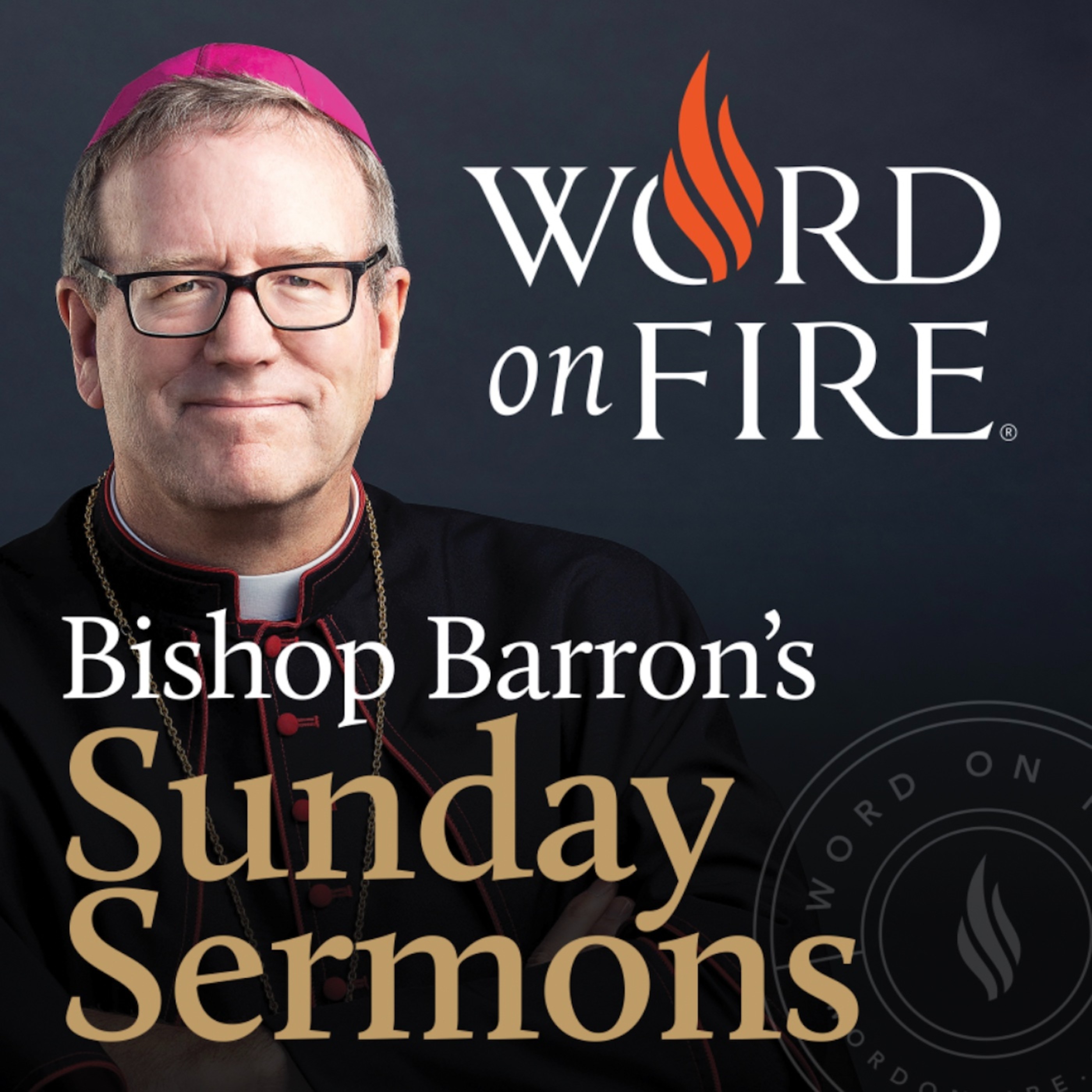
Bishop Robert Barron
Bishop Barron’s Sunday Sermons - Catholic Preaching and Homilies
Weekly homilies from Bishop Robert Barron, produced by Word on Fire Catholic Ministries.
Author
Bishop Robert Barron
Category
Podcast website
Latest episode
Jul 8, 2026
Where to listen?
Podcasts in the app Replaio Radio Coming soonPodcasts are coming to the app soon. Install now and be the first to see a whole new take on podcasts
 Install for free
Android 5M+ downloads · 4.8 rating
iOS soon
Install for free
Android 5M+ downloads · 4.8 rating
iOS soon
Episodes
Training in the Divine School 22.08.2004 14:54
In the years following the Second Vatican Council, we became very hesitant ever to invoke the category of the divine punishment. Yet, this motif can be found throughout the Bible, both Old Testament and New. How do we properly understand it? Our second reading from Mass, taken from the letter to the Hebrews, gives us some important guidance. It places God's punishment in the context of love and di...
Walking the Path of Faith 08.08.2004 14:51
Our second reading this week is from the 11th chapter of the letter to the Hebrews, and it concerns that central virtue of the Christian life: faith. To believe is not to be naive, superstitious, or uncritical. It is not opposed to reason. Rather, it is a reasonable leap into the darkness of that which transcends what we can know and control. As such, it is analogous to the "leaps" made by a man a...
The Wisdom of Qoheleth 01.08.2004 14:55
Our first reading for this Sunday is taken from the wonderful book of Ecclesiastes. This Biblical text is made up of the cranky reflections of Qoheleth, an old man who has seen it all and done it all--and finds all of it "vanity and a chase after wind." Why do we attend to his rather sardonic meditations? We do so because it is altogether salutary to be reminded that our ultimate joy is found in n...
The Ways of Prayer 25.07.2004 15:00
The Bible speaks often of prayer, that intimate communion and conversation with God. Our readings for this Sunday present, if I can put it this way, the rules of prayer. First, we must pray with faith and confidence; secondly, our prayer must be accompanied by forgiveness; thirdly, we must pray with persistence, and finally, we must pray in the name of Jesus the Lord. Why does our prayer not "work...
The One Thing Necessary 18.07.2004 15:00
Both our first reading and Gospel for this week speak of the importance of keeping our attention riveted on God. The three angels visit Abraham, and he drops everything in order to receive them with hospitality; Jesus comes to her home, and Mary sits at his feet, listening to his words. When God is the absolute priority in our lives, everything else that we are worried about about falls into place...
The Good Samaritan 11.07.2004 15:00
The story of the Good Samaritan is not merely a morality tale, an account of the kind of life we should lead. It is that, but, at the deepest level, it is also a telling of the basic story of sin, fall, and redemption. All of us sinners are the man beaten up and left half-dead by the side of the road. We cannot be saved by law or religion or our own works, but only by Jesus Christ and his grace. T...
A Portrait of the Church 04.07.2004 15:00
Our Gospel reading for this Sunday is the account of Jesus' sending of the seventy-two disciples. In the instructions he gives them, we can discern an outline of the life and work of the Church down through the ages. At our best, we are missionary church, empowered by prayer, marked by simplicity of life, bearing health and salvation, and proclaiming the reign of God.
Elijah, You're Fired! 27.06.2004 15:00
In the stories of the prophets Elijah and Elisha we clearly see the great Biblical theme of vocation and election. Our lives our not about us; it is not finally our autonomy that matters. Rather, we are claimed and chosen and sent by God, and only in the measure that we accept this divine mission do we find true joy. When he resisted God's will and sought to justify himself, Elijah was summarily f...
They Shall Look on Him Whom They Have Pierced 20.06.2004 14:58
The book of the prophet Zechariah provides a sort of interpretive key for the life and ministry of Jesus. It tells us what the Messiah would do and what kind of figure he would be. The passage that we read from Zechariah for Mass this week emphasizes that the Messiah, curiously enough, would be "pierced." In our Gospel, Peter correctly identifies Jesus as the Messiah, but then he (and we) are give...
Jesus Yesterday, Today, and Forever! 13.06.2004 15:00
Paul tells us that whenever we eat the body and drink the blood of the Lord, we proclaim his death until he comes. This means that the Eucharist involves a wonderful compression of time, past and future meeting dynamically in the present. When we gather around the Lord's table now, we call to mind the breakthrough moment of the Paschal Mystery and we anticipate the culminating moment of the end of...
The Three-Personed God 06.06.2004 15:02
This weekend, we celebrate the Trinity, a mystery which stands at the very heart of the faith. The doctrine of the Trinity is a technical way of stating what St. John said in his first letter, viz. that God is love. If God is love, then there must be within God a play of lover, beloved, and love. This is the relationality that obtains among the Father, Son, and Holy Spirit.
Come, Holy Spirit 30.05.2004 15:00
The two great symbols of the descent of the Holy Spirit are wind and tongues of fire. Wind is powerful, unpredictable, destructive, like the Spirit which seizes us and takes us where we would rather not go. Tongues of fire signal impassioned speech on behalf of the Good News, a willingness to announce the Gospel publicly and even in the face of opposition. With the whole church around the world, w...
The Ascension of the Lord 23.05.2004 15:00
The feast of the Ascension is meant to awaken hope. In Jesus, risen from the dead and ascended to the right hand of the Father, our lowly human nature participates in the very life of God. In the light of the ascension, therefore, we are permitted to hope for a way of being, elevated and perfected beyond our imagining.
Paul's Basic Message 16.05.2004 15:02
Last week we explored the central teaching of St. Paul: to live in Christ Jesus. This week, we draw out four implications from this teaching: the corporate nature of the church, a sacramental imagination, the gifts of the Spirit, and the acknowledgement of Jesus as Lord. In emphasizing these themes, Paul gave shape to the whole of Christian theology through the ages.
Being in Christ 09.05.2004 15:00
Last week we looked at the life and times of Paul, the person who, after Jesus himself, is the most influential figure in the formation of the Christian church. In this week's sermon, I look briefly at Paul's central teaching, which I identify as "being in Christ." The phrase "en Christo," in Christ, appears 83 times in the letters of Paul, indicating how central it is to the Apostle's teaching an...
Paul the Apostle 02.05.2004 15:02
During the Easter season, we are reading from the book of the Acts of the Apostles. Though John, Philip, Peter, and James are all featured in Acts, the "star" of the text is clearly Paul, missionary and evangelist. Who was this extraordinarily important figure, the man that many say, after Jesus himself, was most influential on the development of Christianity? For the next three weeks, I will be e...
Victory Day 11.04.2004 15:00
Easter is the dawn of a new creation. St. John tells us that Mary Magdalene came to the tomb early on the morning of the first day of the week. This is meant to call to mind the first day of creation, when God said, "Let there be light" and brought order out of chaos. From the meaninglessness of death, God brings eternal life. This is the central and revolutionary message of Easter.
The Lesson of the Prodigal Son 21.03.2004 15:02
Jesus' parable of the Prodigal Son is one of the most memorable, carefully crafted, and inspiring stories ever told. In some ways, the whole of the Christian "thing" is summed up in this narrative. We have a God who invites us into the dynamism of his own life, and who relentlessly pursues us even when, in our stupidity and sin, we refuse to respond to the invitation.
The Adventure of Faith 07.03.2004 15:02
We have a God of adventure, a God who is always out ahead of us. Faith, in the Biblical sense of the term, is not primarily the acquiesence to propositions; rather, it is an attitude of trust in the God who calls us beyond ourselves. We witness this faith in Abraham's willingness to follow where God leads, and we see it too in the disciples' willingness to follow Jesus on the path toward the cross...
Jesus is Tempted in the Desert 29.02.2004 15:00
Jesus is driven by the Spirit into the desert in order to be tempted by the devil. The three temptations--to sensual pleasure, to power, and to pride--respresent three fundamental ways that all of us can be distracted from the path that God wants us to walk. It is therefore a salutary Lenten exercise to attend carefully to the texture of Jesus' responses.
Four Reasons to Love Your Enemies 22.02.2004 15:00
One of the most challenging and disconcerting of Jesus' commands is to love our enemies. In this sermon, I will explore four reasons why this moral demand makes sense. First, it helps us to test the quality of our love; second, it tells us a great deal about ourselves; third, it makes us see that sometimes our enemies might be right; and fourth, it allows us sometimes to win our enemy back.
Blessed Detachment 15.02.2004 15:02
Detachment is a key theme in the spiritual masters. It means that we must detach ourselves from all of those created goods--sex, money, power, pleasure--that are not our ultimate good. When we do this, we experience a spiritual freedom that actually enables us to enjoy those things more. Luke's version of the Beatitudes is, I submit, all about this detachment.
The Strange Path of Love 01.02.2004 15:02
Our second reading for Mass this weekend is one of the most beautiful and oft-quoted in the Biblical tradition: Paul's hymn to love in the 13th chapter of 1 Corinthians. Love--willing the good of the other--must undergird everything else in Christian life. Even the strongest faith, if it is unformed by love, is nothing; even the greatest pastoral outreach, if it is not for the sake of love, means...
The Lessons of Nehemiah 25.01.2004 15:00
Our first reading for this week is taken from the book of Nehemiah in the Old Testament. Nehemiah returned from exile in order to rebuild the walls of Jerusalem and to preside over the reconstitution of the Israelite nation. The Church, the new Israel, is a people with an identity grounded in tradition, law, word, and sacrament. When we allow those foundations to be destroyed, we are in danger of...
Similar podcasts






Listen to the Bishop Barron’s Sunday Sermons - Catholic Preaching and Homilies podcast in Replaio
Radio and podcasts in one app - free, with no sign-up. Install today and do not miss the launch
Replaio is not a podcast publisher; show names, artwork and audio belong to their authors and are distributed through public RSS feeds.