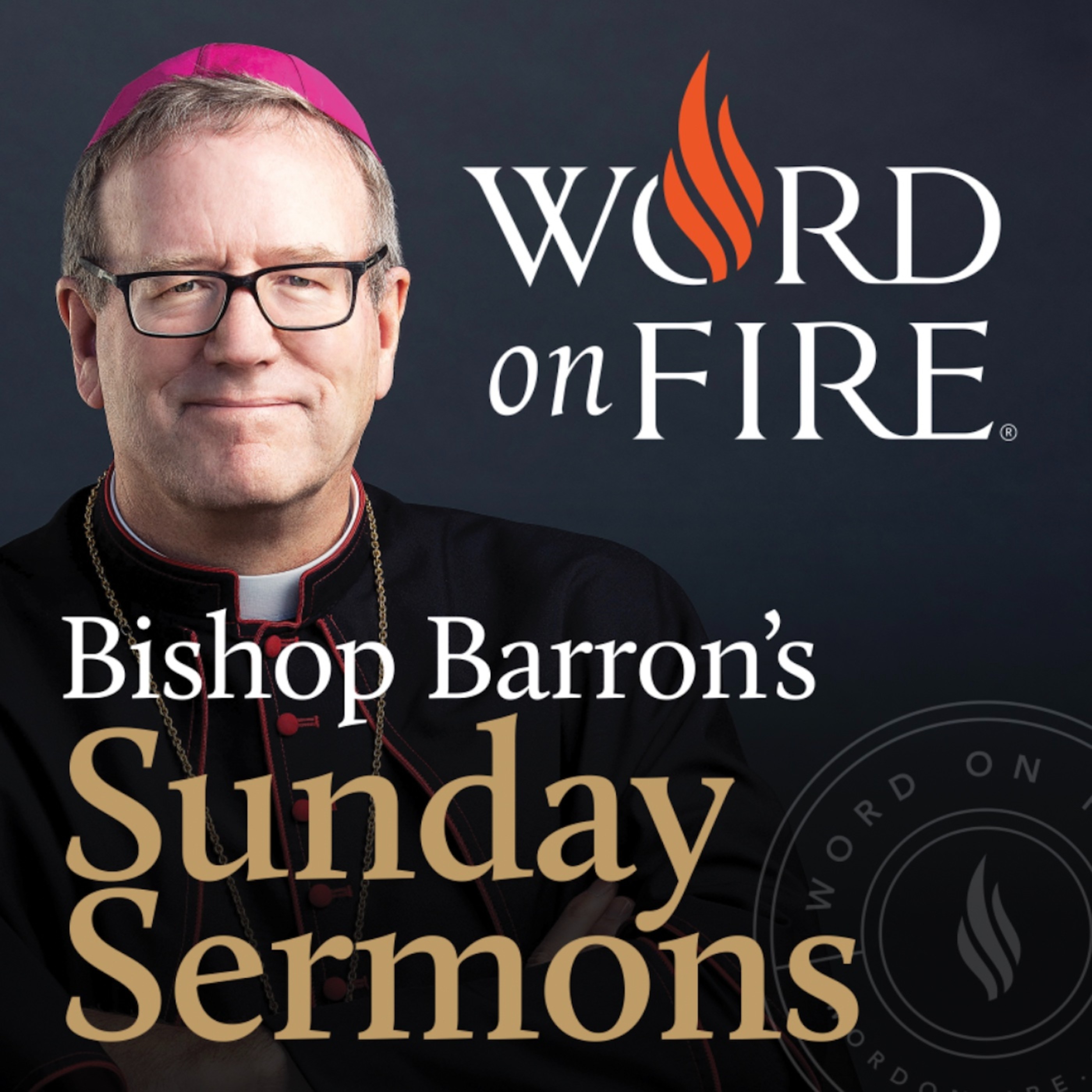
Bishop Robert Barron
Bishop Barron’s Sunday Sermons - Catholic Preaching and Homilies
Weekly homilies from Bishop Robert Barron, produced by Word on Fire Catholic Ministries.
Author
Bishop Robert Barron
Category
Podcast website
Latest episode
Jul 8, 2026
Where to listen?
Podcasts in the app Replaio Radio Coming soonPodcasts are coming to the app soon. Install now and be the first to see a whole new take on podcasts
 Install for free
Android 5M+ downloads · 4.8 rating
iOS soon
Install for free
Android 5M+ downloads · 4.8 rating
iOS soon
Episodes
Seventy Times Seven Times 11.09.2005 14:57
Our capacity to forgive others is tightly linked to our realization that we have been forgiven by God. When we try to justify an ethic of radical forgiveness on purely humanistic grounds, we will fail. But when we know in our bones that our sins have been eradicated through the cross of Christ, then we are able to forgive one another even seventy times seven times.
Offer Your Bodies as a Living Sacrifice 28.08.2005 14:56
Paul tells the Christians in Rome to offer their bodies as a living sacrifice of praise. I suggest that this Pauline image provides a very good context for thinking about the moral life. We want our bodies--our lives--to be pure offerings to the Father. We don't want to give the Lord lips that have spoken calumny, hands that have reached out in violence, feet that have walked away from the poor an...
Testing Our Faith 14.08.2005 14:54
The idea of testing faith is a common one in the Bible. Abraham's faith was tried on Mt. Moriah, as was Jacob's and Joseph's. The Gospel story of the Syro-Phoenician woman is a New Testament instance of this dynamic. Why is Jesus so resistant to the reasonable and loving request of the woman? He wants, not to frustrate her, but to bring out her faith in all of its breadth and depth.
Walking on the Water 07.08.2005 14:54
Often in the Bible, water functions as a symbol of chaos and sin: the waters at the beginning of creation, the waters of the Red Sea, the waters of Noah's flood, etc. Just as the Spirit of God hovered over the abyss in the beginning, so the Son of God walks on the waves. This signals God's lordship over all of the forces of destruction that confront us. As long as we look to Jesus, we can walk on...
The Loop of Grace 31.07.2005 14:53
It all begins with grace, and it all ends with grace. Bernanos' country priest summed up Christianity with the phrase "Toute est grace," everything is grace. God gives graciously, gratuitously, superabundantly--and then we are called to respond with a similar exuberance. The more we give back to God, the more we get, and then we must give that back again, so as to get even more in return. This is...
Both the Old and the New 24.07.2005 14:54
At the conclusion of chapter 13 of Matthew's Gospel, the chapter of parables, Jesus says, "the scribe who is learned in the Kingdom of God is like the householder who brings forth from his storehouse both the old and the new." The one who is wise in the ways of God escapes the ideologies of both left and right--the idolatry of both the new and the old. Focused on God alone, he is able to see the v...
The Mystery of the Wheat and the Weeds 17.07.2005 14:53
In our Gospel for today, we hear the parable of the wheat and the tares. Jesus speaks of the mysterious, and often frustrating, intertwining of good and evil. Don't be too eager, he says, to tear out the weeds, for you might, in the process, compromise the wheat. Listen, as I try to search out the meaning of this important and complex parable.
The Irresistable Word 10.07.2005 14:55
Our first reading, from the prophet Isaiah, shows that God's word is not so much descriptive as creative: it produces what it says. In the very intelligibility of the material world, we can sense this reality-producing power. We can also sense it in the Biblical word, an invitation into divine friendship. But we encounter it most powerfully in the Word made flesh, Jesus Christ. To what extent do w...
Zechariah's Strange Prophecy 03.07.2005 14:53
We hear in our first reading from the prophet Zechariah. This post-exilic figure is trying to reassure the people that their Messiah will come and will restore their fortunes. But then he specifies the nature and quality of this hero: he will enter Jerusalem, not on an Arabian charger, but on the foal of a donkey--and he will effectively disarm the nation, destroying horse and chariot! What could...
Are You Not Aware? 26.06.2005 14:52
In our second reading for this week, St. Paul reminds the Christian community in Rome that baptism means an immersion into the dying of the Lord. In his first letter to the Corinthians, he had similarly told his followers that every eucharist is a participation in the dying of Christ. Why this preoccupation with death? Because it is only through this journey into Christ's death and resurrection th...
What Are You Afraid Of? 19.06.2005 14:49
"Who or what are you most afraid of?" is, I submit, a very important spiritual question. To answer it honestly is to know how and why your life is structured the way it is. The simple message of the the Gospel for this week is that one should fear, above all, the loss of friendship with God. More than the loss of money, health, power, the esteem of others, life itself, one should be afraid of losi...
The New Israel 12.06.2005 14:54
In our first reading from the book of Exodus, we hear the wonderful promise of God to Moses and his people that they would constitute a holy nation, a nation of priests. For the first Christians, this promise was fulfilled in Jesus and in the twelve apostles that he gathered round him. Peter, James, John, Thomas and their companions--with all of their faults--became the core of the renewed Israel....
The Conversion of Matthew 05.06.2005 14:56
Our Gospel for this week is a literary and theological masterpiece. It subtly yet powerfully tells the story of the conversion of Matthew from tax collector to disciple. The call, the response, the rising up to a new form of existence, the radical re-creation of a human being, the primacy of grace, the introduction into a life of celebration: all of it is on display. Enter into this story, for it...
The Liturgy: A Play of Priest, Congregation, and Ritual 29.05.2005 14:54
On this feast of Corpus Christi, I would like to reflect on the sacred liturgy, the central prayer of the Church. According to Msgr. Francis Mannion, good liturgy is the result of a balanced play between priest, people, and rite. When the first becomes exaggerated, we find the clerical abuse of the liturgy; when the second is overstressed, we encounter the congregationalist abuse; and when the thi...
The New Pope and the Trinity 22.05.2005 14:56
In my course on the Trinity here at the seminary, I have, for many years, been using Joseph Ratzinger's book Introduction to Christianity. In the pages of that text, our new pope presents the Trinity in terms of three theses: God's transcendence of the unity/diversity polarity; God's radical personhood; and the metaphysical primacy of relationality. In this sermon for Trinity Sunday, I will spell...
The Falling of the Fire 15.05.2005 14:52
On this great feast of Pentecost, we reflect on the charismatic gifts of the Holy Spirit. God's Spirit has given to each baptized person some gift for the upbuilding of the church. When one finds that gift, he should center his entire life around it. There are three paths to the discernment of one's charismatic gift: prayer, listening to the church, and the stirring of the acorn. To find out what...
Habemus Papam (Part 2 of 2) 08.05.2005 14:54
This week I continue my exploration of the life, career, and work of our new Pope, Joseph Ratzinger. In the years after the council, a split occured in the ranks of the Conciliar progressives, some calling for deeper and broader reform and others calling for a more careful appropriation of Vatican II. Joseph Ratzinger, along with Henri de Lubac, Hans Urs von Balthasar, and Karol Wojtyla, belonged...
Habemus Papam (Part 1 of 2) 01.05.2005 14:49
This week and next, I reflect on the life and work of Joseph Ratzinger, the man who now leads the church as Pope Benedict XVI. Ratzinger was strongly shaped by his Bavarian Catholicism, by his struggle against Nazism, and by the "nouvelle theologie," the new theology inaugurated by Henri de Lubac and others. This set of influences made him a unique and powerful voice at the Second Vatican Council....
A Royal Priesthood 24.04.2005 14:52
St. Peter tells us in our second reading that all of us--all the baptized--constitute a royal priesthood. This means that we perform sacrifices, acts which reconcile divinity and humanity. The entire life of a disciple should be a sustained act of bringing people to God and God to people. We are bridge-builders, reconcilers, royal priests.
Redemptive Suffering 17.04.2005 14:51
We hear this week from the Apostle Peter, speaking to the Christian community about redemptive suffering. This is the suffering that comes from doing what is right, even in the face of opposition. What it accomplishes is redemption, that is to say, "buying back" for God the one who perpetrates the injustice. No one in our own American tradition understood this principle--and put it into practice--...
On the Road 10.04.2005 14:53
The story of the two disciples on the road to Emmaus is one of the best-loved in the Biblical tradition. It speaks to us of the manner in which we come to see the risen Jesus. When we look through the lenses of the Biblical revelation and the Eucharistic mystery, Jesus comes into clear focus. This, of course, is the structure of the Mass, with its liturgy of the Word and liturgy of the Eucharist....
Falling in Love With God 03.04.2005 14:52
So many of us skeptical moderns--intellectual heirs of Descartes-- identify with doubting Thomas. We too struggle with faith, ask tough questions, want proof. And to some degree, this is praiseworthy. But the trouble with systematic and persistent doubt is that it precludes the possibility of love, for love is always a surrender. "How blessed are those who have not seen and have yet believed," bec...
Lazarus, Come Out 13.03.2005 15:16
Our God hates death. Through the prophet Ezekiel, he said, "I will open your graves and have you rise from them." Jesus came to end the reign of death, to wrestle death to the ground. In the raising of Lazarus--which anticipates his own even more glorious resurrection--he fulfills the prophecy of Ezekiel, calling the dead man from his grave.
The Man Born Blind 06.03.2005 15:04
Blindness is a great Biblical symbol of spiritual blindness, the darkening and distortion of our vision. Jesus salves and washes the blind man in John's Gospel in order to restore his sight. In the same way, he washes us (in Baptism) and salves us (in the other sacraments) so that we might see with his eyes.
The Infinite Thirst 27.02.2005 15:02
We are made for God, and therefore our hearts are restless until they rest in him. This longing is symbolized in the thirst of the woman at the well. Directing her away from all earthly goods, Jesus draws her to himself: "I will give you water springing up to eternal life." We hear the same invitation to the font of grace.
Similar podcasts






Listen to the Bishop Barron’s Sunday Sermons - Catholic Preaching and Homilies podcast in Replaio
Radio and podcasts in one app - free, with no sign-up. Install today and do not miss the launch
Replaio is not a podcast publisher; show names, artwork and audio belong to their authors and are distributed through public RSS feeds.