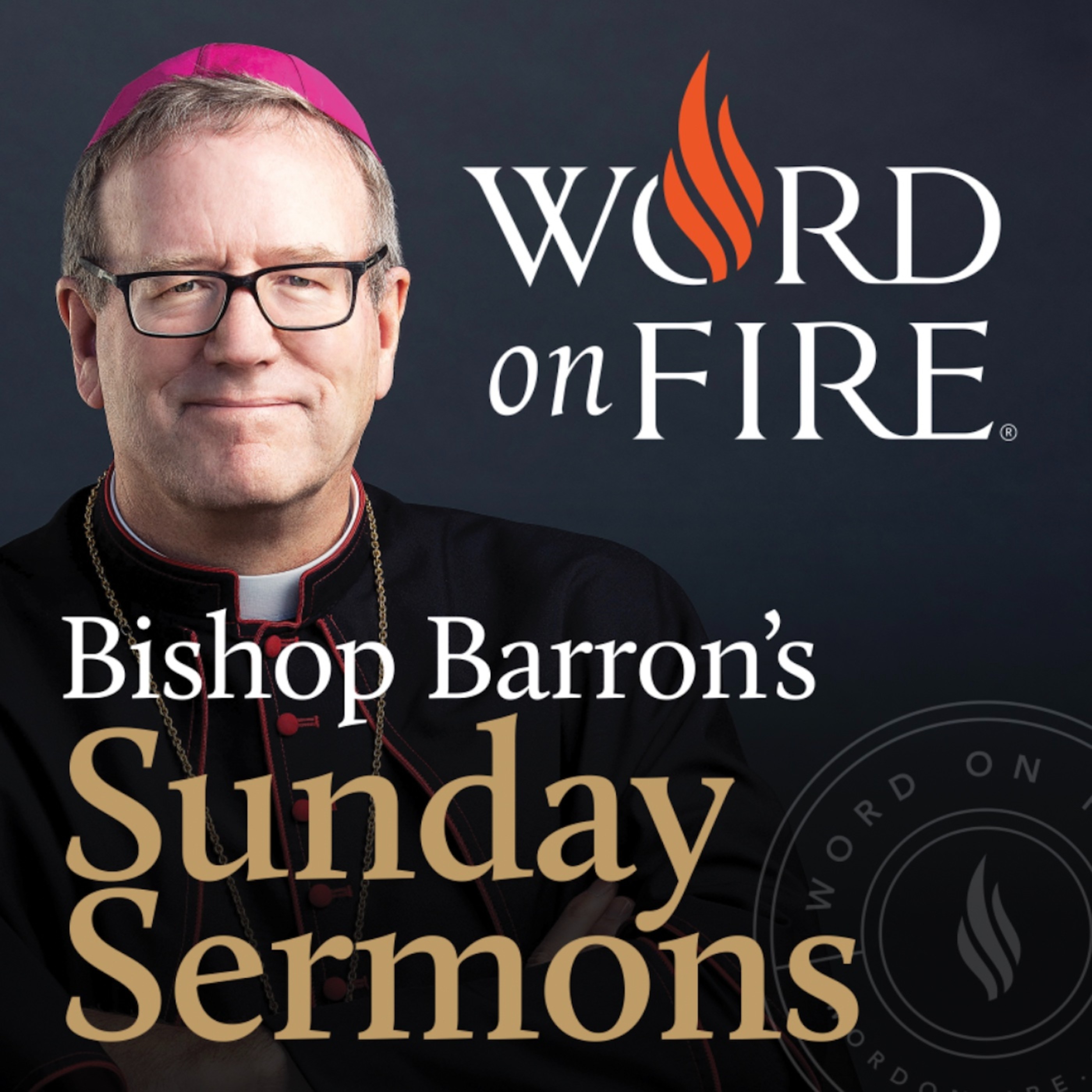
Bishop Robert Barron
Bishop Barron’s Sunday Sermons - Catholic Preaching and Homilies
Weekly homilies from Bishop Robert Barron, produced by Word on Fire Catholic Ministries.
Author
Bishop Robert Barron
Category
Podcast website
Latest episode
Jul 8, 2026
Where to listen?
Podcasts in the app Replaio Radio Coming soonPodcasts are coming to the app soon. Install now and be the first to see a whole new take on podcasts
 Install for free
Android 5M+ downloads · 4.8 rating
iOS soon
Install for free
Android 5M+ downloads · 4.8 rating
iOS soon
Episodes
The Addiction of Honor 02.09.2007 15:03
The lust for honor interrupts the great banquet that God wants us to enjoy. This is why Jesus interrupts the interruption in today's Gospel, urging people purposely to take the lowest place and to entertain only those who cannot repay the favor. We must free ourselves of the addiction to honor!
Jacob Neusner, Benedict XVI, and the Vocation of Israel 26.08.2007 15:03
In his new book, Pope Benedict engages in a fascinating dialogue with the American rabbi Jacob Neusner on the identity and meaning of Jesus. In this sermon, I will tease out the implications of this debate, especially in regard to the vocation of Israel.
Trusting the Darkness 12.08.2007 14:55
Authentic faith has nothing to do with credulity or intellectual naivte. It has everything to do with placing one's trust in the God whom we cannot, even in principle, know with clarity. It is the willingness to follow the promptings of God, even when we don't see where they might lead.
The Lessons of Qoheleth 05.08.2007 14:55
Both our first reading and Gospel function as a slap in the face, cold water, a wake-up call. They show how passing, ephemeral, and unreliable are the goods of this world. The idea is to set our hearts, as Paul says, on the higher things, rooting our lives in God.
The Lord’s Prayer 29.07.2007 14:55
Our Gospel for this week is of the utmost importance, for we hear the Son of God himself teaching us to pray. In this homily, I walk rather carefully through the major petitions of the Our Father, noting how central this prayer is to Christian life and spirituality.
Paul's Suffering 22.07.2007 14:55
Paul says in our second reading that he "makes up in his own sufferings what is lacking in the sufferings of Christ." This means that Paul-and all of us-have the enormous privilege of participating in the act by which Christ saved the world, an act of suffering love. How do you interpret your own pain? Might it be a participation in the salvation of Christ?
The Natural Law 15.07.2007 14:55
What the church calls "the natural law" is, as Moses suggests in our first reading, close to us, in fact, written on our hearts. Thomas Aquinas said that this natural, moral law is a reflection of the eternal law of God and is, in turn, the ground for all of our positive laws. When the relationship between God's law, the moral law, and political law is lost, our society suffers.
Gospel Freedom 01.07.2007 14:55
Our readings for this weekend are completely counter-cultural and counter-intuitive. We put a huge premium on freedom and self-determination in regard to choosing our careers. But this is not the Biblical perspective. Elisha accepts the mantle of prophecy, simply because God commands him, and he leaves everything behind. Jesus tells a man to follow him, even if that means not attending his own fat...
Great Canticle of Zechariah 24.06.2007 14:55
Another homily from Fr. Robert Barron and Word on Fire Catholic Ministries.
A New Creation 08.04.2007 14:55
Easter is the dawn of a new creation. St. John tells us that Mary Magdalene came to the tomb early on the morning of the first day of the week. This is meant to call to mind the first day of creation, when God said, "Let there be light" and brought order out of chaos. From the meaninglessness of death, God brings eternal life. This is the central and revolutionary message of Easter.
The Burning Bush 11.03.2007 14:57
Moses sees a bush that burns but is not consumed. This is a lovely symbolic expression of the way God relates to the world. The closer God gets, the more we become radiant with his presence. God's proximity does not mean our destruction or the compromising of our integrity; rather it is the means by which we become fully ourselves.
The Father in Faith 04.03.2007 14:57
Abraham was chosen by God as the founder of a people who would be the means by which God would save the world. His great mark is faith, that is to say, trust. Faith is what Adam and Eve couldn't muster (they grasped at godliness) and from this followed the agony of the world. God commenced a rescue operation by setting Abraham in quest of a promised land.
The Three Temptations 25.02.2007 14:57
As we once again commence the penitential season of Lent, it is good to get back to basics. We journey with Jesus into the desert, and with him, we confront the three basic temptations: sensual pleasure, power, and glory. Only when we set aside our obsessions with these three things can we be free to serve the Lord.
Enemy Love 18.02.2007 14:57
The most troubling and challenging of Jesus' teaching is the command to love our enemies. In this homily, I explore four good reasons why it is so important to engage in this most difficult act of love.
Where Do You Put Your Faith 11.02.2007 14:57
The readings for this weekend pose a blunt question: whom, finally, do you trust? "Trust" is meant here in an absolute sense. Where do you base your life? In God or in the things of this world? How you answer that question determines pretty much everything else.
What is Love? 28.01.2007 14:57
In the thirteenth chapter of his first letter to the Corinthians, St. Paul sings a hymn to love. He tells us that love is "patient, gentle, kind, not snobbish" and that it "never fails." Love, after all, is what God is: willing the good of the other as other. When we love, therefore, we are sharing in the very life of God.
The Paradox of Walls 21.01.2007 14:57
Nehemiah, the 5th century governor of Judea, has an important spiritual lesson for us today. Nehemiah led the project of re-building the walls of Jerusalem after the return from exile. Walls, which set a community apart, are essential for identity and clarity of purpose. If the church is to be a world-transforming agent, it must, first, know clearly who she is and what makes her distinctive.
The Task of the Church 14.01.2007 14:57
As we enter into ordinary time, we reflect with St. Paul on the ordinary task of the church: the discernment and exercise of the gifts of the Holy Spirit. How do we use the gifts of wisdom, knowledge, healing, and faith?
Biblical Family Values 31.12.2006 14:57
There are family values in the Bible, but they might not be the ones you'd expect. The Biblical authors--both Old Testament and New--put a stress, not on sentiment and personal connection, but rather on mission. They see the family as a place where one's vocation from God is prioritized and cultivated. We see this theme on clear display in both the Hannah story and the account of the finding in th...
The Inexhaustibly Fascinating Figure of Mary 24.12.2006 14:57
On the final Sunday of Advent, the Church invites us to consider the inexhaustibly fascinating figure of Mary. The Mother of God is a figure of faithful Israel, the people who for so many centuries waited for the coming of the Messiah. She is, accordingly, the new Eve, the new Moses, the true Isaiah and Ezekiel. In meditating upon her, we come to a deeper appreciation of the Christ she bore.
What Should We Do? 17.12.2006 14:57
Our Gospel for today centers around a question that is bracing in its directness and simplicity. A group of people come to the Baptist and ask "what should we do?" The spiritual life is about a set of behaviors and practices, focused, as John the Baptist specifies, around the work of justice.
Return Home 10.12.2006 14:57
In our first reading for this week, we hear the prophet Baruch predicting the return of the children of Israel to Zion. God will level the mountains and fill in the valleys so as to make a highway for them. In the Gospel, John the Baptist announces a similar preparation for a similar return, but this time it is the return of Israel from the exile of sin and death, facilitated by the coming of the...
The Second Coming 03.12.2006 14:57
The readings for this first Sunday of Advent focus, not on the historical coming of Jesus at Bethlehem, but rather at his eschatological coming at the end of time. Knowing that all of history tends toward and culminates in Jesus changes radically the way we live now.
Pilate and Jesus 26.11.2006 14:57
In the confrontation between Pilate and Jesus we see, according to Benedict XVI, a clash of two visions of politics. Pilate, who cynically dismisses any claim to know the truth, allows Jesus' fate to be determined by the will of the majority. But Jesus reminds Pilate that his legitimate political authority comes to him, not from the people, but ""from above,"" that is to say, from certain moral va...
Christ the High Priest 12.11.2006 14:57
For the past several weeks, we have been reading from the extraordinary letter to the Hebrews, the principal theme of which is the priesthood of Jesus Christ. Jesus can be the ultimate bridge-builder between God and us, precisely because in his own person he reconciles divinity and humanity. True God and true man, Christ is true priest.
Similar podcasts






Listen to the Bishop Barron’s Sunday Sermons - Catholic Preaching and Homilies podcast in Replaio
Radio and podcasts in one app - free, with no sign-up. Install today and do not miss the launch
Replaio is not a podcast publisher; show names, artwork and audio belong to their authors and are distributed through public RSS feeds.