prasad ernala
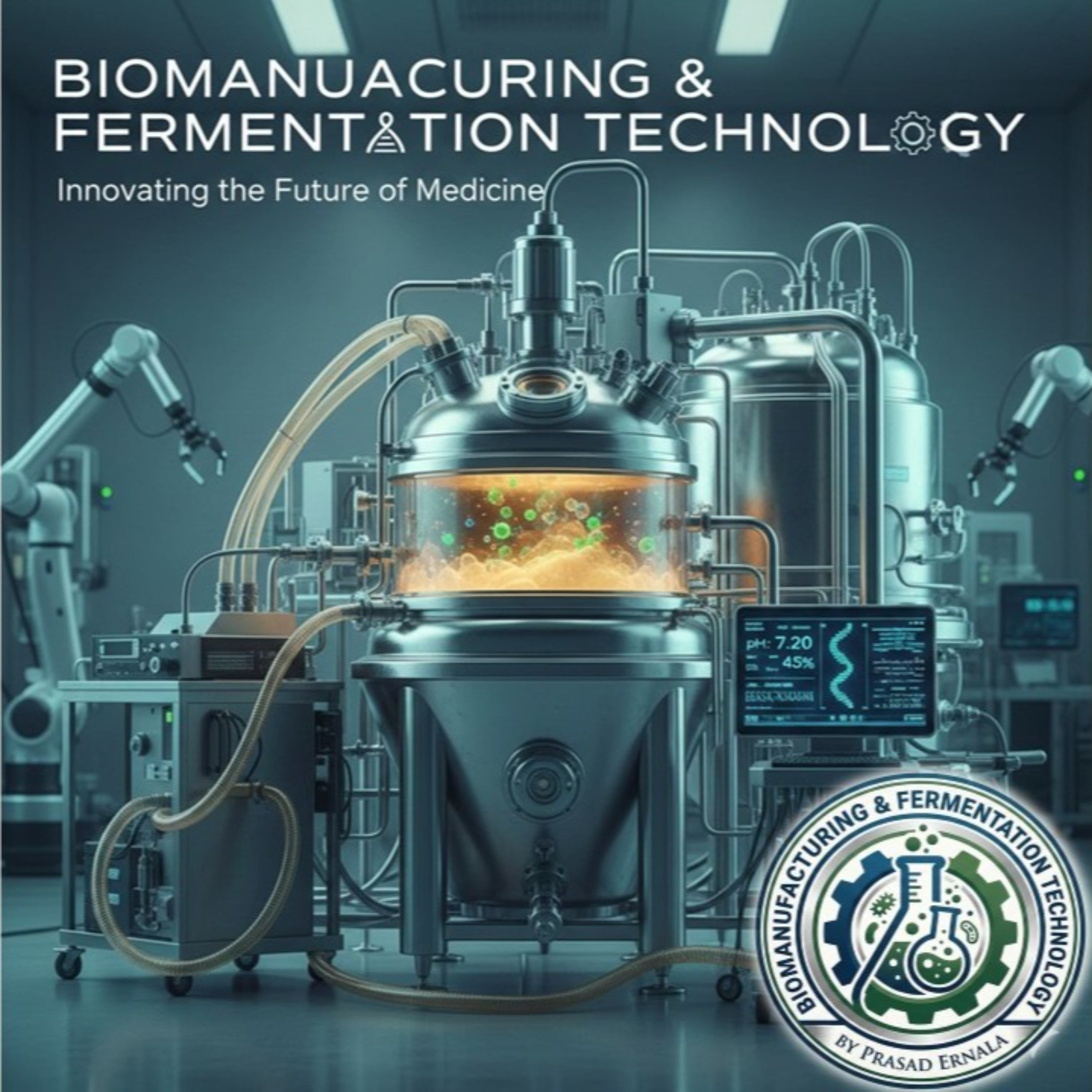
Biomanufacturing & Fermentation Technology
Welcome to Biomanufacturing & Fermentation Technology, the podcast where microbes meet manufacturing and science turns into scalable reality. In each episode, we dive inside real bioprocesses. from lab-scale experiments to commercial fermenters. to unpack how products are actually made, fixed, and optimized in the real world. Expect candid conversations on fermentation failures and breakthroughs, scale-up war stories, regulatory realities, emerging technologies, and the decisions that separate a promising culture from a profitable process. Whether you are a scientist, engineer, entrepreneur, o
Be sure to visit the podcast's website and support the creator: podcasters.spotify.com
Author
prasad ernala
Category
Podcast website
Latest episode
Aug 22, 2026
Where to listen?
Podcasts in the app Replaio Radio Coming soonPodcasts are coming to the app soon. Install now and be the first to see a whole new take on podcasts
 Install for free
Android almost 10M downloads · 4.8 rating
iOS soon
Install for free
Android almost 10M downloads · 4.8 rating
iOS soon
Episodes
Industrial Fermentation Sterile Boundary Management and Contamination Dynamics 14.02.2026 16:39
In this episode we explores sterile boundary management as a continuous, evolving challenge in industrial fermentation rather than a one-time achievement. My analysis highlights that boundary crossings, such as sampling and feeding, act as repeated stress tests that can lead to subclinical contamination, where foreign microbes subtly distort a culture’s metabolism without triggering traditional al...
Bio-manufacturing and Fermentation Technology. (2026 February 2nd week edition) 13.02.2026 16:22
This intelligence brief from 2nd week February 2026 identifies actionable breakthroughs in bioprocessing and biocatalysis that prioritize practical scalability over speculative science. The report highlights significant process optimizations, such as high-density microbial fermentation strategies for GLP-1 analogues and advanced metabolic engineering to achieve high titers of toxic intermediates....
Predictive Quality and the Reality of Real-Time Release Testing 12.02.2026 17:48
This text explores the complex transition from predictive data science to real-time release testing (RTRT) within a regulated manufacturing environment. While digital twins and soft sensors offer the potential to reduce offline testing delays, the source emphasizes that a high-performing model is not a substitute for a validated control strategy. Successful implementation requires moving beyond si...
Upstream Digital Twins: Navigating Scale and Physical Constraints 11.02.2026 22:12
Upstream digital twins use soft sensors and mechanistic models to estimate metabolic states like biomass and uptake rates. At scale, physical constraints like oxygen transfer and mixing gradients can cause model failure. Success requires sensor fusion and safe MPC control. Upstream digital twins are colliding with physical reality at scale. Oxygen transfer limits, mixing gradients, and CO₂ strippi...
Biomass Separation Strategies in Microbial Fermentation 10.02.2026 18:36
In this episode we focus on the technical criteria for selecting biomass separation strategies in microbial fermentation, focusing on how cell morphology, broth rheology, and product localization dictate industrial success. It explains that bacterial systems often require centrifugation due to their small size and tendency to form compressible cakes, though this carries a risk of shear-induced lys...
Circular Biomanufacturing: Waste Valorization in Integrated Production Systems 09.02.2026 15:37
This episode explores the transition of industrial biomanufacturing from a linear waste-heavy model to a circular system that treats side streams as valuable assets. Successful valorization requires a multidisciplinary approach combining process intensification, sophisticated separation technologies, and engineered microorganisms capable of handling inconsistent feedstocks. The discussion highligh...
Downstream Digital Twins: Predicting Performance and Managing Process Drift 08.02.2026 15:21
Downstream bioprocessing is often unstable due to upstream variability and equipment aging. Digital twins use mechanistic and hybrid models to predict fouling, optimize chromatography, and perform root-cause analysis, shifting DSP from reactive craft to predictive science. Downstream Digital Twins Are Shifting DSP From Reactive Firefighting to Predictive Control Mechanistic and hybrid digital twin...
Microbe-Derived Therapeutics: Next-Generation Drug Discovery Through Engineered Microbial Systems 07.02.2026 17:13
The emergence of microbe-derived therapeutics represents a fundamental shift from traditional drug discovery toward the use of engineered biological systems as both production factories and living medicines. These sources explain how advancements in synthetic biology and genetic engineering allow microbes to synthesize complex molecules, such as insulin, or act as intelligent couriers that sense a...
Bio-manufacturing and Fermentation Technology. (2026 February first week edition) 06.02.2026 11:09
Across microbial fermentation and bio-catalysis, new data is forcing us to rethink where cost curves bend, where scale-up really fails, and where regulation is no longer the bottleneck we thought it was. If you are designing strains, scaling reactors, running manufacturing campaigns, or deciding where to place your next technical bet, this week’s signals matter. Upstream: B. licheniformis OP16‑2 c...
Risk Allocation in Industrial Microbial Biomass Separation 05.02.2026 19:19
The primary focus of this episode is to explore a framework for managing biomass separation in industrial microbial manufacturing, framing it as a strategic exercise in risk allocation rather than simple efficiency maximization. It evaluates the physical and economic trade-offs between centrifugation, which carries risks related to mechanical shear and impurity propagation, and filtration, which i...
Quantum Fermentation: Exploring Sub-Atomic Interactions for Enhanced Yield 04.02.2026 15:23
The most credible “quantum lever” in fermentation is not macroscopic entanglement across cells; it is the possibility that some rate‑limiting metabolic steps already rely partly on quantum tunneling of hydrogen , and that enzymes modulate tunneling through protein dynamics and active-site geometry. This implies a nontrivial proposition: for specific steps, improving yield may require engineering n...
Addressing the Biotech Valley of Death as a Systemic Market Failure 03.02.2026 18:47
The episode argues that the biotech "valley of death" is a systemic market failure rather than a simple lack of startup funding. It suggests that moving from laboratory success to industrial production requires specialized infrastructure that behaves more like a public utility than a typical private asset. Because venture capital is often poorly suited for the high costs and long timelin...
Microbial Cell–Broth Separation: Industrial Clarification and Recovery Technologies 02.02.2026 24:02
In this episode we focus on primary cell–broth separation acts as the critical interface between upstream fermentation and downstream purification, converting raw microbial cultures into clarified feed streams. Industrial processes typically utilize centrifugation, filtration, or sedimentation, though the choice depends on complex variables like cell morphology, broth viscosity, and the risk of sh...
Harvest Timing as a Risk-Control Lever in Biomanufacturing 01.02.2026 17:13
This episode examines how harvest timing serves as a vital tool for managing technical risks in industrial microbial fermentation. Rather than chasing the highest possible product concentration, manufacturers must balance marginal yield gains against the dangers of product degradation and increased impurity levels. My analysis highlights that a multi-layered decision architecture that uses real-ti...
Engineering Harvest-End Specifications in Industrial Microbial Fermentation 31.01.2026 17:50
This episode outlines a sophisticated industrial framework for determining the optimal moment to conclude microbial fermentation. Rather than relying on fixed timeframes, modern manufacturing uses a multivariate approach that balances metabolic performance, product quality, and downstream operability. The strategy employs online respiratory triggers for immediate data, at-line quality checks for c...
Bioprocess and Biomanufacturing Intelligence Bulletin: January 2026 30.01.2026 50:42
The Episode of a comprehensive intelligence report detailing the latest advancements in bioprocessing and biomanufacturing as of January 2026. It highlights transformative scientific breakthroughs, such as the completion of the first synthetic yeast genome and the implementation of AI-driven protein design to maximize industrial yields. The bulletin also examines strategic industry shifts, includi...
Bridging the Gradient: Engineering Microbial Scale Translation 29.01.2026 14:10
The primary focus of this episode is on a sophisticated approach to scale-translation engineering in microbial fermentation, moving beyond simple parameter matching to focus on how cells experience fluctuating microenvironments. The core problem is that large-scale reactors create spatial and temporal gradients in oxygen, pH, and nutrients that are absent in laboratory settings, often leading to r...
Biotech Innovation Preservation through IP-Centric Restructuring 28.01.2026 20:01
The episode argues that biotechnology ventures often collapse financially while their underlying scientific innovations remain viable, leading to the avoidable loss of valuable intellectual property and specialized human capital. To combat this, the author proposes a policy shift toward IP-centric restructuring and the formation of new companies well before formal insolvency occurs. Current barrie...
Fermenter Readiness: Engineering the Sterile Boundary and Control Foundation 27.01.2026 16:53
The episode argues that fermenter readiness should be viewed as a measurable, engineered state rather than a simple administrative checklist. My analysis highlights that consistent biological results at an industrial scale depend on the mechanical integrity of the sterile boundary and the rigorous management of SIP (Sterilization-in-Place) cycles. Effectively managing air removal, condensate drain...
Reliable Microbial Fermentation: Human Factors and Facility Resilience 26.01.2026 14:26
The primary focus of this episode is to explore an integrated, risk-based approach to industrial microbial fermentation that treats human behavior and facility maintenance as critical engineering variables. It argues that achieving consistent results at scale requires moving beyond laboratory models to address the socio-technical realities of manufacturing, such as operator error and equipment deg...
Process Analytics and Data Integrity in Industrial Fermentation 25.01.2026 16:11
The primary focus of this episode is to discuss about how modern industrial fermentation relies on process analytics and data integrity to bridge the gap between engineering and biology. By utilizing Process Analytical Technology (PAT), such as off-gas analysis and capacitance sensors, facilities can monitor metabolic states and viable biomass in real time. These tools, often enhanced by soft-sens...
Preserving Innovation Capital in Biotech Asset Liquidations 24.01.2026 18:36
This episode details the traditional insolvency procedures often fail to preserve the unique value of biotechnology firms, which rely heavily on intangible assets like process know-how and specialized human capital. Because standard legal frameworks prioritize immediate creditor recovery, critical innovation capital is frequently lost or undervalued when companies face financial distress. The prov...
Sterility Assurance and Engineering Across the USP–DSP Interface 23.01.2026 19:15
The primary focus this episode is on maintaining a validated sterile boundary during the transfer of material from upstream fermentation to downstream processing is a complex engineering challenge that extends beyond simple logistics. My analysis highlights that sterility is a dynamic variable influenced by mechanical integrity, equipment design, and rigorous cleaning protocols rather than a stati...
Post-Fermentation Biological State Control and Product Preservation Engineering 22.01.2026 14:38
In this episode of industrial fermentation, the harvest phase marks a critical transition where the focus shifts from maximizing growth to preserving product integrity. At manufacturing scales, large volumes of broth remain biologically active for hours after feeding stops, making the product highly susceptible to enzymatic degradation and oxidative damage. Maintaining quality requires biological...
Industrial Fermentation: Productivity, Variability, and Scale Translation 21.01.2026 19:26
In this episode we discuss transition of microbial fermentation from controlled laboratory settings to the complex realities of industrial manufacturing. It characterizes productivity not as a simple biological trait, but as an emergent property shaped by mechanical constraints like oxygen transfer limits, non-ideal mixing, and equipment drift. I would like to emphasize that performance often decl...
Similar podcasts








Listen to the Biomanufacturing & Fermentation Technology podcast in Replaio
Radio and podcasts in one app - free, with no sign-up. Install today and do not miss the launch
Replaio is not a podcast publisher; show names, artwork and audio belong to their authors and are distributed through public RSS feeds.