Liz Covart
Ben Franklin's World
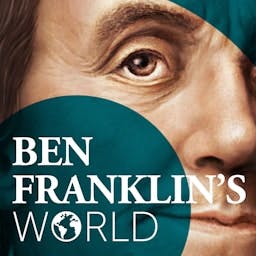
This is a multiple award-winning podcast about early American history. It’s a show for people who love history and who want to know more about the historical people and events that have impacted and shaped our present-day world. Each episode features conversations with professional historians who help shed light on important people and events in early American history.
Be sure to visit the podcast's website and support the creator: www.benfranklinsworld.com
Author
Liz Covart
Category
Podcast website
Latest episode
Oct 13, 2026
Where to listen?
Podcasts in the app Replaio Radio Coming soonPodcasts are coming to the app soon. Install now and be the first to see a whole new take on podcasts
 Install for free
Android almost 10M downloads · 4.8 rating
iOS soon
Install for free
Android almost 10M downloads · 4.8 rating
iOS soon
Episodes
BFW Revisited: The Nat Turner Revolt 10.12.2024 58:56
In our last episode, Episode 399, we discussed Denmark Vesey’s revolt and the way biblical texts and scripture enabled Vesey to organize what would have been the largest slave revolt in United States history if the revolt had not been thwarted before Vesey could put it into action. Early American history is filled with revolts against enslavers that were thwarted and never made it past the plannin...
399 Denmark Vesey's Bible 03.12.2024 57:07
Denmark Vesey’s failed revolt in 1822 could have been the largest insurrection of enslaved people against their enslavers in United States history. Not only was Vesey’s plan large in scale, but Charleston officials arrested well over one hundred rumored participants. Jeremy Schipper, a Professor in the departments for the Study or Religion and Near and Middle Eastern Studies at the University of T...
BFW Revisited: World of the Wampanoag, Pt. 2 26.11.2024 53:56
This week is Thanksgiving week in the United States. On Thursday, most of us will sit down with friends, family, and other loved ones and share a large meal where we give thanks for whatever we’re grateful for over the last year. In elementary school, we are taught to associate this holiday and its rituals with the religious separatists, or pilgrims, who migrated from England to what is today Plym...
398 The Shawnee-Dunmore War, 1774 19.11.2024 1:09:21
After the Seven Years’ War (1754-1763), Great Britain instituted the Proclamation Line of 1763. The Line sought to create a lasting peace in British North America by limiting British colonial settlement east of the Appalachian Mountains. In 1768, colonists and British Indian agents negotiated the Treaties of Fort Stanwix and Hard Labour to extend the boundary line further west. In 1774, the Shawne...
BFW Revisited: World of the Wampanoag, Pt. 1 12.11.2024 50:13
It’s November, the time of year when we Americans get ready for the Thanksgiving holiday. Although the federal holiday we know and honor today came about in 1863, Thanksgiving is a day that many modern-day Americans associate with the Indigenous peoples and religious separatists of Plymouth, Massachusetts. What do we know about the Indigenous people the so-called Pilgrims interacted with? This mon...
397 Native Nations: A Millennium in North America 05.11.2024 1:04:15
The North American continent is approximately 160 million years old, yet in the United States, we tend to focus on what amounts to 3300 millionths of that history, which is the period between 1492 to the present. Kathleen DuVal, a Professor of History at the University of North Carolina, Chapel Hill, asks us to widen our view of early North American history to at least 1,000 years. Using details f...
BFW Revisited: Committees & Congresses of the American Revolution 29.10.2024 1:42:15
Ben Franklin’s World Revisited is a series where Liz surfaces one of our earlier episodes that complements and adds additional perspectives to the histories we discuss in our new episodes. Given the conversation we just had in Episode 396 about Carpenters’ Hall & the First Continental Congress, Liz would like to offer you an episode she produced in 2017 as part of our Doing History: To the Revolut...
396 Carpenters' Hall & the First Continental Congress 22.10.2024 44:59
“Monday, September 5, 1774. A number of the Delegates chosen and appointed by the Several Colonies and Provinces in North America to meet and hold a Congress at Philadelphia assembled at the Carpenters’ Hall.” That statement begins the Journals of the Continental Congress, the official meeting minutes of the First and Second Continental Congresses. Between September 1774 and March 1789, the congr...
395 The Great New York Fire of 1776 08.10.2024 58:23
When we think about the American Revolution, textbooks, documentaries, and historic sites have trained most of us to think about American triumphs in battles or events when American revolutionaries overcame moments of despair, when all seemed lost, to triumph in the cause of American independence. Benjamin L. Carp will help us look at the American Revolution differently. The Daniel M. Lyons Chair...
394 The Pursuit of Happiness 24.09.2024 1:02:50
What did Thomas Jefferson and the members of the Second Continental Congress mean when they wrote “the pursuit of Happiness” into the United States Declaration of Independence? And why is pursuing happiness so important that Jefferson and his fellow Founding Fathers included it in the Declaration of Independence’s most powerful statement of the new United States’ ideals? Jeffrey Rosen, the Presid...
393 Politics & Political Culture in the Early American Republic 10.09.2024 1:07:17
The Constitution is a document of “We the People.” The ways Americans have supported, debated, and interpreted the Constitution since 1787 have played a vital role in the rise of politics and political parties within the United States. What kind of political culture did the United States Constitution and its interpretations help establish? What were the expectations, practices, and cultural norms...
392 Religion and Race in Early America 27.08.2024 55:03
What does history have to tell us about how we, as Americans, came to define people by their race; the visual ways we have grouped people together based on their skin color, facial features, hair texture, and ancestry? As you might imagine, history has a LOT to tell us about this question! So today, we’re going to explore one aspect of the answer to this question by focusing on some of the ways re...
391 Government in Colonial Virginia 13.08.2024 1:02:28
Do you ever wonder how governments met and worked in colonial British America? Williamsburg, Virginia, served as the capital of Virginia between 1699 and 1779. During its 80 years of service as capital, Williamsburg represented the center of British authority in Virginia. This meant the Royal Governor of the colony lived in Williamsburg. Indigenous, colonial, and other delegations came to Williams...
390 Objects of Revolution 30.07.2024 1:02:43
When we think about the American Revolution, the French Revolution, or the Haitian Revolution, we think about the ideals of freedom and equality. These ideals were embedded and discussed in all of these revolutions. What we don’t always think about when we think about these revolutions are the objects that inspired, came out of, and were circulated as they took place. Ashli White, an Associate Pr...
389 Indigenous Justice in Early America 16.07.2024 55:58
Early North America was a place that contained hundreds of distinct Indigenous nations and peoples who spoke at least 2,000 distinct languages. In the early sixteenth century, Spain began to establish colonies on mainland North America, and they were followed by the French, Dutch, and English, and the forced migration of enslaved Africans who represented at least 45 different ethnic and cultural g...
388 John Hancock 02.07.2024 1:05:16
Happy Fourth of July! We’ve created special episodes to commemorate, celebrate, and remember the Fourth of July for years. Many of our episodes have focused on the Declaration of Independence, how and why it was created, the ideas behind it, and its sacred words: “We hold these truths to be self-evident, that men are created equal, that they are endowed by their Creator with certain unalienable R...
387 California and Slavery 25.06.2024 1:03:29
When we think of California, we might think about sunny weather, Hollywood, beaches, wine country, and perhaps the Gold Rush. What we don’t usually think about when we think about California is the state’s long history of slavery. Jean Pfaelzer, a Californian and a Professor Emerita of English, Asian Studies, and Women and Gender Studies at the University of Delaware, joins us to lead us through s...
386 Sleeping with the Ancestors 11.06.2024 52:27
In this special Juneteenth episode, as we honor the emancipation of enslaved African Americans, we delve into the work of those working to preserve slave dwellings across the United States, safeguarding the essential stories these structures embody. In our conversation, Joseph McGill, the Executive Director and Founder of the Slave Dwelling Project, joins us to share why former slave dwellings are...
385 Did George Washington Have Heirs? 28.05.2024 1:05:15
The United States Constitution of 1787 gave many Americans pause about the powers the new federal government could exercise and how the government's leadership would rest with one person, the president. The fact that George Washington would likely serve as the new nation’s first president calmed many Americans’ fears that the new nation was creating an opportunity for a hereditary monarch. Washing...
384 Making Maine: A Journey to Statehood 14.05.2024 1:06:31
Article IV, Section 3 of the United States Constitution establishes guidelines by which the United States Congress can admit new states to the American Union. It clearly states that “no new State shall be formed or erected within the Jurisdiction of any other State…without the Consent of the Legislatures of the States concerned as well as of the Congress.” Five states have been formed from pre-exi...
383 Aquatic Culture in Early America 30.04.2024 58:38
If you will recall from Episode 331, the Williamsburg Bray School is the oldest existing structure in the United States that we know was used to educate African and African American children. As the Colonial Williamsburg Foundation prepares the Bray School for you to visit and see, we’re having many conversations about the history of the school, its scholars, and early Black American History in ge...
382 Hessians in the American Revolutionary War 16.04.2024 56:32
Within the Declaration of Independence, the founders of the United States present twenty-seven grievances against King George III as they declare their reasons for why the thirteen British North American colonies sought their independence from Great Britain. Their twenty-fifth grievance declares that King George III “is at this time transporting large Armies of foreign Mercenaries to compleat [sic...
381 Texas in the Spanish Empire 02.04.2024 1:04:46
The vast and varied landscapes of Texas loom large in our American imaginations. As does Texas culture with its BBQ, cowboys, and larger-than-life personality. But before Texas was a place that embraced ranching, space flight, and country music, Texas was a place with rich and vibrant Indigenous cultures and traditions and with Spanish and Mexican cultures and traditions. Martha Menchaca, a Profes...
380 The Tory's Wife 19.03.2024 1:06:23
The American Revolution was a movement that divided British Americans. Americans did not universally agree on the Revolution’s ideas about governance and independence. And the movement’s War for Independence was a bloody civil war that not only pitted brother against brother and fathers against sons; it also pitted wives against husbands. Cynthia A. Kierner is a professor of history at George Maso...
379 Women Healers in Early America 05.03.2024 1:02:14
Women make up eight out of every ten healthcare workers in the United States. Yet they lag behind men when it comes to working in the roles of medical doctors and surgeons. Why has healthcare become a professional field dominated by women, and yet women represent a minority of physicians and doctors who serve at the top of the healthcare field? Susan H. Brandt, a historian and lecturer at the Univ...
Similar podcasts





Listen to the Ben Franklin's World podcast in Replaio
Radio and podcasts in one app - free, with no sign-up. Install today and do not miss the launch
Replaio is not a podcast publisher; show names, artwork and audio belong to their authors and are distributed through public RSS feeds.