Liz Covart
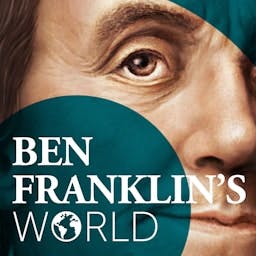
Ben Franklin's World
This is a multiple award-winning podcast about early American history. It’s a show for people who love history and who want to know more about the historical people and events that have impacted and shaped our present-day world. Each episode features conversations with professional historians who help shed light on important people and events in early American history.
Be sure to visit the podcast's website and support the creator: www.benfranklinsworld.com
Author
Liz Covart
Category
Podcast website
Latest episode
Oct 13, 2026
Where to listen?
Podcasts in the app Replaio Radio Coming soonPodcasts are coming to the app soon. Install now and be the first to see a whole new take on podcasts
 Install for free
Android almost 10M downloads · 4.8 rating
iOS soon
Install for free
Android almost 10M downloads · 4.8 rating
iOS soon
Episodes
286 Elections in Early America: Native Sovereignty 20.10.2020 56:22
Who is American democracy for and who could participate in early American democracy? Women and African Americans were often barred from voting in colonial and early republic elections. But what about Native Americans? Could Native Americans participate in early American democracy? Julie Reed, an Assistant Professor of History at the Pennsylvania State University, and Kathleen DuVal, the Bowman and...
285 Elections in Early America: Elections & Voting in the Early American Republic 13.10.2020 1:09:31
Independence from Great Britain provided the former British American colonists the opportunity to create a new, more democratic government than they had lived under before the American Revolution. What did this new American government look like? Who could participate in this new American democracy? And what was it like to participate in this new democracy? Scholars Terrance Rucker, a Historical Pu...
284 Elections in Early America: Democracy & Voting in British North America 06.10.2020 51:13
The British North American colonies formed some of the most democratic governments in the world. But that doesn't mean that all early Americans were treated equally or allowed to participate in representative government. So who could vote in Early America? Who could participate in representative government? Historians James Kloppenberg, the Charles Warren Professor of History at Harvard University...
Bonus: A Brief History of the United States Supreme Court 22.09.2020 12:09
On Friday, September 18, 2020, Ruth Bader Ginsburg, an Associate Justice of the United States Supreme Court, died. Justice Ginsburg's death has caused a lot of debate about whether the President should appoint a new justice to fill her seat and, if he does appoint someone, whether the Senate should vote on the President’s nomination before the election. This short bonus episode offers a brief hist...
283 Acadie 300 22.09.2020 1:03:39
2020 commemorates the 300th anniversary of French presence on Prince Edward Island. Like much of North America, the Canadian Maritime provinces of New Brunswick, Nova Scotia and Cape Breton Island, and Prince Edward Island were highly contested regions. In fact, the way France and Great Britain fought for presence and control of this region places the Canadian Maritimes among the most contested re...
282 Tacky's Revolt 08.09.2020 59:24
Between 1760 and 1761, Great Britain witnessed one of the largest slave insurrections in the history of its empire. Although the revolt took place on the island of Jamaica, the reverberations of this revolt stretched across the Atlantic Ocean and into the British North American colonies. Vincent Brown, the Charles Warren Professor of American History and a Professor of African American Studies at...
281 The Business of Slavery 25.08.2020 53:48
We live in an age where big businesses track our shopping habits and in some cases our work habits. But is the age of data new? When did the “age of the spreadsheet” and quantification of habits develop? Caitlin Rosenthal, an Assistant Professor of History at the University of California, Berkeley and the author of Accounting for Slavery: Masters and Management, leads us on an investigation into...
280 The British Are Coming 11.08.2020 1:01:28
The American Revolution is embedded in the American character. It’s an event that can tell us who we are, how we came to be who we are, and how we can strive to be who we want to be as a nation and people. Rick Atkinson, a three-time winner of the Pulitzer Prize, a journalist who has worked at The Washington Post, and the author of The British Are Coming: The War for America, Lexington to Princeto...
279 The Cabinet: Creation of an American Institution 28.07.2020 1:13:03
As the first President of the United States, George Washington set many precedents for the new nation. One of the biggest precedents Washington set came in the form of the Cabinet, a body of advisors from across the U.S. government who advise the president on how to handle matters of foreign and domestic policy. Today, we investigate Washington’s creation of the Cabinet and how it became a governm...
278 Polygamy: An Early American History 14.07.2020 56:07
Polygamy is not a practice that often comes to mind when many of us think about early America. But it turns out, polygamy was a ubiquitous practice among different groups of early Americans living in 17th and 18th-century North America. Sarah Pearsall, a University Teaching Officer, Fellow, and Historian at the University of Cambridge, joins us to discuss the surprising history of polygamy in earl...
277 Whose Fourth of July? 30.06.2020 1:13:45
On July 5, 1852, Frederick Douglass delivered a speech to an anti-slavery society and he famously asked “What to the Slave is the Fourth of July?” In this episode, we explore Douglass’ thoughtful question within the context of Early America: What did the Fourth of July mean for African Americans in the late eighteenth and early nineteenth centuries? To help us investigate this question, we are joi...
Bonus Listener Q & A: Young Benjamin Franklin 26.06.2020 17:33
This special bonus episode introduces the Ben Franklin's World Subscription program and a new monthly Listener Question & Answer feature for subscribers to that program. In this preview, award-winning historian Nick Bunker answers your questions about the life of young Benjamin Franklin. Show Notes: https://www.benfranklinsworld.com/207 Join Ben Franklin's World! Subscribe and help us bring histor...
276 Benjamin Rush: Founding Father 16.06.2020 1:07:08
Who gets to be a founding father? “Founding Father” status goes to men who helped found the United States. That means the 56 men who signed the Declaration of Independence, those who led the Continental Army, and the 36 delegates who signed the Constitution. We’re talking about more than 100 men and yet, we don’t really talk about more than a handful of these “founders” as Founders. Stephen Fried,...
275 Pets in Early America 02.06.2020 26:50
What kinds of animals did early Americans keep as pets? How did early Americans acquire pets? What kinds of animals did early Americans keep as pets? Ingrid Tague, a Professor of History at the University of Denver and the author of Animal Companions: Pets and Social Change in Eighteenth-Century Britain, joins us to answer your questions about pets and pet keeping in Early America. Show Notes: htt...
274 Walter Ralegh: Architect of Empire 19.05.2020 1:10:51
What do we know about how and why England came to establish its first permanent colony at Jamestown? And what do we know about the English colony that came before it, the Colony of Roanoke? Alan Gallay, Lyndon B. Johnson chair of United States History at Texas Christian University and author of Walter Ralegh: Architect of Empire, leads us on exploration of the life and work of Sir Walter Ralegh, t...
273 David Hosack, Botany, and Medicine in the Early Republic 05.05.2020 1:05:15
How did Americans learn to establish philanthropic institutions? Victoria Johnson, an Associate Professor of Urban Policy and Planning at Hunter College in New York City and author of American Eden: David Hosack, Botany, and Medicine in the Garden of the Early Republic, leads us on an investigation of the life of Dr. David Hosack and the many organizations he founded, including the Elgin Botanical...
272 Origins of the 11th Amendment 21.04.2020 12:37
What do you know about the Eleventh Amendment to the United States Constitution? Caitlin Galante-DeAngelis Hopkins, a Lecturer in the History Department at Harvard University and a former research associate for the Harvard and Slavery Project, joins us to explore the origins of the Eleventh Amendment and why the United States added it to its Constitution. Show Notes: https://www.benfranklinsworld....
271 BFW Team Favorites: Paul Revere's Ride Through History 31.12.2019 1:34:40
On April 18, 1775, Paul Revere rode to Lexington, Massachusetts to spread the alarm that the Regulars were marching. Revere made several important rides between 1774 and 1775, including one in September 1774 that brought the Suffolk Resolves to the First Continental Congress in Philadelphia. So why is it that we remember Paul Revere’s ride to Lexington and not any of his other rides? Why is it tha...
270 BFW Team Favorites: Slavery & Freedom in Early Maryland 24.12.2019 52:45
How do you uncover the life of an enslaved person who left no paper trail? What can the everyday life of an enslaved person tell us about slavery, how it was practiced, and how some enslaved people made the transition from slavery to freedom? We explore the life of Charity Folks, an enslaved woman from Maryland who gained her freedom in the late-18th century. Our guide through Charity’s life is Je...
269 BFW Team Favorites: One Colonial Woman's World 17.12.2019 47:45
What was everyday life like for average men and women in early America? Listeners ask this question more than any other question and today we continue to try to answer it. Michelle Marchetti Coughlin, author of One Colonial Woman's World: The Life and Writings of Mehetabel Chandler Coit, joins us to explore the life of an average woman who lived in early New England. This episode originally posted...
268 BFW Team Favorites: Young Benjamin Franklin 10.12.2019 1:03:51
What in the first 40 years of his life made Benjamin Franklin the genius he became? Benjamin Franklin serves as a great window on to the early American past because as a man of “variety” he pursued many interests: literature, poetry, science, business, philosophy, philanthropy, and politics. But one aspect of Franklin’s life has gone largely unstudied: his childhood and early life. Nick Bunker, au...
267 Winter in the Early American Northeast 03.12.2019 1:03:45
How did the people of early America experience and feel about winter? Thomas Wickman, an Associate Professor of History and American Studies at Trinity College in Hartford, Connecticut and author of Snowshoe Country: An Environmental and Cultural Winter in the Early American Northeast, joins us to investigate how Native Americans and early Americans experienced and felt about winter during the 17t...
266 Education in Early America 26.11.2019 33:46
How did early Americans educate their children? How and when did Americans create a formal system of public education? You sent me these questions for Episode 200: Everyday Life in Early America. You also said you wanted to know more about how early American boys and girls learned the trades they would practice later in life. Johann Neem, a Professor of History at Western Washington University and...
265 An Early History of the White House 19.11.2019 1:02:04
On July 1, 1790, Congress passed “An Act for Establishing the temporary and permanent Seat of the Government of the United States.” This act formalized a plan to move the capital of the United States from New York City to Philadelphia, for a period of 10 years, and then from Philadelphia to Washington D.C., where the United States government would make its permanent home. What buildings did Congre...
264 The Iroquois, United States, and the Treaty of Canandaigua 1794 12.11.2019 58:22
The Treaty of Paris 1783 ended the American War for Independence, but it did not bring peace to North America. After 1783, warfare and violence continued between Americans and Native Americans. So how did the early United States attempt to create peace for itsnew nation? Michael Oberg, a Distinguished Professor of History at the State University of New York-Geneseo and the author of Peacemakers:...
Similar podcasts




Listen to the Ben Franklin's World podcast in Replaio
Radio and podcasts in one app - free, with no sign-up. Install today and do not miss the launch
Replaio is not a podcast publisher; show names, artwork and audio belong to their authors and are distributed through public RSS feeds.