Liz Covart
Ben Franklin's World
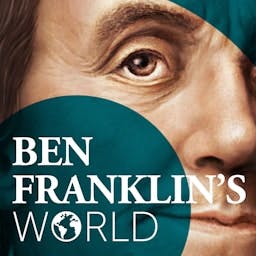
This is a multiple award-winning podcast about early American history. It’s a show for people who love history and who want to know more about the historical people and events that have impacted and shaped our present-day world. Each episode features conversations with professional historians who help shed light on important people and events in early American history.
Be sure to visit the podcast's website and support the creator: www.benfranklinsworld.com
Author
Liz Covart
Category
Podcast website
Latest episode
Oct 13, 2026
Where to listen?
Podcasts in the app Replaio Radio Coming soonPodcasts are coming to the app soon. Install now and be the first to see a whole new take on podcasts
 Install for free
Android almost 10M downloads · 4.8 rating
iOS soon
Install for free
Android almost 10M downloads · 4.8 rating
iOS soon
Episodes
353 Women and the Making of Catawba Identity 14.03.2023 57:09
How did Indigenous people adapt to and survive the onslaught of Indigenous warfare, European diseases, and population loss between the sixteenth and eighteenth centuries? How did past generations of Indigenous women ensure their culture would live on from one generation to the next so their people would endure? Brooke Bauer, an assistant professor of history at the University of Tennessee, Knoxvil...
352 James Forten and the Making of the United States 28.02.2023 49:17
People of African descent have made great contributions to the United States and its history. Think about all of the food, music, dance, medicine, farming and religious practices that people of African descent have contributed to American culture. Think about the sacrifices they’ve made to create and protect the United States as an independent nation. Matthew Skic, a Curator of Exhibitions at the...
351 Wealth and Slavery in New Netherland 14.02.2023 52:45
African chattel slavery, the predominant type of slavery practiced in colonial North America and the early United States, did not represent one monolithic practice of slavery. Practices of slavery varied by region, labor systems, legal codes, and empire. Slavery also wasn’t just about enslavers enslaving people for their labor. Enslavers used enslaved people to make statements about their social s...
350 The Revolutionary: Samuel Adams 31.01.2023 1:02:34
Before the American Revolution became a war and a fight for independence, the Revolution was a movement and protest for more local control of government. So how did the American Revolution get started? Who worked to transform a series of protests into a revolution? This is a BIG question with no one answer. But one American who worked to transform protests into a coordinated revolutionary movement...
349 The Women Behind Benjamin Franklin 17.01.2023 1:05:45
There are a lot of books about Benjamin Franklin. They tell us about his youth and accomplishments in business, politics, and diplomacy. They tell us about his serious interest in electricity and science, and about his philanthropic work. But only a handful of these books tell us about Benjamin Franklin as a man. What did Benjamin Franklin think about and experience when it came to his private, li...
348 Valley Forge 03.01.2023 1:06:37
On December 19, 1777, George Washington marched his Continental Army into its winter encampment at Valley Forge. In school we learned this was a hard, cold winter that saw the soldiers so ill-supplied they chewed on the leather of their shoes. But is this what really happened at Valley Forge? Were soldiers idle, wallowing in their misery? Ricardo Herrera, a historian of American military history a...
347 African and African American Music 20.12.2022 59:41
It’s impossible to overstate the importance of African and African American music to the United States’ musical traditions. Steven Lewis, a Curator of Music and Performing Arts at the Smithsonian, notes that “African American influences are so fundamental to American music there would be no American music without them.” Jon Beebe, a Jazz pianist, professional musician, and an interpretive ranger a...
346 Music and Politics in the Early United States 13.12.2022 45:38
How did everyday Americans in the early United States use and enjoy music? How did they create and circulate new songs and musical lyrics? Our five-episode series about music in early America continues in this fourth episode about music and politics in the early United States. Billy Coleman, an Assistant Teaching Professor of History at the University of Missouri and author of the book Harnessing...
345 Amateur Musicians in the Early United States 06.12.2022 49:25
Our study of music in Early America continues with this third episode in our five-episode series. Our last two episodes (Episode 343 and Episode 344) helped us better understand the musical landscapes of Native North America around 1492 and colonial British America before 1776. In this episode, we jump forward in time to the early days of the United States. Glenda Goodman, an Associate Professor o...
344 Music in British North America 29.11.2022 41:55
Our 5-episode series about music in Early America continues with this second episode that seeks to answer your questions about music in Early America. David Hildebrand is a musicologist and an expert on early American music. His research specialty is in Anglo-American music, and he joins us to answer your questions. Show Notes: https://www.benfranklinsworld.com/344 Complementary Episodes 🎧 Episod...
343 Music and Song in Native North America 22.11.2022 47:13
What was music like in Early America? How did different early Americans—Native Americans, African Americans, and White Americans—integrate and use music in their daily lives? Your questions about music inspired this 5-episode series about music in Early America. Our exploration begins with music in Native America. Chad Hamill, a Professor of Applied Indigenous Studies at Northern Arizona Universit...
342 The Great Power of Small Native Nations 08.11.2022 1:13:19
Did you know that small Native American nations had the power to dictate the terms of French colonization in the Gulf South region? Elizabeth Ellis, an Assistant Professor of History at Princeton University and a citizen of the Peoria Tribe of Indians of Oklahoma, joins us on an exploration of the uncovered and recovered histories of the more than 40 distinct and small Native nations who called th...
341 Possession and Exorcism in New France 25.10.2022 1:02:08
Prepare for tricks, treats, and time travel! In honor of Halloween, we’re traveling back to the mid-seventeenth century to investigate a case of demonic possession and the practice of exorcism in New France. Mairi Cowan, an Associate Professor of History at the University of Toronto, Mississauga, joins us to investigate the life of a young French woman named Barbe Hallay and her demonic possession...
340: Prisoners of War and the War of 1812 11.10.2022 1:18:59
The War of 1812 is an under-known conflict in United States history. It’s not a war that many Americans think about or dwell upon. And it was not a war that the United States can claim it clearly won. Nicholas Guyatt, a Professor of North American History at the University of Cambridge, joins us to investigate the War of 1812 and the experiences of American prisoners of war using details from his...
339 Women and the Constitutional Moment of 1787 27.09.2022 1:15:44
Between May 25 and September 17, 1787, delegates from each of the United States’ thirteen states assembled in Philadelphia for an event we now call the Constitutional Convention. What do we know about the moment of the United States Constitution’s creation? What was happening around the Convention, and what issues were Americans discussing and debating as the Convention’s delegates met? Mary Sarah...
338 The Early History of the United States Senate 13.09.2022 1:20:18
On September 17, 1787, thirty-nine delegates to the Constitutional Convention signed the United States Constitution and submitted it to the states for ratification. In honor of Constitution Day, we join three historians from the Senate Historical Office to investigate Article 1 of the Constitution and its creation of the United States Senate. Show Notes: https://www.benfranklinsworld.com/338 Compl...
337 Early America's Trade with China 30.08.2022 1:01:46
What made trade with China so important to the new United States that one of Americans’ first acts after securing the United States’ independence was to establish a trade with China and other Southeast Asian countries? Deal Norwood, an Assistant Professor of History at the University of Delaware, joins us to explore the lure of trade with China with details from his book, Trading Freedom: How Trad...
336 Surviving the Southampton Rebellion 16.08.2022 1:12:09
What did it take to stage a successful slave uprising? Over the course of the early republic, we see a few violent slave uprisings in the United States. A particularly brutal rebellion took place in Louisiana in January 1811. Another violent rebellion took place in Southampton County, Virginia in August 1831. Neither of these rebellions led to the abolishment of slavery, but they did lead to the d...
335 The Jewish World of Alexander Hamilton 02.08.2022 1:11:21
Alexander Hamilton played important roles in the founding of the United States. He served in the Continental Army, helped frame the United States Constitution, and helped place the United States on a secure economic footing with his work as the first Secretary of the Treasury. But how did Hamilton come to know so much about the economic systems that could help the new United States build a strong...
334 Missions & Mission Building in New Spain 19.07.2022 1:06:46
Spanish explorers and colonists visited, settled, and claimed territory in 42 of the United States’ 50 states. So what does the history of Early America look like from a Spanish point of view? Brandon Bayne, an Associate Professor of Religious Studies at the University of North Carolina-Chapel Hill and author of the book Missions Begin with Blood, joins us to investigate some of the religious aspe...
333 Experiences of Revolution: Disruptions in Yorktown 05.07.2022 1:00:30
What was everyday life like during the American War for Independence? Our Fourth of July series continues with an investigation of how the American War for Independence impacted those who remained on the home front. As episode 332 explored how the war impacted the lives of people who lived in urban Philadelphia, this episode investigates how the war impacted the lives of people who lived in the mo...
332 Experiences of Revolution: Occupied Philadelphia 28.06.2022 1:03:52
What was everyday life like during the American War for Independence? In honor of the Fourth of July, we’ll investigate answers to this question by exploring the histories of occupied Philadelphia and Yorktown, and how civilians, those left on the home front in both of those places, experienced the war and its armies. These episodes will allow us to see how the war impacted those who remained at...
331 The Discovery of the Williamsburg Bray School 21.06.2022 1:26:46
In a town as old as Williamsburg, Virginia, which was established in 1638, it’s often the case that historic buildings with interesting pasts stand unnoticed and in plain sight. Such was the case for the building that once housed Williamsburg’s Bray School. A school founded by a group of Anglican clergymen with the express purpose of educating Black children in the ways of the Anglican faith. It w...
330 Loyalism in the British Atlantic World 07.06.2022 1:10:33
We’ll never know for certain how many Americans supported the American Revolution, remained loyal to the British Crown and Parliament, or tried to find a middle way as someone who was disaffected from either loyalty. But we can know about the different ideologies that drove people to support the Revolution, to remain loyal to crown and parliament, or to become disaffected from both sides. Brad Jo...
329 Freemasonry in Early America 24.05.2022 1:05:23
This is an episode you’ve been waiting for! Mark Tabbert, the Director of Archives and Exhibits at the George Washington Masonic National Memorial Association and the author of Almanac of American Freemasonry and A Deserving Brother: George Washington and Freemasonry, joins us so we can investigate and better understand Freemasonry and its role in Early America. Show Notes: https://www.benfranklin...
Similar podcasts




Listen to the Ben Franklin's World podcast in Replaio
Radio and podcasts in one app - free, with no sign-up. Install today and do not miss the launch
Replaio is not a podcast publisher; show names, artwork and audio belong to their authors and are distributed through public RSS feeds.