Crazyrouter
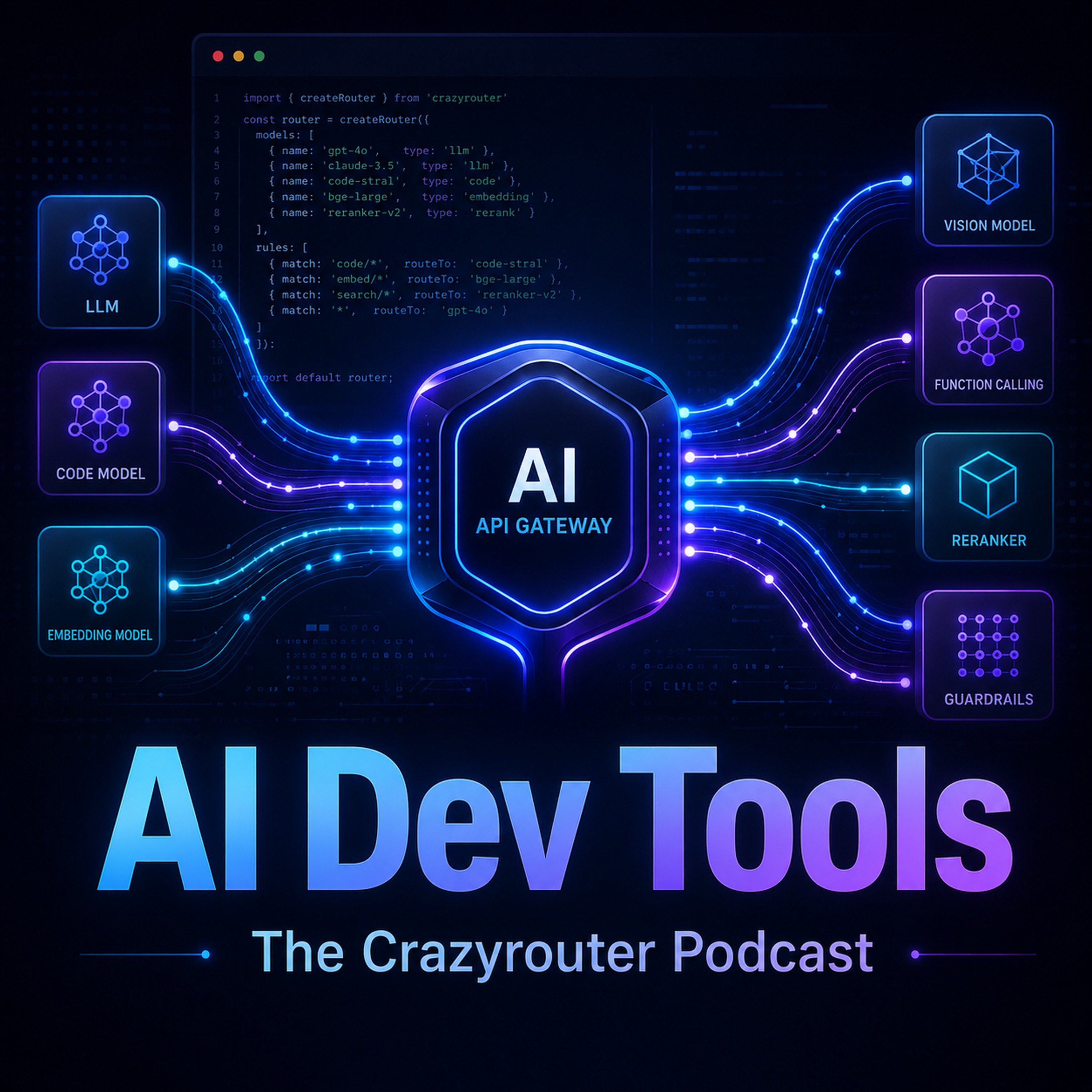
AI Dev Tools — The Crazyrouter Podcast
Your weekly breakdown of AI development tools, API gateways, model pricing, and building with GPT, Claude, Gemini, and DeepSeek. Hosted by Crazyrouter — one API key for 627+ AI models.
Be sure to visit the podcast's website and support the creator: crazyrouter.com
Where to listen?
Podcasts in the app Replaio Radio Coming soonPodcasts are coming to the app soon. Install now and be the first to see a whole new take on podcasts
 Install for free
Android 10M+ downloads · 4.7+ rating
iOS soon
Episodes
EP001: AI API Gateway Explained — Your Questions Answered 17.03.2026 3:53
What is an AI API gateway? How many models does Crazyrouter support? Is it cheaper than going direct? How hard is migration? We answer the 9 most common questions about using a unified API gateway for GPT-5, Claude Sonnet 4.6, Gemini 3, DeepSeek V3.2, and 627+ other models.
EP006: Building an AI Chatbot in 10 Minutes with One API Key 15.03.2026 4:50
Building an AI chatbot is easier than most tutorials make it look. In this episode, we break down the simplest architecture: a tiny backend, one API key, one OpenAI-compatible endpoint, and the freedom to switch between models without rewriting your app. Perfect for developers shipping their first chat product fast.
EP005: DeepSeek V3.2 Deep Dive — Is It Really Better Than GPT-4o? 13.03.2026 4:00
DeepSeek V3.2 is making waves with 88% on HumanEval and 35x cheaper pricing than GPT-4o. But is it actually better? We break down the benchmarks, real-world performance, where it excels (coding, reasoning, Chinese), where it falls short (creative writing, censorship), and when to use each model. Plus the multi-model strategy that saves you money.
EP004: AI Agent Skills — Build Smarter Agents with One Command 12.03.2026 2:40
Everyone's building AI agents, but everyone's writing the same boilerplate. What if you could install pre-built skills with one command? We introduce npx crazyrouter-skills — 8 ready-to-use agent capabilities from chat to image gen to video. Plus how it fits into MCP and why composability is the future of agent development.
EP579: Remediation Assurance Reentry Decision Closure - Know When Temporary Governance Can End
Close remediation reentry safely by retiring temporary authority, transferring durable controls, preserving evidence, and defining reactivation triggers.
EP578: Remediation Assurance Baseline Reentry - Restore Normal Operations Without Reopening Risk
Restore normal AI gateway operations through staged reentry, current evidence, negative tests, immutable receipts, and precomputed rollback.
EP576: Remediation Assurance Exception Expiration Governance - Let Temporary Boundaries End Safely
Govern remediation expiration with runtime enforcement, canonical time, renewal evidence, safe no-response behavior, propagation checks, and capability revocation.
EP577: Remediation Assurance Post-Expiration Reconciliation - Prove State Returned to the Safe Baseline
Reconcile policies, routes, providers, credentials, caches, workers, queues, tools, and evidence after exception expiration to prove the safe baseline is real.
EP575: Remediation Assurance Containment Drift - Detect When Temporary Boundaries Weaken
Detect containment drift by comparing approved scope with runtime routes, providers, credentials, caches, failover, tools, queues, and current evidence.
EP573: Remediation Assurance Exception Escalation - Route Unresolved Risk to the Right Authority
Escalate unresolved remediation exceptions with explicit triggers, containment, decision rights, bounded risk acceptance, evidence packets, and durable records.
EP574: Remediation Assurance Exception Containment - Prove the Temporary Boundary Is Real
Make remediation exception containment enforceable and testable across routes, providers, regions, retries, tools, queues, credentials, and background work.
EP572: Remediation Assurance Exception Closure Verification - Prove Temporary Bypasses Are Gone
Verify that remediation exceptions are truly closed by testing residual reachability, propagation, caches, failover, queues, restored controls, and honest closure states.
EP571: Remediation Assurance Enforcement Point Testing - Prove a Fix Works Where Risk Actually Enters
Test remediation controls at real enforcement points across routes, regions, providers, tools, streams, fallbacks, and failure modes with boundary evidence and honest coverage.
EP570: Remediation Assurance Control Dependency Mapping - Find Hidden Conditions Behind a Fix
Map the hidden conditions behind remediation assurance with explicit dependency graphs, freshness rules, failure impact, ownership, targeted revalidation, and safe alternatives.
EP177: AI API Streaming Backpressure — Keep Tokens Flowing Without Melting Clients
A practical guide to streaming backpressure for AI APIs: bound buffers, propagate cancellation, handle slow clients, protect concurrency, resume honestly, and make token delivery observable.
EP178: AI API Load Testing — Find Capacity Before Production Does
A practical guide to load testing AI APIs: model realistic workloads, separate concurrency from rate limits, protect budgets, measure accepted results, rehearse provider failures, and turn test data into capacity decisions.
EP179: AI API Idempotency — Stop Duplicate Work and Charges
A practical guide to idempotency for AI APIs: design request keys, persist results, handle retries and timeouts, protect tool effects, scope deduplication, and make duplicate work observable.
EP180: AI API Budgets — Put Spend Controls Where They Matter
A practical guide to AI API usage budgets: set tenant and workflow limits, reserve spend, enforce model-aware controls, handle streaming and retries, expose useful feedback, and keep budget enforcement reliable during incidents.
EP181: AI API Error Taxonomy — Make Failures Actionable
A practical guide to AI API error taxonomy: classify failures by retryability and ownership, preserve provider context, return stable client errors, prevent unsafe retries, and turn failure data into better operations.
EP182: AI API Observability — Trace Every Request From Gateway to Model
A practical guide to AI API observability: define request context, trace multi-provider calls, measure useful latency and quality signals, protect sensitive data, correlate retries and spend, and make production failures diagnosable.
EP183: AI API Prompt Versioning — Ship Prompt Changes Like Code
A practical guide to prompt versioning for AI APIs: keep templates reproducible, separate content from code, test changes, roll out safely, preserve rollback, and connect prompt releases to quality, cost, and incidents.
EP184: AI API Request Hedging — Cut Slow Tails Without Paying Twice
A practical guide to request hedging for AI APIs: identify true tail latency, launch a bounded backup safely, avoid duplicate side effects and charges, protect streaming responses, and measure whether the extra capacity is worth it.
EP185: AI API Quotas — Separate Fairness From Mere Rate Limits
A practical guide to AI API quotas: separate requests from tokens and concurrency, allocate fair tenant budgets, handle bursts, prevent noisy neighbors, and make quota decisions visible and reversible.
EP186: AI API Admission Control — Keep Overload From Becoming the User Experience
A practical guide to admission control for AI APIs: classify work, reserve capacity, shed safely, protect interactive traffic, and make overload decisions visible before queues become outages.
EP187: AI API Graceful Degradation — Preserve the Core User Journey Under Pressure
A practical guide to graceful degradation for AI APIs: define essential outcomes, reduce optional work, preserve contracts, and keep user journeys useful when models or providers are slow, expensive, or unavailable.
Similar podcasts






Listen to the AI Dev Tools — The Crazyrouter Podcast podcast in Replaio
Radio and podcasts in one app - free, with no sign-up. Install today and do not miss the launch
Replaio is not a podcast publisher; show names, artwork and audio belong to their authors and are distributed through public RSS feeds.