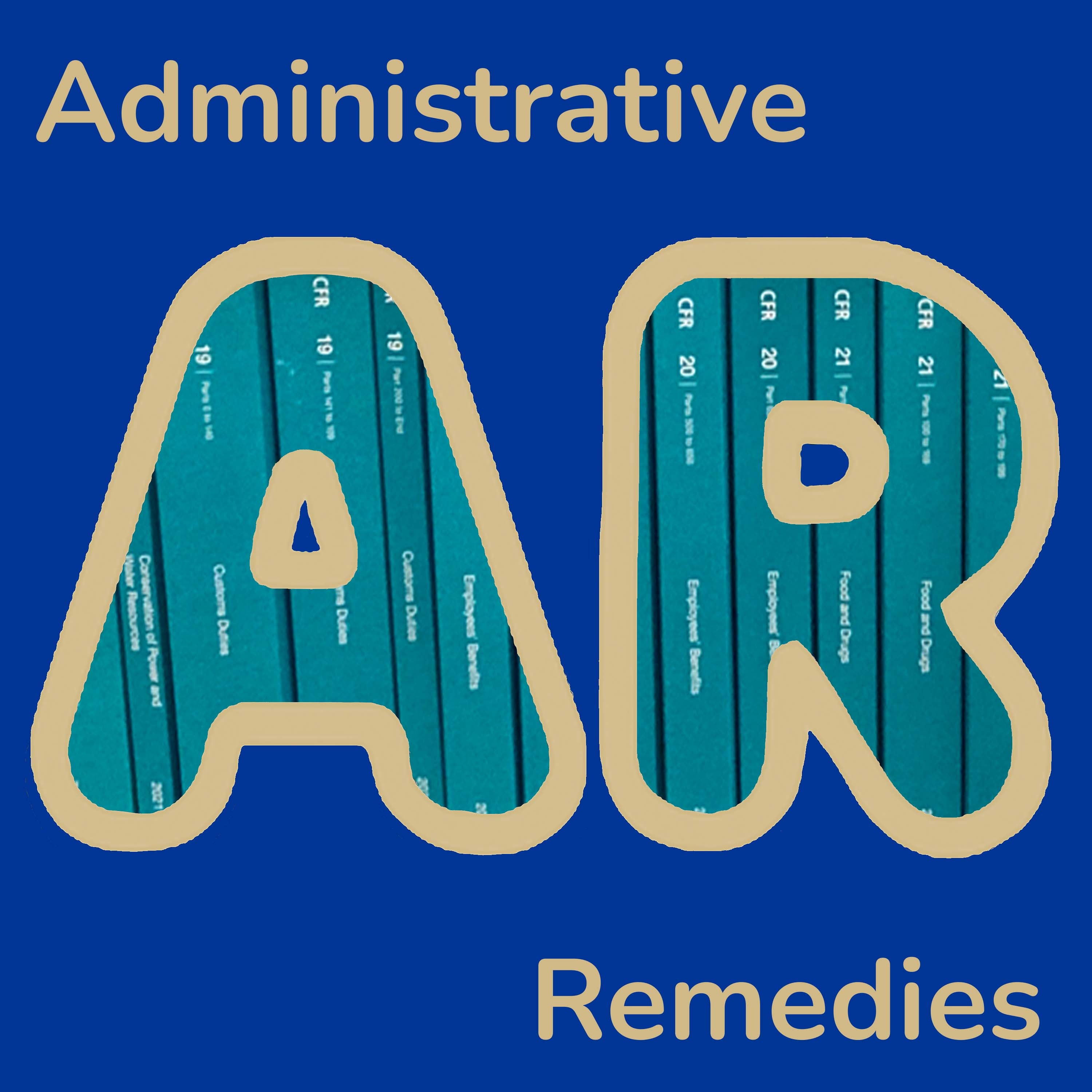
Gwendolyn Savitz and Marc Roark
Administrative Remedies
Because you can't fix what you don't understand. The rules governing your daily life - from the medications you take to the air you breathe, from workplace safety to financial regulation - weren't made by Congress. They were made by federal agencies operating under delegated authority. And there's an entire body of law governing how that power works, when it can be challenged, and what happens when it goes wrong. Administrative Remedies explains that law. Professor Gwendolyn Savitz and Dean Marc Roark of the University of Tulsa College of Law break down the doctrines behind the headlines - Che...
Be sure to visit the podcast's website and support the creator: remediespodcast.com
Author
Gwendolyn Savitz and Marc Roark
Category
Podcast website
Latest episode
Oct 13, 2026
Where to listen?
Podcasts in the app Replaio Radio Coming soonPodcasts are coming to the app soon. Install now and be the first to see a whole new take on podcasts
 Install for free
Android almost 10M downloads · 4.8 rating
iOS soon
Install for free
Android almost 10M downloads · 4.8 rating
iOS soon
Episodes
Learning Resources v. Trump Part 1 - The Actual Holding (No Major Questions Doctrine) 24.02.2026 24:04
On February 20, the Supreme Court ruled 6-3 that the International Emergency Economic Powers Act does not authorize the President to impose tariffs. In Part 1 of our emergency coverage, we break down the textual holding that all six majority justices agreed on — why "regulate" has never meant "tax" anywhere in the U.S. Code, why IEEPA's fifty-year history cuts against the government, and why the g...
On the Record or Out of Luck: The Adjudication Spectrum 17.02.2026 28:01
When an agency decides your case, what kind of process do you get? Sometimes it’s a full trial-type hearing with witnesses, cross-examination, an independent decisionmaker, and a written opinion. Other times it’s a paper review and a short explanation. In this episode, we map the adjudication spectrum under the Administrative Procedure Act (APA) — from “straight to your room” to a full family meet...
Rulemaking and Adjudication - the Two Engines of Agency Power 10.02.2026 26:54
This episode introduces one of the most important structural distinctions in administrative law: the difference between rulemaking and adjudication. Agencies don’t just enforce law — they also create policy. Sometimes they do it prospectively through general rules. Other times they do it case-by-case while deciding what happens to a specific party. That choice affects procedure, fairness expectati...
Corner Post and the Problem of Regulatory Finality 20.01.2026 30:43
In the season finale, Gwen and Marc turn to Corner Post v. Board of Governors , a decision that reshapes when federal regulations can be challenged—and potentially destabilizes decades of settled law. They open with a property-law analogy, explaining the doctrine of “coming to the nuisance” and why legal systems protect settled expectations and reliance. They then explain how statutes of limitatio...
Loper Bright and the End of Chevron Deference 13.01.2026 22:37
In this episode, Gwen and Marc examine Loper Bright v. Raimondo , the Supreme Court decision that formally overruled Chevron deference after forty years. They begin with an analogy about inconsistent babysitters to explain the core concern motivating the Court: agency interpretations that change across administrations, creating instability and unpredictability. They then turn to the facts of the c...
Skidmore Deference: When Agencies Must Persuade 06.01.2026 22:49
In this episode, Gwen and Marc step back from Chevron to examine the older doctrine that both preceded it and now survives it: Skidmore deference . They begin with a medical analogy that contrasts expert judgment grounded in examination and experience with advice that merely sounds confident—setting up the central question of Skidmore: when agencies lack the power to control, how much weight shoul...
Chevron and the Fight Over Who Decides 30.12.2025 23:02
Who gets to decide what the law means—Congress, agencies, or courts? For forty years, that question was largely answered by a single Supreme Court case: Chevron . Under what became known as “Chevron deference,” courts were required to defer to an agency’s reasonable interpretation of an ambiguous statute the agency administers. In this episode, Gwen and Marc explain what Chevron deference actually...
The Major Questions Doctrine in Practice 23.12.2025 18:08
Picking up where they left off, Gwen and Marc turn to the two competing versions of the Major Questions Doctrine: the weak , interpretive version and the strong version that demands near-microscopic specificity. And to show how these versions operate in real life, they walk straight into the blockbuster 2023 case Biden v. Nebraska, where the Supreme Court struck down the administration’s student-l...
The Major Questions Doctrine Explained 16.12.2025 15:53
Gwen and Marc open this episode with a deceptively simple babysitter analogy: you tell the sitter “use anything in the kitchen,” but you don’t expect her to mount a cutting board to the wall and teach knife-throwing, or install a $6,000 closet system. The permission technically covers those choices — but that’s clearly not what you meant. That disconnect becomes the doorway into the Major Question...
Trump v. Slaughter at Oral Argument 09.12.2025 19:45
In this episode, Gwen and Marc break down the Supreme Court’s oral argument in Trump v. Slaughter , the case that could upend nearly a century of precedent on independent agencies. Building on Part 1’s explanation of how the case reached the Court, this episode examines what happened in the courtroom: the justices’ questions, the strategies on both sides, and the constitutional stakes that hovered...
Trump v. Slaughter: Background and Stakes 09.12.2025 20:24
Trump v. Slaughter, Part 1: How We Got Here In this episode, Gwen and Marc explore the road leading to Trump v. Slaughter , the Supreme Court case that places the very existence of independent agencies under constitutional scrutiny. After two episodes explaining why independent agencies exist and how they function, they turn to the core question now before the Court: can Congress insulate agency o...
Who the President Can Remove — and Why It Matters 02.12.2025 25:41
Having laid out why independent agencies exist, Gwen and Marc turn to the harder question: what happens when a president decides he wants someone gone? This episode unpacks the constitutional and political fault lines around the president’s removal power — and why the ability to “fire the referee” is one of the most dangerous pressures in modern governance. The episode opens on the youth soccer fi...
Independent vs. Executive Agencies: What’s the Difference? 25.11.2025 22:35
After exploring why agencies need power, Gwen and Marc turn to how we keep that power honest . This episode explains why Congress sometimes chooses to bind the president’s hands in advance — creating institutions that can resist political pressure, maintain stability, and preserve public trust. The episode opens with the now-infamous PAC-12 “boat call,” where a conference executive phoned in from...
How Notice-and-Comment Rulemaking Works 18.11.2025 26:15
After learning why agencies need power, Gwen and Marc now explain how they use it. This episode breaks down the Administrative Procedure Act’s notice-and-comment process — the backbone of modern rulemaking — through the Department of Transportation’s debate over emotional-support animals on planes. This episode follows the DOT’s 2020 service-animal rule to show how notice-and-comment rulemaking ac...
What Counts as an Intelligible Principle? 11.11.2025 13:53
After 1935, the Supreme Court mostly gave up enforcing the Nondelegation Doctrine — but it didn’t give agencies unlimited power. In this episode, Gwen and Marc use relatable examples — a micromanaging homeowners association and an overzealous parks director — to explain how an “intelligible principle” keeps delegation from turning into dictatorship. From HOA lawn rules to broadband speeds, they sh...
Why the Administrative State Is So Important 04.11.2025 11:16
Gwen Savitz and Marc Roark start Administrative Remedies by explaining why modern government can't function without agencies. From small-town mayors to the FDA’s milk standards, they show how specialization and scale make the administrative state essential. Agencies make democratic promises real. Using analogies—from small-town government to the FDA’s definition of “milk”—they explain how constitu...
Why Congress Delegates Power to Agencies 04.11.2025 14:26
Why does Congress hand power to agencies? Gwen and Marc compare delegation to leaving instructions for a babysitter—trust plus judgment. They trace how this practical necessity shaped everything from Hamilton’s Treasury memos to the EPA’s air-quality standards. Gwen and Marc unpack why Congress can’t—and shouldn’t—do it all. Through stories of early Treasury circulars and modern environmental regu...
When Delegation Goes Too Far: The Nondelegation Doctrine 04.11.2025 19:47
Journey back 90 years to 1935 - the one and only year the Supreme Court decided that Congress had tried to delegate too much power. If delegation is so useful, why can’t Congress delegate everything? Gwen and Marc explain the Nondelegation Doctrine through analogies to filmmaking and explore how Supreme Court cases—including Schechter Poultry —define the boundary between lawmaking and execution. G...
Teaser 01.11.2025 1:12
Administrative Remedies - coming soon.
Similar podcasts




Listen to the Administrative Remedies podcast in Replaio
Radio and podcasts in one app - free, with no sign-up. Install today and do not miss the launch
Replaio is not a podcast publisher; show names, artwork and audio belong to their authors and are distributed through public RSS feeds.