Carl Rylett
A History of Europe Key Battles
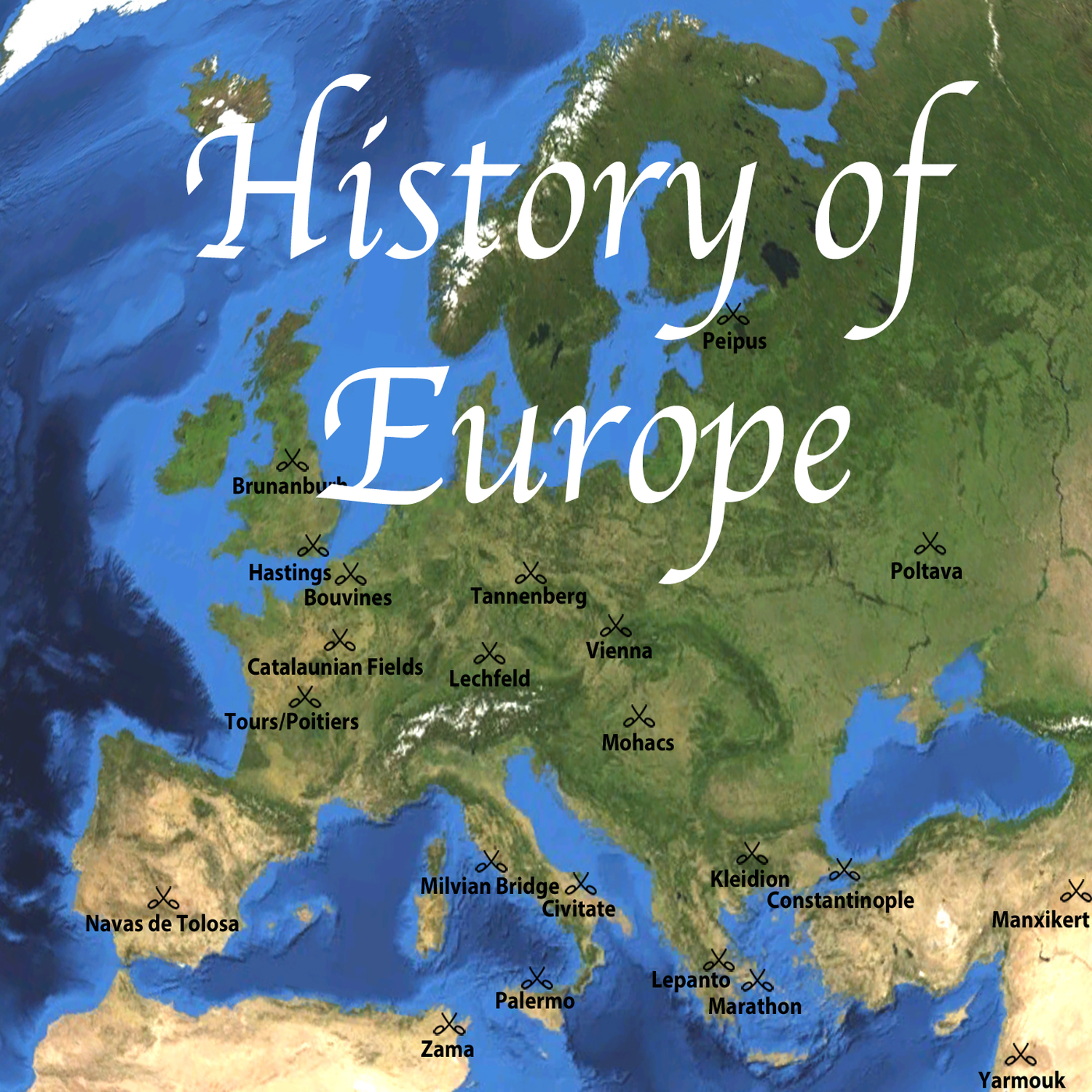
A podcast on European conflicts from the perspective of each side to provide an alternative to the traditional national narratives. Going chronologically from the Ancient Greeks onwards I described to some extent how each battle was won or lost by particular decisions, tactics, technology or fortune. But the aim of each main narrative will be to place each battle in the context of the overall history of Europe. New series on the Interwar Years 1918-1945 begins 18th July 2025 Hosted on Acast. See acast.com/privacy for more information.
Author
Carl Rylett
Category
Podcast website
Latest episode
Jun 12, 2026
Where to listen?
Podcasts in the app Replaio Radio Coming soonPodcasts are coming to the app soon. Install now and be the first to see a whole new take on podcasts
 Install for free
Android 5M+ downloads · 4.8 rating
iOS soon
Install for free
Android 5M+ downloads · 4.8 rating
iOS soon
Episodes
73.1 Russo-Turkish War 1877-78 - Background 02.12.2022 23:52
In 1875, the Balkans entered a period of turmoil as various nationalities (Serbians, Bulgarians, Macedonians, Albanians and Romanians) struggled for independence from the Ottoman Turks. Uprisings quickly spread across the region and resulted in a major war between the Ottomans and Russians from 1877 to 1878. Meanwhile, Constantinople was suffering a renewed period of political instability which le...
72.1 Philippa Gregory Interview 11.11.2022 18:09
Philippa has written novels set in several different historical periods, especially the Tudor period. We discussed the period around the Glorious Revolution 1688 when the Prince of Orange invaded England from Holland and replaced James II as king, and the Battle of Sedgemoor 1685 three years before. Some of Philippa's novels have won awards and have been adapted into television dramas. The most su...
71.2 Franco-Prussian War 1870-71 04.11.2022 27:16
For centuries, Europe’s German centre had been politically fragmented and weak. The continent had been dominated by states on the periphery, whose interest was to maintain the power vacuum at the centre. Now, however, for the first time, the Germans were united under the leadership of Otto von Bismarck and launched a major invasion into France, which ended up destroying the balance of power on the...
71.1 Franco-Prussian War 1870-71 - Background 28.10.2022 23:12
Following Prussia's victory at Königgrätz in 1866, the North German Confederation became an instrument for Prussian dominance. All northern German states not directly annexed by Prussia were put in the new Confederation in which Berlin assumed control of their foreign and military affairs, and most of their internal ones as well. A solid block of Prussian territory stretched now between France and...
70.2 Battle of Königgrätz 1866 30.09.2022 33:09
The Austro-Prussian War of 1866 was brief, yet its consequences were profound. It was the culminating event in a rivalry that began with the rise of the house of Brandenburg-Prussia, most notably Frederick the Great’s unprovoked attack upon the Habsburg province of Silesia in 1740. From that time Austria and Prussia were involved in a long struggle for supremacy in Germany. In 1866 Prussian armies...
70.1 Battle of Königgrätz 1866 - Background 23.09.2022 20:57
Any list of decisive battles of European history would be incomplete without a battle which occurred on 3 July 1866 near the town of Königgrätz, in the north of the today’s Czech Republic. The victorious allies of the Schleswig War of 1864, the Austrian Empire and the Kingdom of Prussia, soon after fall out with each other and go to war. Austria faces great challenges - in the centre of Europ...
69.2 Schleswig War of 1864 26.08.2022 23:27
When in November 1863 King Frederick VII of Denmark died, a dispute arose over who had a legitimate claim to rule over the Duchies of Schleswig and Holstein. Otto von Bismarck saw this as a great opportunity to increase Prussian power in the region and decided, together with the Austrians, to invade Denmark. The key battle in the war was the siege of Dybbøl in April 1864 This month, August 2022, I...
69.1 Schleswig War of 1864 - Background 19.08.2022 23:03
A border dispute between the German Confederation and the Kingdom of Denmark in the regions of Schleswig and Holstein breaks out into an inconclusive war in 1848-1850, and tensions remain into the 1860's. Meanwhile, a common culture was developing across the German population of Europe, with the literary works of Goethe and Schiller, and philosophers Kant and Hegel. On the political scene, Otto vo...
68.2 War of Italian Unification 29.07.2022 33:53
Napoleon III of France and Cavour, chief minister of Piedmont come to an agreement to try to remove Austrian influence from the Italian peninsula, and provoke Vienna into war. One of the largest battles was at Solferino where there were three monarchs - Franz Joseph of Austria, Victor Emanuel of Piedmont and Napoleon III. The ensuing conflict lasted until 1861 when finally emerged the brand new na...
68.1 War of Italian Unification - Background 22.07.2022 24:43
The Napoleonic Wars had a dramatic impact on Italy, completing redrawing boundaries. Even though the French were defeated, many of their political reforms were to be both profound and long-lasting. And the temporary unification of parts of the peninsula encouraged Italians to be aware of a common nationality. Yet only decades afterwards would there be real change. Some of the protagonists wer...
67.4 Crimean War - Siege of Sevastopol 24.06.2022 27:45
An allied army of British, French and Italians besiege the Crimean port of Sevastopol in late 1854. Fighting also took place in the Baltic Sea and in the Far East, and in the Caucasus mountains at the siege of the fortress of Kars. The main event at Sevastopol was particularly protracted and bloody as the allies attempted to break through into the city www.patreon.com/historyeurope www.historyeuro...
67.3 Crimean War - Russia invades Moldavia and Wallachia 17.06.2022 23:08
The Russians invade Moldavia and Wallachia (in modern day Romania) and destroy the Ottoman Black Sea fleet at Sinop. Under public pressure, the French and British governments, concerned about growing Russian power, decide to send in troops to force the invaders to retreat. Seeking to neutralise the Russian threat in the Black Sea and Mediterranean, the Allies decide to invade Crimea. One of severa...
67.2 Crimean War 1853 - Beginning 10.06.2022 25:05
The Ottoman Sultans attempt to reform their army and state, under pressure from outside powers, most notably Tsar Nicholas I of Russia, who lays claim to protecting Orthodox Christians within the Ottoman Empire. The Crimean War begins when Russia invades the Orthodox territories of Moldavia and Wallachia in modern day Romania. www.patreon.com/historyeurope www.historyeurope.net Music from Frederic...
67.1 Crimean War 1853 - Background 03.06.2022 25:27
The powers of Europe, especially Britain and France are concerned by the decline of the Ottoman Empire and growing power and ambition of Russia. This episode focuses on the problems of the Ottoman Sultan Mahmud II, who descendants once ruled a mighty empire that threatened Christendom, but in the 1800's was struggling under the pressures of modernity and the threat of regions breaking away e.g. in...
66.4 Revolution of 1848 - Conclusion 29.04.2022 25:55
Revolutionary breaks out across Europe continent from France to Romania, Denmark to Italy. Slowly the authorities regained control but were unable to reverse all of the changes. Most governments, for example, kept some form of constitution, and liberals worked hard to defend what was left of their achievements. The events of 1848 gave millions of Europeans their first taste of politics, and remain...
66.3 Revolutions of 1848 22.04.2022 26:07
In the first months of 1848, a tidal wave of revolution shook the political establishment of Europe to its foundations Events began with an uprising in Sicily in January, and by the end of the year the entire continent had been affected to some degree, including the overthrow of leaders in France, Austria, Italy and Germany www.patreon.com/historyeurope www.historyeurope.net Music: William Tell Ov...
66.2 French Revolution of July 1830, and Greek War of Independence 15.04.2022 27:17
King Charles X of France is overthrown and replaced by his cousin Louis Philippe, Duke of Orléans. Meanwhile a 10 month long insurrection in Poland is crushed by the Russians. In the retribution which followed, eighty-thousand Poles are dragged off in chains to Siberia. The year 1830 also witnessed the formal independence of Greece from the Ottoman Empire after a war which had begun ni...
66.1 Congress of Vienna 1814, Post Napoleonic War Period 08.04.2022 23:58
The Congress of Vienna 1814 at the end of the long Napoleonic Wars led to a period of relative peace on the continent of Europe. A network of institutions was established known as the ‘Concert of Europe’ where differences could be thrashed out before leading to war. After the French Revolution, the basis of sovereignty shifted from individuals and families as leaders to nations and states. Through...
65.3 Napoleon's Invasion of Russia 1812 18.03.2022 27:50
The French army invades Russia. The Russians retreat deep into their own territory then confront the French at the inconclusive Battle of Borodino of September 1812. Napoleon leads his men into Moscow but is forced to abandon the city and return westwards in the middle of winter, resulting in devastating losses. The anti-French coalition regain the initiative at the huge Battle of the Nations and...
65.2 Napoleon's Conquest of Central Europe, and the Peninsular War 11.03.2022 27:19
The French invade Prussia and capture its capital Berlin, and then move into Poland and take Warsaw. Napoleon and Tsar Alexander then agreed the Treaties of Tilsit. The greatest resistance to French dominance comes from the Spanish, aided by the British under the command of the Duke of Wellington.www.patreon.com/historyeuropewww.historyeurope.netMusic from Beethoven - Symphony Nr 5, courtesy of ww...
65.1 Napoleonic Wars - Intro 04.03.2022 22:35
Peace could potentially have lasted after the treaties of Lunéville and Amiens of 1801 and 1802 had the great powers accepted each others’ spheres of influence. However, the agreements turned out to be just a short truce. Napoleon’s continued annexations in Europe and apparent ambitions in the Mediterranean and Near East alarmed the British and Russians. The French suffer defeat at Trafalgar but m...
64.6 Battles of the Nile 1798 and Marengo 1800 28.01.2022 21:04
Napoleon leads the French into Egypt but is defeated at the Battle of the Nile by the British. Afterwards the Russians and Austrians push back against the French in Italy, but then suffer a reverse at the Battle of Marengo. Marengo turned out arguably to be the most important victory of Napoleon’s career. Had he lost the battle, he would have lost the war and probably the consulship. Instead his n...
64.5 French Revolutionary Wars - Napoleon's Conquest of Italy 21.01.2022 27:35
The French invade Belgium in 1794 and the Netherlands in 1795. The coalition against them starts to fall apart as individual members came to terms. Russia, Prussia and Austria are distracted by their partitioning of Poland, which is wiped off the map. Next the French invade Austria and Italy, the Italian campaign led by a promising young commander Napoleon Bonaparte. www.patreon.com/historyeurope...
64.4 French Revolutionary Wars, Battle of Valmy 1792 and the Reign of Terror 14.01.2022 20:39
A French military victory at Valmy in 1792 and the execution of Louis XVI in January 1793 focused the growing concern across Europe about the radical new regime in Paris. The true revolutionary nature of events in France was dawning on everyone, including the possibility of the export of the revolutionary principles. In France, there was further political turmoil in 1793 with the coming to po...
64.3 The French Revolution 1789 07.01.2022 27:59
The French king from 1774, Louis XVI, was poorly equipped for the role of national leader at a difficult time. His tragedy was that he had good intentions and a strong sense of responsibility. But he was shy and awkward and lacked the required political skills and charisma. Decades of failure for the French in foreign and domestic affairs, resulted in a profound crisis of legitimacy for the monarc...
Similar podcasts








Listen to the A History of Europe Key Battles podcast in Replaio
Radio and podcasts in one app - free, with no sign-up. Install today and do not miss the launch
Replaio is not a podcast publisher; show names, artwork and audio belong to their authors and are distributed through public RSS feeds.