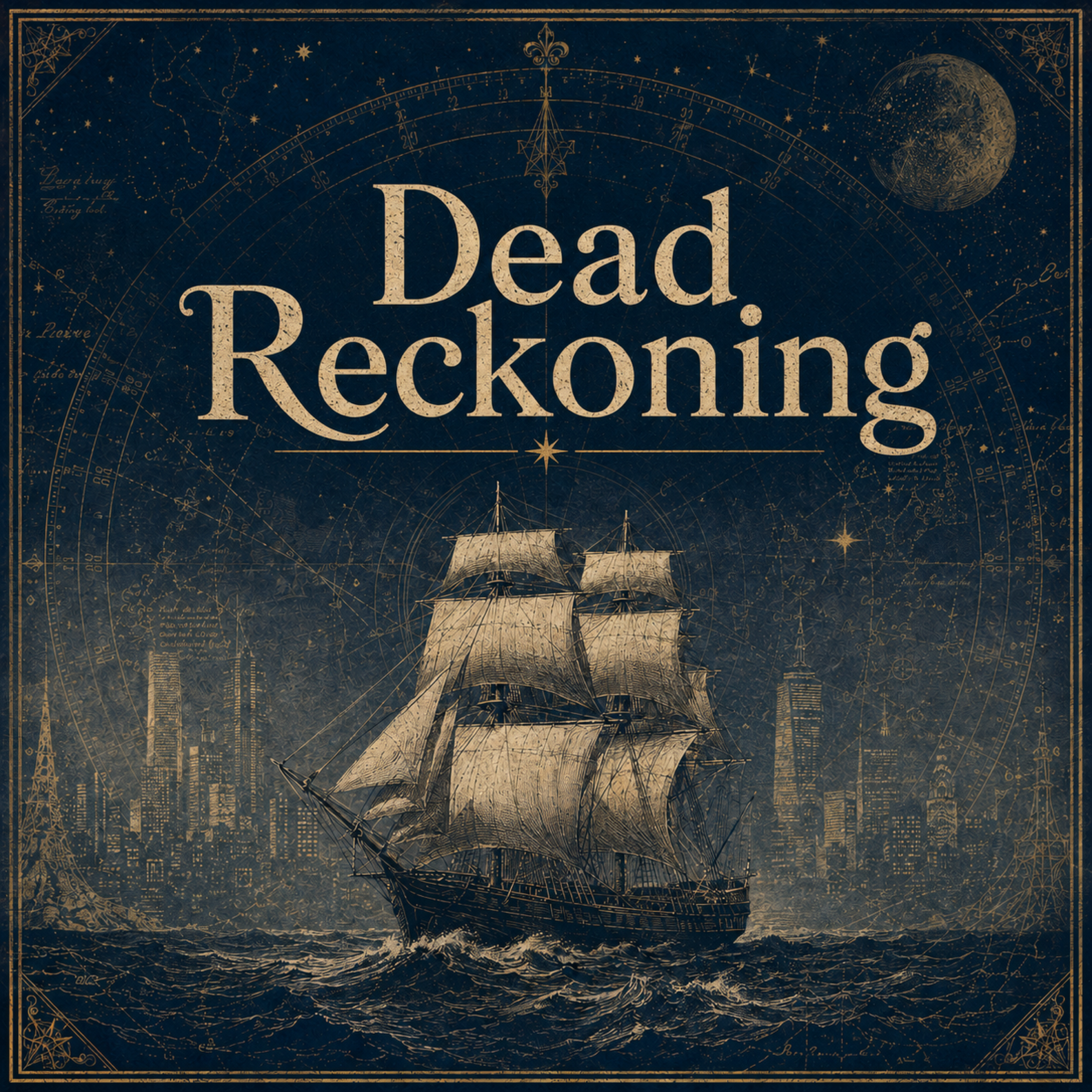
Dead Reckoning
Dead Reckoning
15 minutes decoding today's news through the wisdom of classical texts. Just as sailors once determined their position from past speed and direction — we navigate today's headlines using the timeless wisdom of the classics.
Visita il sito del podcast e sostieni chi lo crea: pub-df2b9beb4d714ffab9234a265cf286ab.r2.dev
Autore
Dead Reckoning
Categoria
Sito del podcast
Ultimo episodio
9 nov 2026
Dove ascoltare?
I podcast nell'app Replaio Radio In arrivoI podcast stanno per arrivare nell'app. Installala ora e scopri per primo un modo tutto nuovo di vivere i podcast
 Installala gratis
Android quasi 10 mln di download · valutazione 4,7+
iOS in arrivo
Episodi
#35 The Strait, The Toll, and The Tyranny of Choke Points: Who Really Controls the World's Veins? 23.06.2026 15:00
The US-Iran deal reopens shipping through the Strait of Hormuz, with Rubio warning Iran not to charge tolls. Beneath the headline lies an ancient question: who has the right to control the chokepoints through which civilization itself flows?
#34 The Strawberry Paradox: Brexit, Borders, and the Hands That Feed Us 23.06.2026 15:00
Ten years after Brexit promised to reclaim British jobs, the strawberry fields of England are picked by workers from Kyrgyzstan and Tajikistan. We examine what this reveals about labor, value, and the gap between political promises and economic reality.
#33 When the State Forgets Its Purpose: Myanmar, Kenya, and the Locke Test 22.06.2026 15:00
A UN report documents Myanmar's army killing over 700 civilians in six months, while a Kenyan minister is found in contempt of court over a US-backed Ebola facility. Both stories raise the oldest political question: what happens when those entrusted with power turn against the people they're supposed to protect?
#32 Custard Apples and Quiet Coercion: How Trade Becomes a Weapon 22.06.2026 15:00
Taiwan fears China is preparing to weaponize the atemoya — a humble local fruit — by ramping up imports and creating dependency. Behind this strange fruit story lies a profound lesson about how gifts, trade, and economic ties can become instruments of soft power and political pressure.
#31 The Negotiator's Mask: Trump, Iran, and Machiavelli's Lions 21.06.2026 15:00
As US-Iran talks begin in Switzerland, Trump threatens military action while his negotiators sit at the table. We decode this 'good cop with a flamethrower' strategy through Machiavelli's The Prince, examining what coercive diplomacy reveals about power, fear, and the eternal grammar of statecraft.
#30 The Strait, the Sanctions, and the Bargaining Table: Reading the US-Iran Crisis Through Hobbesian Eyes 21.06.2026 15:00
As the US and Iran return to the negotiating table in Switzerland, Tehran claims to have closed the Strait of Hormuz in response to Israeli strikes in Lebanon. We decode this multi-front crisis through Hannah Arendt's analysis of power, violence, and the loneliness of nations.
#29 The Chokepoint and the Chessboard: Why the Strait of Hormuz Keeps Reappearing 20.06.2026 15:00
Iran claims to have closed the Strait of Hormuz amid escalating Israel-Lebanon strikes, just as US Vice President Vance heads to Switzerland for nuclear talks. We decode the ancient logic of chokepoints, ambiguous signals, and coercive diplomacy through Sun Tzu's Art of War.
#28 The Debt of History: When Nations Demand Apology for Slavery 20.06.2026 15:00
African and Caribbean nations are formally demanding apologies, debt relief, and reparations from countries that profited from the transatlantic slave trade. We unpack the deep moral logic behind this demand through Hegel's master-slave dialectic and the philosophy of gift, debt, and recognition.
#27 The Bill That Rewrites Time: Zimbabwe, Power, and the Dictator's Hidden Trap 19.06.2026 15:00
Zimbabwe's parliament has passed a bill extending President Mnangagwa's term by two years and scrapping direct presidential elections. We decode this maneuver through Shakespeare's Macbeth — the ancient logic of ambition that promises security but devours its bearer.
#26 The President Who Wouldn't Leave: Zimbabwe and the Eternal Temptation of Power 19.06.2026 15:00
Zimbabwe's parliament has passed a bill extending President Mnangagwa's term by two years and scrapping direct presidential elections. We examine this through the lens of Montesquieu's analysis of how power corrupts the structures meant to contain it.
#25 When the War Ends, Who Won? The US-Iran Deal Through Livy's Eyes 18.06.2026 15:00
The US has lifted its naval blockade on Iran while both sides claim victory in a deal ending their war. Yet Iran's supreme leader calls Trump 'desperate,' and analysts note the Iranian regime emerged not just intact but empowered. What does it mean to 'win' a war?
#24 Japan's Pacifist Crossroads: The Heike Bell and the Logic of Rearmament 18.06.2026 15:00
Japan's Defence Minister Shinjiro Koizumi tells the BBC that ramping up defence is 'critical' to prevent war, signaling a potential break from the country's post-WWII pacifist posture. We examine this through the lens of The Tale of the Heike's meditation on impermanence and the inevitable cycles of rise and fall.
#23 The Tanker, the Blockade, and the Invisible Hand: Why Sanctions Keep Failing 17.06.2026 15:00
Three Iranian oil tankers slipped past a US naval blockade in the Gulf of Oman. Beneath this single headline lies a centuries-old question: can political power actually override the logic of markets? We turn to Adam Smith to decode why blockades, embargoes, and sanctions so often fail to do what their architects promise.
#22 The Sniper, the Drone, and the Cave: When Conspiracy Becomes Reality 17.06.2026 15:00
The FBI unsealed filings revealing a group planned to attack a White House UFC event with snipers and drones, motivated by grievances over corruption, the Epstein files, and data centers. We decode how conspiracy-driven violence emerges through Plato's Allegory of the Cave and Le Bon's crowd psychology.
#21 The Billionaire and the Broadcaster: When Power Speaks, Who Listens? 16.06.2026 15:00
A German public broadcaster, ZDF, removed a TV intro after Elon Musk sent a cease-and-desist letter, accusing them of 'outrageous lies.' We examine what happens to press freedom when a single private individual commands more wealth, reach, and legal firepower than many nation-states.
#20 The Page-and-a-Half Peace: Reading Trump's Iran Deal Through Machiavelli 16.06.2026 15:00
Vice President Vance announces that Trump may release a US-Iran deal — reportedly just 'a page and a half' and 'very general' — before Friday. Meanwhile, the same agreement traps Netanyahu in a political nightmare. We decode this through Machiavelli's The Prince: what does it mean when a superpower signs a deliberately vague treaty, and what happens to allies caught in its wake?
#19 The Aid Worker's Shadow: Power, Hunger, and the Banality of Abuse 15.06.2026 15:00
MSF (Doctors Without Borders) staff have been accused of abusing Sudanese refugees in a sex-for-food scandal, with victims staying silent for fear of losing aid access. We examine how humanitarian institutions, designed to save lives, can replicate the very power asymmetries they exist to relieve.
#18 The Strait, the Sage, and the Art of Not Fighting: Decoding the US-Iran Deal 15.06.2026 15:00
The US and Iran have announced a framework agreement that reopens the Strait of Hormuz and lifts the US naval blockade — but notably leaves Iran's nuclear program untouched. Oil prices fell, markets surged. What does this deal really tell us about power, leverage, and the ancient art of strategic compromise?
#17 The Crowded Paradise: Switzerland's Vote and the Ancient Question of 'How Many Is Too Many?' 14.06.2026 15:00
Swiss voters rejected a referendum to cap the country's population at 10 million by sharply cutting immigration. Though framed as a question of affordability and sustainability, the vote exposes ancient anxieties about the size, identity, and self-governance of a political community.
#16 Resurrecting the Dead: Russian Families, AI Grief, and the Vampires of Capital 14.06.2026 15:00
Russian families are using AI to 'resurrect' loved ones killed in Ukraine, generating video and voice replicas of the dead. This phenomenon sits at the crossroads of grief, war, technology, and a deeper question: what happens to mourning itself when it becomes a commodity, and what does it mean to refuse the finality of death in a state at war?
#15 The Patient Adversary: Why Iran No Longer Fears the Storm 13.06.2026 15:00
Trump announces a US-Iran deal will be signed Sunday, but Tehran disputes the timeline. Behind the diplomatic theater lies a deeper truth: Iran's new leadership, hardened by war, has discovered that surviving pressure is itself a form of victory. We decode this through the lens of stoic endurance and the strategic mind of the samurai.
#14 When the King Walks Out: Trump, the Press, and the Mirror He Refused to Hold 08.06.2026 15:00
President Trump abruptly ended an NBC interview after being challenged on his 'rigged election' claims. We examine what happens to a democracy when its powerful refuse to be questioned, through the lens of John Stuart Mill's defense of dissenting speech.
#13 When the Strongman Trembles: Drones Over St. Petersburg and the Illusion of Power 07.06.2026 15:00
Putin's flagship economic forum in St. Petersburg was overshadowed by Ukrainian drone attacks, exposing the fragility behind the spectacle of strength. We decode this through the lens of Laozi's Tao Te Ching — what does it mean when the 'hard' meets the 'soft'?
#12 The Theater of Memory: D-Day, Migration, and the Weaponization of the Past 07.06.2026 15:00
US Defence Secretary Pete Hegseth used a D-Day commemoration speech in Normandy to attack European migration policies, framing migrants as an 'invasion.' We examine how political language transforms memory into propaganda, and how the dead are conscripted to fight battles they never knew.
#11 When the Devil Collects Debts: Venezuela, Shame, and the Hidden Architecture of Money 06.06.2026 15:00
In Caracas, a man dressed as the devil publicly humiliates debtors until they pay. Behind this bizarre street theater lies a profound question: what happens to economic life when formal institutions collapse? We decode it through Karl Polanyi's insight that markets must be embedded in society.
Podcast simili




Ascolta il podcast Dead Reckoning su Replaio
Radio e podcast in un'unica app - gratis e senza registrazione. Installala oggi e non perderti il lancio
Replaio non è un editore di podcast; i nomi dei programmi, le copertine e l'audio appartengono ai rispettivi autori e vengono distribuiti tramite feed RSS pubblici