Audible
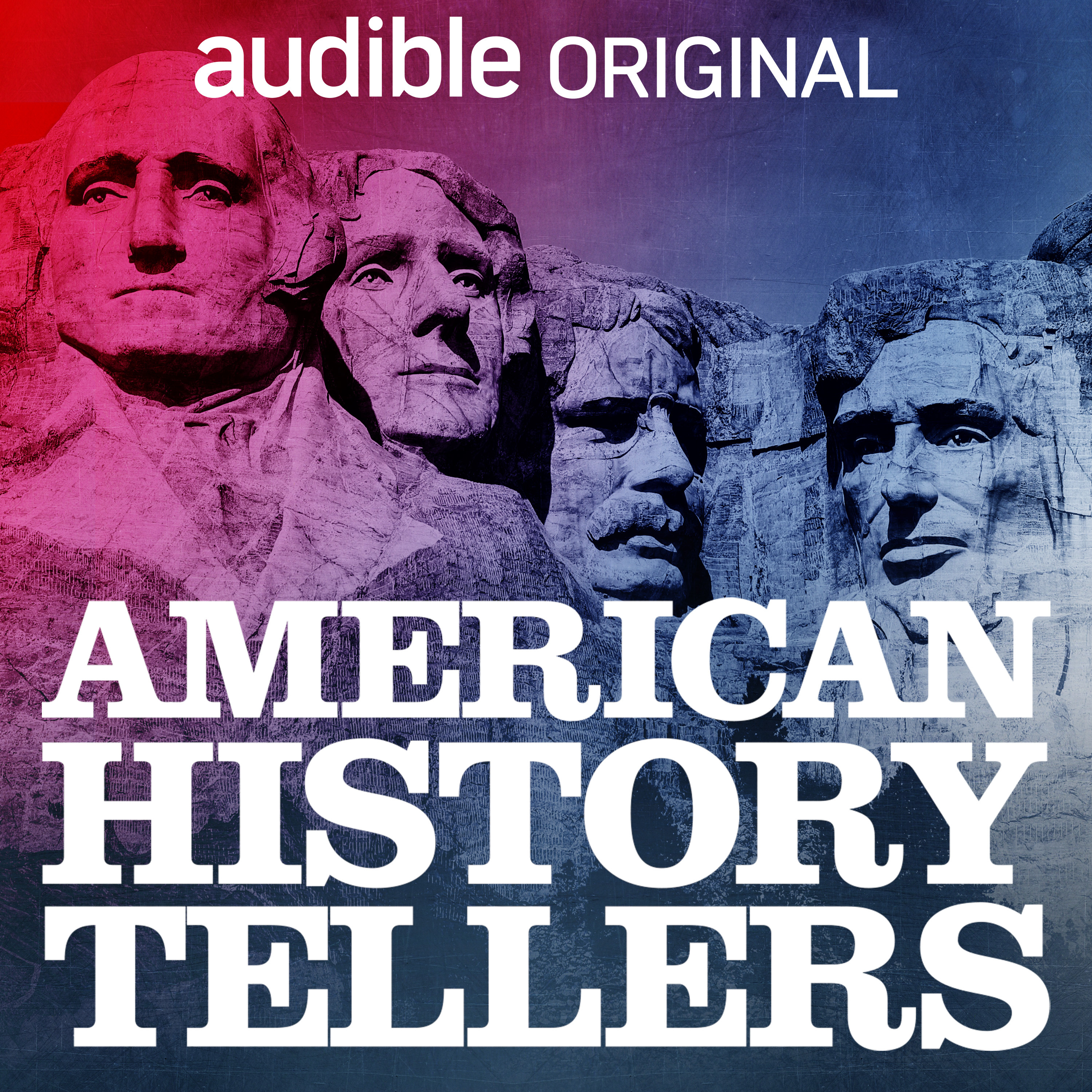
American History Tellers
The Cold War, Prohibition, the Gold Rush, the Space Race. Every part of your life - the words you speak, the ideas you share - can be traced to our history, but how well do you really know the stories that made America? We'll take you to the events, the times and the people that shaped our nation. And we'll show you how our history affected them, their families and affects you today. Hosted by Lindsay Graham (not the Senator). From Wondery, the network behind American Scandal, Tides of History, American Innovations and more. Audible subscribers can listen to all episodes of American History Te...
Visita il sito del podcast e sostieni chi lo crea: wondery.com
Dove ascoltare?
I podcast nell'app Replaio Radio In arrivoI podcast stanno per arrivare nell'app. Installala ora e scopri per primo un modo tutto nuovo di vivere i podcast
 Installala gratis
Android quasi 10 mln di download · valutazione 4,8
iOS in arrivo
Installala gratis
Android quasi 10 mln di download · valutazione 4,8
iOS in arrivo
Episodi
Encore: Tulsa Race Massacre | The Powder Keg | 2 02.06.2021 39:41
As Black teenager Dick Rowland sat in a jail cell at the Tulsa courthouse, news of his arrest flew through the town. Egged on by rumors about his alleged rape of white teenager Sarah Page, a white mob bent on a lynching Rowland began assembling outside the courthouse. By that evening, the crowd had swelled to thousands. Meanwhile, some young African American veterans of the recent world war...
Encore: Tulsa Race Massacre | The Promised Land | 1 26.05.2021 48:32
In 1921, Tulsa, Oklahoma boasted one of the nation’s most prosperous African-American communities. Greenwood was home to 108 Black-owned businesses, two theaters, 15 physicians, two newspapers, and a luxury hotel. It was nicknamed “the Black Wall Street.” Then, on May 30th, a Black shoeshine boy named Dick Rowland was accused of assaulting a white teenaged elevator operator, Sarah Page. What happe...
The Mystery of D.B. Cooper | The Man in Row 18 | 1 19.05.2021 35:18
On November 24th, 1971, a man on a Boeing 727 bound for Seattle handed a flight attendant a note that read, “Miss, I have a bomb here.” No one knew the man’s real name. But soon, the press was calling him D.B. Cooper -- and his hijacking of Northwest Orient Flight 305 would go down as one of the most audacious in aviation history. Cooper parachuted out of that flight with $200,000 in cash, then di...
Bleeding Kansas | The Man Who Sparked the Civil War | 5 12.05.2021 43:49
John Brown has been called many things: fanatic, hero, terrorist, martyr, zealot. Some of his contemporaries, including Frederick Douglass, believed that were it not for his raid on Harpers Ferry, the Civil War would never have started. But did Brown’s actions really bring about slavery’s eventual downfall? And can his impact still be seen today in a nation that remains deeply divided over issues...
Bleeding Kansas | His Soul Goes Marching On | 4 05.05.2021 38:05
On October 17th, 1859, John Brown was barricaded inside the federal armory at Harpers Ferry with his hostages and his remaining followers. His attempt to lead an antislavery insurrection had failed. A detachment of U.S. Marines led by Colonel Robert E. Lee had the armory surrounded. For the radical abolitionist, it was his last stand. But after he was captured and sentenced to death, Northern abol...
Bleeding Kansas | The Raid on Harpers Ferry | 3 28.04.2021 36:40
In December 1858, John Brown was back in Kansas and Missouri, making headlines for dramatic and deadly raids on plantations. He and his followers freed 11 enslaved men and women and led them on an 1,100-mile journey to freedom in Canada. But all the while, Brown was focused on finally launching his long-planned attack on slavery in Harpers Ferry, Virginia. After months of preparation, on the night...
Bleeding Kansas | The Pottawatomie Massacre | 2 21.04.2021 39:09
On the night of May 24th, 1856, radical abolitionist John Brown and seven of his followers crept along the banks of Kansas’s Pottawatomie Creek and stormed a proslavery settlement. They dragged five men from their cabins and killed them in cold blood. Soon, Brown’s name was splashed across the nation’s newspapers, making him a lightning rod for controversy. He would exploit his notoriety to...
Bleeding Kansas | John Brown's Crusade | 1 14.04.2021 40:53
In the 1850s, the United States was lurching toward a crisis over slavery -- and abolitionist John Brown stepped into the fray. Brown believed it was his God-given destiny to destroy slavery. His crusade took him from abolitionist meetings in the Northeast, to the Underground Railroad in Ohio, to the bloody plains of Kansas. In 1854, a fierce conflict erupted over whether the territory of Kansas w...
America's Monuments | The Trouble With Confederate Statues | 7 07.04.2021 38:06
In recent years, there’s been a movement to remove statues of Confederate leaders and other monuments that some see as celebrations of America’s racist history. But does taking down these statues help address the racial inequities that plague our nation to this day? Or is it just erasing history? In his forthcoming book How the Word Is Passed: A Reckoning With the History of Slavery Across A...
America's Monuments | 58,000 Names | 6 31.03.2021 37:13
The Vietnam War was one of the most divisive conflicts in American history. Over 58,000 Americans died in the fighting; many more returned home with wounds both visible and hidden. When veterans lobbied for a memorial to honor American soldiers lost in Vietnam, a young college student named Maya Lin was picked from a blind competition to design it. Her unconventional vision would lead to a b...
America's Monuments | The Mansion of the King | 5 24.03.2021 40:20
Few historic residences are more synonymous with their owners than Graceland. Purchased by Elvis Presley in 1957, the stately Memphis mansion was the heart of his private world and his most prized possession. He always swore he’d never sell it. But after Elvis’s sudden and tragic death, Graceland faced an uncertain future. It would take a risky move by his ex-wife Priscilla to sa...
America's Monuments | The Longest Bridge | 4 17.03.2021 36:42
In the early 1920s, San Francisco was a picturesque city on a narrow, isolated peninsula. Known for its scenic, natural beauty, it had the potential to become one of America’s leading metropolises. But to fuel its economic growth, it needed a bridge -- across one of the most treacherous bodies of water on the Western seaboard. To build a bridge across the strait known as the Golden Gate, engineers...
America's Monuments | Four Faces | 3 10.03.2021 40:44
In 1927, workers began blasting granite rock off a towering cliff in South Dakota’s Black Hills. It was the start of an arduous 14-year struggle to carve the portraits of four American presidents into Mount Rushmore. The feat required grueling labor in extreme conditions. And it was led by an obsessive sculptor named Gutzon Borglum. Borglum was the creative genius behind Rushmore, with a talent an...
America’s Monuments | A Passage Through Panama | 2 03.03.2021 38:35
For centuries, sailors and merchants dreamed of finding a passage between the Atlantic and Pacific Oceans across the narrow isthmus of Central America. But no natural passage existed. To get ships across the fifty-mile stretch of land, someone would have to dig a canal. The French tried first, and failed. Then, in 1904, President Theodore Roosevelt and the U.S. took on the challenge. Struggling ag...
America’s Monuments | The Colossus of New York Harbor | 1 24.02.2021 39:38
It’s perhaps the most iconic of American monuments -- the Statue of Liberty. A towering 305-foot sculpture of copper and steel that is synonymous with American values of liberty, freedom and self-determination. But it began as a gift from France. And when it first arrived on American soil, its future was far from certain. For over a decade, artists, craftsmen and everyday people from France and th...
Great Chicago Fire | Out of the Ashes | 4 17.02.2021 32:46
After the 1871 fire destroyed a third of their city, Chicagoans wanted to do more than rebuild. They wanted to envision a new kind of American city. That included everything from changes to fire codes and labor laws to an entirely new style of architecture -- the skyscraper. Professor Ann Keating is an urban historian and expert on Chicago history both before and after the Great Fire. She and Lind...
Great Chicago Fire | The Great Rebuilding | 3 10.02.2021 40:08
As dawn broke on October 10, 1871, the dazed survivors of the Great Chicago Fire stumbled through their burned and battered city. A 30-hour inferno had reduced Chicago to ashes. Homes and business were replaced by gaping holes and smoldering rubble. Tens of thousands of people had lost their houses and jobs. Many had lost loved ones. As aid poured into the city, officials turned their attention to...
Great Chicago Fire | Fleeing the Flames | 2 03.02.2021 35:45
Just before midnight on October 8, 1871, the inferno that had ravaged Chicago’s West Side leapt the Chicago River. A wall of flames surged toward downtown, threatening to devour Chicago’s most magnificent hotels, offices, and government buildings. Mayor Roswell B. Mason raced to the Chicago courthouse, but he would soon find he was helpless to save his city. Panic-stricken South Side residents str...
Great Chicago Fire | We Are Going to Have a Burn | 1 27.01.2021 35:21
In 1871, Chicago was the fastest growing city in the world. Built almost entirely of wood, it was also a tinderbox. That October, a severe drought ravaged the city. Fires ignited constantly, and Chicago’s firefighters were at their breaking point. But the worst was yet to come. On a hot, windy night, a fire broke out in a barn owned by Irish immigrants Catherine and Patrick O’Leary. By the time fi...
Presidential Inaugurations: Traditions, Crisis, and Unity | 1 20.01.2021 35:21
As America prepares to swear in a new president, we’ll look back to the inaugurations of the past. Jim Bendat, author of Democracy's Big Day: The Inauguration of Our President, 1789-2013 , joins us as we cover the friction between the outgoing and incoming president, the Capitol Hill breach on January 6th, and how inaugurations have served as a powerful reminder of the strength of American de...
Coal Wars | Charles Keeney on Restoring His Great Grandfather’s Legacy | 5 13.01.2021 45:29
Once the coal miners lost the Battle of Blair Mountain, the story of their uprising was suppressed, and their leader Frank Keeney eventually faded into obscurity—even among members of his own family. But historian Charles Keeney, Frank Keeney’s great grandson, has made it a personal mission to raise public awareness of the mine wars and the pivotal role his ancestor played. Charles Keeney is...
Coal Wars | The Battle of Blair Mountain | 4 06.01.2021 37:57
The Coal Wars reached an explosive climax in August 1921, as thousands of miners furious over the death of their hero Sid Hatfield shouldered their weapons and marched south. Their destination was Mingo County, where they hoped to free their fellow miners jailed under martial law. But first, they would have to cross Blair Mountain and armed men led by Logan County’s ruthless anti-union Sheriff Don...
Coal Wars | Bloody Mingo | 3 30.12.2020 38:37
In May 1920, Sheriff Sid Hatfield won the loyalty of Mingo County’s miners after a deadly gun battle that left seven Baldwin-Felts agents dead on the streets of Matewan, West Virginia. That summer, the coal companies brought in trainloads of strikebreakers to get the mines running again. But local miners were electrified by the Matewan Massacre and they waged an all-out guerilla war as Hatfield aw...
Coal Wars | The Matewan Massacre | 2 23.12.2020 40:56
In March 1913, famed labor activist Mother Jones was locked up in a shack in Pratt, West Virginia, suffering from pneumonia and a high fever as she awaited court martial. For a year, the striking miners she led endured hunger and violence as they waged their desperate battle for the right to organize. Now, their struggle hung in the balance. West Virginia was under martial law, and hope for victor...
Coal Wars | The Most Dangerous Woman in America | 1 16.12.2020 39:01
In the early 20th century, coal was the fuel that powered the nation. But the men who mined it in the rugged and remote hills of West Virginia endured harsh exploitation by the coal companies that controlled their lives. In the spring of 1912, miners in West Virginia’s Kanawha Valley rose up against the companies and their powerful allies in law enforcement with a strike for their right to join a...
Podcast simili





Ascolta il podcast American History Tellers su Replaio
Radio e podcast in un'unica app - gratis e senza registrazione. Installala oggi e non perderti il lancio
Replaio non è un editore di podcast; i nomi dei programmi, le copertine e l'audio appartengono ai rispettivi autori e vengono distribuiti tramite feed RSS pubblici