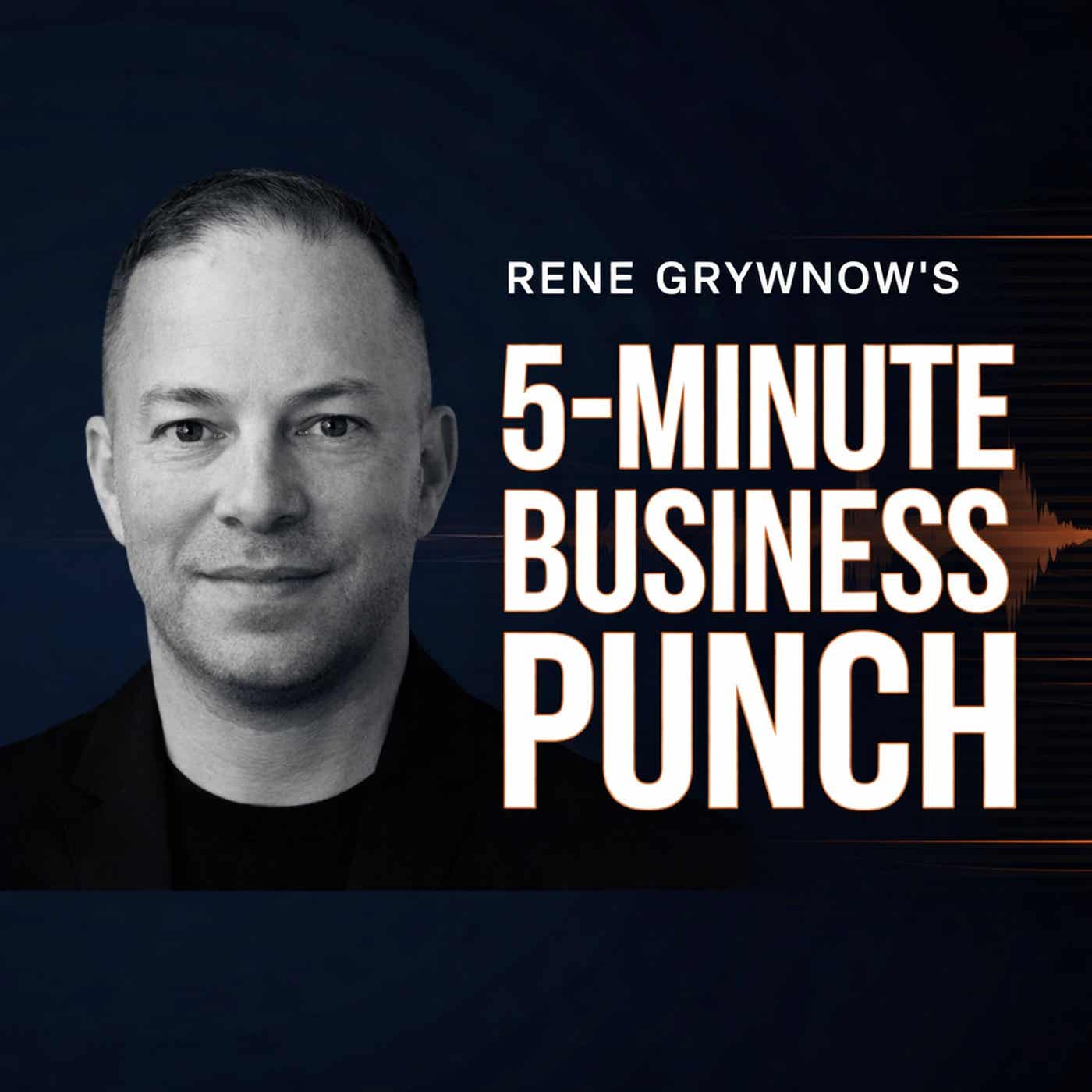
Rene Grywnow, DBA
Rene Grywnow’s 5-Minute Business Punch
5-minute business insights on AI, energy, supply chain & leadership. No fluff. Just actionable ideas for real-world results. Built for people in industry who want to stay ahead, not catch up. Every episode delivers practical, high-impact ideas on AI, energy systems, engineering, supply chain strategy, sustainability, and leadership under pressure. No theory. No buzzwords. Just real-world insights you can use the same day. New episodes every Tuesday and Thursday, plus special episodes when markets move. renegrywnow.substack.com
Mindenképp látogasd meg a podcast oldalát, és támogasd a készítőjét: renegrywnow.substack.com
Szerző
Rene Grywnow, DBA
Kategória
A podcast weboldala
Legutóbbi epizód
2026. okt. 6.
Hol hallgathatod?
Podcastok az alkalmazásban Replaio Radio HamarosanA podcastok hamarosan megérkeznek az alkalmazásba. Telepítsd most, és láss elsőként egy teljesen új megközelítést a podcastokhoz
 Telepítsd ingyen
Android közel 10 M letöltés · 4,8-as értékelés
iOS hamarosan
Telepítsd ingyen
Android közel 10 M letöltés · 4,8-as értékelés
iOS hamarosan
Epizódok
AI Regulation vs. Innovation: The European Tightrope 30.07.2026 5:32
Part I asked how you prove a learning system is safe. Part II asks what happens when the rules for proving it change eight times in eighteen months. Since the EU AI Act entered into force, its timeline has been rewritten repeatedly — most recently with the Council’s final green light at the end of June 2026. Strip away the politics and the Digital Omnibus makes one change: it moves the clock, not...
The Compliance Challenge Nobody Talks About: AI in Safety-Critical Operations 28.07.2026 5:00
Week 30 asked who’s responsible when an agent gets it wrong. Week 31 asks the earlier, quieter question: how do you even prove the decision was safe before anything goes wrong? Ask a functional-safety engineer what “validated” means and you get “tested, documented, frozen.” Ask an AI engineer and it’s closer to “as of last Tuesday.” That gap is the whole problem. Functional safety — IEC 61508, ISO...
Many Agents, Many Vendors, Legacy Everywhere. Where AI Accountability Actually Breaks 23.07.2026 6:59
Part I asked who is responsible when an agent gets it wrong. Part II answers where that responsibility actually breaks, not inside any single agent, but in the gaps between agents, vendors, and machines that were never designed to talk to each other. No agent on a real floor acts alone. It acts inside a conversation with legacy PLCs, other agents, human operators and external data, which makes roo...
Who Is Responsible When AI Gets It Wrong on the Factory Floor? 21.07.2026 7:12
An agent reroutes production tonight and gets it wrong. Tomorrow someone asks who’s responsible. Could you answer in one sentence? In conventional automation, a wrong outcome had a name, the operator, the supervisor. One link. In agentic AI, the chain runs five links deep: developer, integrator, operations, real-world conditions, and the agent itself. This episode maps the four dimensions now shar...
GDPR Won't Save You When the Robot Moves: Regulating Physical AI 16.07.2026 6:06
Part I argued that governance is the missing layer. Part II makes the gap concrete, and legal. In conversation with regulatory and liability counsel Dr. Miriam Vogt (former functional-safety engineer), we draw the line data-protection rules can’t cross: GDPR asks whether you were allowed to process the data; it never asks whether the robot should have moved. We walk the five places current rules f...
The Layer That Decides Who Decides: AI Governance in Industrial Transformation 14.07.2026 6:44
Almost every manufacturer can point to a successful AI pilot. Far fewer can point to one running at scale in production. The gap between those two sentences is rarely technical, it’s the layer nobody puts on the architecture diagram: who decides what, within which limits, and who answers when it goes wrong. This episode diagnoses the two failure modes that follow when governance is missing, paraly...
When Robots Decide, Who's Accountable? Leadership in the Age of Embodied AI 09.07.2026 7:28
Part I ended on an uncomfortable truth: the hardest part of shop-floor agents isn’t the model, it’s the scoping, integration and governance around it. Those aren’t engineering problems. They’re leadership problems. The moment a robot decides, “who is accountable?” stops being a footnote and becomes the organizing question of the whole operation. This episode maps the shift from command-and-control...
AI Agents on the Shop Floor: The Upside Everyone Sells, the Risks Few Map (Week 28 · Part I) 07.07.2026 8:28
An agent that only recommends is a colleague you can overrule. An agent that acts is a colleague with its hands on the machine. This episode holds both halves of that sentence at once, the value and the danger, because most of the 2026 hype skips the second. The upside is real: agents collapse the detection-to-action gap from hours to seconds, acting within safe limits in predictive maintenance, r...
The Wall Socket Problem: Why Energy Infrastructure Decides Whether Physical AI Scales 02.07.2026 7:20
Part I separated AI that thinks from AI that acts. Part II ends at the wall socket, because acting in the physical world runs on power, and power is where Europe’s manufacturers are most constrained. The conversation fixates on chips and models; the real bottleneck quietly forming underneath is the factory grid you already own. Physical AI relocates energy demand from one predictable hyperscale lo...
Industrial AI Is Not ChatGPT: What Manufacturers Must Understand Before Scaling (Week 27 · Part I) 30.06.2026 7:37
Ask a chatbot for the wrong word and you lose nothing. Ask an AI to adjust a press or stop a line, and a wrong millisecond can cost a hand, a batch, or a shipment. This episode draws the line consumer hype keeps blurring: Generative AI produces content a human acts on, Industrial AI must produce safe physical action in real time. The binding constraint is rarely the model. It’s real-time sensor-da...
The European Reality Check: Why Physical AI Is Harder Here, and Pays Back Anyway 25.06.2026 7:08
Part I sketched the global vision. Part II lands it in a forty-year-old plant in the Ruhr or Lombardy, where every kilowatt has a price, every robot a safety dossier, and every legacy line a reason it can’t be ripped out. We map the European equation: high, volatile energy prices, EU ETS and brownfield reality make Physical AI both more urgent and harder to scale . The deployments actually winning...
When Machines Stop Waiting: Generative AI to Autonomous Operations (Week 26 · Part I) 23.06.2026 6:28
For three years, AI on the shop floor has been an advisor. In 2026, it becomes an actor. This episode maps the decisive leap from Generative AI — systems that perceive, analyze and recommend, then stop — to Agentic AI: systems that hold a goal, reason over changing conditions, and act within bounded, safe write-access to your OT. We walk the closed loop on the floor as it actually looks in 2026: p...
The Missing Link: Why Most AI Initiatives Never Reach the Shop Floor - And How Leaders Close the Gap 18.06.2026 7:05
Part I argued the future of AI value lives on the factory floor, not in the cloud. The problem? Most of it never gets there. For every pilot showcased at a trade fair, a quiet graveyard fills with experiments that worked in the lab and died on contact with a real production line. The 2025–2026 data is sobering: 80%+ of AI projects fail to reach production (double the IT failure rate), 42% of organ...
From Data Centers to Factory Floors: Why Physical AI Will Define the Next Predictive Reality 16.06.2026 8:42
For two years, the energy story of AI lived in megawatts and cooling towers, and stopped at the data-center fence line. In Part One of Week 25, I make the case that the next frontier of value is migrating out of the cloud and onto the factory floor, to the exact point where a sensor reads, an edge model decides, and a robot acts. The core reframe: the bottleneck is no longer model intelligence in...
The Next Bottleneck After GPUs? Power, Cooling, and Photonic Infrastructure. How Photonic Systems Could Reshape AI Infrastructure and Break the Energy Wall 11.06.2026 5:03
We won the compute race, and the prize was a thermodynamics problem. GPUs made performance abundant and, in doing so, relocated the constraint from the chip to the infrastructure around it. Rack densities have climbed from 10–20 kW to 100+ kW in under five years, and auxiliary systems already consume 30–40% of facility energy before useful work begins. In Part Two of Week 24, I make the case that...
Photonic Computing and Data Centers: Why Energy Could Finally Become the Constraint 09.06.2026 8:30
For three years we’ve been winning the wrong battle. Liquid cooling, variable-frequency drives and system optimisation deliver real 15–50% savings, but only within the limits of electronic, silicon-based computing. And demand keeps doubling toward 945–1,200 TWh globally by 2030. In Part One of Week 24, I make the case that incremental efficiency has hit a hard physical ceiling, and that the next l...
The Next Industrial Shift: AI, Energy, and Data Center Infrastructure. Why Energy Mastery, Not Just Algorithms, Will Separate the Winners From the Laggards 04.06.2026 7:19
Everyone is telling you the AI story is about chips and models. It isn’t. The next industrial revolution will be won, or lost, in the energy-and-infrastructure layer, and most boards are still treating that layer as plumbing. In Part Two of Week 23, I step back from the single-facility budget of Part One and take the macro view. Global data center electricity demand surged seventeen percent in 202...
CO₂ Reduction vs Economics in Data Centers: What Leaders Ignore – Why Pure Decarbonisation Targets Without Efficiency Gains Are Driving Up Costs and Delaying AI Projects 02.06.2026 4:48
Most boards treat decarbonisation as a purchasing decision — more PPAs, more certificates, more offsets. In 2026 this approach is quietly driving up total cost of ownership, extending grid queues, and delivering only marginal real emissions reductions while absolute demand keeps climbing. In this hard-hitting episode I expose the false “green versus profitable” trade-off and show why efficiency-fi...
Why Sustainability Without Energy Efficiency Fails in Data Centers. The Costly Illusion of Green Energy Without Demand Reduction 28.05.2026 4:52
A Power Purchase Agreement changes the accounting, not the physical load. In 2026, renewables-only strategies are driving higher absolute consumption, longer grid queues, and growing regulatory exposure while efficiency-first operators pull ahead with 20–40 % better TCO and verifiable decarbonisation. In this hard-hitting episode I expose why procurement without demand reduction is backfiring, and...
From Ships to Servers: The Same Energy Problem in AI Data Centers – Why Operators Are Repeating Shipping’s Costly Mistake 26.05.2026 4:43
Data centers are losing 30–40 % of total facility energy in auxiliary systems, pumps, fans, and power distribution, the exact same structural waste shipping solved a decade ago. The physics, the organisational failure, and the proven remedy are identical. In this episode I show why most data center operators are repeating shipping’s old mistakes and how to leapfrog them using the maritime Efficien...
The Leadership Gap in AI Data Center Decisions – Why C-Level Risk Aversion and Short-Term KPIs Are Blocking the Next Wave of AI Dominance 21.05.2026 5:40
Part II of Week 21 reveals why most organisations are still not building the energy moat established in Part I: C-level risk aversion, siloed decision-making and legacy KPIs that reward raw scale over energy-efficient compute. In this episode I expose the four recurring leadership blind spots and the exact governance playbook top performers are using to close the gap, achieving 15–30 % lower TCO a...
Energy as the New Moat in AI Infrastructure – Why Mastering Power Demand Is Now the Decisive Competitive Advantage 19.05.2026 5:24
The AI race has moved from the server hall to the substation. With data center demand nearly doubling by 2030 and grid queues of 4–7 years, energy strategy has become the new competitive moat. In this hard-hitting episode I challenge every leader to confront whether their energy approach is still reactive procurement or true Energy Dominance. You’ll be forced to ask yourself: * Is energy still a f...
Why Emotional Toughness Is Not Resilience: The Dangerous Myth Leaders Still Believe 15.05.2026 4:34
Colonel Morrison was “The Machine” – until he wasn’t. This powerful conversation with HR expert Dr. Elena Voss reveals why emotional suppression (what we call “toughness”) is not resilience, and what actually builds sustainable strength in leaders and teams. You’ll learn: * The difference between pseudo-stoicism and real resilience * Why “never showing emotion” can lead to delayed breakdown * The...
Why Most Data Center Strategies Fail: The Painful Blind Spots Turning Billion-Dollar AI Bets into Expensive Failures 14.05.2026 5:16
$400+ billion in data center Capex in 2025, yet delays, budget overruns and underperforming capacity are becoming the norm. The problem isn’t technology. It’s four recurring strategic blind spots: power & cooling as afterthoughts, siloed teams, MW obsession, and invisible auxiliary waste. In this hard-hitting episode (Energy Dominance Week 20, Part II) I expose exactly why most AI infrastructure s...
Efficiency vs Scale: The Next Battle in AI Infrastructure – Why Raw Expansion Alone Will Lose the AI Race in 2026 12.05.2026 4:13
Grid queues of 4–7 years and transformer shortages have turned raw scale into a high-risk strategy. In 2026 the real winners will extract 15–30 % more compute from every MW through system-level efficiency — no new grid connection required. In this provocative episode (Energy Dominance Week 20, Part I) I challenge Technical Leads, Facility Managers, Energy Coordinators, and C-suite leaders to face...
Hasonló podcastok






Hallgasd a(z) Rene Grywnow’s 5-Minute Business Punch podcastot a Replaióban
Rádió és podcastok egy alkalmazásban - ingyen és regisztráció nélkül. Telepítsd még ma, és ne maradj le a premierről
A Replaio nem podcastkiadó; a műsorok nevei, borítóképei és hanganyagai a szerzőiket illetik, és nyilvános RSS-csatornákon keresztül terjednek.