James Edward Mills
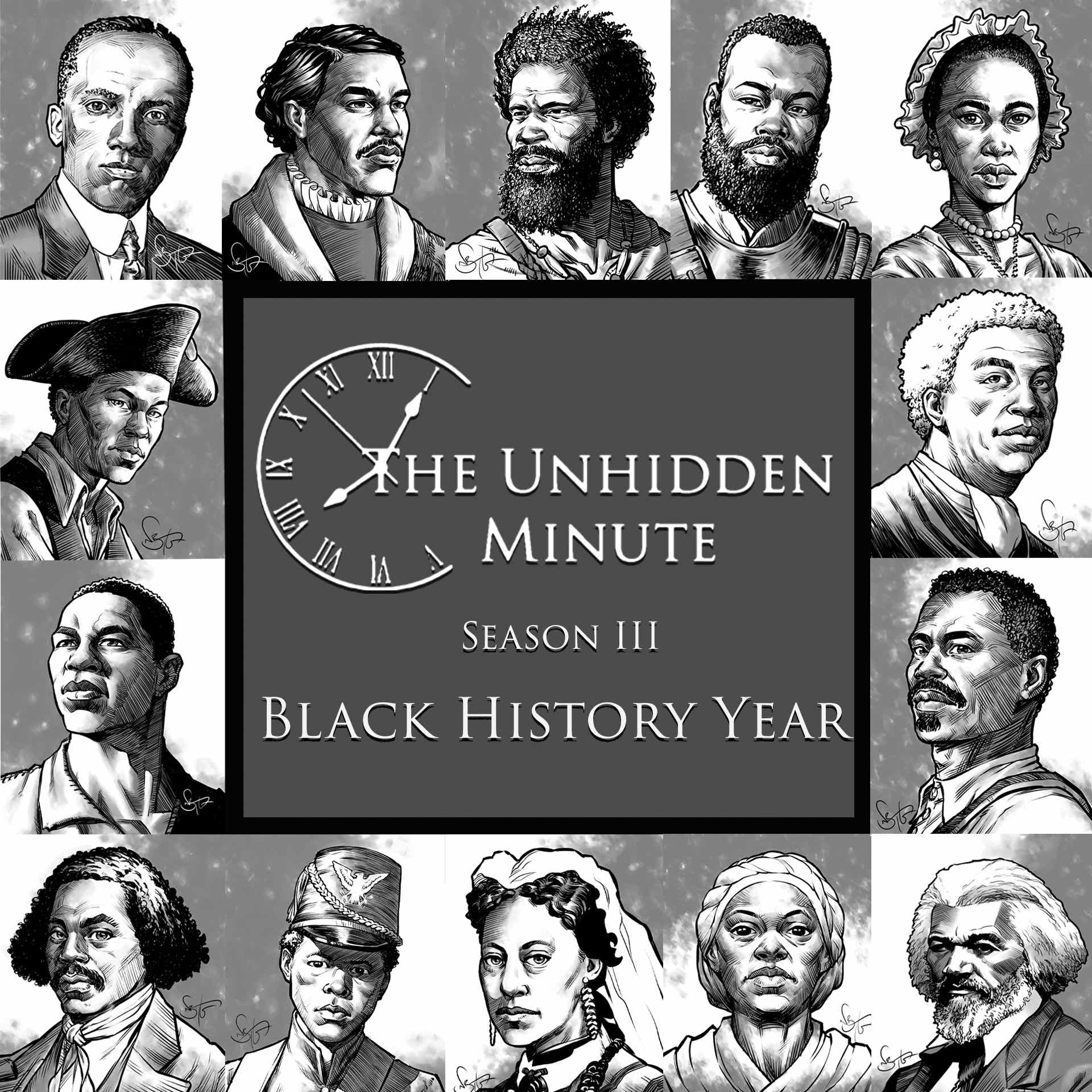
The Unhidden Minute
The Unhidden Minute is part of the Unhidden Podcast Project supported through a National Geographic Explorer Grant from the National Geographic Society. This series celebrates the untold stories of Black American history. jamesedwardmills.substack.com
N'hésitez pas à visiter le site du podcast et à soutenir son créateur : jamesedwardmills.substack.com
Auteur
James Edward Mills
Catégorie
Site du podcast
Dernier épisode
27 oct. 2026
Où écouter ?
Les podcasts dans l'appli Replaio Radio Bientôt disponibleLes podcasts arrivent très bientôt dans l'appli. Installe-la dès maintenant et découvre en avant-première une toute nouvelle façon de vivre les podcasts
 Installe-la gratuitement
Android près de 10 M de téléchargements · note de 4,8
iOS bientôt
Épisodes
Tie Sing 28.10.2025 1:20
A Chinese American chef named Tie Sing worked for the U.S. Geological Survey (USGS) in California through the early 20th century. As head cook on major mapping expeditions, his role was far more critical than it might seem. His creative meals nourished surveyors while on grueling journeys through the rugged terrain of the American West. Sing became a legend within the USGS for his ingenuity, using...
The Wereth 11 21.10.2025 1:20
The Wereth 11 were a group of Black American soldiers who were captured, tortured, and executed by Nazi troops near Wereth, Belgium, on December 17, 1944 . Part of the 333rd Field Artillery Battalion during the Battle of the Bulge these men had sought refuge in the home of a Belgian farmer after their unit was overrun. Betrayed to the Germans by a local collaborator, they were taken outside the vi...
William Monroe Trotter 14.10.2025 1:20
William Monroe Trotter was a pioneering Black journalist, activist, and civil rights leader. His uncompromising demand for racial equality helped to shape Black political thought in the early 20th-century. Born in Boston, Massachusetts, and educated at Harvard University, where he graduated magna cum laude, Trotter became one of the most outspoken critics of racial accommodation and segregation. A...
Lt. Col George E. Hardy 07.10.2025 1:20
Lieutenant Colonel George E. Hardy (1925–2025) was one of the last surviving members of the famed Tuskegee Airmen, the pioneering group of Black aviators who shattered racial barriers during World War II. Born in Philadelphia, Hardy enlisted in the U.S. Army Air Corps in 1943 and trained at the Tuskegee Army Airfield in Alabama, earning his wings in 1944. As a member of the 332nd Fighter Group , h...
Fannie Lou Hamer 30.09.2025 1:20
Fannie Lou Hamer (October 6, 1917 – March 14, 1977) was a powerful voice in the Civil Rights Movement, renowned for her fight for voting rights and economic justice. Born into a sharecropping family of 20 children in Mississippi, she began laboring in cotton fields at age six and left school by age twelve. In 1962, at age 45, she joined the Student Nonviolent Coordinating Committee (SNCC) and was...
Ranger Robert Stanton 22.09.2025 1:20
Robert Stanton (1940– ) was the 15th Director of the National Park Service (NPS) and the first Black American to hold the position, serving from 1997 to 2001 under President Bill Clinton. Born in Fort Worth, Texas, Stanton earned a degree in recreation and park administration from Huston–Tillotson University. His NPS career began in 1962 as a seasonal ranger at Grand Teton National Park . Over nea...
Ranger Betty Reid Soskin 22.09.2025 1:20
Betty Reid Soskin (1921– ) is a trailblazing figure who was the oldest active U.S. National Park Ranger until her retirement at age 100. Born in Detroit and raised in Oakland, Soskin lived through nearly a century of American history, experiencing segregation, the Great Depression, and the civil rights movement firsthand. During World War II, she worked as a file clerk in a segregated shipyard uni...
Lt. Colonel Lee Archer 16.09.2025 1:20
Lieutenant Colonel Lee Archer was a decorated Tuskegee Airman and one of the few Black American fighter pilots to achieve ace status during World War II. Born on September 6, 1919, in Yonkers, New York, Archer joined the U.S. Army Air Corps in 1941 and trained at Tuskegee Army Airfield. As a member of the 332nd Fighter Group , he flew 169 combat missions in the European theater, escorting bombers...
The Yorktown Battlefield 08.09.2025 1:20
The Yorktown Battlefield in Virginia is known for its pivotal role as the site of the decisive victory of the Continental Army over the British in 1781that ended the American Revolutionary War. However, during the Civil War, it became a critical site for Black Americans seeking freedom. In 1862, as Union forces advanced, thousands of enslaved people fled to Union lines from the South, forming what...
Gordon Parks 02.09.2025 1:20
Gordon Parks (1912–2006) was a groundbreaking Black American photographer, filmmaker, and writer whose work forever shaped American culture. Born in Fort Scott, Kansas, Parks grew up in poverty and experienced the harsh realities of segregation. Despite these challenges, he taught himself photography and used the camera as a tool for social change. His early photo essays revealed systemic racism a...
Fazendeville 19.08.2025 1:19
Fazendeville , Louisiana, was a historic Black community founded in the 1860s by freedman Jean Pierre Fazende, not long after the Civil War. The land near Chalmette, just outside of New Orleans was subdivided to sell to formerly enslaved people. For nearly a century, Fazendeville thrived as a tight-knit settlement, with many homes, a school, a church, and cemetery. Generations of Black families li...
Mary Jane Richards 12.08.2025 1:19
Mary Jane Richards, also known as Mary Bowser, was a formerly enslaved Black woman who became a Union spy during the American Civil War. Born in Richmond, Virginia, around 1840, she was freed by her owner , Elizabeth Van Lew , a wealthy white abolitionist. Van Lew arranged for Richards to be educated in the North before returning her back to the South to gather intelligence. Under the alias Mary B...
James Baldwin 05.08.2025 1:20
James Baldwin ( 1924–1987) was a groundbreaking Black American writer and social critic whose work explored the intersections of race, sexuality, and identity. Born in Harlem, he rose from poverty to become one of the 20th century’s most influential voices. His essays, such as those in Notes of a Native Son (1955), and novels like Go Tell It on the Mountain and Giovanni’s Room, boldly addressed bo...
The Chicago Race Riot of 1919 29.07.2025 1:18
The Chicago Race Riot of 1919 erupted on July 27 in the Bronzeville neighborhood along the shores of Lake Michigan. A Black teenager, Eugene Williams , drowned when white beachgoers threw rocks at him for drifting into a whites-only swimming area. When police refused to arrest the white perpetrator, long-simmering racial tensions exploded into violence. For eight days, white and Black residents cl...
Lincoln Hills 22.07.2025 1:20
Lincoln Hills, Colorado, established in 1922, was the only Black-owned mountain resort west of the Mississippi River during the Jim Crow era. Founded by entrepreneurs E.C. Regnier, Robert Ewalt, and Edmund J. McMahon, this site provided a refuge for Black Americans barred from other vacation destinations due to segregation. Over 600 lots were sold to middle-class Black families, creating a vibrant...
The Victory Monument 15.07.2025 1:20
The Victory Monument in Chicago’s Bronzeville neighborhood honors the all-Black Eighth Regiment of the Illinois National Guard. Later known as the 370th Infantry , these soldiers fought valiantly under French command in World War I. Erected in 1927 and later enhanced with a bronze “doughboy” statue in 1936, the monument features granite reliefs depicting battles, symbols of victory, and a Black in...
The Bronzeville Armory 08.07.2025 1:20
During World War I, the Bronzeville Armory in Chicago played a crucial role as a center of Black military organization and community pride. Located in the heart of the city's thriving African American neighborhood, the armory was home to the Eighth Regiment of the Illinois National Guard—the first all-Black regiment officially recognized by the U.S. Army. When the U.S. entered the war, this regime...
What to the Slave is the 4th of July 04.07.2025 1:19
On July 5, 1852, in Rochester, New York, Frederick Douglass delivered his searing speech “ What to the Slave is the Fourth of July ?” His eloquent words exposed the hypocrisy of a nation that celebrated liberty while millions remained enslaved. Invited to commemorate America’s independence, Douglass instead challenged his audience to confront the deep contradictions of a country that proclaimed fr...
Gwendolyn Brooks 01.07.2025 1:19
Gwendolyn Brooks was a groundbreaking American poet whose work captured the joys, struggles, and beauty of Black life, particularly in Chicago’s South Side community of Bronzeville. Born in 1917, she began writing poetry at a young age and published her first poem at 13. Her 1949 collection, Annie Allen , won the Pulitzer Prize for Poetry, making her the first African American to receive the honor...
The Yosemite Act of 1864 30.06.2025 1:19
The Yosemite Act of 1864 was a landmark piece of legislation signed by President Abraham Lincoln during the Civil War. Signed on June 30th the new law granted the Yosemite Valley and the Mariposa Grove of Giant Sequoias to the state of California, with the stipulation that the land be preserved for “ public use, resort, and recreation .” This act marked the first time in U.S. history that the fede...
Bronzeville 27.06.2025 1:20
Located on Chicago’s South Side, Bronzeville is one of the most historically significant Black communities in the United States. Often called the "Black Metropolis," Bronzeville thrived in the early to mid-20th century as a vibrant center of Black American culture, business, and political life. Following the Great Migration, thousands of Black families moved north from the Jim Crow South, settling...
The Buffalo Soldiers Defend Ute Indians 17.06.2025 1:20
In 1887, members of the 9th Cavalry Regiment—known as Buffalo Soldiers—intervened to protect a band of Ute Indians. These Native Americans had fled into Utah after tensions escalated with white settlers and the Colorado state militia. The Utes had left the White River Reservation in Colorado, fearing violent retribution and encroachment on their lands. In response, the Colorado militia pursued the...
The Buffalo Soldiers at Fort Douglas 10.06.2025 1:19
In 1887, Buffalo Soldiers of the 9th Cavalry were stationed at Fort Douglas , near Salt Lake City, Utah. They were part of the U.S. Army’s broader efforts to secure western territories during the post-Civil War era. These Black American troops, many of them formerly enslaved, were among the most disciplined units in the frontier army. The performed with distinction and honor. At Fort Douglas, thei...
The First Memorial Day 26.05.2025 1:22
The origins of Memorial Day are deeply rooted in Black American history, though this is often overlooked in mainstream narratives. On May 1, 1865, just weeks after the Civil War ended, over 10,000 formerly enslaved people in Charleston, South Carolina , held a procession to honor Union soldiers who had died in a Confederate prison camp and were buried in a mass grave. Black residents exhumed the b...
The Greensboro Sit-Ins 29.04.2025 1:19
The Greensboro lunch counter protests of 1960 marked a pivotal moment in the American Civil Rights Movement. On February 1, 1960, four Black American college students from North Carolina Agricultural and Technical State University — Ezell Blair Jr., David Richmond, Franklin McCain, and Joseph McNeil — sat down at a "whites-only" lunch counter at the Woolworth’s store in Greensboro, North Carolina....
Podcasts similaires








Écoute le podcast The Unhidden Minute sur Replaio
La radio et les podcasts dans une seule appli - gratuite, sans inscription. Installe-la dès aujourd'hui et ne rate pas le lancement
Replaio n'est pas éditeur de podcasts ; les noms des émissions, les visuels et l'audio appartiennent à leurs auteurs et sont diffusés via des flux RSS publics