Immanuel Kant
Critique of Pure Reason
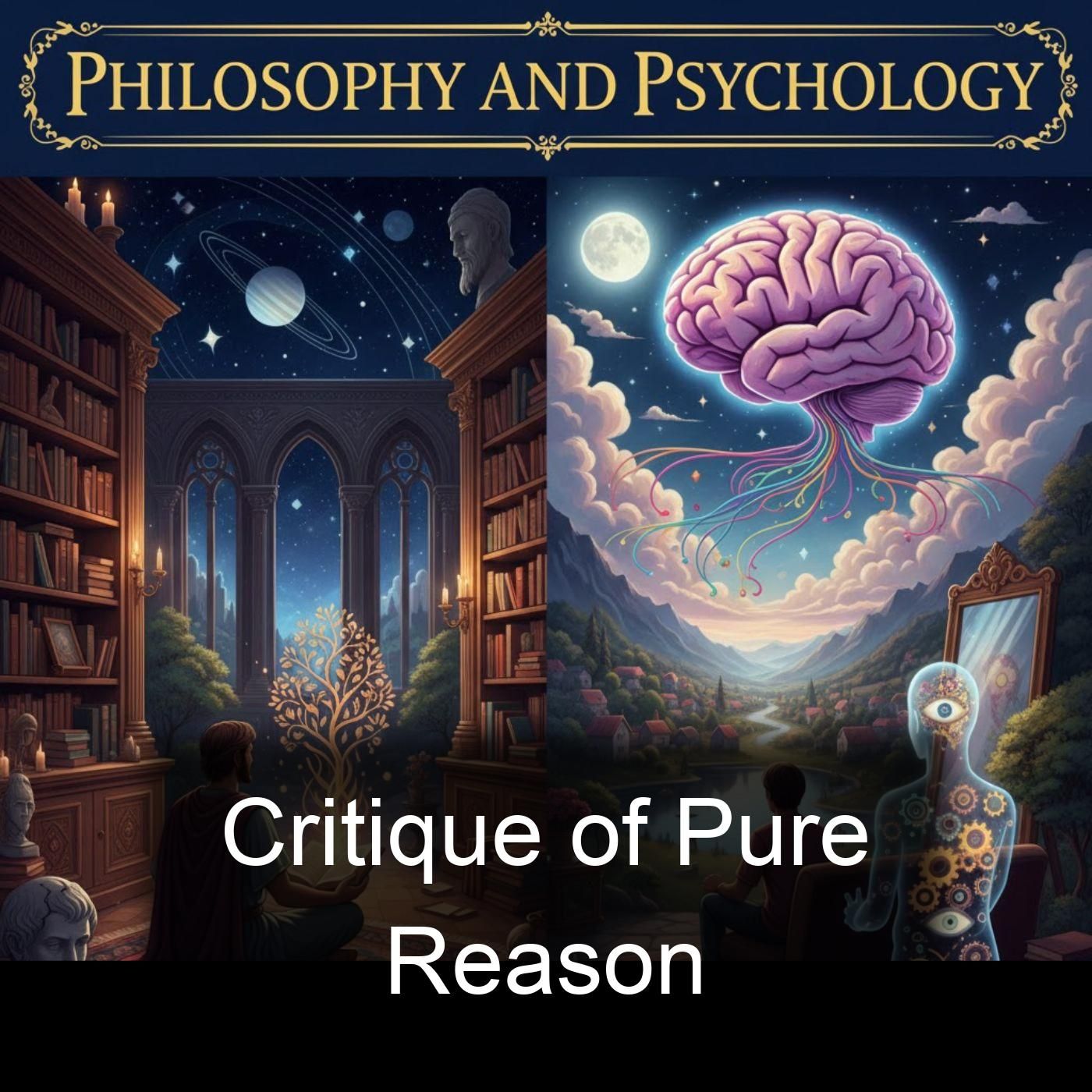
The Critique of Pure Reason, originally published in 1781 with a revised edition in 1787, stands as one of the most pivotal and transformative philosophical works of the modern era. In this text, Kant endeavors to reconcile the divide between rationalism—where knowledge is derived from reason independent of sensory experience—and empiricism, which posits that our understanding is rooted in sensory input. Specifically, he confronts the radical empiricism of David Hume, who argued that our beliefs are merely products of habitual responses to sensory experiences. Employing scientific methods, Kan...
N'hésitez pas à visiter le site du podcast et à soutenir son créateur : www.spreaker.com
Auteur
Immanuel Kant
Catégorie
Site du podcast
Dernier épisode
12 sept. 2026
Où écouter ?
Les podcasts dans l'appli Replaio Radio Bientôt disponibleLes podcasts arrivent très bientôt dans l'appli. Installe-la dès maintenant et découvre en avant-première une toute nouvelle façon de vivre les podcasts
 Installe-la gratuitement
Android près de 10 M de téléchargements · note de 4,8
iOS bientôt
Installe-la gratuitement
Android près de 10 M de téléchargements · note de 4,8
iOS bientôt
Épisodes
019 - Remark on the Amphiboly of the Conceptions of Reflections 09.02.2026 55:52
The Critique of Pure Reason, originally published in 1781 with a revised edition in 1787, stands as one of the most pivotal and transformative philosophical works of the modern era. In this text, Kant endeavors to reconcile the divide between rationalism—where knowledge is derived from reason independent of sensory experience—and empiricism, which posits that our understanding is rooted in sensory...
018 - Of the Equivocal Nature of Amphiboly 09.02.2026 12:26
The Critique of Pure Reason, originally published in 1781 with a revised edition in 1787, stands as one of the most pivotal and transformative philosophical works of the modern era. In this text, Kant endeavors to reconcile the divide between rationalism—where knowledge is derived from reason independent of sensory experience—and empiricism, which posits that our understanding is rooted in sensory...
017 - Division of All Objects into Phenomena and Noumena 09.02.2026 34:56
The Critique of Pure Reason, originally published in 1781 with a revised edition in 1787, stands as one of the most pivotal and transformative philosophical works of the modern era. In this text, Kant endeavors to reconcile the divide between rationalism—where knowledge is derived from reason independent of sensory experience—and empiricism, which posits that our understanding is rooted in sensory...
016 - The Postulates of Empirical Thought 09.02.2026 43:09
The Critique of Pure Reason, originally published in 1781 with a revised edition in 1787, stands as one of the most pivotal and transformative philosophical works of the modern era. In this text, Kant endeavors to reconcile the divide between rationalism—where knowledge is derived from reason independent of sensory experience—and empiricism, which posits that our understanding is rooted in sensory...
015 - Third Analogy 09.02.2026 14:48
The Critique of Pure Reason, originally published in 1781 with a revised edition in 1787, stands as one of the most pivotal and transformative philosophical works of the modern era. In this text, Kant endeavors to reconcile the divide between rationalism—where knowledge is derived from reason independent of sensory experience—and empiricism, which posits that our understanding is rooted in sensory...
014 - Second Analogy 09.02.2026 36:49
The Critique of Pure Reason, originally published in 1781 with a revised edition in 1787, stands as one of the most pivotal and transformative philosophical works of the modern era. In this text, Kant endeavors to reconcile the divide between rationalism—where knowledge is derived from reason independent of sensory experience—and empiricism, which posits that our understanding is rooted in sensory...
013 - Systematic Representation of All Synthetical Principles1st Analogy 09.02.2026 1:25:00
The Critique of Pure Reason, originally published in 1781 with a revised edition in 1787, stands as one of the most pivotal and transformative philosophical works of the modern era. In this text, Kant endeavors to reconcile the divide between rationalism—where knowledge is derived from reason independent of sensory experience—and empiricism, which posits that our understanding is rooted in sensory...
012 - System of All Principles of the Pure Understanding 09.02.2026 15:12
The Critique of Pure Reason, originally published in 1781 with a revised edition in 1787, stands as one of the most pivotal and transformative philosophical works of the modern era. In this text, Kant endeavors to reconcile the divide between rationalism—where knowledge is derived from reason independent of sensory experience—and empiricism, which posits that our understanding is rooted in sensory...
011 - Analytic of PrinciplesSchematism 09.02.2026 45:15
The Critique of Pure Reason, originally published in 1781 with a revised edition in 1787, stands as one of the most pivotal and transformative philosophical works of the modern era. In this text, Kant endeavors to reconcile the divide between rationalism—where knowledge is derived from reason independent of sensory experience—and empiricism, which posits that our understanding is rooted in sensory...
010 - Application of the Categories to Objects of the Senses 09.02.2026 48:47
The Critique of Pure Reason, originally published in 1781 with a revised edition in 1787, stands as one of the most pivotal and transformative philosophical works of the modern era. In this text, Kant endeavors to reconcile the divide between rationalism—where knowledge is derived from reason independent of sensory experience—and empiricism, which posits that our understanding is rooted in sensory...
009 - Transcendental Deduction of the Pure Conceptions 09.02.2026 46:22
The Critique of Pure Reason, originally published in 1781 with a revised edition in 1787, stands as one of the most pivotal and transformative philosophical works of the modern era. In this text, Kant endeavors to reconcile the divide between rationalism—where knowledge is derived from reason independent of sensory experience—and empiricism, which posits that our understanding is rooted in sensory...
008 - Deduction of the Pure Conceptions 09.02.2026 17:21
The Critique of Pure Reason, originally published in 1781 with a revised edition in 1787, stands as one of the most pivotal and transformative philosophical works of the modern era. In this text, Kant endeavors to reconcile the divide between rationalism—where knowledge is derived from reason independent of sensory experience—and empiricism, which posits that our understanding is rooted in sensory...
007 - Transcendental Analytic 09.02.2026 47:18
The Critique of Pure Reason, originally published in 1781 with a revised edition in 1787, stands as one of the most pivotal and transformative philosophical works of the modern era. In this text, Kant endeavors to reconcile the divide between rationalism—where knowledge is derived from reason independent of sensory experience—and empiricism, which posits that our understanding is rooted in sensory...
006 - Transcendental Logic 09.02.2026 26:15
The Critique of Pure Reason, originally published in 1781 with a revised edition in 1787, stands as one of the most pivotal and transformative philosophical works of the modern era. In this text, Kant endeavors to reconcile the divide between rationalism—where knowledge is derived from reason independent of sensory experience—and empiricism, which posits that our understanding is rooted in sensory...
005 - Transcendental Doctrine of Elements--Time 09.02.2026 44:05
The Critique of Pure Reason, originally published in 1781 with a revised edition in 1787, stands as one of the most pivotal and transformative philosophical works of the modern era. In this text, Kant endeavors to reconcile the divide between rationalism—where knowledge is derived from reason independent of sensory experience—and empiricism, which posits that our understanding is rooted in sensory...
004 - Transcendental Doctrine of Elements--Space 09.02.2026 20:22
The Critique of Pure Reason, originally published in 1781 with a revised edition in 1787, stands as one of the most pivotal and transformative philosophical works of the modern era. In this text, Kant endeavors to reconcile the divide between rationalism—where knowledge is derived from reason independent of sensory experience—and empiricism, which posits that our understanding is rooted in sensory...
003 - Introduction 09.02.2026 53:21
The Critique of Pure Reason, originally published in 1781 with a revised edition in 1787, stands as one of the most pivotal and transformative philosophical works of the modern era. In this text, Kant endeavors to reconcile the divide between rationalism—where knowledge is derived from reason independent of sensory experience—and empiricism, which posits that our understanding is rooted in sensory...
002 - Preface to the Second Edition 1787 09.02.2026 53:27
The Critique of Pure Reason, originally published in 1781 with a revised edition in 1787, stands as one of the most pivotal and transformative philosophical works of the modern era. In this text, Kant endeavors to reconcile the divide between rationalism—where knowledge is derived from reason independent of sensory experience—and empiricism, which posits that our understanding is rooted in sensory...
001 - Preface to the First Edition 1781 09.02.2026 20:05
The Critique of Pure Reason, originally published in 1781 with a revised edition in 1787, stands as one of the most pivotal and transformative philosophical works of the modern era. In this text, Kant endeavors to reconcile the divide between rationalism—where knowledge is derived from reason independent of sensory experience—and empiricism, which posits that our understanding is rooted in sensory...
Podcasts similaires






Écoute le podcast Critique of Pure Reason sur Replaio
La radio et les podcasts dans une seule appli - gratuite, sans inscription. Installe-la dès aujourd'hui et ne rate pas le lancement
Replaio n'est pas éditeur de podcasts ; les noms des émissions, les visuels et l'audio appartiennent à leurs auteurs et sont diffusés via des flux RSS publics