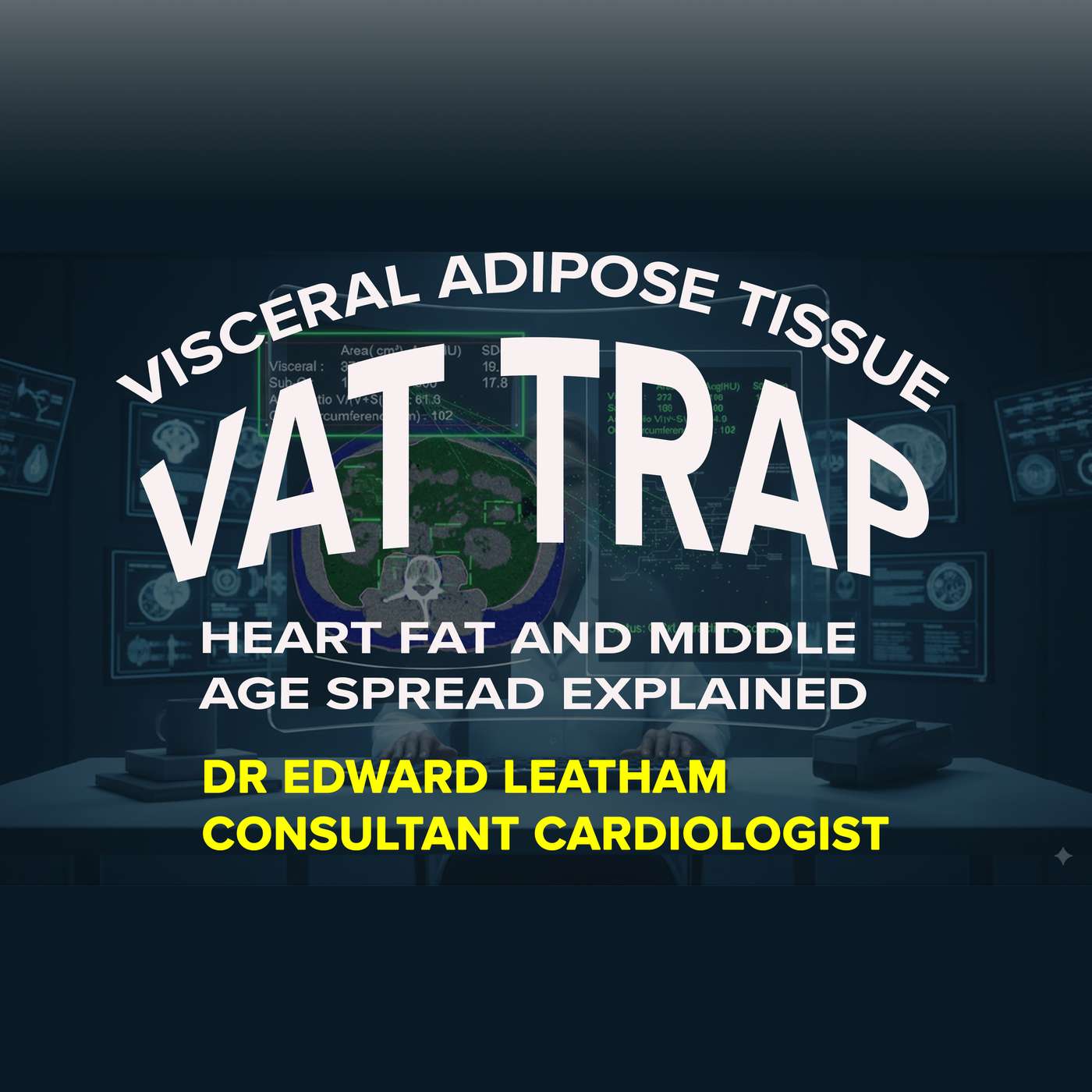
Dr Edward Leatham
VAT Trap
The VAT Trap book, blog and digital media series reveals how visceral fat — the hidden metabolic organ — drives heart disease, hypertension, and diabetes. Drawing on 30 years of frontline cardiology and the latest in imaging, app-based tracking, and metabolic science, Dr Ed Leatham translates complex research into clear, actionable steps. Whether you want to avoid heart disease, stabilise your metabolism, or understand GLP-1 therapy, these four concise podcast seasons accompany a four book series that will help you see, track, and reverse the VAT trap. To join the mailing list click on the lin...
Besuch unbedingt die Website des Podcasts und unterstütze die Macher: vat-trap.com
Wo hören?
Podcasts in der App Replaio Radio Bald verfügbarPodcasts kommen bald in die App. Installiere sie jetzt und erlebe als Erster einen ganz neuen Blick auf Podcasts
 Kostenlos installieren
Android fast 10 Mio. Downloads · Bewertung 4,8
iOS bald
Kostenlos installieren
Android fast 10 Mio. Downloads · Bewertung 4,8
iOS bald
Folgen
If You Spend 2 Minutes Brushing Your Teeth, Why Not 10 Minutes Saving Your Life? 03.02.2026 16:15
Ten minutes of strength training, five days a week, is enough to change metabolic health. Like brushing your teeth, it works because it’s sustainable. Keep the time fixed, increase the weights gradually, and focus on strength, not scales. Small daily habits protect muscle, reduce visceral fat, and support long-term health. To read more see https://www.scvc.co.uk/metabolic-health/if-you-spend-2-min...
Sarcopenia: Are We Diagnosing the Correct Muscle Problem? 27.01.2026 16:43
In cardiometabolic medicine, muscle is not a cosmetic tissue but a metabolic organ. Evidence consistently shows that strength, not muscle mass, predicts insulin resistance, cardiovascular risk, and survival. Many older adults are not losing muscle tissue — they are losing muscle function, and that is the pathology that matters. Read the blog here For all podcasts see https://feeds.transistor.fm/va...
Why GLP-1 Withdrawal Trials Fail — and Why Cardiometabolic Care Must Look Different 20.01.2026 13:18
A 2026 BMJ systematic review confirms that weight regain is the rule after stopping pharmacological weight-management therapy. Across drug classes, most lost weight is regained within 24 months, with parallel loss of metabolic benefit. This reflects biological defence of adiposity, not patient failure. Blog
Smart body composition scales: helpful metabolic tool—or misleading distraction? 10.01.2026 14:00
Smart body composition scales are not metabolic truth machines. Their value lies in engagement, not precision. During weight loss—especially with GLP-1 therapy—hydration and glycogen shifts distort “muscle” readings. Used within a tiered system that prioritises waist, strength, and function, they can support behaviour without undermining progress. Blog see https://www.scvc.co.uk/metabolic-health/s...
A New Year Reset: Why Your Waist Matters More Than Your Scales 05.01.2026 16:52
January isn’t just about weight loss. Much winter weight gain occurs as visceral fat, which drives insulin resistance and cardiovascular risk. Measuring your waist, not just your weight, gives a clearer picture of metabolic health. Building muscle and reducing visceral fat supports a healthier metabolism long after January ends.
The Insulin Paradox: How GLP-1 Drugs Reduce Belly Fat and Heart Risk 14.12.2025 15:35
GLP-1 drugs seem paradoxical: they enhance insulin action yet shrink dangerous belly fat. The explanation lies in restoring normal insulin timing, reducing chronic insulin exposure, and reversing fat “spillover” from liver to abdomen. Real patient cases show rapid visceral fat loss alongside smoother glucose profiles and lower cardiovascular risk. See blog for more details All VAT TRAP Podcasts
Why Protein Matters More Than Ever as We Age 08.12.2025 15:43
Adequate protein and resistance training are essential for healthy ageing and reducing visceral fat. As we grow older, muscles become less responsive, making higher protein intake vital to preserve strength, metabolism, and independence. Building and feeding muscle is the most effective way to improve insulin sensitivity, raise metabolic rate, and burn harmful VAT. For full story and links, see bl...
“ChatGPT Says My Thyroid Might Be Underactive… What Next?” 28.11.2025 12:40
Raised visceral fat quietly disrupts thyroid chemistry, increasing reverse T3 and lowering active T3 inside tissues. This pushes the body into metabolic “conservation mode” — slowing energy, mood and fat loss despite normal blood tests. Reducing VAT gradually restores healthy thyroid activation and metabolic resilience. For the full story see blog
Statins: who do you trust? 24.11.2025 14:08
One of the greatest challenges in the online world is investigator bias. Any “expert” with a strong conviction — whether pro- or anti-statin — can easily find studies that appear to confirm their view. The internet is full of such cherry-picked data. When presented with confident authority, this can sound utterly convincing to a lay audience. The reality is that true medical understanding does not...
What Your Glucose Curve Is Trying to Tell You: Why Continuous Glucose Monitoring Matters Long Before Diabetes 17.11.2025 14:20
At Surrey Cardiovascular Clinic, we have seen a pattern: some people whose blood sugar (HbA₁c) is technically “normal” are quietly drifting towards diabetes. Their blood tests look fine — but their day-to-day glucose readings tell another story. Full blog
What Keto and Atkins Diets Do 10.11.2025 12:03
Multiple studies show that low-carb, high-fat diets tend to shift LDL particles toward larger, more buoyant LDL (pattern A) . These particles are considered less atherogenic than small, dense LDL (pattern B), typical of insulin resistance. Therefore, while LDL-C concentration may rise , LDL particle number (apoB) or non-HDL cholesterol may not rise proportionally — and inflammation markers (hs-CRP...
MASLD/MASH -metabolic dysfunction -associated steatotic liver disease: What You Need to Know 03.11.2025 12:05
MASLD is a silent but important marker of metabolic health and another consequence of raised Visceral Adipose Tissue (VAT). Although often discovered by chance, it carries significant implications for both liver and cardiovascular wellbeing. Through caloric restriction, physical activity, improved nutrition, and early intervention, MASLD can usually be stabilised or reversed — protecting not just...
The Hidden Culprit Behind Heart Disease: Small Dense LDL and the Fat You Can’t See 27.10.2025 17:10
Small dense LDL (sdLDL) is the most harmful form of “bad cholesterol.” It forms when the liver overproduces VLDL — often driven by visceral fat and high insulin levels. Visceral fat sits deep around the organs and feeds directly into the liver, causing early metabolic disruption long before blood tests detect it. For full blog
Cholesterol, LDL, and what we learnt from PCSK9 mutations in familial hypercholesterolaemia 18.10.2025 18:18
In families with inherited high cholesterol (familial hypercholesterolaemia), mutations in the PCSK9 gene have been identified which make this protein overactive. These are known as gain-of-function mutations — they increase PCSK9 activity and push LDL cholesterol to dangerous levels. For over 90% of people with raised LDL who do NOT have a mutation, there are alternative explanations outlined in...
So what does determine your LDL (‘bad’) Cholesterol? 17.10.2025 9:15
In the first podcast in the series, the discussion revolves around cholesterol and the fact that while your blood LDL cholesterol determines the development of coronary plaque, your levels are more about your genetics than necessarily what you eat. In contrast, what happens to coronary plaque over your lifetime and whether it causes a heart attack is more about 'inflammation', what carbohydrates...
Ähnliche Podcasts






Höre den Podcast VAT Trap in Replaio
Radio und Podcasts in einer App - kostenlos und ohne Anmeldung. Installiere sie noch heute und verpasse den Start nicht
Replaio ist kein Herausgeber von Podcasts; die Namen der Sendungen, Cover und Audioinhalte gehören ihren Autoren und werden über öffentliche RSS-Feeds verbreitet