The Archive Network
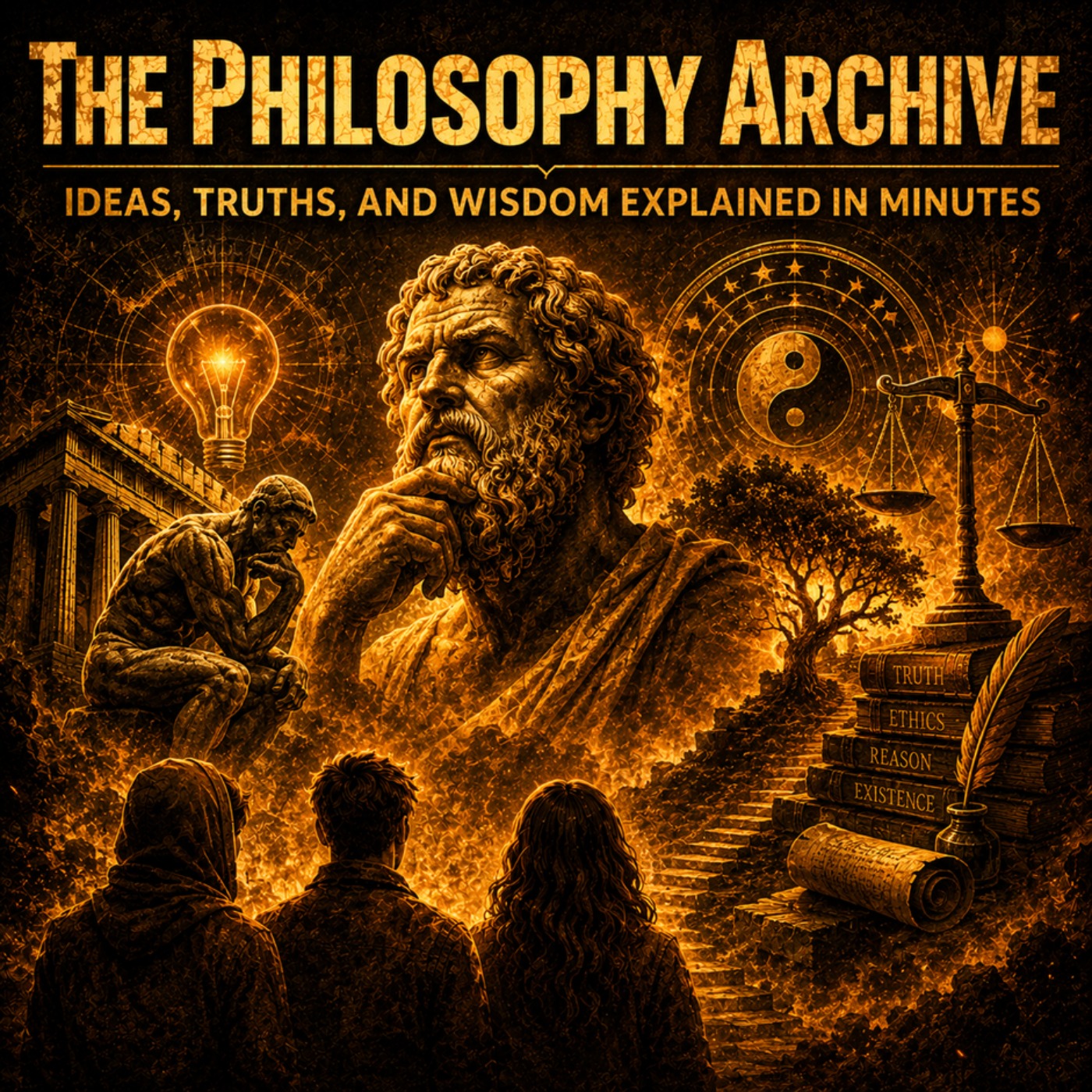
The Philosophy Archive – The Great Ideas and Thinkers explained in minutes
The Philosophy Archive is part of The Archive Network by Jonkai Ventures, a collection of podcasts dedicated to the stories that shaped our world. This series makes the great ideas of human thought vivid and clear: the thinkers, schools, and arguments that shaped how we live and reason — explained in plain language, with no jargon. From Socrates, Plato, and Aristotle to Kant, Nietzsche, and modern thought experiments, each series explores one thinker or idea across five episodes as a documentary-style narrative: the world that produced it, its central argument, the system built around it, the...
Besuch unbedingt die Website des Podcasts und unterstütze die Macher: shows.acast.com
Autor
The Archive Network
Kategorie
Podcast-Website
Neueste Folge
5. Okt 2026
Wo hören?
Podcasts in der App Replaio Radio Bald verfügbarPodcasts kommen bald in die App. Installiere sie jetzt und erlebe als Erster einen ganz neuen Blick auf Podcasts
 Kostenlos installieren
Android fast 10 Mio. Downloads · Bewertung 4,8
iOS bald
Kostenlos installieren
Android fast 10 Mio. Downloads · Bewertung 4,8
iOS bald
Folgen
Marxism - Part 1: Factories, flames, and the birth of a critique 05.10.2026 6:38
Smoke billowed from the new factories of nineteenth-century Europe, and with it, the familiar world began to dissolve. Old rhythms and inherited rules were torn apart as cities swelled, railways crisscrossed the landscape, and work itself was transformed into something hard, fast, and strange. Beneath all this change, a new and unsettling question grew louder: Why did a society capable of such wea...
Karl Marx - Part 5: Why Marx still haunts the world he tried to change 02.10.2026 6:58
Picture this: a philosopher’s words echoing across continents, shaping parties, revolutions, classrooms, and even the language of everyday complaint. How did a theory turn into both a movement and a target, a living vocabulary for thinking about labor, crisis, and power? Marx’s afterlife is as strange as his vision was ambitious. He has been invoked by union organizers, revolutionaries, critics, a...
Karl Marx - Part 4: Objections, rivals, and the fire of critique 01.10.2026 6:53
A theory that tries to explain everything will attract more than followers. It will attract fierce critics, sharp alternatives, and the hardest questions. For Marx, the more total his system became, the more places it could be challenged. Does Marx’s account really capture the richness of social life, or does it flatten everything into one grand pattern? That is the test that would haunt his legac...
Karl Marx - Part 3: How Marx built a system to explain it all 30.09.2026 6:43
Imagine a theory that claims to explain not just why people work, but how societies rise, fall, and transform. What if every wage slip, every law, every crisis carried the mark of a hidden engine? For Marx, the challenge was to build a system that could connect the smallest details of daily life to the broadest patterns of history. Marx’s ambition was sweeping. He wanted to show that production, c...
Karl Marx - Part 2: How the hidden rules of production shape us all 29.09.2026 5:58
Step into a world where freedom feels real, but the ground beneath your feet is always shifting. What if the daily routines of work and exchange, the things you barely notice, were quietly shaping your thoughts, your politics, even your sense of self? For Marx, the most powerful forces in society were the ones that faded into the background. Marx’s breakthrough was not the simple claim that money...
Karl Marx - Part 1: Where a young mind learned to see through power 28.09.2026 6:56
Imagine a young man growing up in a town where every law, every custom, and every family story is shaped by unseen hands of power. What if your status, your future, even your religion, could be decided by silent rules you never made? For Karl Marx, these weren’t distant questions—they pressed in on daily life. The world that shaped Marx was not just Europe in the age of revolutions and empires. It...
Utilitarianism - Part 5: Echoes in the modern world 25.09.2026 5:46
Imagine a moral theory that doesn’t just shape philosophy seminars, but quietly organizes the way governments, hospitals, and charities make decisions every day. Utilitarianism became more than an idea—it became part of the machinery of the modern world. In economics, utilitarian thinking made it routine to compare outcomes and preferences, to weigh policies by their effects on welfare. In law and...
Utilitarianism - Part 4: In the fire of critique 24.09.2026 5:16
Would you sacrifice one innocent person if it meant saving many more? This is not a philosopher’s riddle—it’s the pressure point at the heart of utilitarianism. The theory’s greatest power is also its greatest vulnerability: it will not blink at the arithmetic of sacrifice. Critics have seized on these hard cases for centuries. If utility justifies convicting an innocent to avert a riot, what keep...
Utilitarianism - Part 3: Calculating the good 23.09.2026 5:42
What happens when you try to turn morality into a system, with its own vocabulary, rules, and even formulas for happiness? Welcome to the world of the felicific calculus—a moral ledger meant to weigh every pleasure and pain. Once the idea of maximizing happiness takes hold, utilitarianism becomes more than a slogan. Jeremy Bentham broke down the value of pleasures and pains into intensity, duratio...
Utilitarianism - Part 2: The greatest happiness principle 22.09.2026 5:10
What if the whole of morality could be boiled down to a single question: Will this action increase happiness or reduce suffering for everyone affected? It’s an idea so simple it sounds like common sense, but so radical it rewrote the rules of ethics. At its core, utilitarianism makes a bold claim: judge actions, laws, and institutions by their consequences for happiness. Not by their pedigree, not...
Utilitarianism - Part 1: Counting happiness in an age of reform 21.09.2026 5:16
Imagine a world where the worth of every law, every custom, and every punishment is weighed, not by tradition, but by how much happiness or suffering it creates. What if morality itself could be measured, calculated, even audited like a merchant’s ledger? In eighteenth-century Britain, this was not just a fantasy—it was the ground for a revolution in ethics. Britain pulsed with counting: merchant...
Existentialism - Part 5: Echoes in the Everyday 18.09.2026 6:41
Existentialism was once the scandal of the postwar world. Black turtlenecks, smoky cafés, and the drama of Parisian rebellion—it was all style, all pose. Or was it? Behind the image, something deeper survived. The suspicion that a life is not meaningful just because it is busy, successful, or fits in. Existentialism’s legacy is less about style than a lasting question: how do we live without a scr...
Existentialism - Part 4: The Trouble With Freedom 17.09.2026 5:34
If existentialism claims that meaning must be made, not found, what happens when that burden becomes too heavy? Can anyone really be as free as existentialism demands? Or is the movement simply inflating human agency beyond recognition? Critics were quick to ask whether existentialism’s talk of freedom was realistic or just wishful thinking. What about unconscious motives? What about coercion, tra...
Existentialism - Part 3: Under the Weight of Freedom 16.09.2026 6:11
You might think existentialism is all about mood—anxiety, alienation, the weight of being. But beneath the surface, there’s a system at work. What happens when you look closely at the machinery that makes existentialism tick? The movement isn’t just a feeling; it’s a toolkit for making sense of freedom and responsibility in a world with no guarantees. One of the first tools is the split between fa...
Existentialism - Part 2: Existence Before Essence 15.09.2026 5:33
Imagine being told that your life has no prewritten script. There’s no hidden meaning waiting for you, no essence stamped on your soul before you take your first breath. What you do is what you become. That is the provocation at the heart of existentialism—a claim that flips philosophy on its head. “Existence precedes essence.” It’s one of those phrases that sounds neat, but in the hands of thinke...
Existentialism - Part 1: When Certainty Cracks 14.09.2026 6:13
Picture this: a world where the answers to life’s biggest questions are supposed to be set in stone, yet everything beneath your feet feels like it’s shifting. What if the blueprints for meaning suddenly stopped making sense? In nineteenth-century Europe, society was built on the idea that reason could map reality, that history had a direction, and that everyone had a clear role. But the ground wa...
Stoicism - Part 5: How Stoicism shaped Rome, modern minds, and today’s search for steadiness 11.09.2026 5:49
After fire and trial, Stoicism did not vanish. Instead, its ideas traveled—across centuries, across empires, and into the uncertain present. In Rome, Stoicism became more than a Greek school. It turned into a practical language for handling power, loss, and responsibility. Roman thinkers like Panaetius softened the doctrine for elites, and Posidonius expanded it into history and science. By the ti...
Stoicism - Part 4: Testing the Stoic ideal against human pain and critique 10.09.2026 5:25
Is the Stoic ideal too hard for real life? The school’s sharp line—virtue alone is good, everything else indifferent—has always faced resistance. The critics didn’t just object in the classroom. They pressed their cases wherever Stoic teaching met the raw facts of vulnerability, loss, and grief. Aristotle stands behind the first major challenge. For Aristotle, happiness needs not just virtue but s...
Stoicism - Part 3: How logic, physics, and ethics build the Stoic life 09.09.2026 5:40
If happiness depends only on what is truly yours, how do you build a life around that? Stoicism was not just advice—it was a system, tightly assembled to carry its central idea through every test. Strip away the scaffolding, and the core message risks becoming empty comfort. The Stoics believed the world was shaped by logos—a rational order that runs through all things. Nature, for them, is not ch...
Stoicism - Part 2: Freedom, judgment, and the true measure of happiness 08.09.2026 6:12
What if the only thing you could truly control was your own mind? Picture a world where health, wealth, reputation, and even family could vanish overnight—but your happiness would not have to go with them. For the Stoics, the heart of wisdom was not about mastering fate, but about mastering your response to it. At the core of Stoicism is a claim as sharp as it is simple: the good life depends on t...
Stoicism - Part 1: How crisis and uncertainty forged a new philosophy 07.09.2026 5:38
Imagine losing everything—your city in turmoil, your fortune gone, the world shifting beneath your feet. Would you crumble, or could you learn to stand unshaken? In ancient Athens, as the pillars of old certainty cracked, one school dared to ask: what can we hold onto when fortune turns against us? The world that birthed Stoicism was not a tranquil one. The old city-states had lost their power. Af...
David Hume - Part 5: The Shadow That Never Lifts 04.09.2026 5:43
Hume did not just leave a puzzle for philosophers. He left a challenge that spread across disciplines, from science and economics to psychology and ethics. His questions escaped the library and started haunting every field that dared ask: What makes knowledge trustworthy? In philosophy, Hume’s legacy is the problem of induction and the naturalization of belief. Later thinkers, from pragmatists to...
David Hume - Part 4: Doubt in the Fire: The Critics Respond 03.09.2026 6:13
Hume’s clear-eyed skepticism made philosophy look honest about its own limits. But could honesty alone hold the weight of science, morality, and belief? As soon as his ideas took hold, critics began to press his system from every side. If reason cannot justify causation, induction, or the self, does Hume leave us with only habit—no firmer ground than custom? The most immediate challenge was to his...
David Hume - Part 3: The Mechanics of Everyday Doubt 02.09.2026 5:50
After Hume’s central idea has swept away metaphysical guarantees, what remains is human nature itself—messy, habitual, and inventive. If you start not from certainty, but from what actually happens in the mind, how far can you build? Hume’s answer is a system built from experience, not deduction—a new way to map the mind’s workings. The Treatise of Human Nature, published between seventeen thirty-...
David Hume - Part 2: The Fragile Foundations of Knowing 01.09.2026 5:46
Picture a child watching a spark leap from a fire, or a farmer planting seeds with hope that the sun and rain will return. We trust that what has happened will happen again, that cause leads to effect, that the future echoes the past. But what if none of this is guaranteed by reason—only by habit? David Hume’s central insight is usually called skepticism, but that word misses the peculiar force of...
Ähnliche Podcasts







Höre den Podcast The Philosophy Archive – The Great Ideas and Thinkers explained in minutes in Replaio
Radio und Podcasts in einer App - kostenlos und ohne Anmeldung. Installiere sie noch heute und verpasse den Start nicht
Replaio ist kein Herausgeber von Podcasts; die Namen der Sendungen, Cover und Audioinhalte gehören ihren Autoren und werden über öffentliche RSS-Feeds verbreitet